

- Performance: Fragmented indexes increase search latency and reduce throughput.
- Accuracy: Out-of-date centroids or partitions hurt recall and precision.
- Cost: Poor index quality forces larger search budgets (more probes, more compute).
- Predictability: Unmaintained indexes produce variable query latencies and inconsistent results.
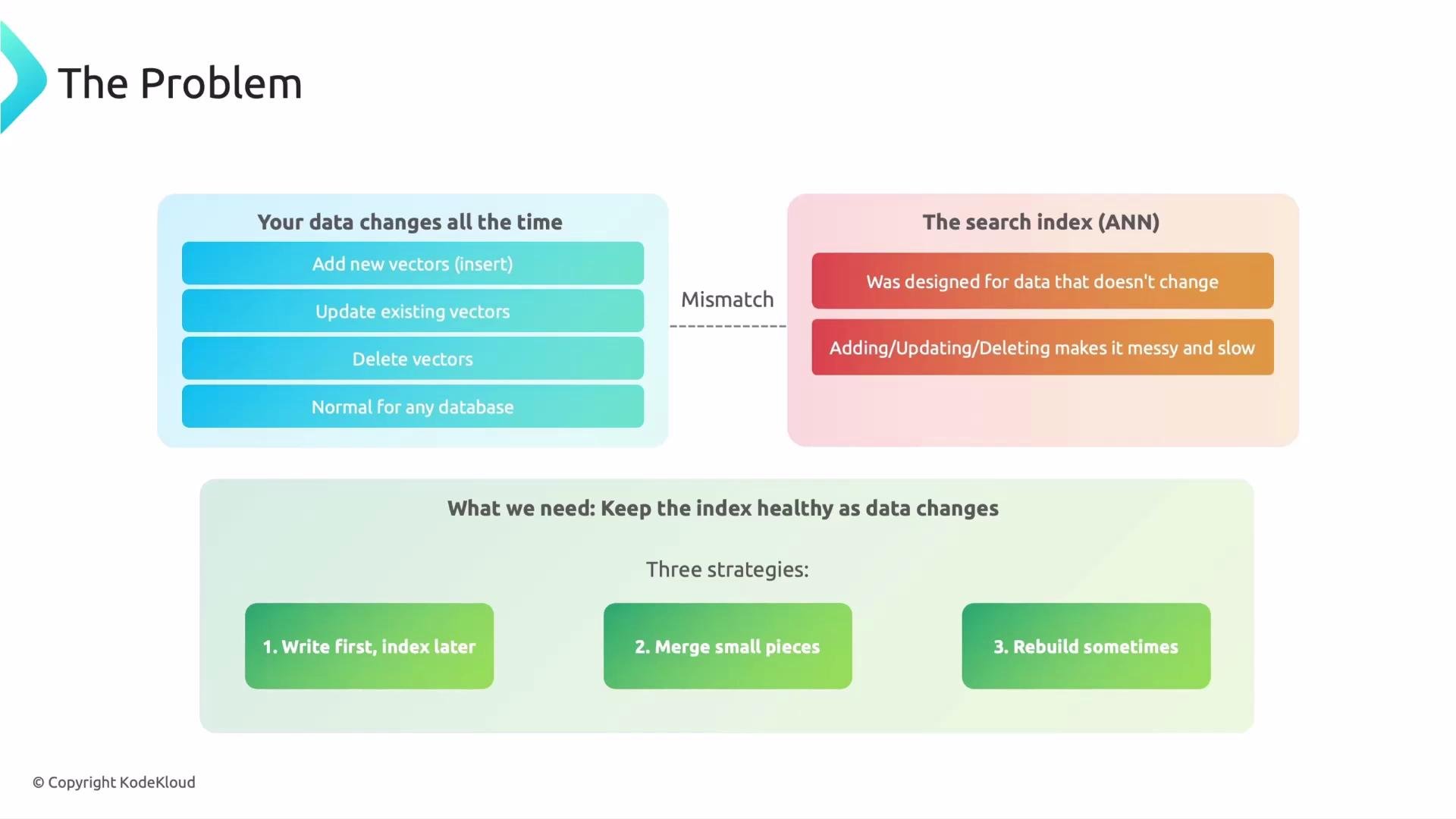
- Write first, index later
- Buffer new writes (for example, in a write log, small in-memory shards, or a write-optimized store) and perform indexing asynchronously in the background.
- Pros: very low write latency; you can batch and tune indexing jobs for throughput.
- Cons: recent writes may be missing or lower-quality in search results until the background indexing completes.
- Merge small pieces (compaction)
- Periodically merge many small or fragmented index shards into larger, optimized shards (similar to compaction in LSM trees).
- Pros: improves consistency and search performance without a full rebuild.
- Cons: requires scheduling and resource management; merges consume CPU, memory, and I/O while running.
- Rebuild sometimes
- Run a full reindex from the canonical data store at scheduled intervals or when metrics indicate fragmentation exceeds a threshold.
- Pros: restores optimal index structure and accuracy by clearing accumulated fragmentation.
- Cons: expensive and potentially disruptive for large datasets; usually performed during low-traffic windows or on dedicated infrastructure.
Best practices and operational tips
- Monitor index health: track fragment counts, average shard size, query latency, and recall metrics.
- Define SLA-driven policies: decide acceptable staleness and schedule compaction/rebuilds around traffic windows.
- Combine strategies: buffer for low-latency writes, compact frequently to reduce fragmentation, and schedule periodic full rebuilds for a reset.
- Automate thresholds: trigger compaction or full reindexing based on measurable indicators (e.g., shard count, average search recall).
- Test on representative workloads: simulate production traffic to tune merge frequencies and batch sizes.
Choose a mix of buffering, compaction, and periodic rebuilds based on your workload: write volume, read SLAs, and how fresh search results must be.