

Quick summary: strengths at a glance
-
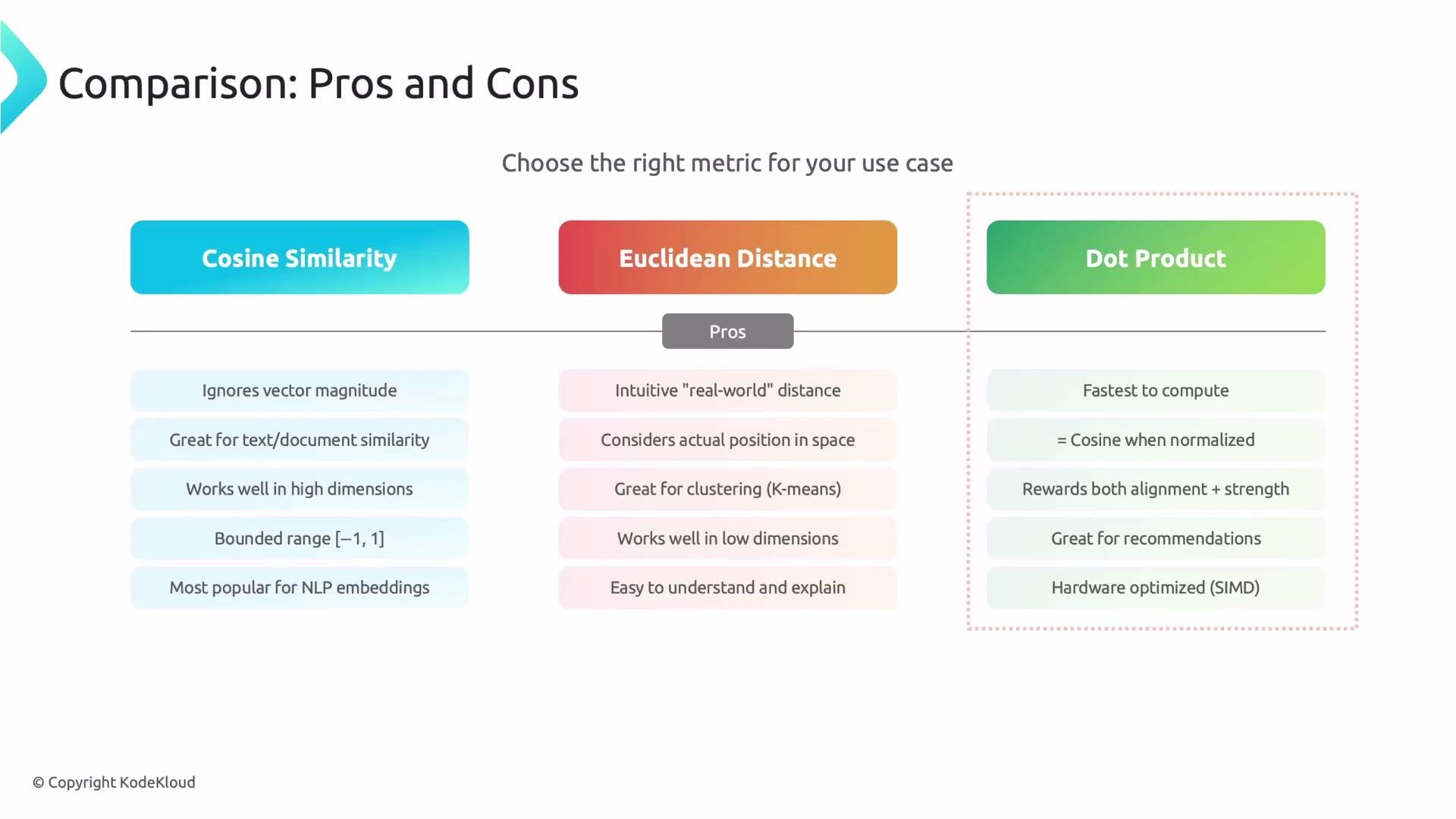
Cosine similarity
- Focuses on vector direction and ignores magnitude.
- Effective in high-dimensional spaces after normalization.
- Bounded between -1 and 1, making scores easy to interpret.
- Common default for NLP embeddings and semantic search.
-
Euclidean distance
- Measures absolute geometric distance (intuitive interpretation).
- Natural for spatial/coordinate data and algorithms like k-means.
- Works well in low-dimensional geometric problems, computer vision coordinates, and geolocation.
-
Dot product
- Accounts for both direction and magnitude—vector norm affects the score.
- Useful when magnitude encodes a meaningful signal (popularity, confidence, counts).
- Highly efficient on modern hardware via optimized matrix multiplications (good for large-scale retrieval).
Limitations to watch for
-
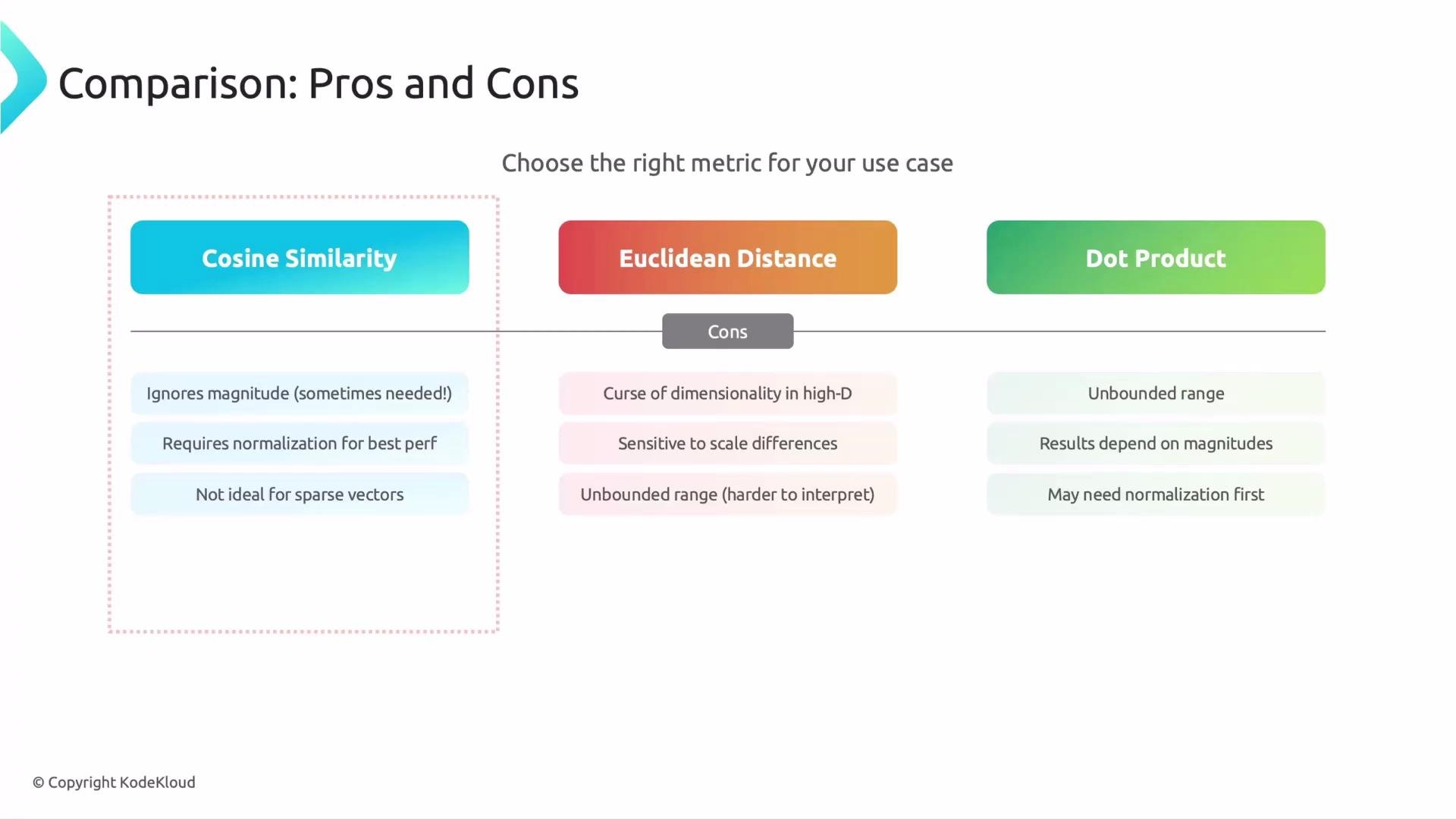
Cosine similarity
- Ignores magnitude—problematic when norms carry important signals (e.g., confidence or counts).
- Can be less discriminative for extremely sparse, high-dimensional vectors (raw one-hot or some TF-IDF) unless you preprocess or reweight features.
-
Euclidean distance
- Degrades in very high-dimensional spaces (curse of dimensionality); distances become less informative.
- Not ideal for dense text embeddings unless the embedding model was trained with Euclidean assumptions.
-
Dot product
- Sensitive to vector norms; unbounded differences in norms can dominate similarity.
- Often requires normalization or scaling depending on whether magnitude should influence the result.
When to choose which metric (decision flow)
Start by characterizing your data and objective. Use the flow below to make a pragmatic choice:- Is your data primarily text/documents or variable-length semantic content?
- Yes → Start with cosine similarity (default for text embeddings).
- If not text/documents:
- Is the task clustering or low-dimensional spatial analysis (e.g., coordinates, image feature coordinates)?
- Yes → Use Euclidean distance (k-means, geolocation).
- Otherwise:
- Do vector magnitudes contain meaningful signals (ratings, popularity, confidence)?
- Yes → Use dot product (magnitude-aware, hardware-friendly).
- No → Use cosine similarity as a robust default and evaluate results.
- Do vector magnitudes contain meaningful signals (ratings, popularity, confidence)?
- Is the task clustering or low-dimensional spatial analysis (e.g., coordinates, image feature coordinates)?

Comparison table (use cases & guidance)
Practical tips
- For text embeddings: normalize vectors and use cosine if you want semantic similarity independent of magnitude. If your retrieval model expects raw scores and magnitude is meaningful, use dot product.
- For recommendation systems: dot product often reflects business signals (e.g., affinity) and is efficient with GPU/BLAS-backed matrix multiply.
- For clustering and geometric problems: Euclidean distance generally matches geometric intuition and common algorithms.
- If unsure: start with cosine for text, measure performance (precision/recall or business KPIs), then consider switching to dot product or Euclidean when magnitude or absolute distances clearly matter.
Start with cosine similarity for text/document embeddings. Use Euclidean for geometric or clustering problems. Choose dot product when magnitude matters (e.g., recommendation scores) and you can leverage hardware-optimized matrix operations.