

Quiz Questions
Question 1: What Is the Primary Goal of Password Cracking?
Choose one of the following options: • Perform data backups• Create strong passwords
• Secure user accounts
• Gain unauthorized access Password cracking is not used for backups. While it might indirectly inform stronger password policies, its main objective is to gain unauthorized access. Therefore, the correct answer is “Gain unauthorized access.”
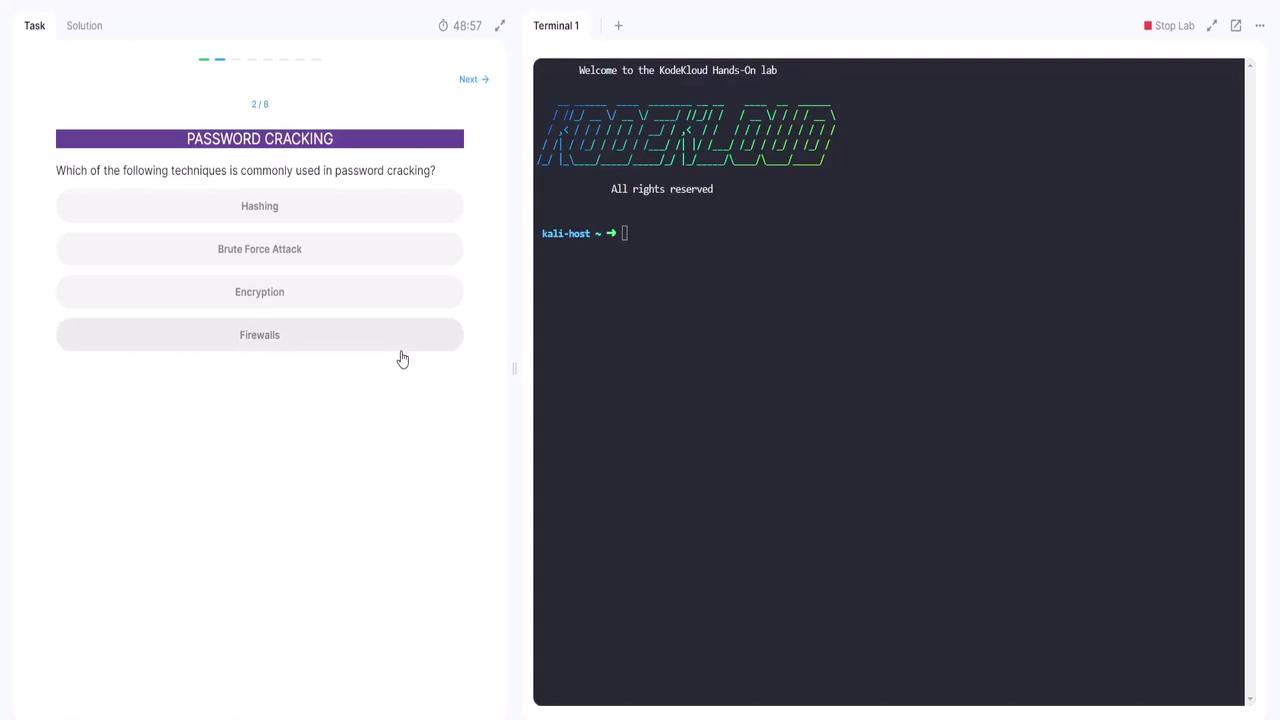
Question 2: Which Technique Is Commonly Used in Password Cracking?
Consider the following options: • Hashing• Brute force attack
• Encryption
• Firewalls
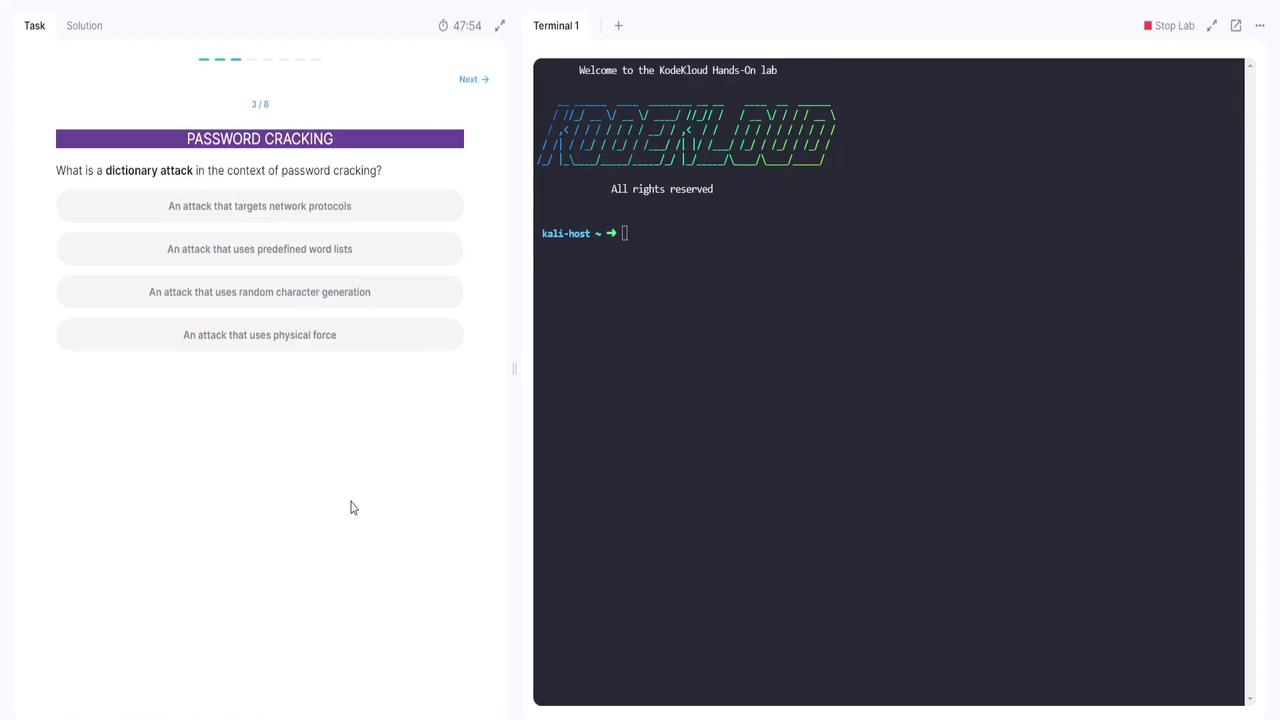
Question 3: What Is a Dictionary Attack in Password Cracking?
Review these options: • An attack that targets network protocols• An attack that uses predefined word lists
• An attack that uses random character generation
• An attack that uses physical force
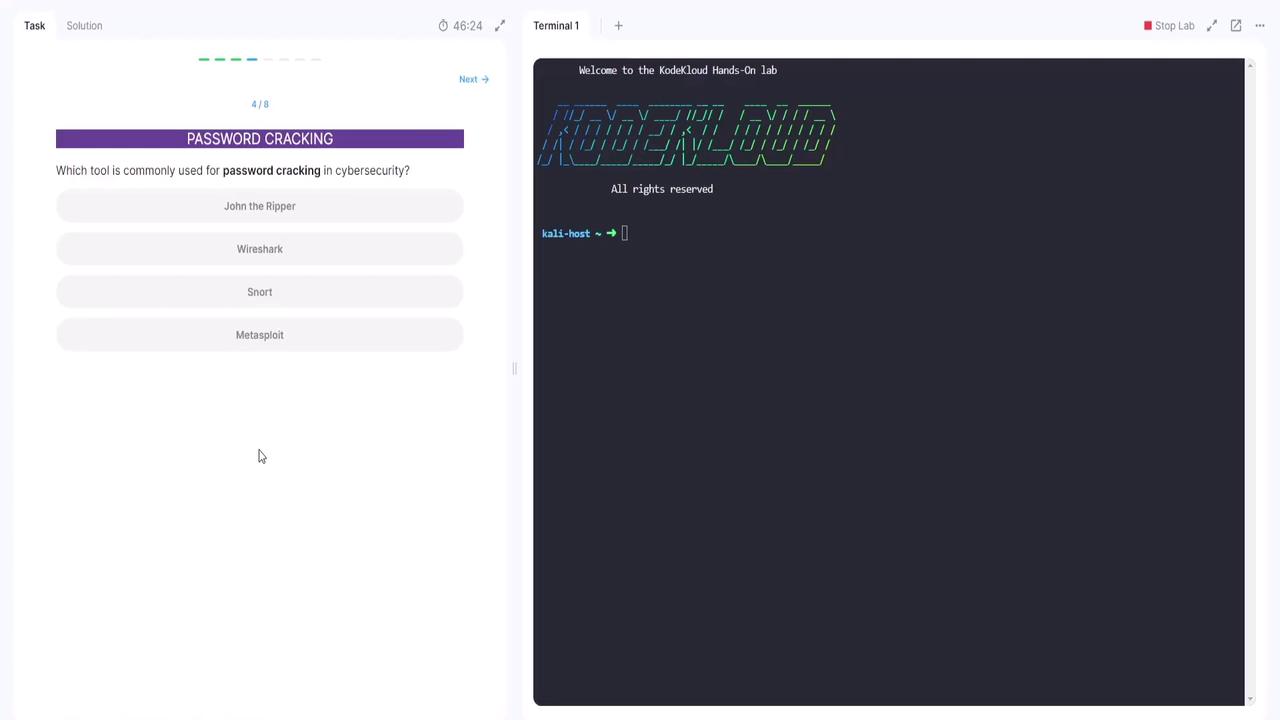
Question 4: Which Tool Is Commonly Used for Password Cracking in Cybersecurity?
Select the correct tool: • John the Ripper• Wireshark
• Snort
• Metasploit
Question 5: What Is Hashcat Primarily Used For?
Hashcat is another powerful tool for password recovery. Among the provided options (data encryption, network monitoring, and software development), its most appropriate use is for recovering passwords. Note that password cracking techniques can also help recover forgotten passwords in legitimate scenarios. Below is an introductory message from the lab interface:Hands-On Lab Exercises
In this section, you will work through three practical labs that show how to crack password hashes using John the Ripper and Hashcat.Lab 1: Cracking a Hashed Password with John the Ripper
Imagine you are a digital forensics investigator in a high-profile cybercrime investigation. A crucial hashed password is located in a file named “business.txt”. Your objective is to recover the password. John the Ripper, using its single crack mode, leverages system data (like login names and home directories) to generate a mini dictionary automatically. Run the following command to start the cracking process with the raw SHA-1 format:The output indicates that the password for the “stealth” account has been successfully retrieved.
Lab 2: Cracking a Hash with Hashcat
In this scenario, a SHA-1 hash is found in the network logs within the file “network.txt”. Unlike the previous lab, this file contains only the hash. Begin by inspecting the file contents:This result confirms that the hashed password has been recovered as “Password123”.
Lab 3: Cracking a Zip File Password Hash with Hashcat
In the final lab, you receive a password-protected zip file from a whistleblower. The zip file’s password hash is stored in “insider.txt”. Your task is to crack this hash to access the secured document. Again, use Hashcat with the straight mode (-a 0) and specify SHA-1 (-m 100) along with the rockyou.txt dictionary:This confirms that the password “password5” has been successfully retrieved.