

Vault tokens are the primary credential material in Vault. Learn how tokens are created, their lifecycle, and how to manage their security, especially for exam objectives and real-world deployments.
- Describe a Vault token
- Differentiate between service and batch tokens
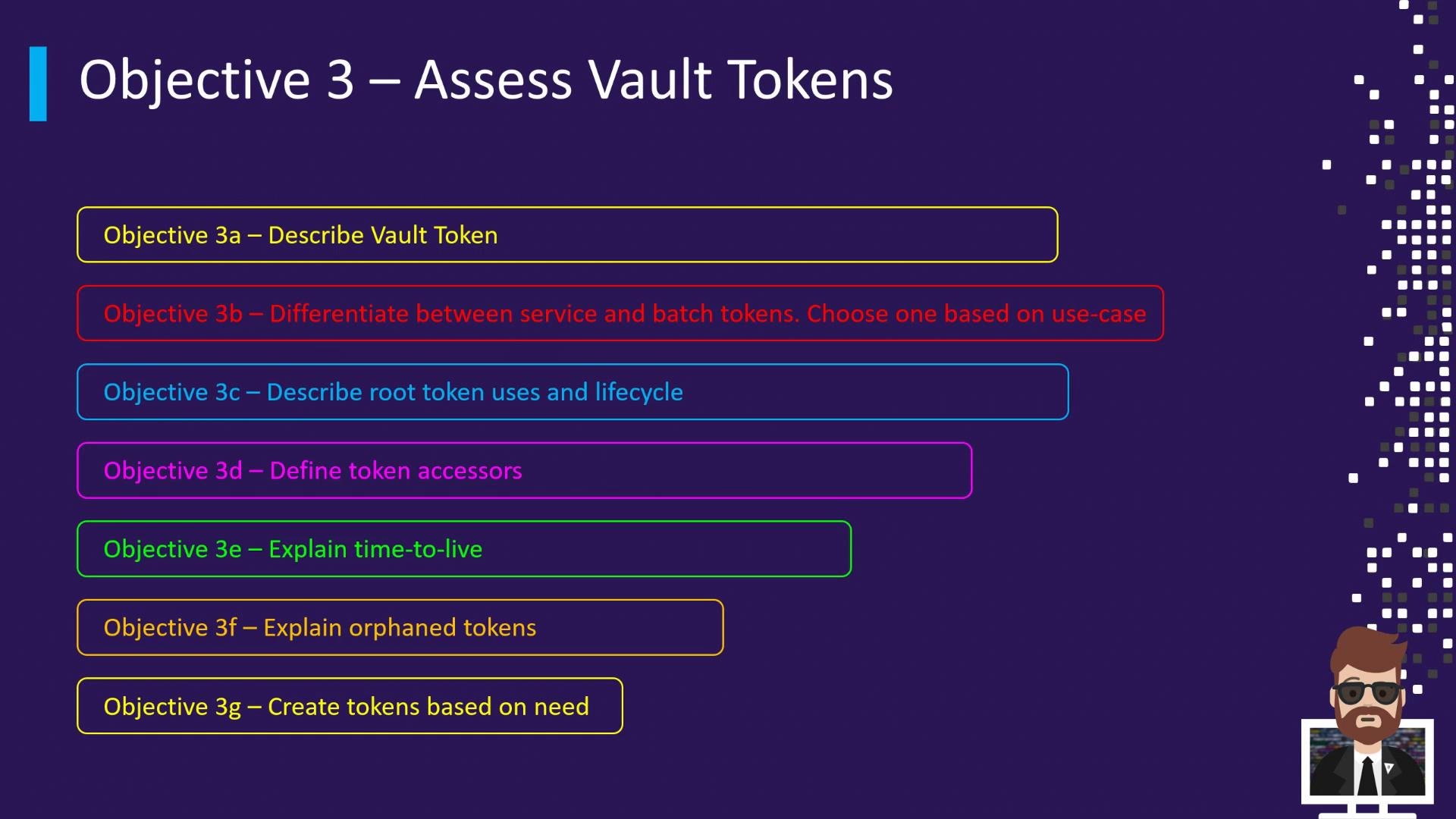
- Root token: purpose, lifecycle, and best practices for handling it.
- Token accessors: what they are and safe operational patterns.
- Time-to-live (TTL): expiration, renewal, and why TTLs matter.
- Orphan tokens and other token types: periodic, service, and batch tokens—use cases and trade-offs.
- Selecting the right token type for a given workload or security posture.
- A Vault token is an authentication credential that represents identity and attached policies. Tokens can be minted by auth methods, created manually, or generated by the system.
- Tokens encapsulate metadata such as policies, TTL, creation time, parent token, and optionally usage limits or periodic semantics.
Root token lifecycle and handling
- The root token is created during Vault initialization and has full capabilities. Treat it like a cryptographic root key.
- Immediately after initialization, you should unseal Vault, create admin users/policies, and then revoke or securely store the root token.
- Limit exposure: avoid using the root token for day-to-day operations. Use it only for recovery or initial bootstrap actions.
Do not use the root token for regular operations. Keep it offline and revoke or seal it as soon as administrative setup is complete. Root tokens are a single point of total access.
- A token accessor is a safe identifier used to look up or revoke a token without exposing the real token value.
- Use accessors when you need to perform token lifecycle operations (e.g., revoke) but must avoid logging or transmitting actual token strings.
- Common commands:
vault token lookup— view token metadata (requires policy permissions).vault token lookup -accessor <ACCESSOR>— look up with an accessor.vault token revoke -accessor <ACCESSOR>— revoke a token using its accessor.
- TTL determines how long a token is valid. When TTL expires, the token no longer authorizes requests.
- Tokens can be renewable or non-renewable:
- Renewable tokens: clients can call
vault token renewto extend the TTL within allowed limits. - Non-renewable (batch) tokens: cannot be renewed and are ideal for short-lived tasks.
- Renewable tokens: clients can call
- Periodic tokens automatically renew up to their maximum TTL, making them suitable for services that can safely refresh tokens.
Orphan tokens and when to use them
- An orphan token’s lifecycle is independent of its parent: revoking the parent does not revoke orphans.
- Use orphan tokens carefully for delegation patterns where the child must outlive the parent.
- Because orphan tokens can outlast the creator, they increase long-term access risk—minimize use and set conservative TTLs.
- Short-lived, non-renewable access for ephemeral jobs → use batch tokens.
- Long-running service that can renew itself → periodic or service tokens (with renew policy).
- Delegation where child must persist beyond parent → orphan token (use sparse and audited).
- Administrative/initial tasks → root token (use only temporarily and secure it).
- Minimize root token usage; store it securely.
- Prefer least privilege: attach only necessary policies to tokens.
- Use accessors for token management to avoid exposing token strings.
- Set conservative TTLs and use renewal/periodic semantics only where appropriate.
- Audit token creation and revocation events.
- Vault Token Documentation
- Token commands reference
- HashiCorp Certified: Vault Associate Certification