

Migration cycle (repeatable)
Follow a small-batch, repeatable loop. Each iteration should be scoped to a single component, service, or small group of related components.
Use feature flags, canary releases, and small-batch rollouts to reduce risk. After each iteration, update runbooks, documentation, and on-call alerts so the operations team has accurate information during incidents.
Validation and observability
During every migration iteration verify both functional correctness and observability:- Validate end-to-end functionality: API responses, background jobs, scheduled tasks.
- Confirm telemetry integrity: metrics, logs, traces, and distributed tracing links.
- Validate dashboards and alerts: ensure existing alerts fire appropriately and dashboards reflect the new implementation.
- Add tests and synthetic checks to prevent regressions.
Managing technical debt during migration
Technical debt often accumulates when teams take shortcuts to meet deadlines or unblock work. If left untracked, debt slows future development and increases operational risk. Treat debt as first-class work and incorporate remediation into migration sprints.Track technical debt items as first-class work items in your backlog. Address high-risk debt early and schedule lower-risk items into regular maintenance windows.
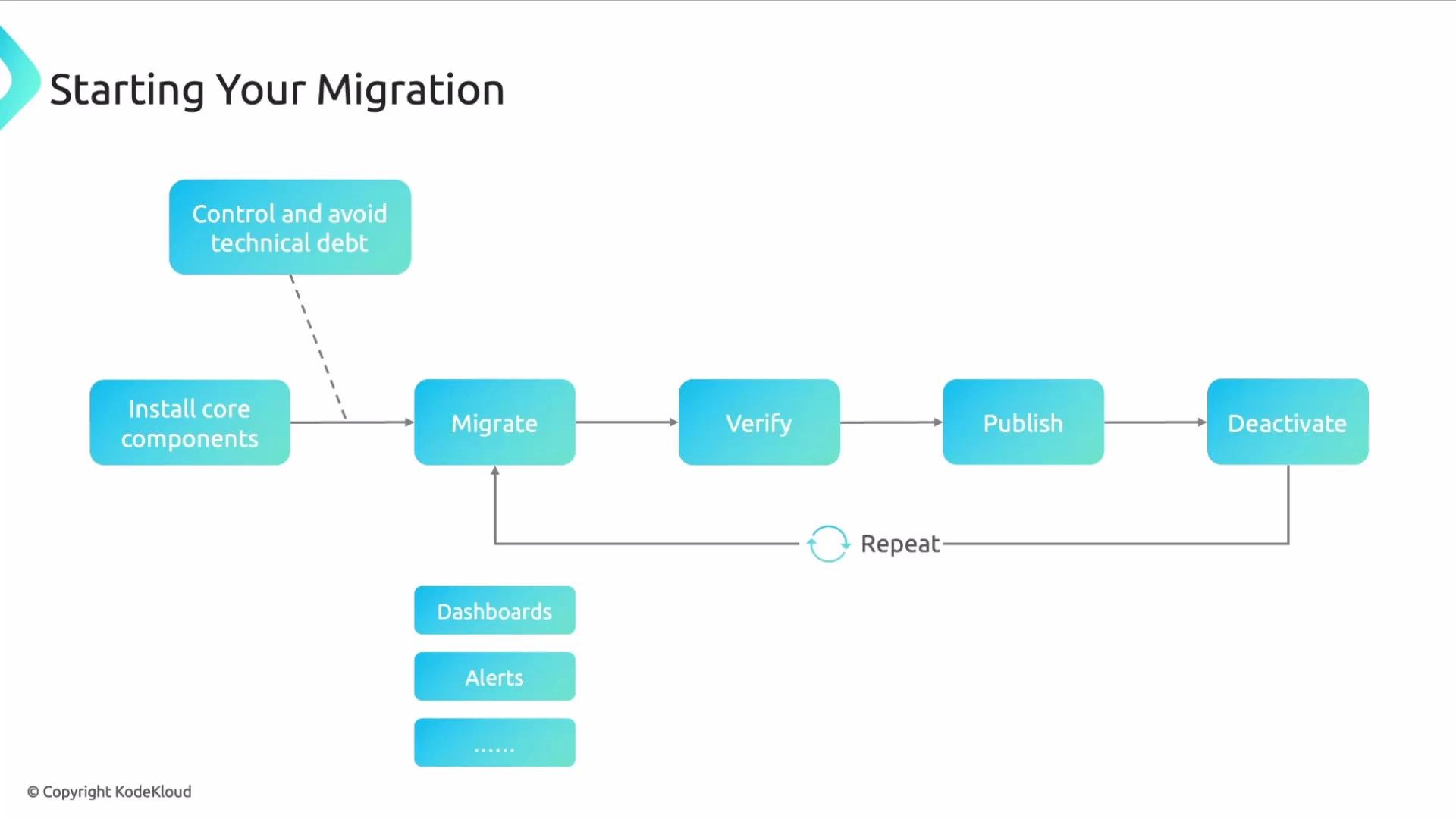
Practical checklist (quick reference)
- Install and verify observability agents, collectors, and central dashboards.
- Pick one small component for the next migration iteration.
- Validate metrics, logs, and traces before and after migration.
- Update dashboards and alerts to reference the new implementation.
- Run canaries or smoke tests in production-like traffic.
- Flip traffic or promote the new service once validated.
- Decommission the legacy component and update runbooks.
- Close or reschedule tracked technical debt items.
Links and references
- Datadog - Migration guidance and observability best practices
- Kubernetes Basics — general reference for deployments and rollouts