This lesson explains why engineering and SRE teams choose to migrate to Datadog for observability and security. With many monitoring options available—cloud-provider tools like Azure Monitor and AWS CloudWatch, and third-party platforms such as Grafana, New Relic, Dynatrace, and Datadog—organizations evaluate platforms against integration, coverage, cost, and operational efficiency. The sections below summarize the main reasons teams pick Datadog. Datadog is a recognized leader in Gartner’s Magic Quadrant for observability, and it positions itself as a unified, all-in-one platform combining observability and security capabilities. That single-platform approach reduces tool sprawl and speeds cross-team collaboration.
Consider Datadog when you need consolidated telemetry (metrics, traces, logs, and user-experience data), fast integrations across cloud and on-prem systems, and built-in ML/AI for anomaly detection and incident prioritization.

Key benefits

  • All-in-one platform
    Datadog collects and correlates telemetry—metrics, traces, logs, and front-end user experience—so you can link customer-facing issues (e.g., slow page loads) to backend causes (e.g., high DB IOPS or query latency). Consolidation reduces context switching and the operational overhead of maintaining multiple disparate tools.
  • Ease of integration
    Datadog offers a broad ecosystem of integrations and lightweight agents for cloud services, orchestration platforms, databases, message queues, and more. These integrations make telemetry collection consistent across environments and simplify onboarding for engineering teams.
  • Modern ML and AI capabilities
    Built-in ML and AI features detect anomalies, prioritize alerts, and surface meaningful signals from noisy telemetry. Datadog also supports monitoring of ML models and data pipelines, improving model observability and reliability.
  • Cost management and FinOps
    Datadog includes cost monitoring and cloud spend attribution features that help teams implement FinOps practices: track spend, attribute costs to teams or services, and identify optimization opportunities to reduce waste.
  • Security and unified visibility
    Datadog extends beyond observability into security—covering CI/CD scanning, infrastructure and runtime protection, and API/data security—so security and reliability teams can use the same platform and correlated data to accelerate incident response and improve posture.

Benefit summary
BenefitWhy it mattersExample features
All-in-one observabilityReduce tool fragmentation and speed troubleshootingUnified metrics, traces, logs, and RUM
Fast integrationsLower onboarding and operational overhead600+ integrations and lightweight agents
ML/AI detectionSurface actionable signals and reduce alert fatigueAnomaly detection, outlier detection, forecasting
Cost optimization (FinOps)Control cloud spend and attribute costsCloud spend dashboards, cost allocation
Security & complianceUnify observability and security dataCI/CD scanning, runtime protection, threat detection
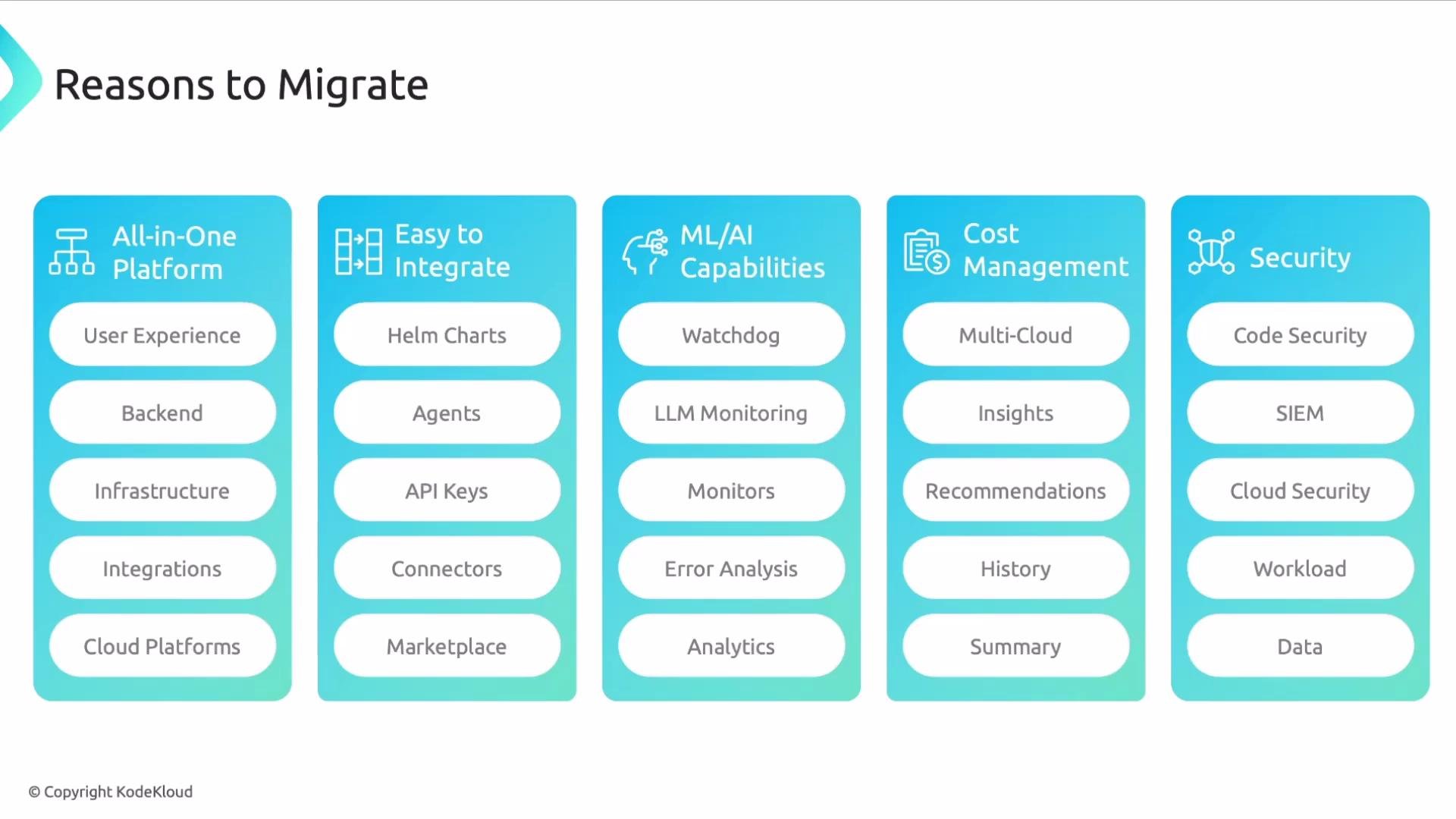
The image outlines reasons to migrate to a platform, featuring categories like All-in-One Platform, Easy to Integrate, ML/AI Capabilities, Cost Management, and Security, each with specific features listed.
Because Datadog centralizes telemetry and security signals, it helps break down organizational silos: development, operations, SRE, and security teams can collaborate around a single source of truth. That unified view accelerates root-cause analysis and supports data-driven decisions to improve system reliability, performance, and cost efficiency. Further reading and references: That’s it for this lesson. I hope you found it useful — see you in the next lesson.

Watch Video