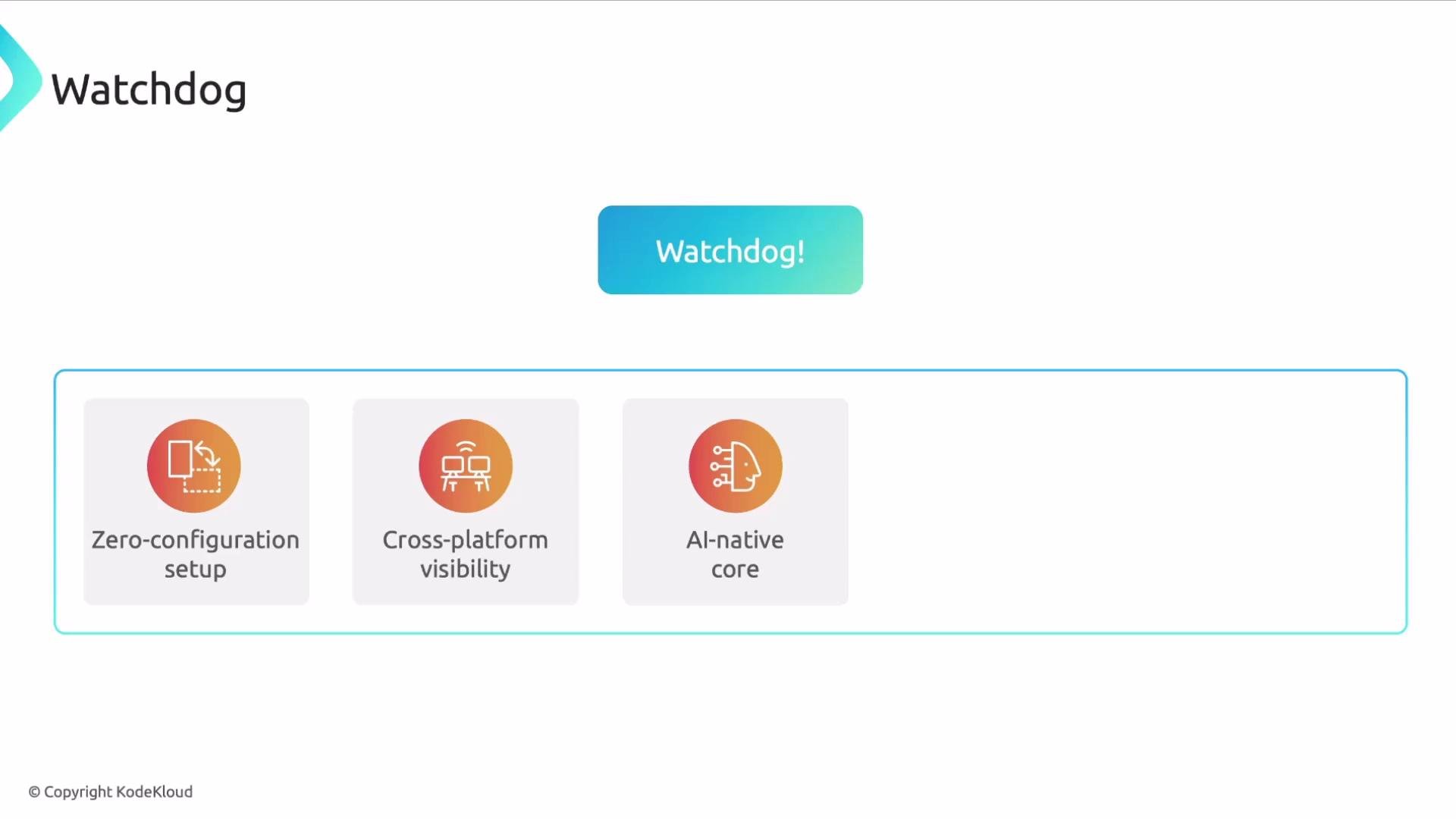
Watchdog is Datadog’s AI-powered observability assistant that surfaces anomalous behaviors across applications and infrastructure. Rather than only monitoring metrics, Watchdog applies machine learning to provide contextualized, prioritized insights that help engineers detect, understand, and act on issues faster. Datadog introduced Watchdog to meet the growing need for solution-integrated AI capabilities—tools that not only detect anomalies but also correlate signals across your stack so you can focus on the most impactful problems. Watchdog’s core advantages include zero-configuration setup, cross-platform visibility, and an AI-native core:
The image features a promotional graphic for "Watchdog" highlighting three features: zero-configuration setup, cross-platform visibility, and an AI-native core.
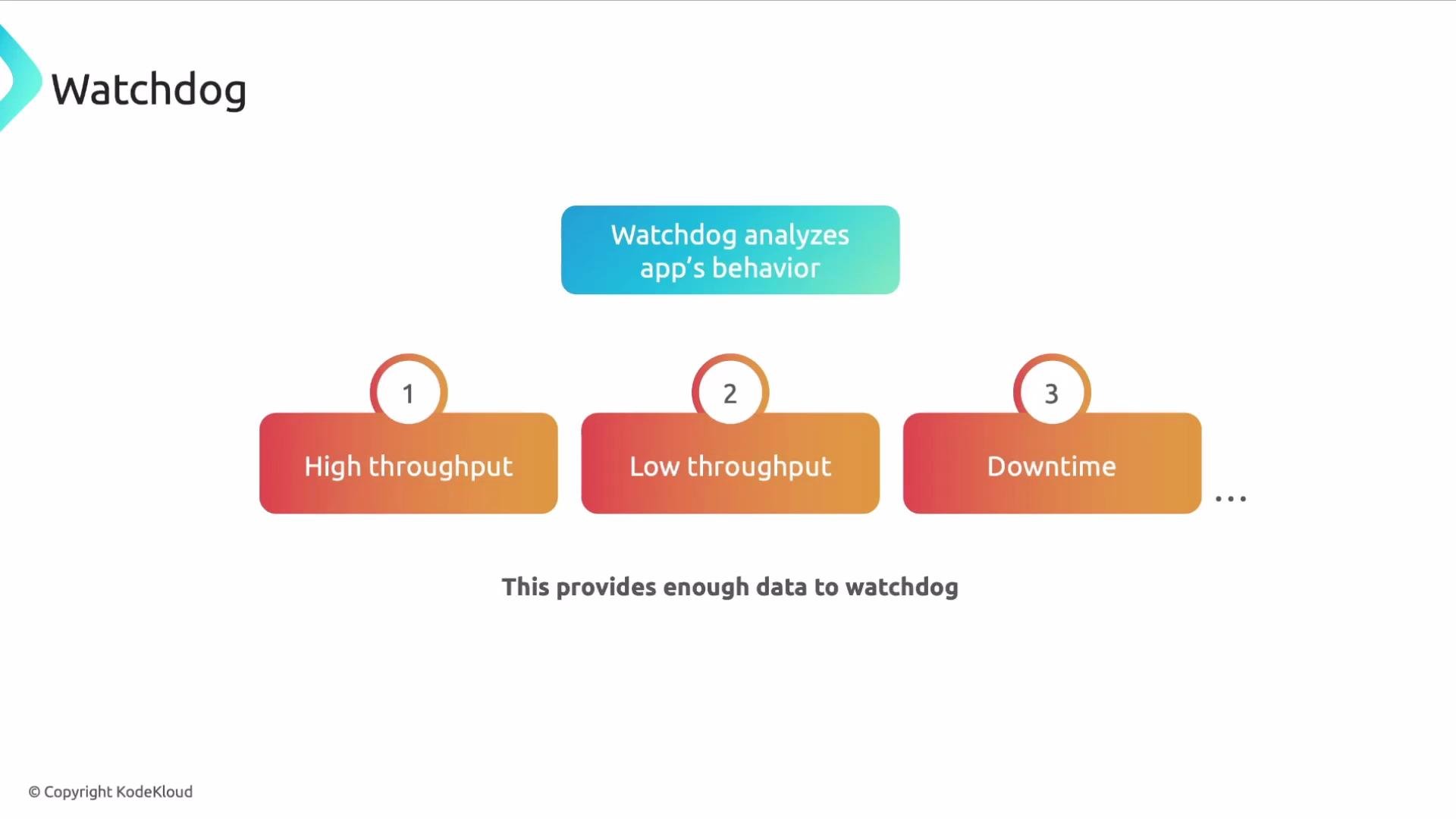
Watchdog is available directly from the Datadog console and surfaces insights under Monitors and the dedicated Watchdog view. It helps you prioritize by highlighting the most impactful anomalies and indicating which issues to investigate first. How Watchdog builds and uses baselines Watchdog constructs a model of “normal” behavior by analyzing historical signals across operational modes—high throughput, low throughput, downtime, and other conditions. With this baseline, it detects deviations from expected patterns, often surfacing problems earlier than threshold-based monitors.
The image describes a process where a tool called "Watchdog" analyzes an app's behavior through stages of high throughput, low throughput, and downtime.
When Watchdog detects a significant anomaly it:
  • Flags the anomalous behavior and can trigger alerts or create monitors automatically.
  • Provides a correlated timeline of relevant events to speed root-cause analysis.
  • Correlates logs and distributed traces (APM) with other signals such as security alerts and infrastructure failures.
  • Suggests probable root causes or contributing factors so you can begin debugging from an informed hypothesis.
This multi-signal correlation reduces manual effort in piecing together timelines across tools, lowers false positives, and improves alert signal-to-noise so teams can act on what matters. Quick feature summary
FeatureWhy it mattersExample outcome
Zero-configurationImmediate value with minimal setupDetects anomalies without custom instrumentation
Cross-platform visibilityCorrelates app, infra, logs, and tracesFaster identification of upstream/downstream causes
AI-native baseliningLearns normal behavior across conditionsFewer false positives and better prioritization
Watchdog uses historical baselining and multi-signal correlation to lower false positives and provide contextualized, prioritized insights. You can find these insights under Monitors in the Datadog console.
Further reading and resources That’s it for this lesson. I hope you found it helpful.

Watch Video