

- Confirm dashboards, monitors, queries, and alerts are firing and presenting expected results.
- Validate that reliability and functionality are maintained or improved compared to the legacy platform.
- Ensure visibility parity: don’t lose monitoring coverage, alerting fidelity, or key observability signals.
Collect structured telemetry and incident data during the first few weeks after cutover so you can quantify differences between the old and new environments.
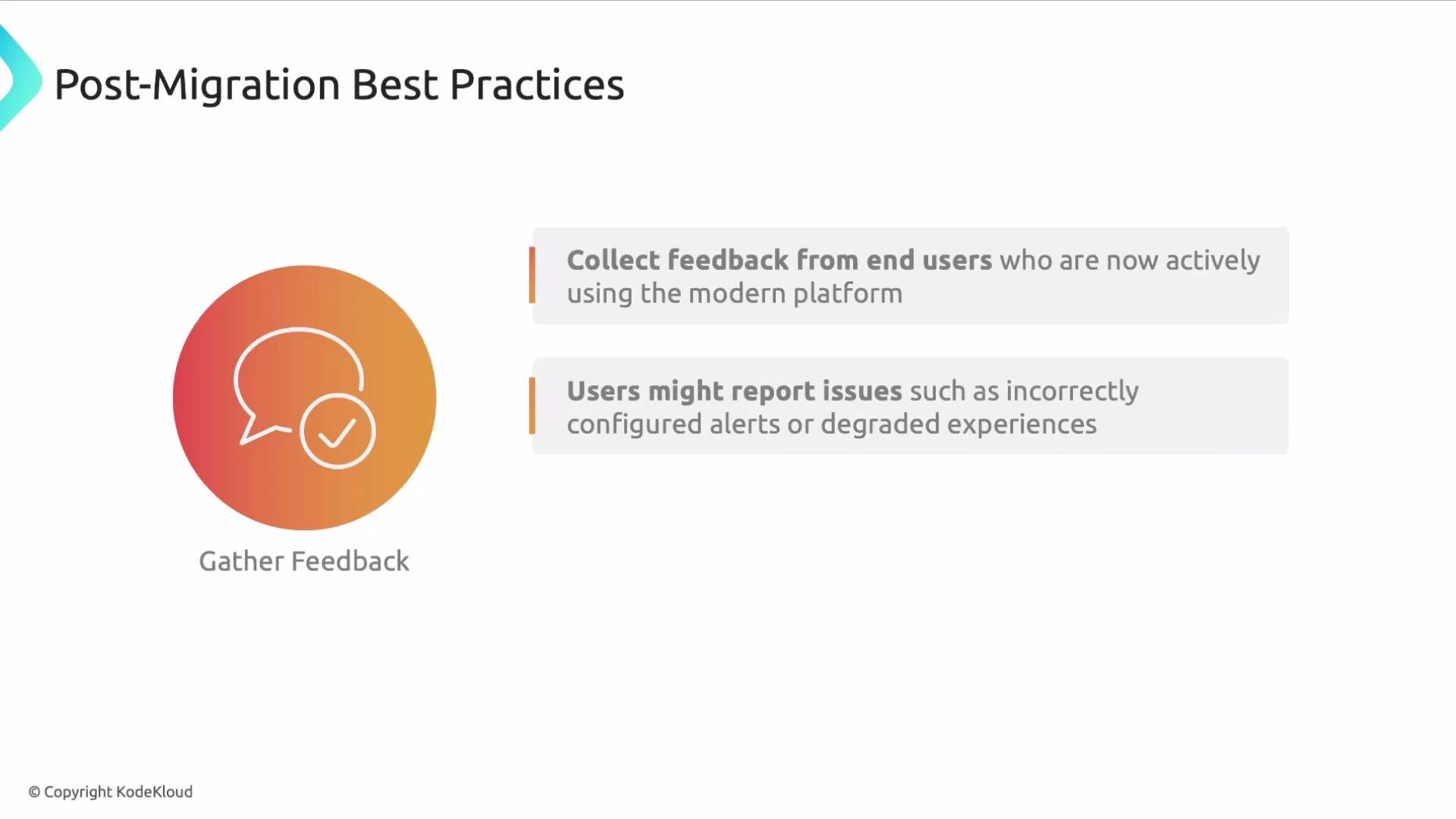
- Solicit feedback from users who now interact with the modern environment — they will surface operational issues you might not have seen during migration (for example: misconfigured alerts, permission gaps, or degraded user experiences).
- Triage and prioritize fixes based on impact: safety/stability issues first, followed by usability and performance improvements.
- Close the feedback loop: communicate resolved issues and expected timelines to stakeholders.
- Reassess data retention, collection granularity, and sampling to balance cost with signal fidelity.
- Add enhancements or new features that were deferred during migration (for example: more granular traces, additional dashboards, or enriched context in logs).
- Remove redundant or low-value metrics, tags, and dashboards to reduce noise and storage costs.
Keep an authoritative, versioned inventory of services, hosts, dashboards, monitors, and alerting policies. This prevents repeating past mistakes and makes future migrations smoother.
Links and references
- Observability and monitoring best practices
- Incident response and postmortem practice
- Metrics retention and sampling strategies