

- Customers place orders = incoming client requests
- Waiters take orders to the kitchen = the event loop registers and dispatches events
- Chefs prepare meals = workers process requests (I/O, proxying, upstreams)
- Waiters deliver meals = worker sends the response back to the client
-
Incoming request
- A client sends an HTTP(S) request to the server; the connection arrives at NGINX.
-
Event loop (the waiter)
- The worker’s event loop observes the new connection and registers events (readable, writable, timers).
- NGINX relies on scalable OS mechanisms: on Linux it typically uses
epoll, on BSD systems it useskqueue, and on older platforms it falls back topoll/select. These mechanisms notify the event loop when I/O is ready, avoiding blocking calls.
-
Processing the event (the chef)
- A worker process handles the work associated with that event: parse headers, proxy to upstreams, run filters, or read files from disk.
- If an operation requires waiting (e.g., upstream response, disk I/O), the worker uses non-blocking calls and returns to the event loop so other connections can be handled in the meantime.
-
Sending the response (the waiter returns)
- Once the required data is available, the worker writes the response to the client (using the event loop to know when the socket is writable) and continues handling other events.
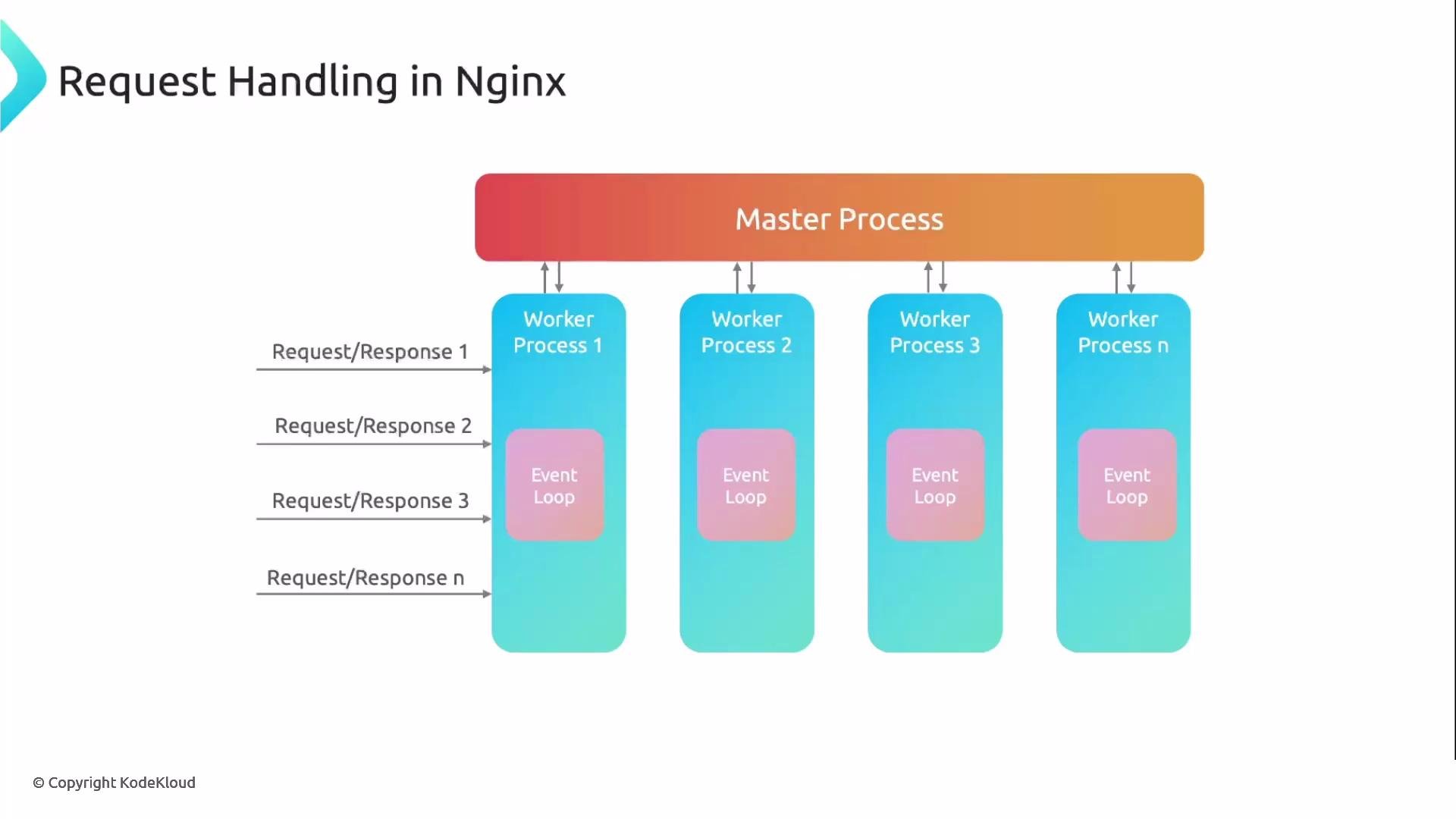
- The master process handles configuration, privilege tasks, and worker lifecycle management (start/reload/stop).
- Each worker process runs independently and uses an event loop to manage many concurrent connections.
Practical tuning tips
- For many deployments set
worker_processestoautoto let NGINX use all available CPU cores:worker_processes auto; - Use
worker_connectionsto control how many concurrent connections a single worker can manage. Total concurrent connections ≈worker_processes * worker_connections. - Choose the appropriate event method (
epoll,kqueue) automatically by default; explicit configuration is rarely necessary.
- Non-blocking I/O prevents idle waiting on slow operations.
- Readiness notifications (epoll/kqueue) allow the event loop to efficiently discover ready sockets.
- Multiple workers let NGINX utilize multiple CPU cores without shared-state contention between event loops.
- Official NGINX documentation: https://nginx.org/en/docs/
- Linux
epolloverview: https://man7.org/linux/man-pages/man7/epoll.7.html - BSD
kqueueoverview: https://man.openbsd.org/kqueue
- The master process manages configuration and the worker lifecycle.
- Worker processes run the event loop and perform non-blocking request processing.
- The event-driven model (epoll/kqueue) lets each worker handle many connections concurrently, giving NGINX its high performance and scalability.
Nginx is non-blocking and asynchronous: workers don’t block waiting for I/O — they register interest in events and continue processing other connections until notified. This is the core reason NGINX can handle large numbers of concurrent clients with low resource usage.