

Overview
In Kubernetes, a Deployment is a controller that creates and manages Pods. You specify the desired state—such as the number of replicas and container specifics—and the Deployment ensures that the actual state matches your specification. In contrast, OpenShift supports both standard Kubernetes Deployments and a native DeploymentConfig. The diagram below illustrates the differences: the top left depicts a standard Kubernetes Deployment, while the bottom right represents an OpenShift-specific DeploymentConfig using a Custom Resource Definition (CRD) operator.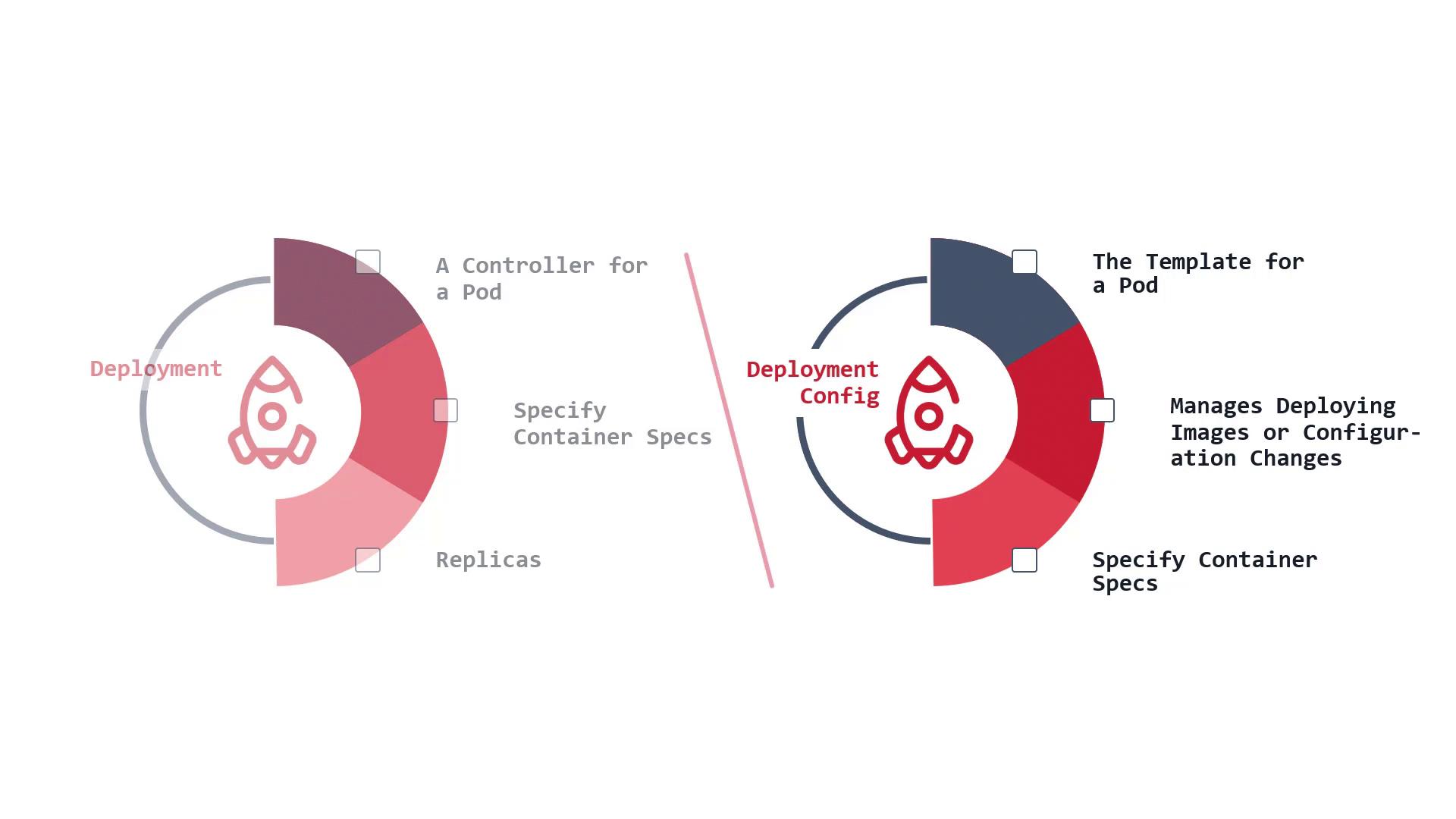
YAML Manifest Examples
Below you will find example YAML manifests for both a Kubernetes Deployment and an OpenShift DeploymentConfig. Notice that both configurations define the desired state for the application, including pod replicas and container specifications.Both objects act as controllers for Pods. By specifying a replica count (such as 1, 3, or 10), the respective controllers ensure that the desired number of Pods is always running.
Key Differences
While both the Kubernetes Deployment and OpenShift DeploymentConfig manage replicas and container specifications, their core differences lie in the underlying mechanisms and update flexibility:Replication Process
- A standard Kubernetes Deployment leverages a ReplicaSet—a native Kubernetes object that ensures the specified number of pod replicas are active. If a pod fails, the ReplicaSet automatically creates a new instance to maintain the required pod count.
- OpenShift’s DeploymentConfig, on the other hand, uses a ReplicaController. Though it functions similarly by managing pod count, its selection criteria are limited to equality-based selectors.
Updating Container Images
- In DeploymentConfigs, container images can be updated directly within the manifest. This allows for rapid upgrades or configuration adjustments.
- In contrast, Kubernetes Deployments use a rolling update strategy. This method provides a safer transition between different image versions by gradually updating the pods.
Red Hat OpenShift documentation advises using standard Kubernetes Deployments unless you require the additional features provided by DeploymentConfigs.