Welcome to the AWS Certified AI Practitioner course. I’m Michael Forrester, and I’ll guide you through this practical, exam-focused lesson on applying artificial intelligence on AWS. The AI landscape is evolving rapidly. If you work with AWS, you need both conceptual AI knowledge and an understanding of how to operationalize AI on the platform — how models are hosted, monitored, governed, and secured, plus how to control costs and infrastructure. This course distills those essentials and helps bridge the gap between theory and real-world AWS deployments while preparing you for the AWS Certified AI Practitioner (Foundational) exam.
This lesson assumes a basic AWS background (roughly AWS Cloud Practitioner / CLF-C02 level). If you need a refresher, review core AWS concepts such as IAM, S3, EC2, and the Shared Responsibility Model before continuing. You can start with the AWS Cloud Practitioner (CLF-C02) course.
Throughout the course you’ll learn core AI concepts tailored to AWS, follow practical implementation patterns, and complete quizzes and a mock exam to measure progress and identify areas for reinforcement. Below is an overview of the modules you’ll cover, followed by diagrams and slides that illustrate each module’s key points.

Course at a glance: modules and outcomes


Module 1 — Fundamentals of AI and ML
In this module we’ll cover the foundational concepts of AI and clarify the distinctions between artificial intelligence, machine learning, and deep learning. You’ll learn about different data types, common learning methods, and how to identify AI and ML use cases that map well to AWS solutions.
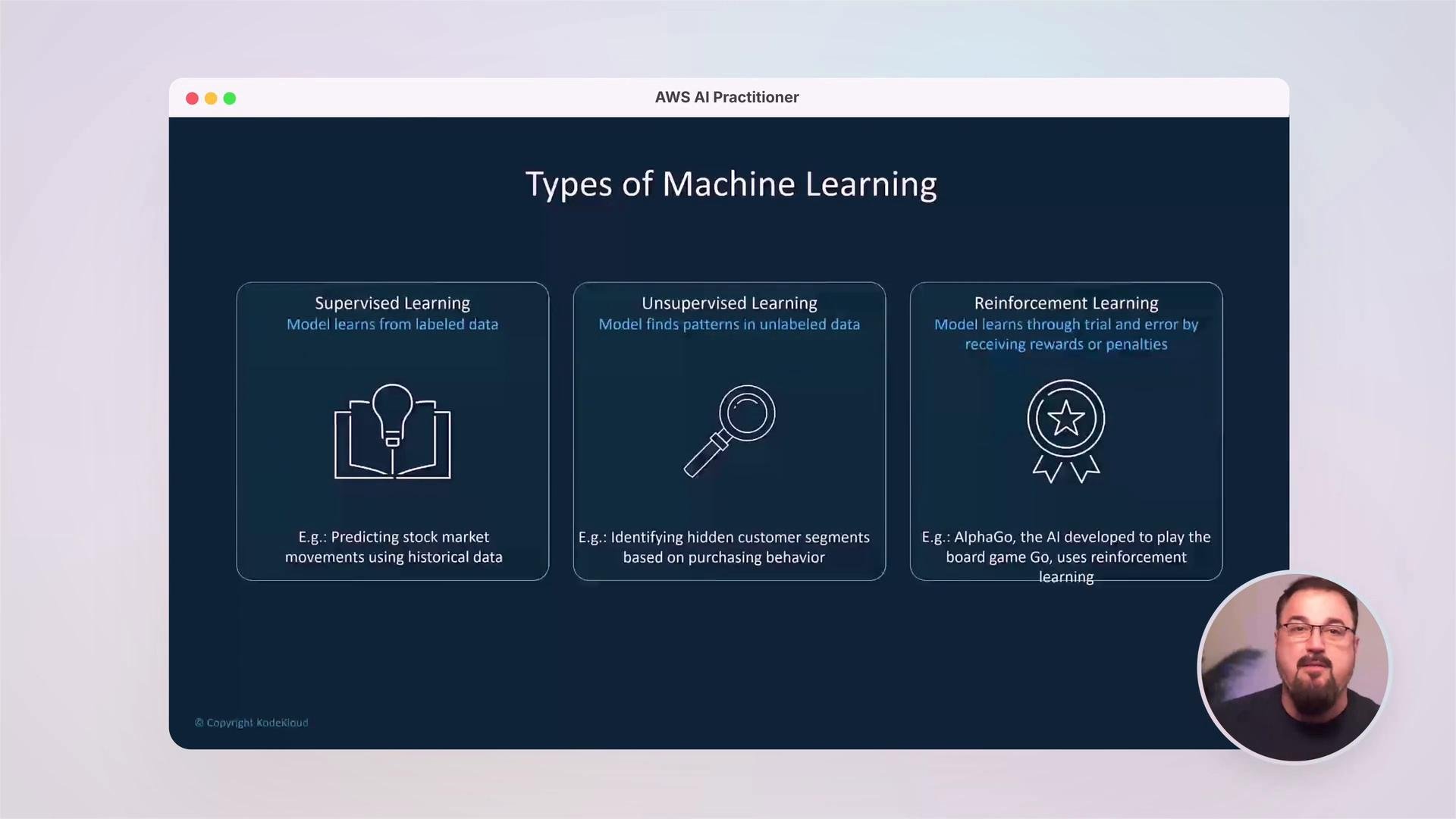
A presentation slide titled "Types of Machine Learning" showing three panels for Supervised, Unsupervised, and Reinforcement learning with short definitions and icons. A small circular webcam overlay with a person appears in the bottom-right.
Module 2 — Fundamentals of Generative AI
This module focuses on generative AI and its unique building blocks: tokens, embeddings, and the lifecycle of foundation models. We’ll cover cost management, infrastructure patterns for generative workloads on AWS, and real-world trade-offs.
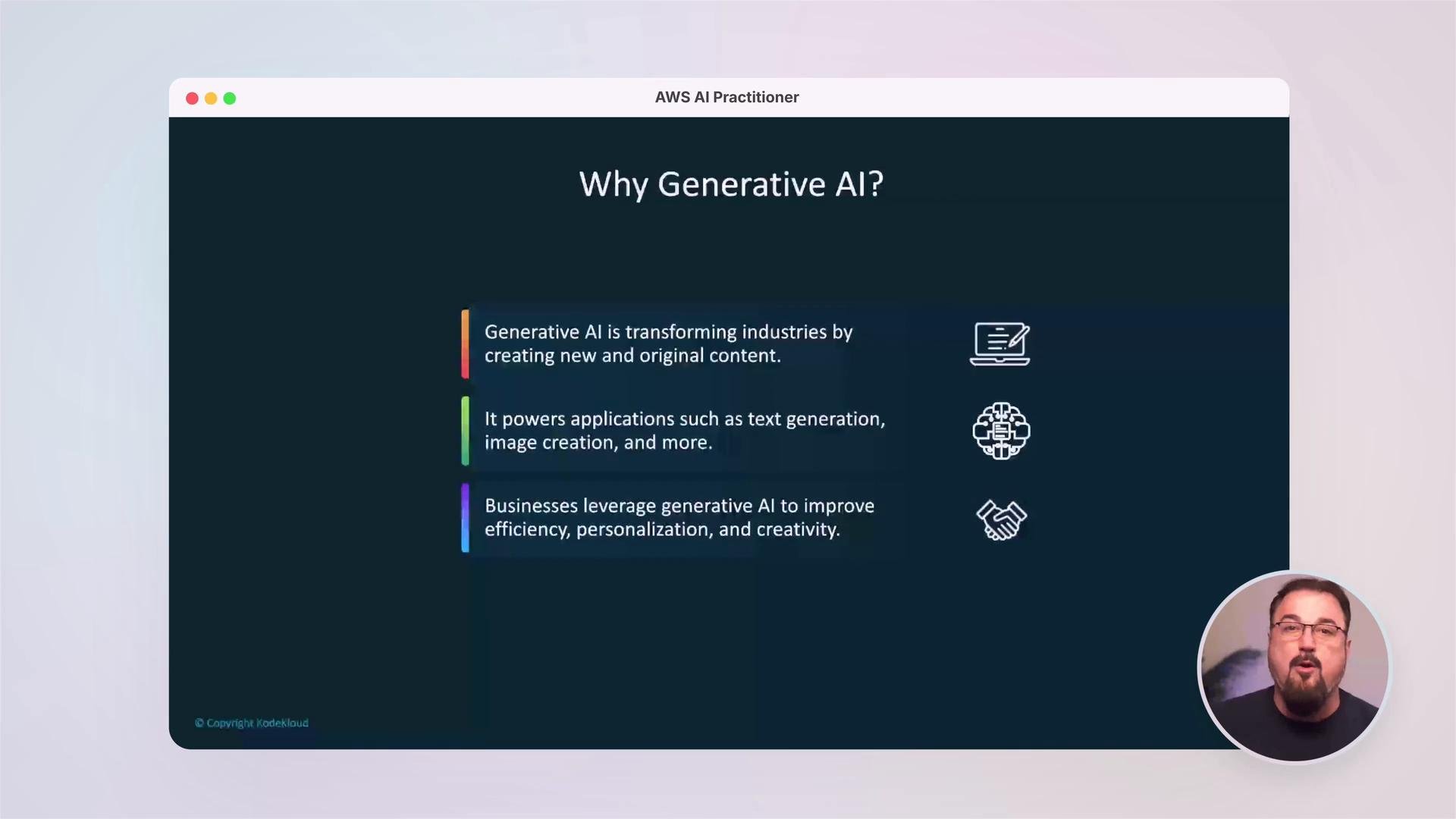
A presentation slide titled "Why Generative AI?" listing benefits like creating original content, powering text and image generation, and helping businesses improve efficiency, personalization, and creativity with accompanying icons. A small circular video inset in the lower-right shows a man speaking.
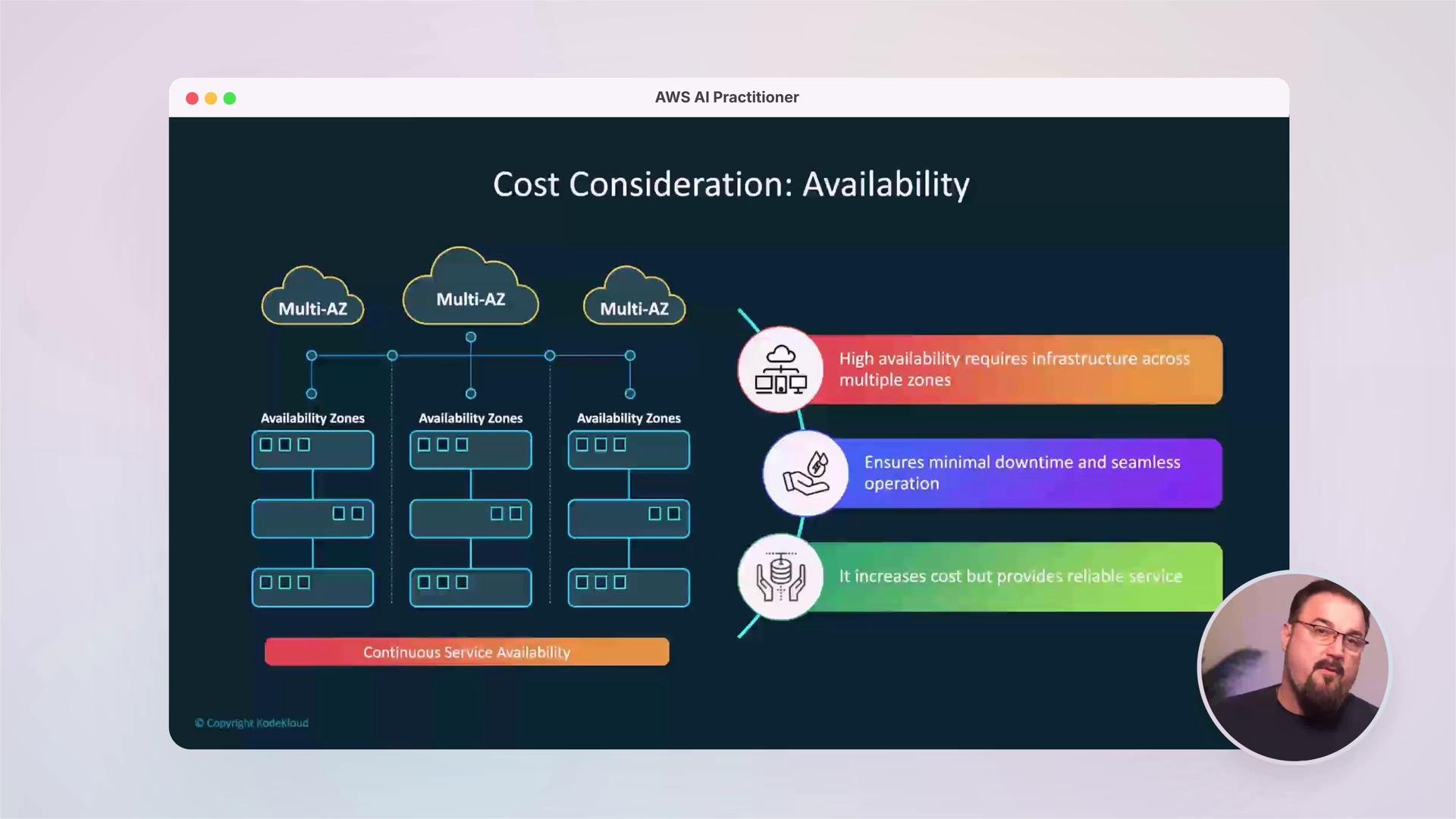
As part of cost planning, we’ll evaluate availability and high-availability trade-offs, such as multi-AZ deployments and their cost impacts. You’ll see practical patterns that balance latency, reliability, and expense.
A presentation slide titled "Cost Consideration: Availability" showing a multi-AZ availability zones diagram on the left and three colored callouts on the right explaining high availability, minimal downtime, and increased cost. A small presenter video thumbnail appears in the bottom-right.
Module 3 — Applications of Foundation Models
This section covers selecting and customizing foundation models—from using managed, pre-trained offerings to fine-tuning and applying Retrieval-Augmented Generation (RAG). We’ll explore vector databases, RAG design patterns, and strategies for injecting relevant context to improve model accuracy and relevance.
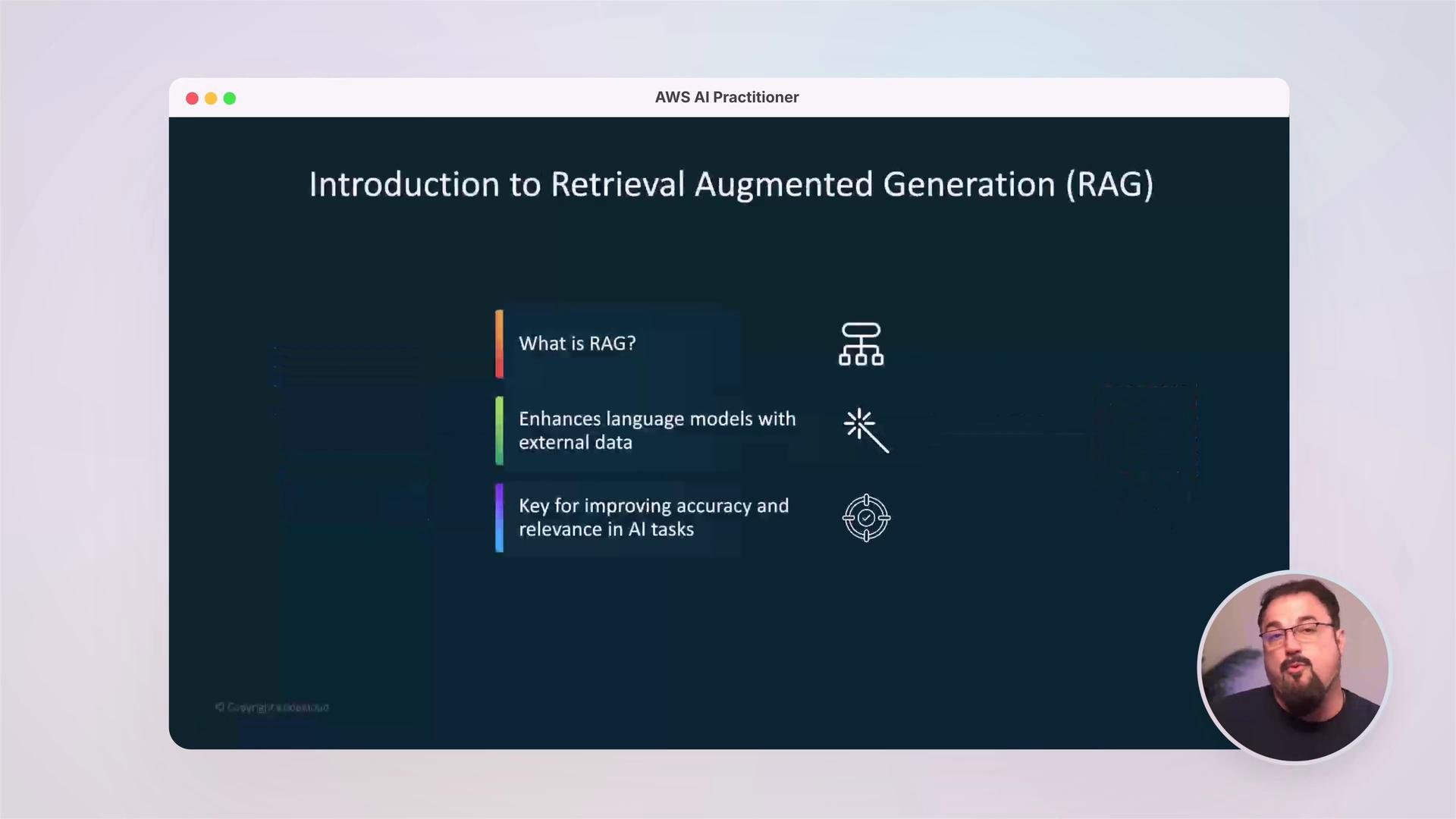
A presentation slide titled "Introduction to Retrieval Augmented Generation (RAG)" showing bullet points about RAG enhancing language models with external data to improve accuracy and relevance. A small circular video of a person speaking appears in the bottom-right corner.
You will also learn deployment strategies for models on AWS, prompt engineering best practices, and the metrics used to evaluate model performance and user experience. Module 4 — Guidelines for Responsible AI
Here we’ll discuss principles and practical tools for building responsible AI applications: selecting models responsibly, managing legal risk, addressing dataset and model bias, and designing transparent, human-centered solutions.
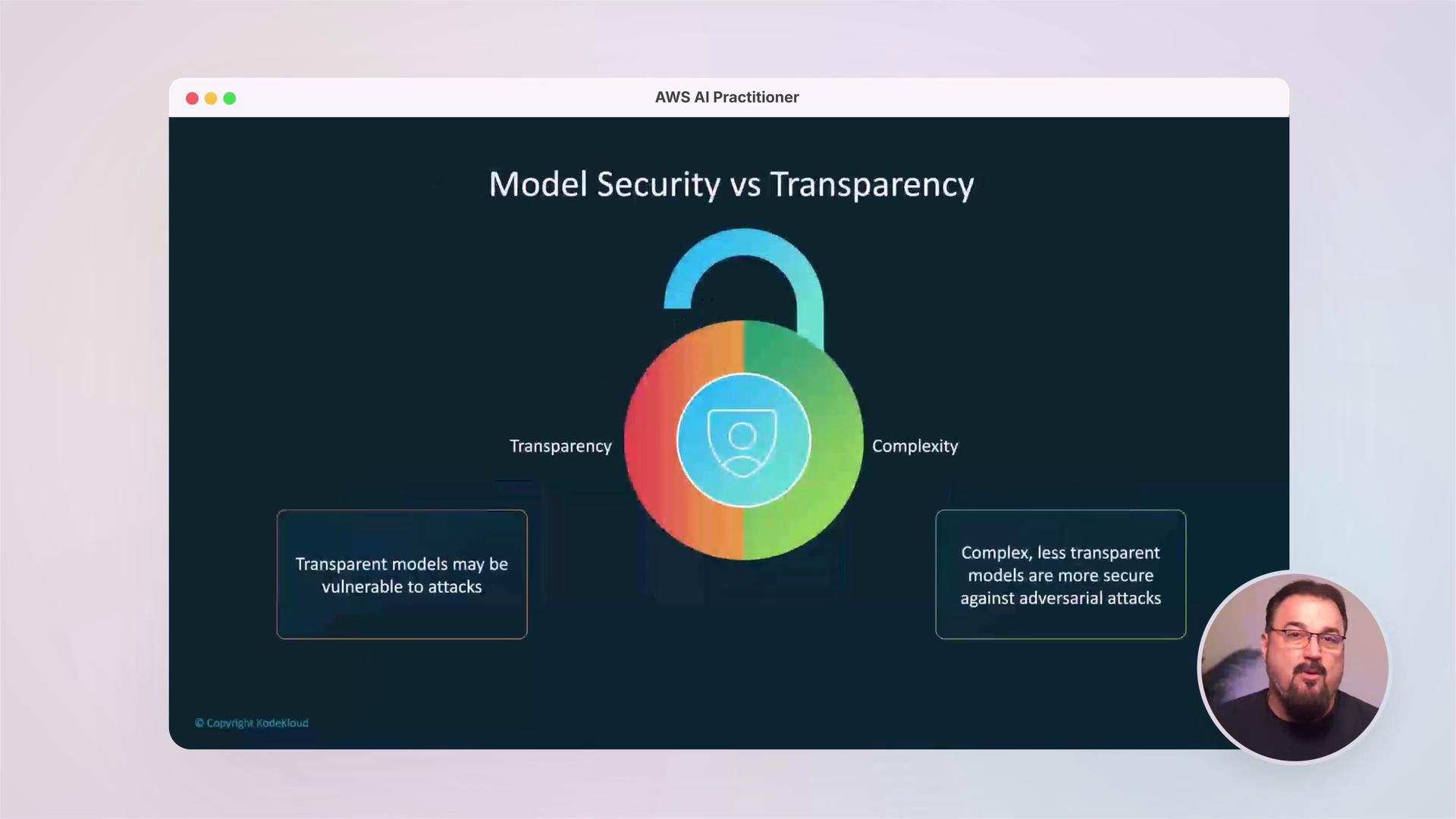
A presentation slide titled "Model Security vs Transparency" showing a colorful open-padlock graphic comparing transparency and complexity, with a small circular video feed of a speaker in the bottom-right corner.
Module 5 — Security, Compliance, and Governance
This module covers securing AI systems on AWS, including data engineering best practices, regulatory compliance considerations, and governance strategies to keep AI applications secure, auditable, and trustworthy. We’ll summarize the key emerging AI compliance frameworks and standards you should be aware of.
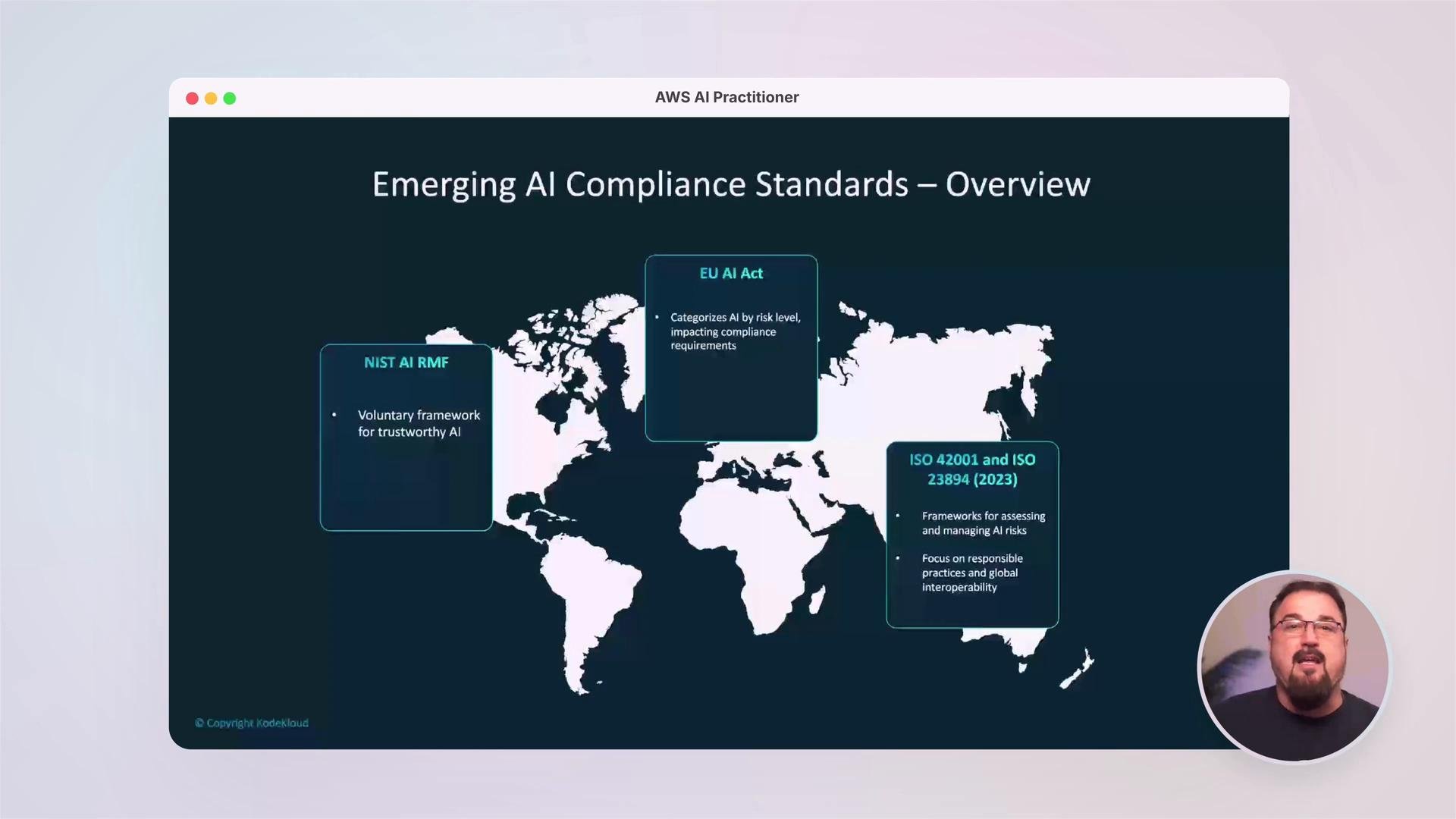
A presentation slide titled "Emerging AI Compliance Standards — Overview" with a world map and callout boxes for NIST AI RMF, the EU AI Act, and ISO standards, plus a small video feed of a speaker in the lower-right corner. The slide summarizes global AI risk and compliance frameworks.
Module 6 — Wrap-up and Next Steps
In the final module we’ll review the core concepts, provide a full mock exam to simulate the AWS exam experience, and point to resources for continued learning. We’ll also offer suggestions on how AI may evolve within AWS and across industry.
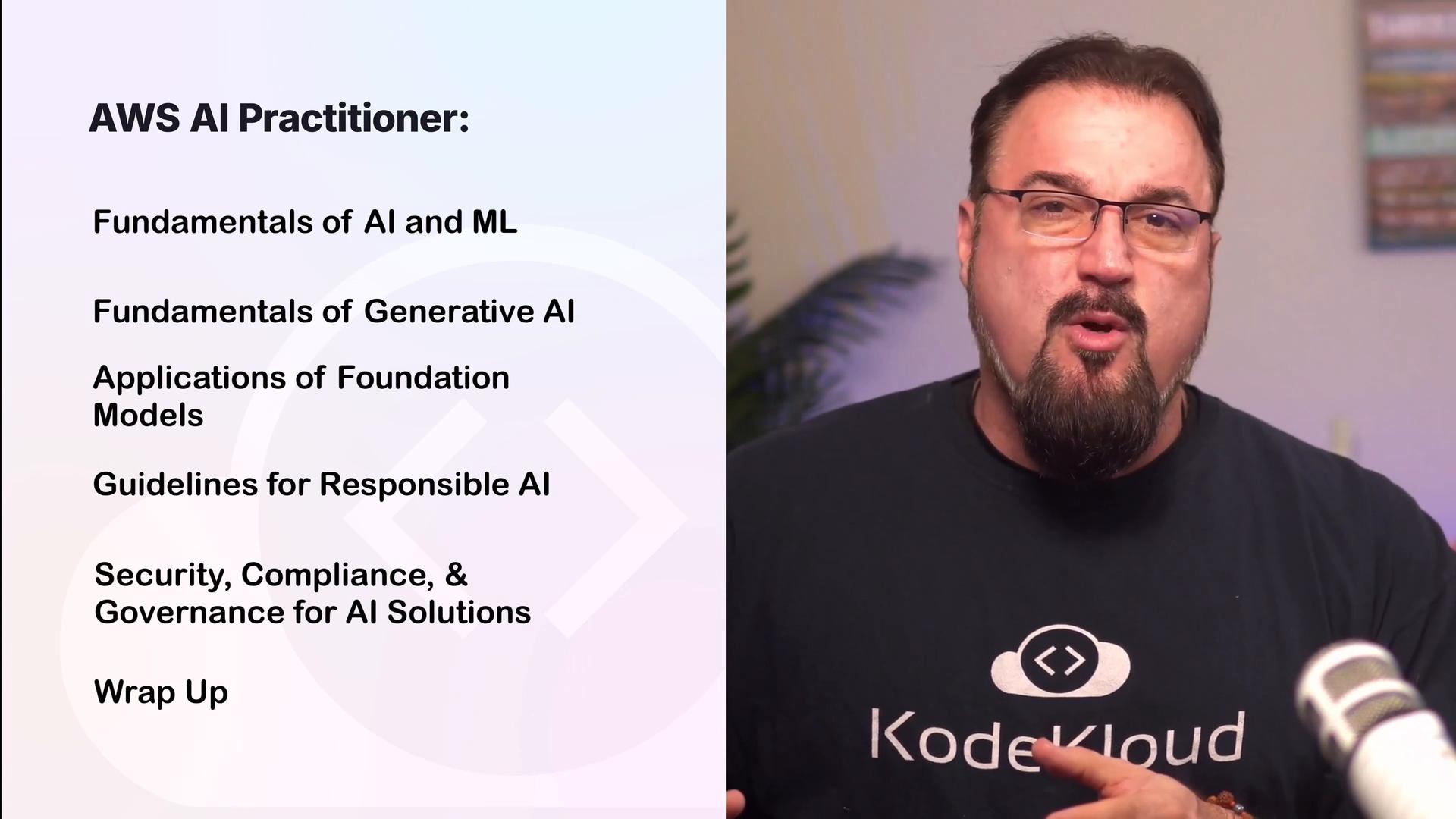
A split-screen shows a slide titled "AWS AI Practitioner" listing topics like Fundamentals of AI, Generative AI, and Responsible AI on the left. On the right, a bearded man wearing glasses and a "KodeKloud" shirt speaks into a microphone.
Community and support
You’ll have access to KodeKloud’s community forum and Discord to engage with other learners, ask questions, and share insights. Peer support accelerates learning, helps troubleshoot practical issues, and offers real-world tips when applying AI on AWS.
A screenshot of a KodeKloud webpage promoting its community, showing a purple-blue hero section with headline text, a world map marked with user avatar pins, and buttons to join Discord or the forum. A small circular video thumbnail of a person appears in the lower-right corner.
If you’re ready to deepen your AI skills and build reliable, cost-effective AI applications on AWS, enroll now.

Watch Video