

Why generative AI is distinct and important
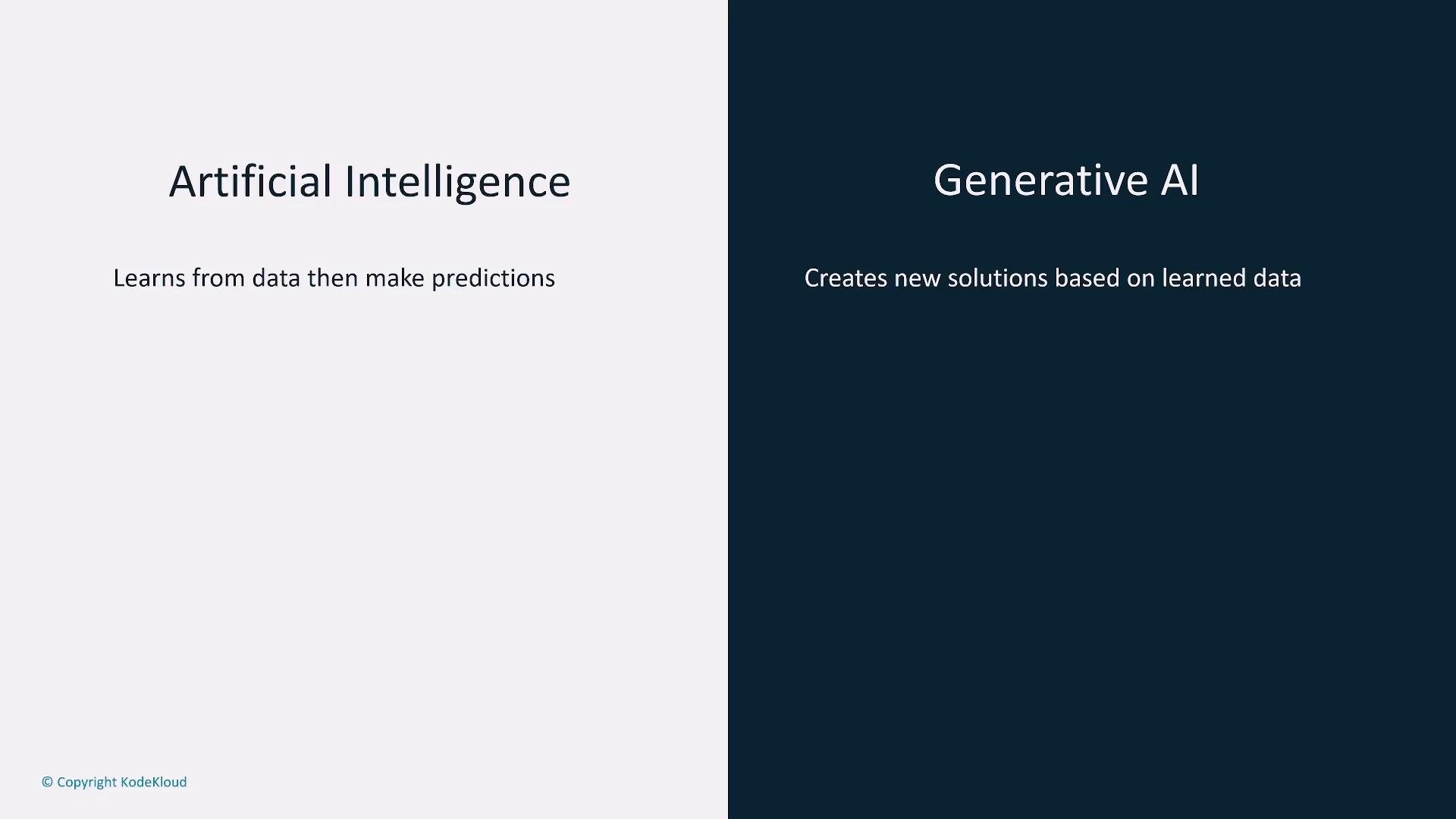
Generative AI creates new, original content (text, images, audio, video, code) by learning statistical patterns from large datasets. Since the public surge in late 2022, generative systems have been rapidly adopted across industries for tasks such as content generation, code synthesis, conversational agents, and creative media. Generative models are often pre-trained on massive corpora and then used directly or fine-tuned for downstream tasks. This distinguishes them from classical supervised models that focus primarily on classification or regression.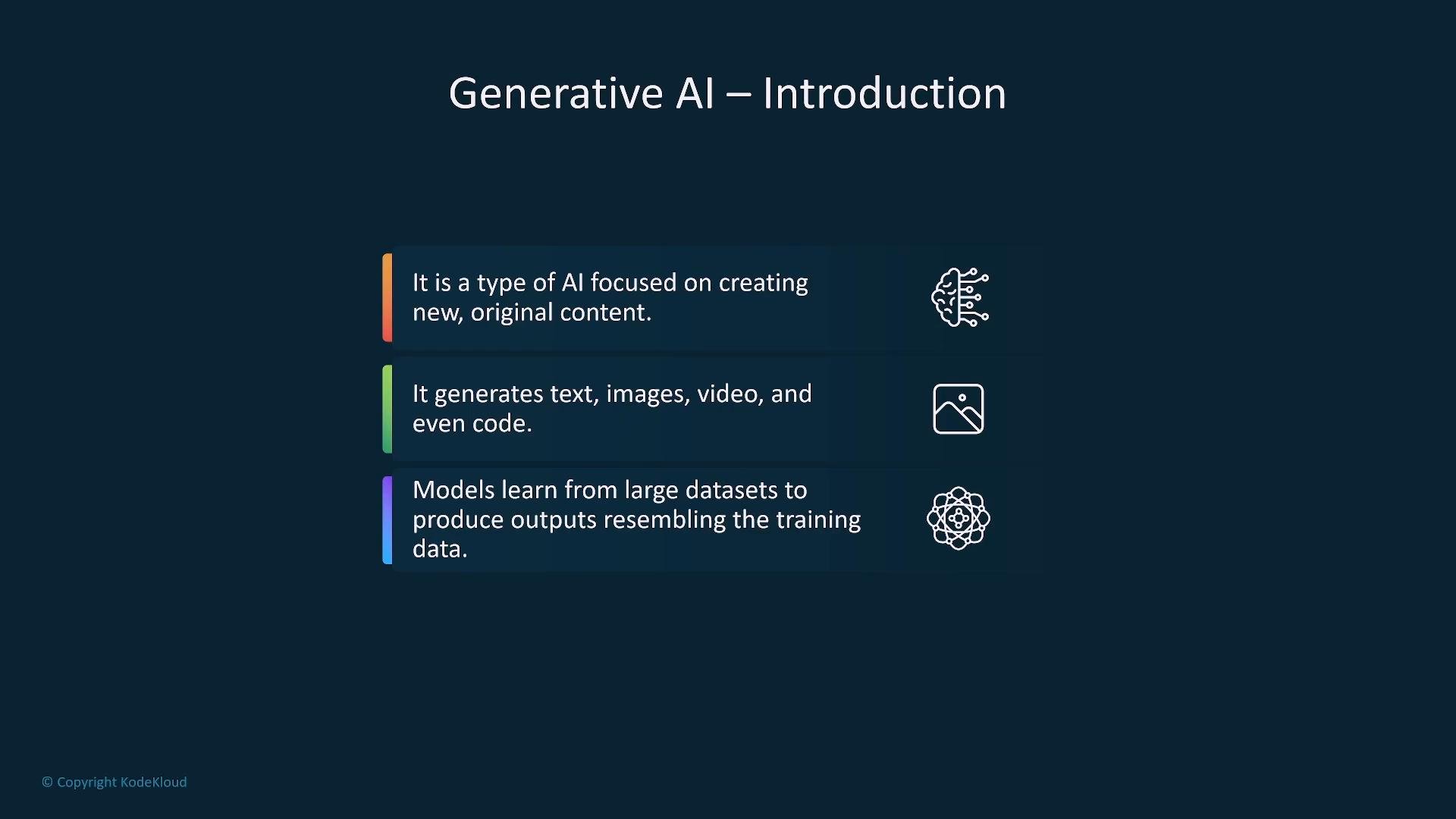
Overview of core concepts
This lesson covers these main topics: model architectures (transformers), context windows and tokens, tokenization and embeddings, chunking (for retrieval), LLMs and fine-tuning, prompt engineering techniques, multimodal architectures, and diffusion models.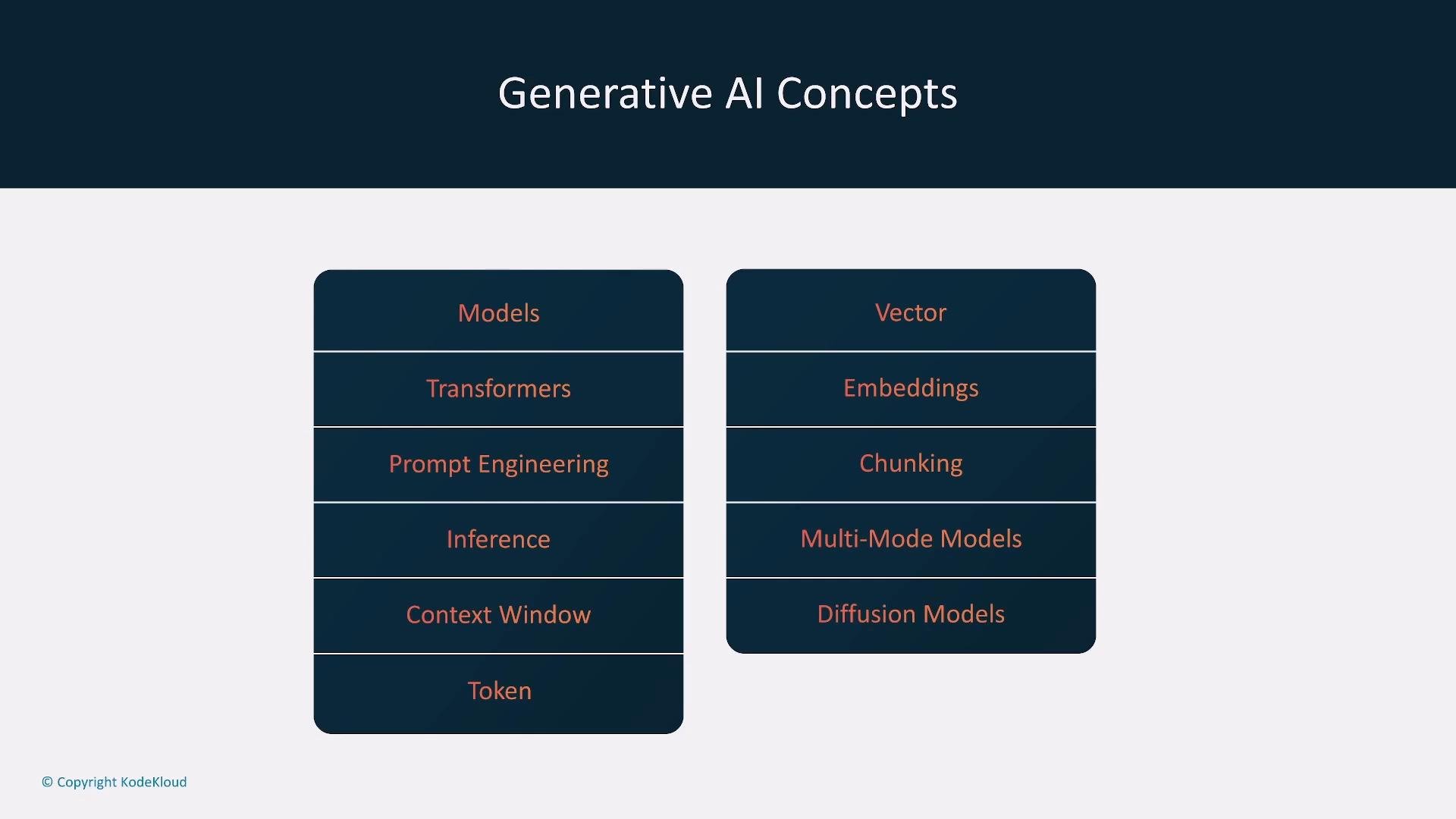
Models and transformers
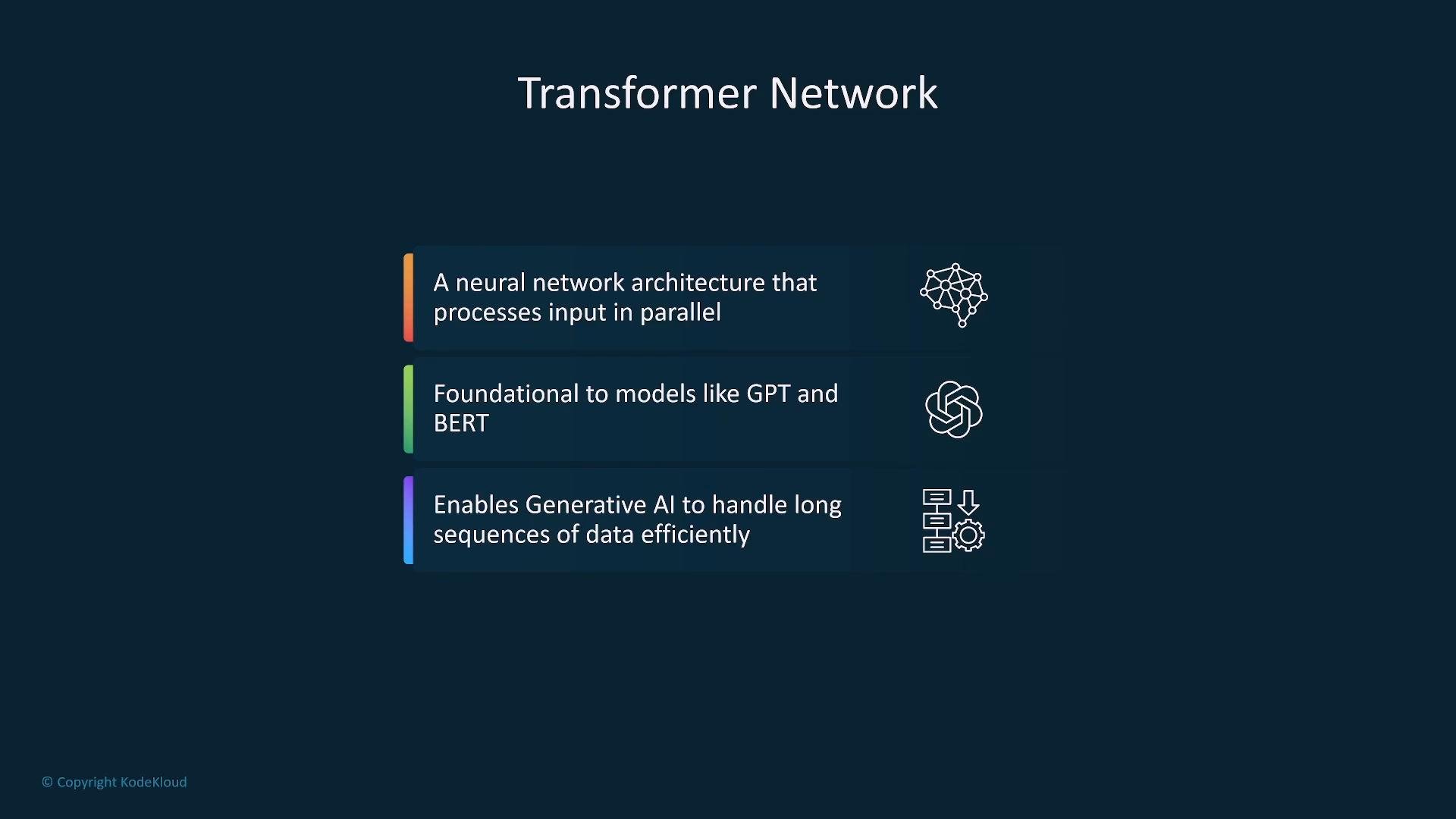
A model is a trained function approximator—usually a large neural network—mapping inputs (text, images, audio) to outputs. In text generation, models predict the next token given prior tokens. The transformer architecture (see “Attention Is All You Need”) uses attention mechanisms to process sequence elements in parallel rather than sequentially. This parallelism allows transformers to scale efficiently for large datasets and long inputs and is the backbone of many state-of-the-art generative models (e.g., GPT-family models).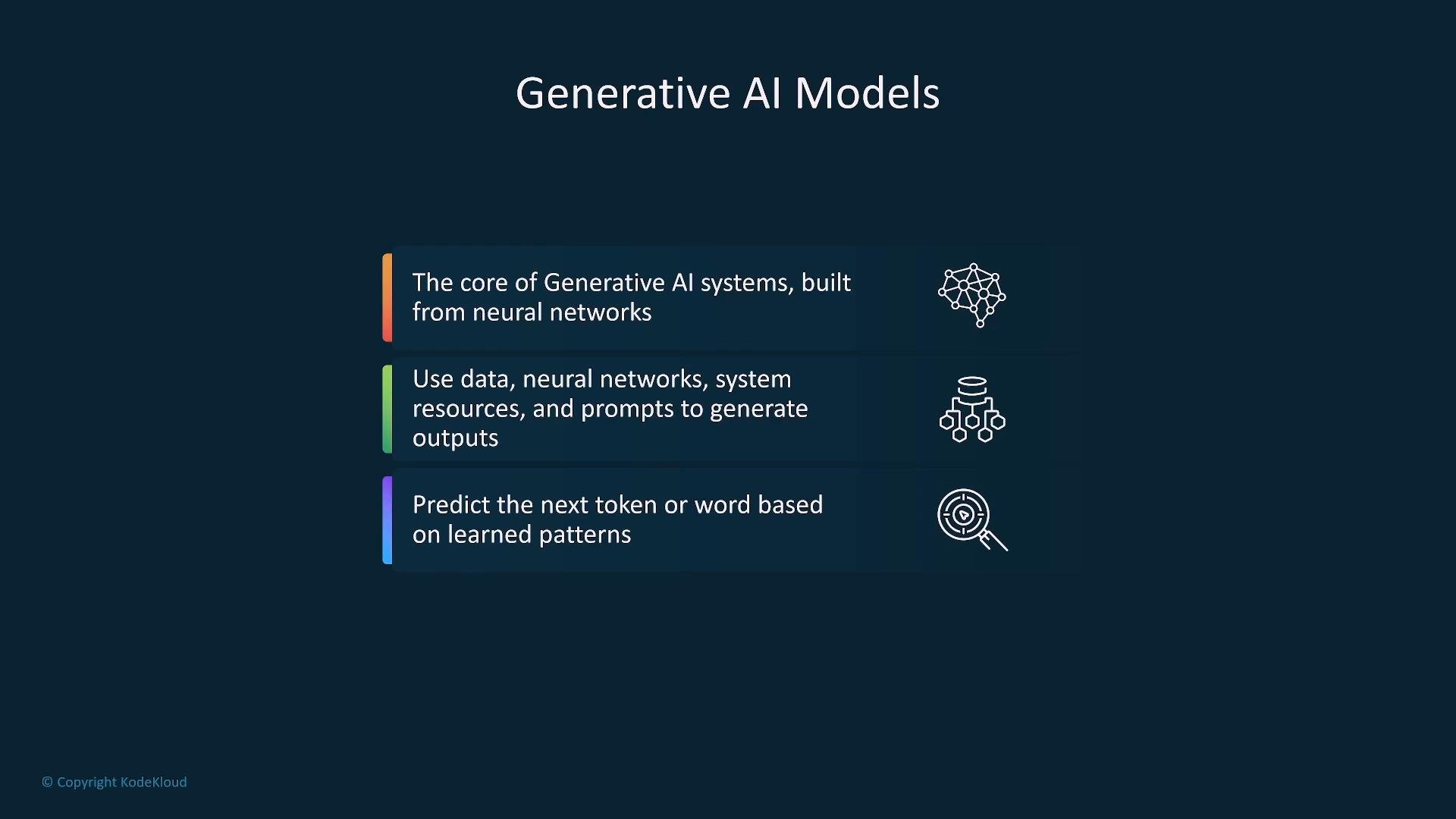
Context window (model memory)
A model’s context window is how many tokens it can consider at once during inference—its short-term memory. Context is measured in tokens (not characters), and the size directly impacts tasks such as long-form writing, code completion, or multi-turn dialogue.- Small context windows limit how much prior text can be considered.
- Large windows enable coherent handling of longer documents and richer prompts.
When designing prompts or systems that rely on context, always measure token usage (not characters). Many tools and SDKs provide tokenizers and token-counting utilities—use them during development to avoid truncation.
Tokens and tokenization
Tokens are the fundamental units a model processes. Tokenization divides text into tokens; depending on the tokenizer, tokens can be whole words, subwords, or characters. Modern tokenizers (BPE, unigram) map common words to single tokens while splitting rare words into subword pieces. Because models generate by predicting the next token, tokenization affects generation behavior, cost (tokens = billing for many APIs), and performance. For multilingual or domain-specific text, tokenizer choice and vocabulary can significantly influence results.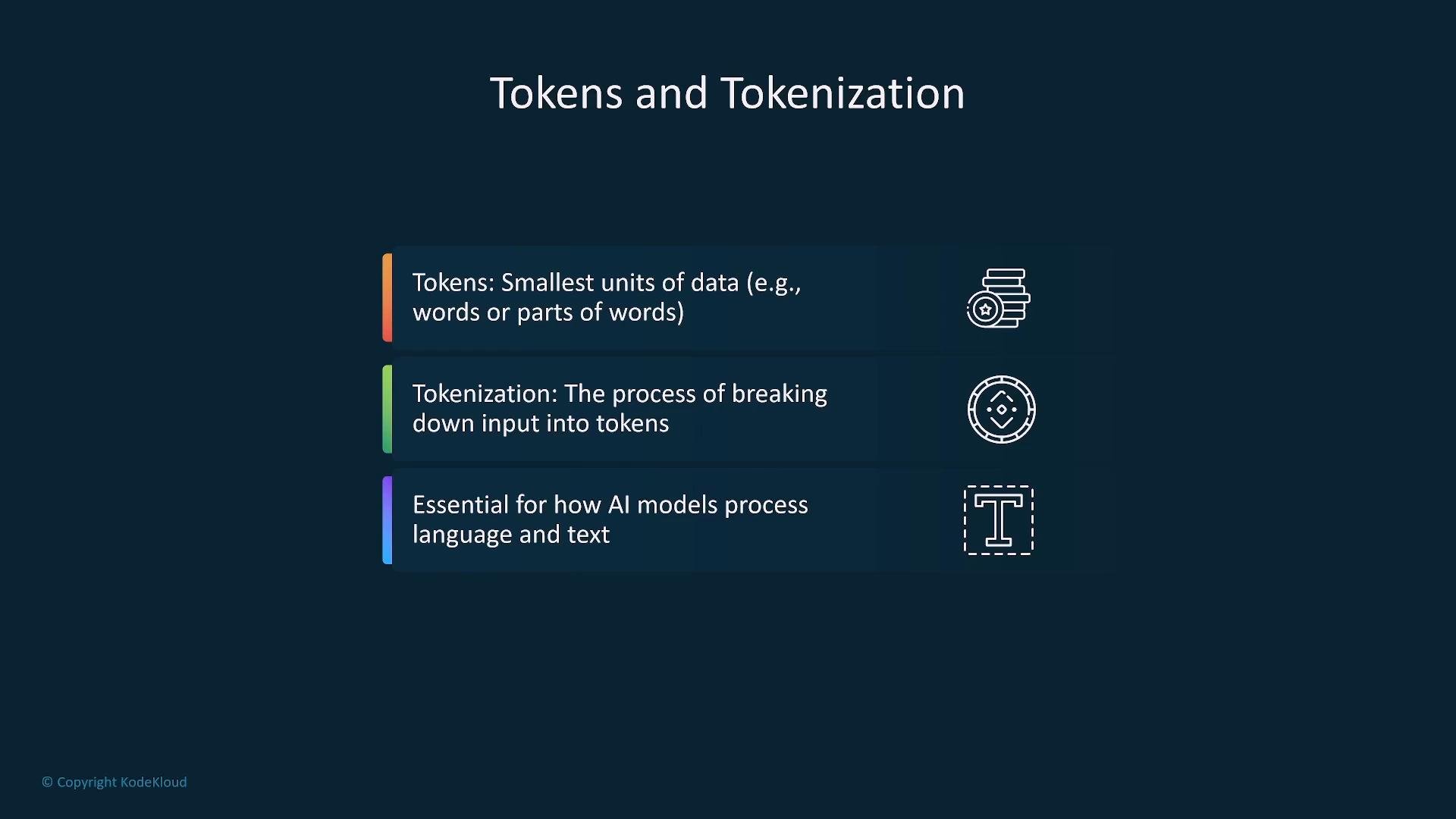
Embeddings and vectors
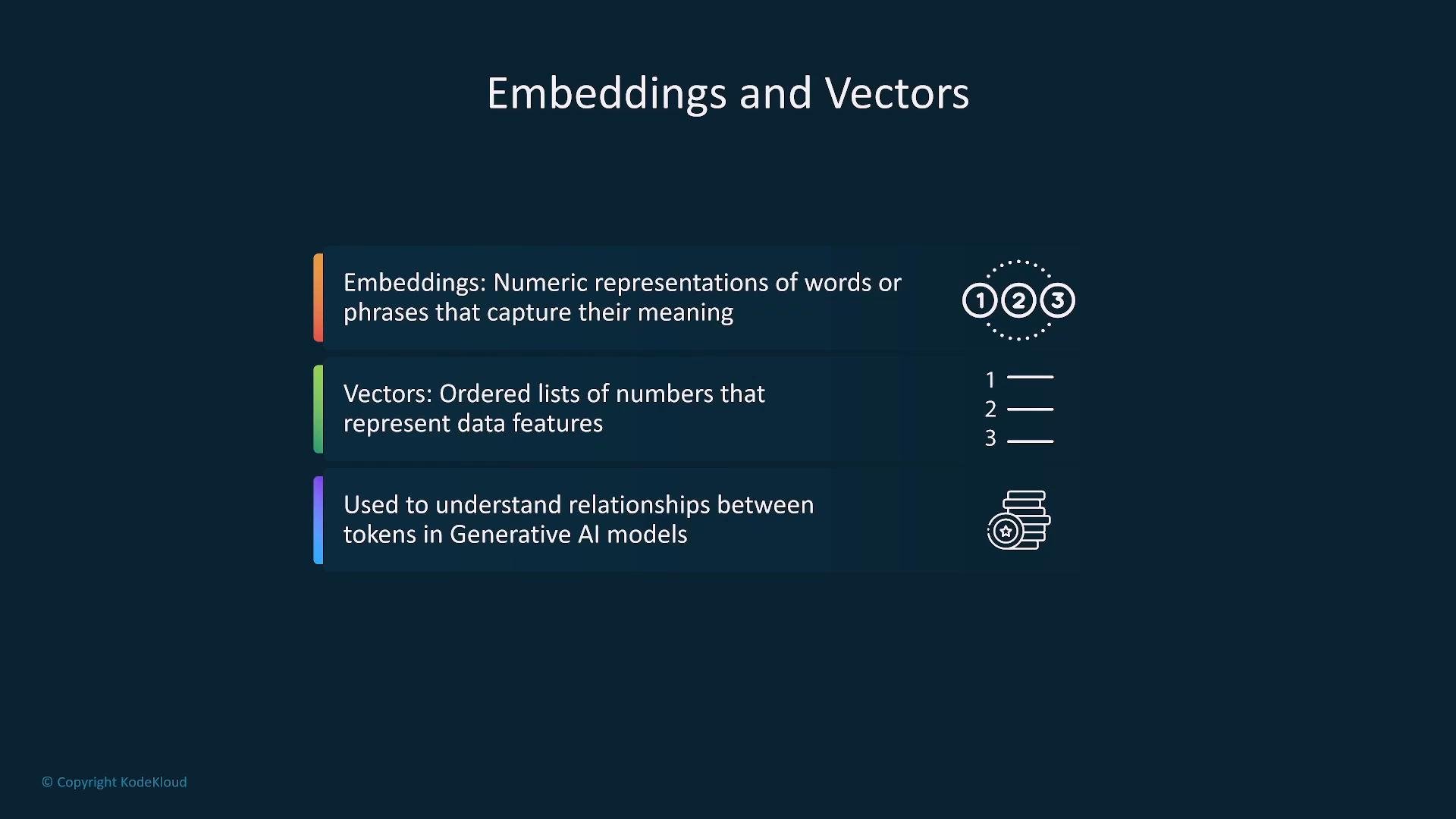
Embeddings convert tokens, phrases, sentences, or other modalities into fixed-length numeric vectors. These vectors encode semantic properties so that similar meanings lie close together in the embedding space. Embeddings are central to semantic search, clustering, and retrieval-augmented generation.- Embeddings support similarity search using distance measures (cosine similarity, Euclidean distance).
- Multimodal embeddings allow matching across text, images, and audio.
Chunking (splitting documents for retrieval and indexing)
Chunking means splitting long documents into semantically coherent pieces (chunks) before embedding and indexing them. Proper chunking improves retrieval relevance in semantic search and RAG pipelines. Trade-offs when choosing chunk size:
Chunking strategy should reflect application needs: document QA often uses smaller chunks for precision; summarization or multi-paragraph reasoning may benefit from larger chunks.
LLMs (Large Language Models)
LLMs are large-scale generative models trained on extensive text corpora. They perform completion, translation, summarization, question answering, and more—often with few or no task-specific examples. LLMs can be adapted through fine-tuning, instruction tuning, or prompt-based few-shot learning.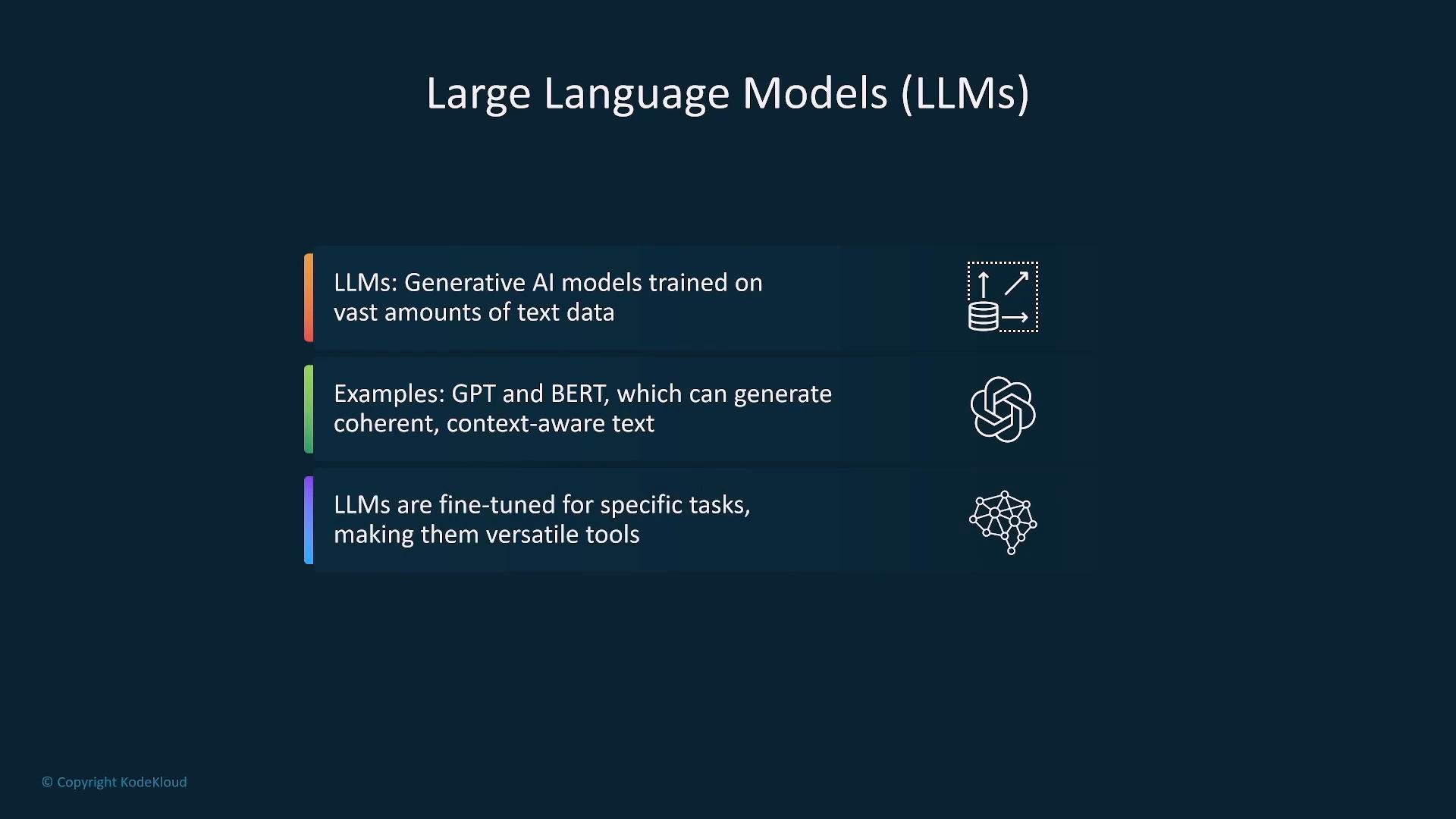
Prompt engineering
Prompt engineering is the practice of constructing inputs to guide models toward desired outputs. Prompts must fit the context window and be structured to minimize ambiguity. Common prompt strategies:
Well-crafted prompts include explicit instructions, desired format, and examples if needed. For deterministic outputs, constrain the response format (e.g., “Return JSON with keys
summary and topics”).
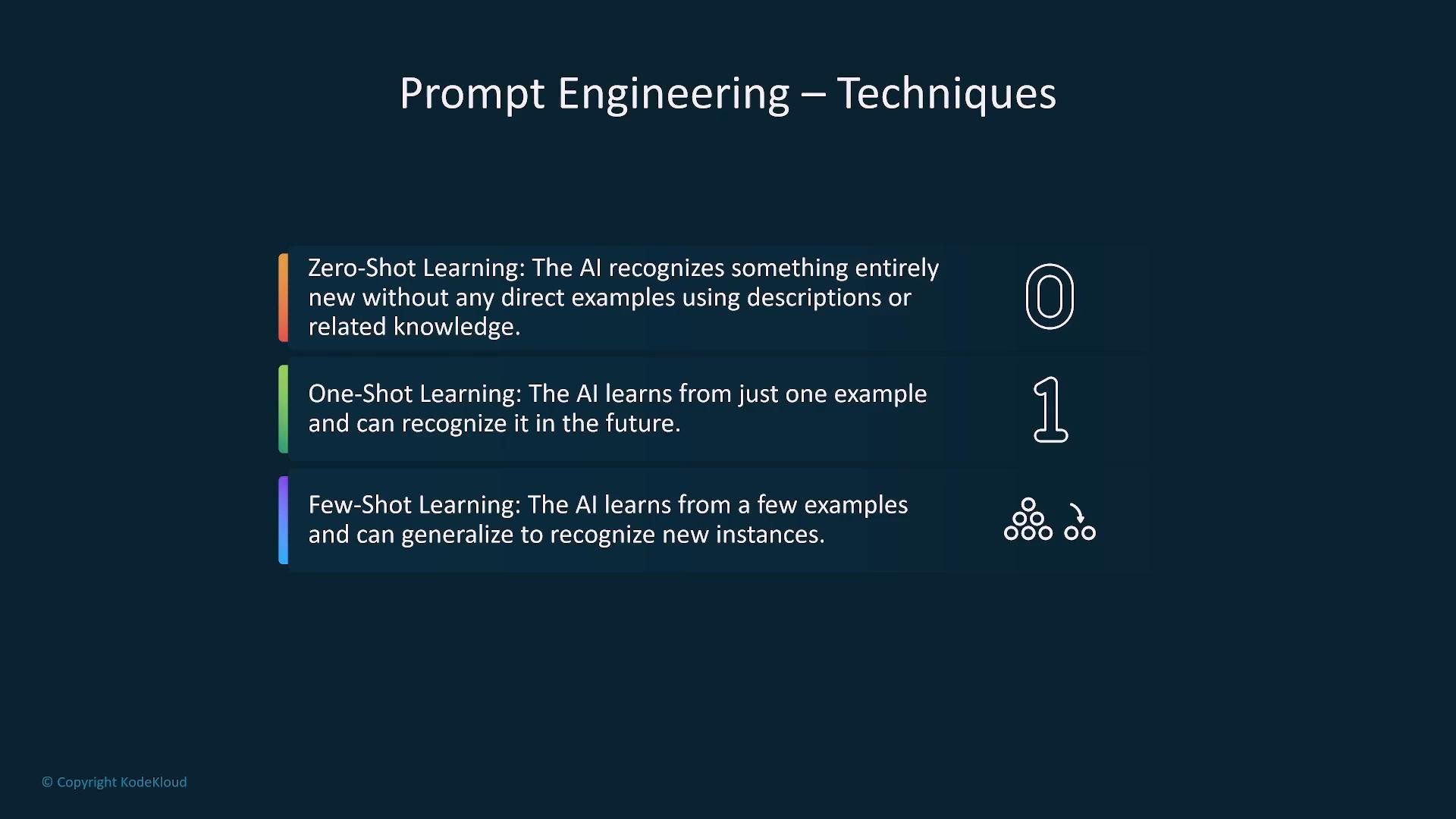
Do not include sensitive or private data in prompts sent to third-party APIs. Treat prompt inputs and model outputs as potentially logged—follow your organization’s data governance and privacy policies.
Multimodal models
Multimodal models accept multiple data types (text, images, audio, video) and can reason across modalities. This enables capabilities such as image captioning, text-conditioned image generation, or voice-and-vision interactive agents.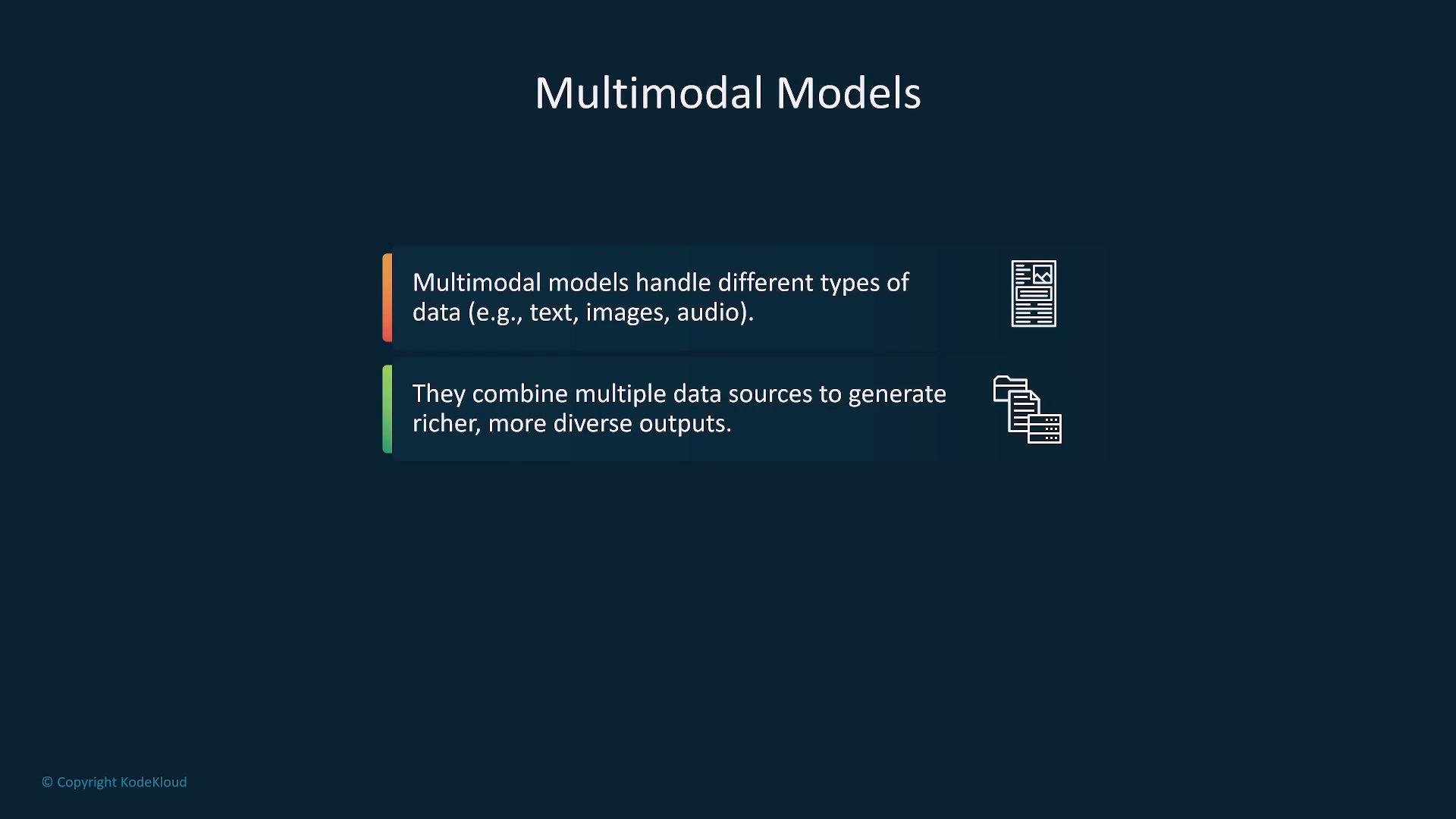
Diffusion models
Diffusion models generate high-quality images, audio, and video by starting from noise and iteratively denoising toward a coherent sample conditioned on prompts. They are widely used for creative generation, editing, and upscaling (e.g., Stable Diffusion).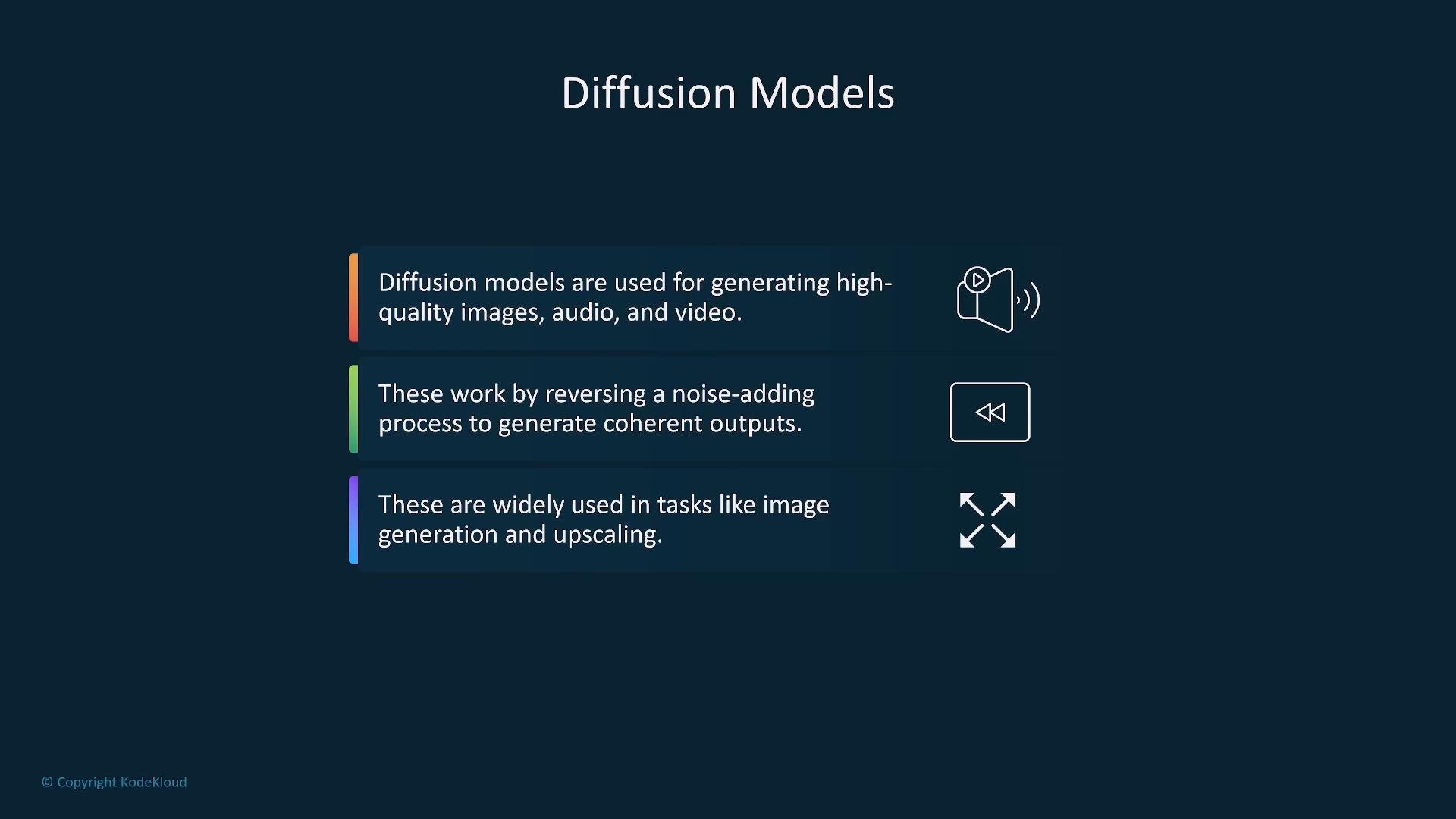
Inference (short note)
Inference is running a trained model to generate outputs for new inputs. It differs from training: inference is optimized for latency, throughput, and cost (consider model quantization, batching, and serving architecture).Wrapping up
This lesson covered the core terminology and architectures behind generative AI:- What generative models do and how they differ from classic supervised models
- How transformer architectures and context windows enable long-context reasoning
- Why tokenization and embeddings make language operable as vectors
- Chunking strategies for retrieval and RAG systems
- Prompt engineering techniques and LLM adaptation strategies
- Multimodal and diffusion model approaches
Links and references
- “Attention Is All You Need” — https://arxiv.org/abs/1706.03762
- Kubernetes Documentation — https://kubernetes.io/docs/ (example resource)
- Stable Diffusion and related diffusion literature