

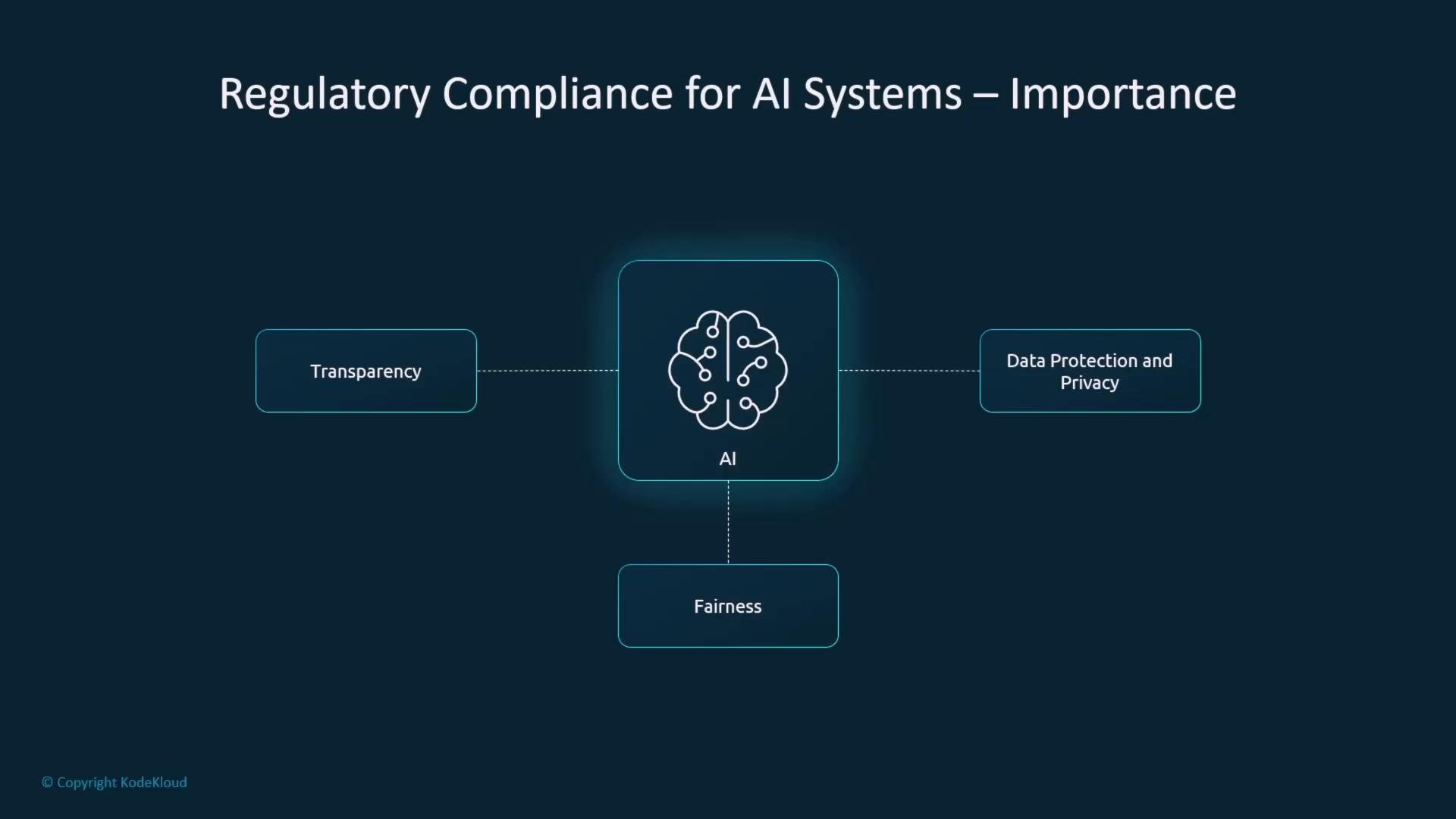
- Data protection and privacy — How is training and inference data collected, stored, and processed? Are any inputs sensitive or personally identifiable?
- Fairness and bias — Do model outcomes show disparate impact or systematic bias because of skewed data or model design? How are bias audits and mitigation implemented?
- Transparency and accountability — Can decisions be justified and traced? Who is responsible for outcomes and model governance?
Regulatory compliance reduces legal and reputational risk and supports trustworthy AI adoption by protecting both organizations and end users.
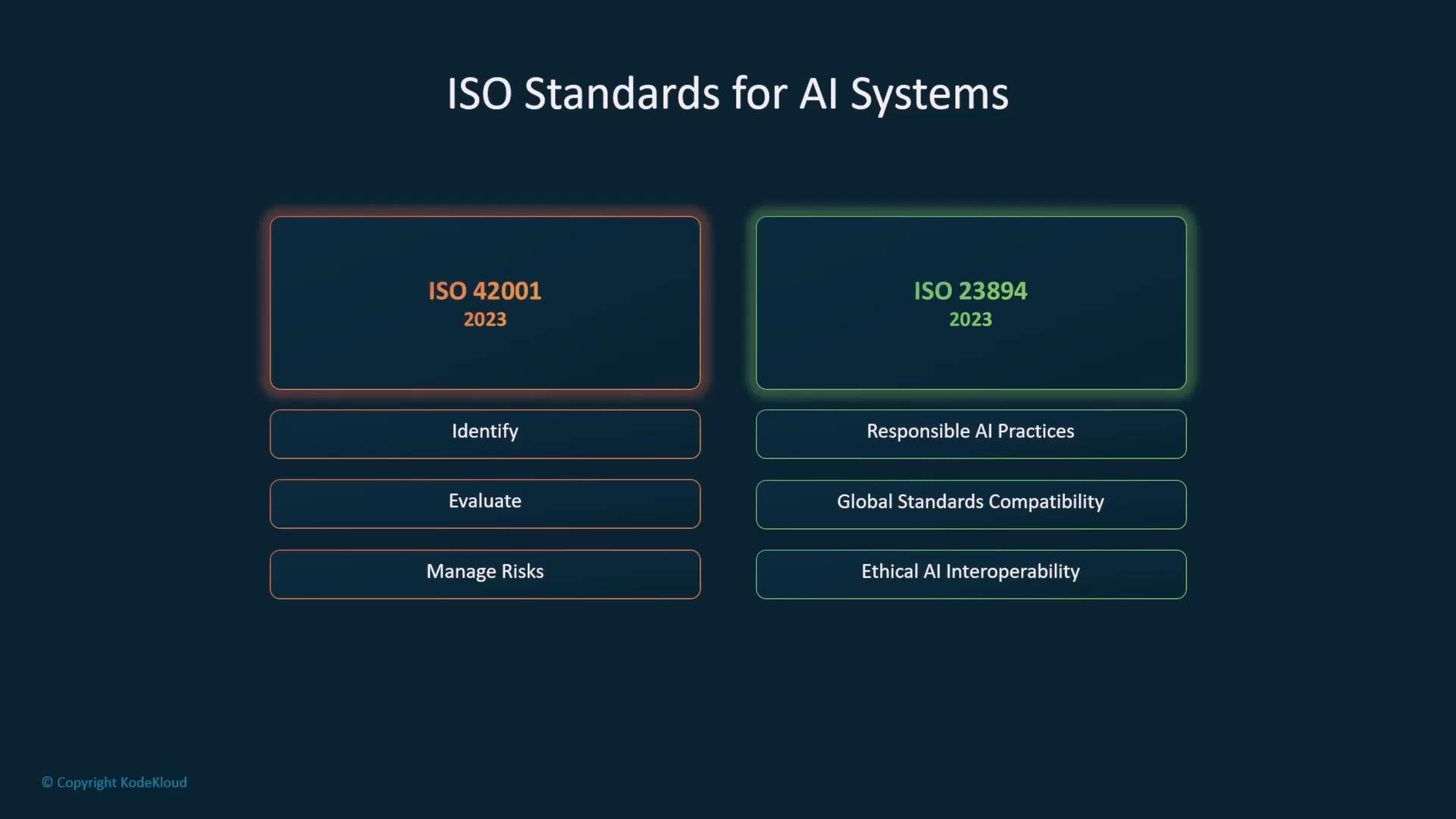
- Relevant ISO standards (published in 2023) include ISO 42001 and ISO 23894:
- ISO 42001 — AI management systems and risk-management requirements: identify, evaluate, and manage AI-related risks in an organizational context.
- ISO 23894 — Responsible AI practices and interoperability: guidance for ethical design, deployment, and standards compatibility across jurisdictions.
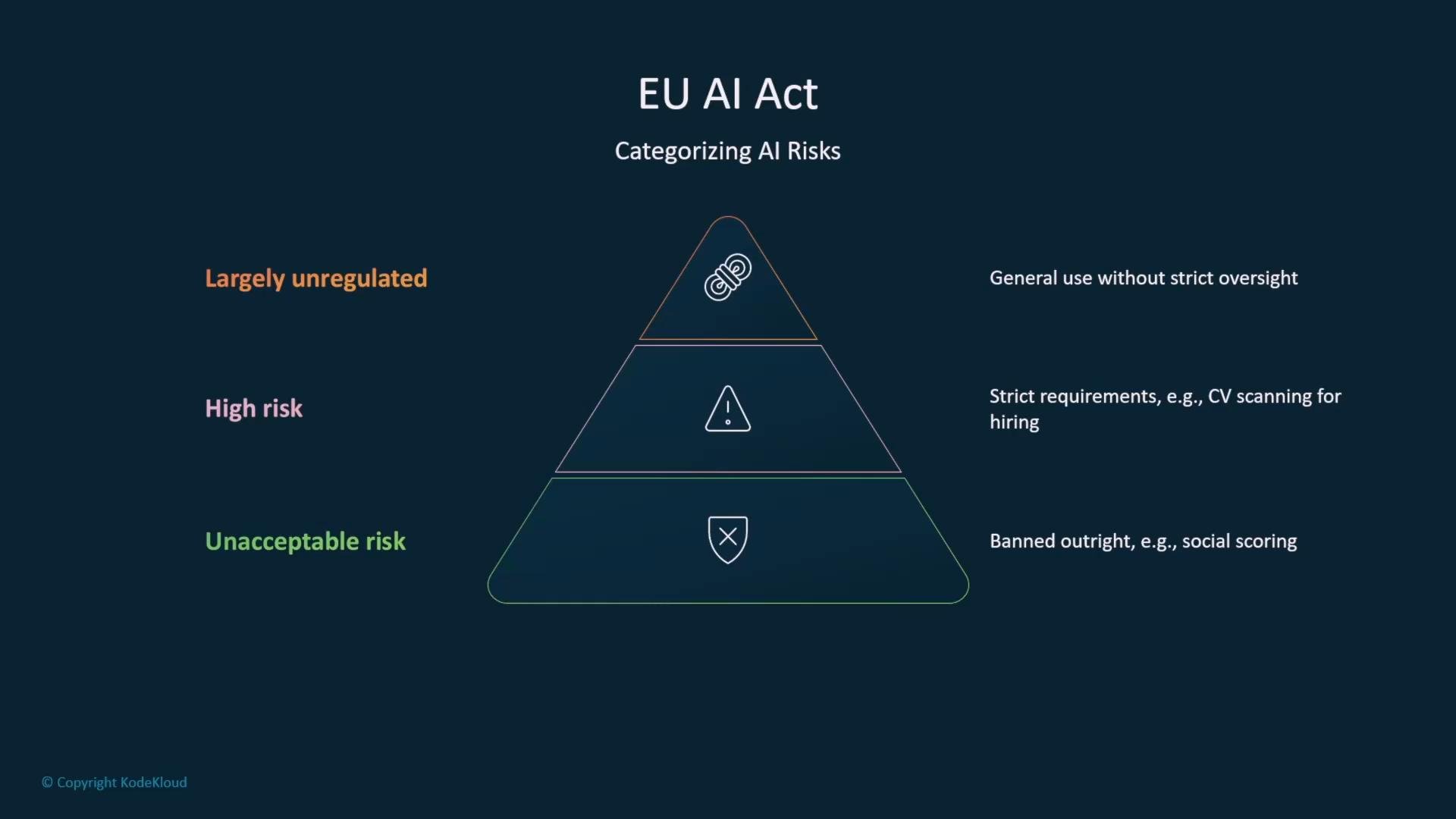
- The EU AI Act classifies AI systems by risk and prescribes proportional obligations: unacceptable, high, and low (or general-purpose) risk.
- Unacceptable risk — Systems and uses that are effectively banned (e.g., social scoring by public authorities).
- High-risk — Systems that trigger strict requirements (e.g., certain hiring tools, critical infrastructure decisioning).
- Low-risk / general-purpose — Light-touch obligations, primarily transparency requirements.
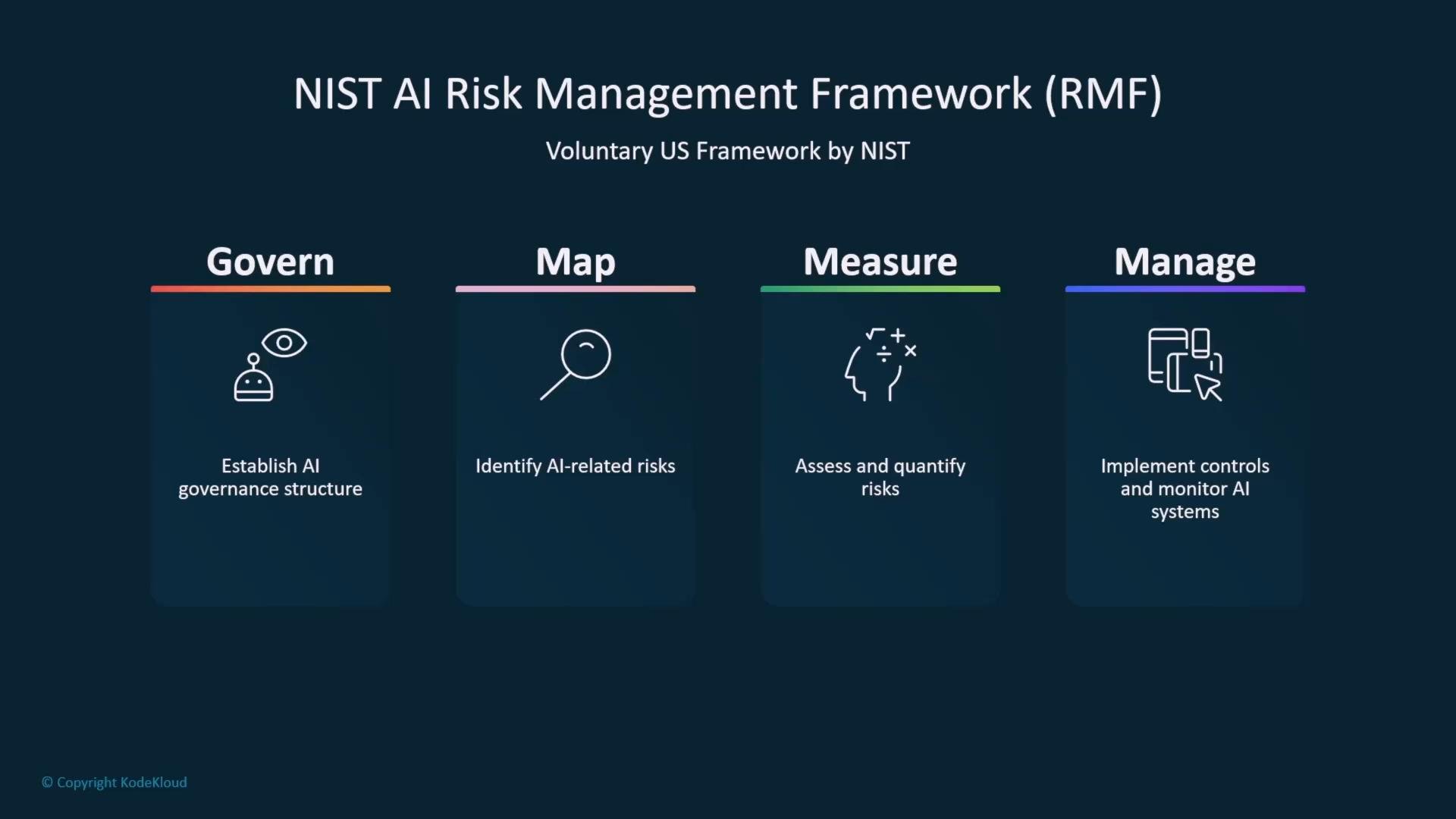
- NIST provides a voluntary, U.S.-focused RMF to help organizations operationalize trustworthy AI by reducing risk.
- The framework centers on four complementary activities: Govern, Map, Measure, and Manage — i.e., establish governance, identify and map AI risks, assess and quantify those risks, and implement controls and monitoring.
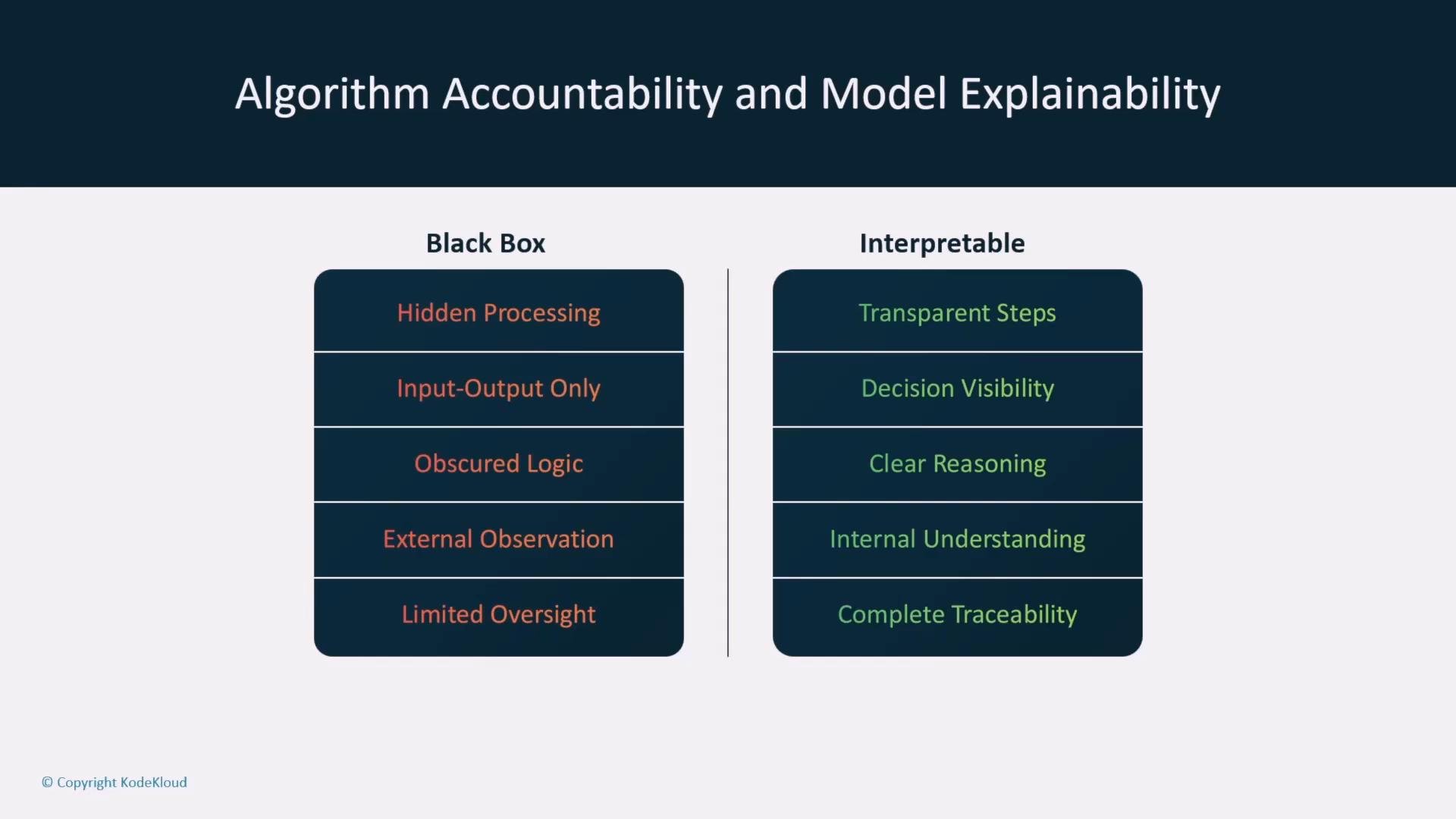
- Interpretability: A model (or its decisions) can be inspected and traced. Interpretable models include decision trees, linear models, and rule-based systems where internal reasoning is explicit.
- Explainability: Techniques that produce post-hoc explanations for opaque (“black box”) models. These help justify outputs without exposing internal model logic directly.
Key takeaways
- Regulatory frameworks converge on three core objectives: protect personal data, reduce unfair bias, and ensure transparency and accountability.
- ISO 42001 and ISO 23894 provide international guidance for AI risk management and responsible practices.
- The EU AI Act uses a risk-based approach that ranges from bans to light-touch transparency obligations.
- The NIST AI RMF (Govern / Map / Measure / Manage) is a practical, voluntary framework to operationalize trustworthy AI.
- Legislative proposals and laws increasingly emphasize explainability, auditability, and documented accountability.
Compliance requirements vary by jurisdiction and sector. Always confirm applicable local laws and sector-specific regulations before deploying AI systems in production.
- ISO Committee on AI — https://www.iso.org/committee/6794475.html
- European Commission — European approach to artificial intelligence (EU AI Act) — https://digital-strategy.ec.europa.eu/en/policies/european-approach-artificial-intelligence
- NIST AI Risk Management Framework (RMF) — https://www.nist.gov/itl/ai-risk-management-framework
- Algorithmic Accountability Act (overview) — https://en.wikipedia.org/wiki/Algorithmic_Accountability_Act