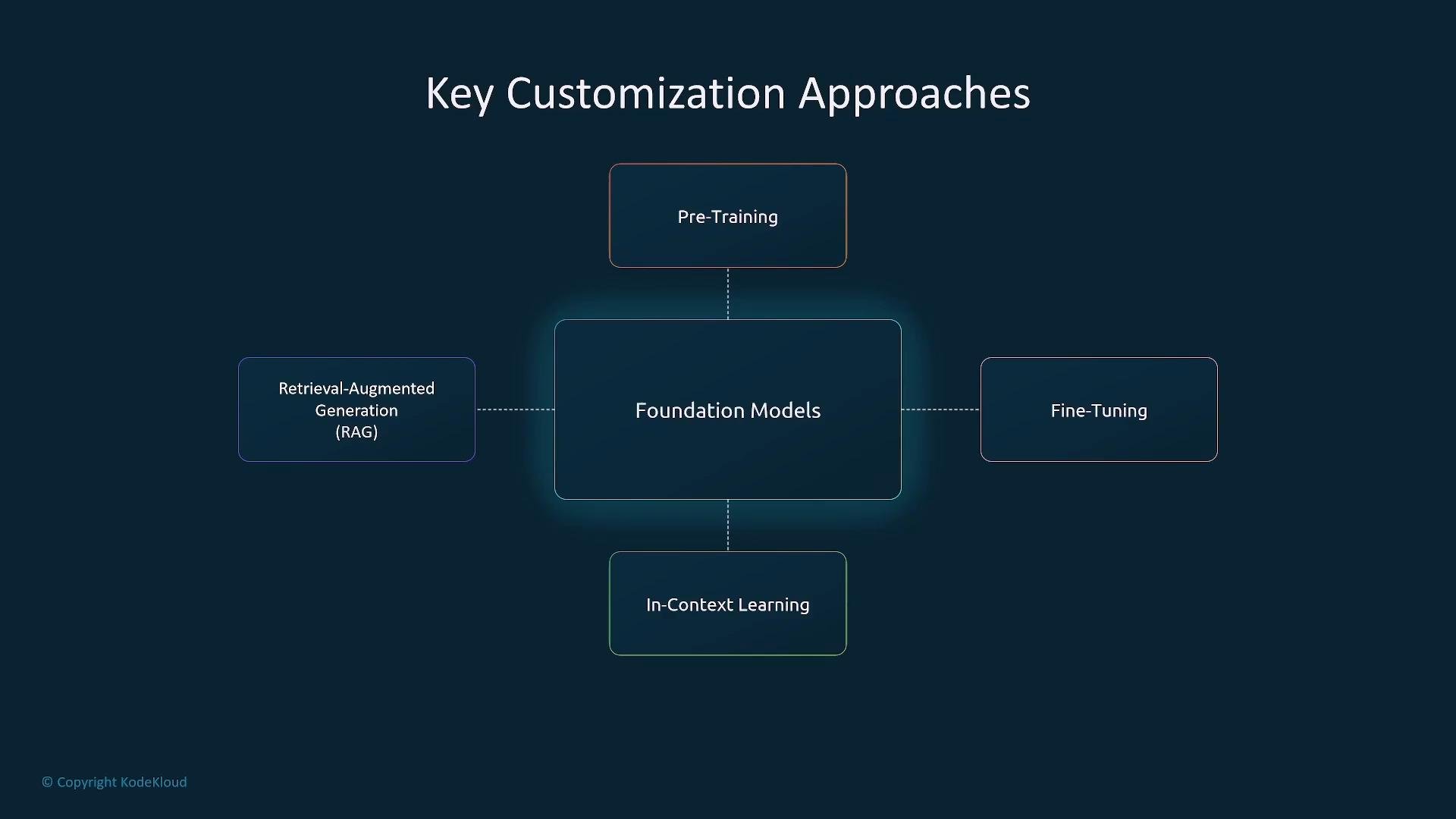
Welcome. This article revisits the primary approaches for customizing foundation models and clarifies when to choose each one. “Foundation models” refers to large pre-trained models (third‑party or internally trained) that act as the baseline for downstream tasks. The common customization strategies covered here are:
  • Pre‑training (training from scratch)
  • Fine‑tuning
  • In‑context learning
  • Retrieval‑Augmented Generation (RAG)
Each method balances cost, time, complexity, and achievable accuracy or domain specificity. Use this guide to match your project constraints (budget, timeline, data, latency) with the right approach.
A slide titled "Key Customization Approaches" showing a central "Foundation Models" box connected to four approaches: Pre-Training (top), Fine-Tuning (right), Retrieval-Augmented Generation (left), and In-Context Learning (bottom).

1. Pre‑training (training from scratch)

Pre‑training means building a foundation model from the ground up and training it on a very large corpus to learn general-purpose representations. Organizations sometimes choose this when existing models can’t meet unique domain needs. Advantages:
  • Maximum control over architecture and learned representations.
  • Best potential performance for highly specialized or novel domains.
Trade-offs:
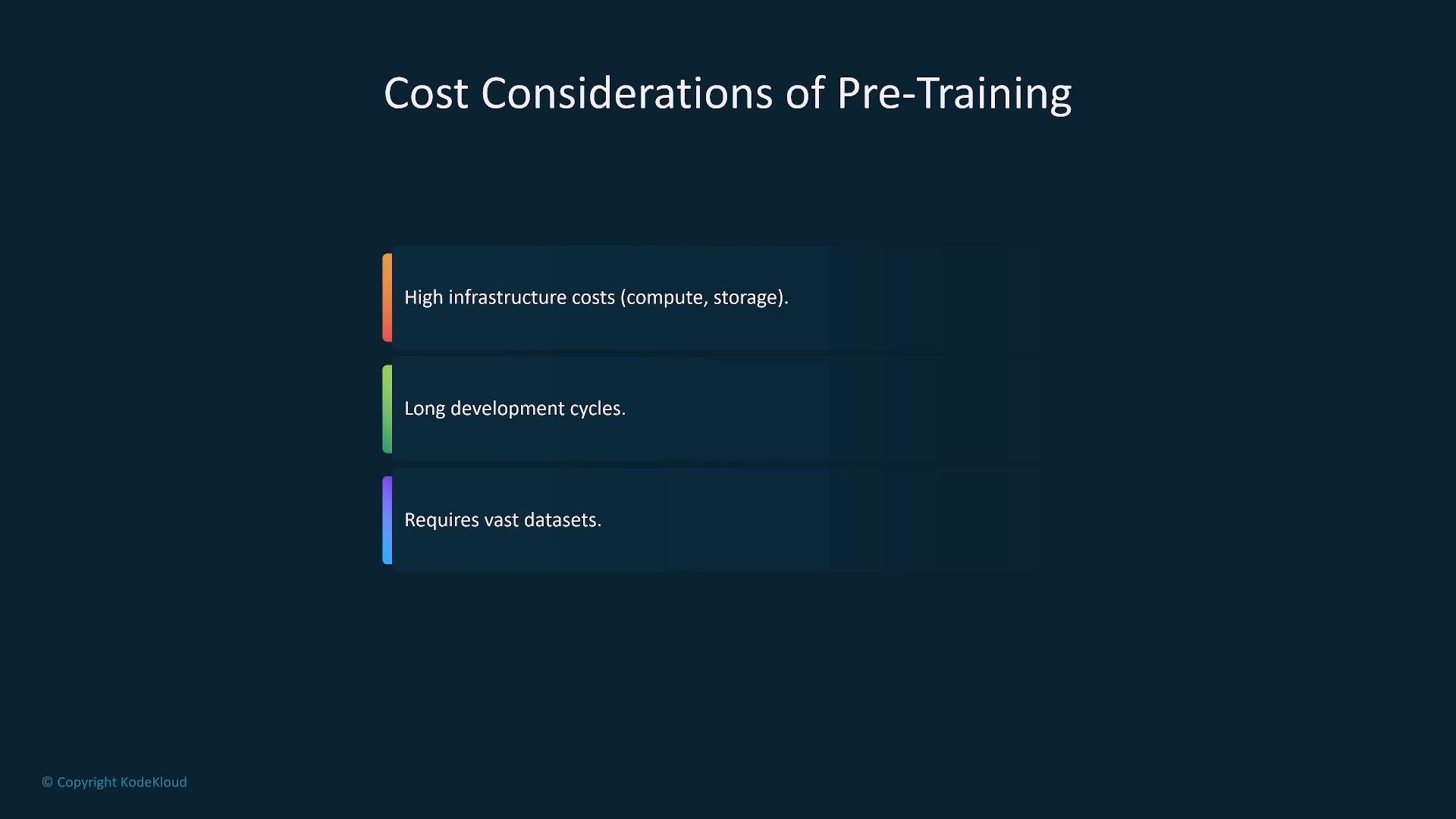
  • Extremely high compute and storage costs.
  • Requires massive datasets and long development cycles.
  • Large engineering effort for data pipelines, training, and evaluation.
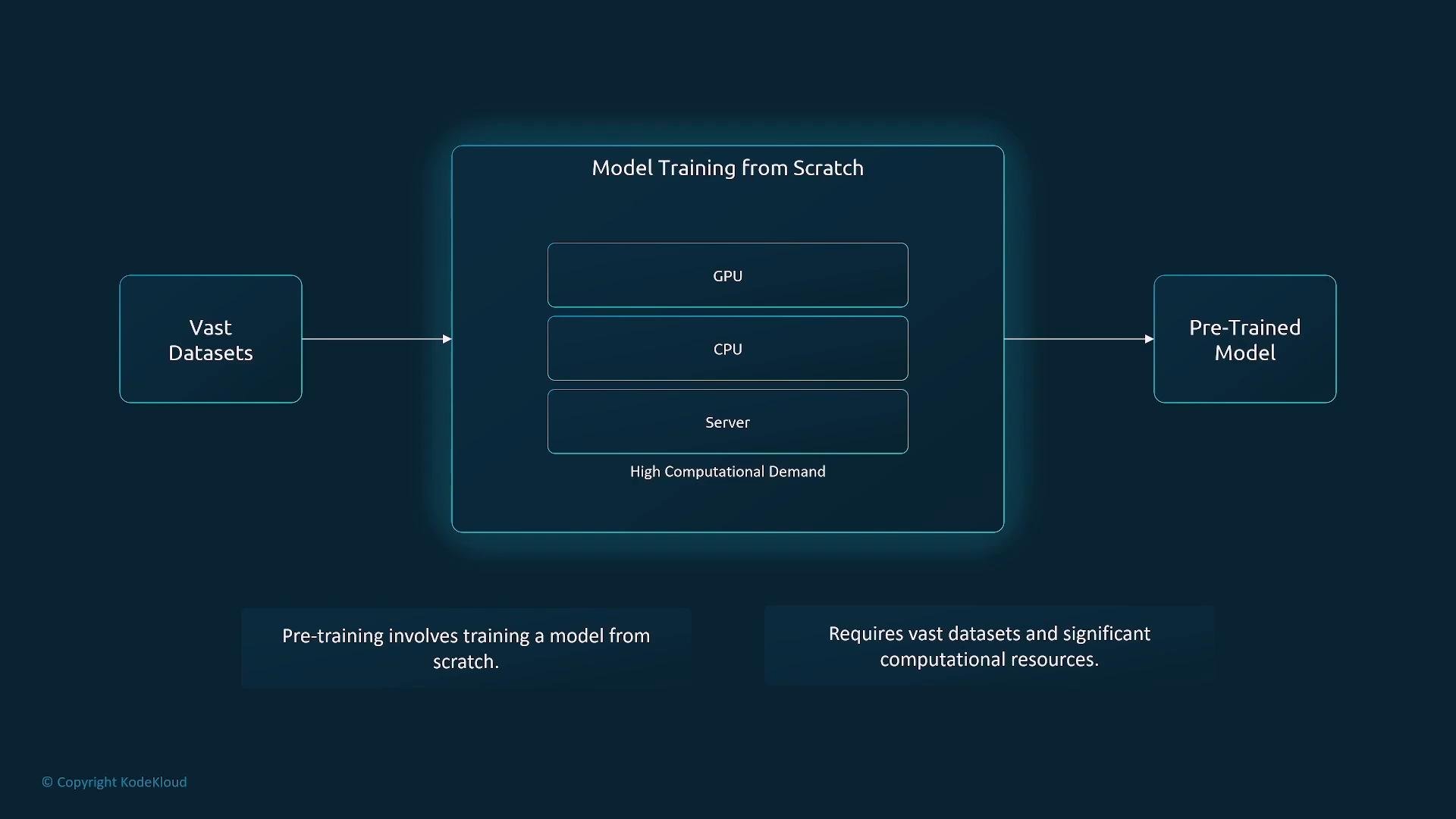
An infographic showing the "Model Training from Scratch" pipeline: vast datasets feed into a high-computation training block (GPU, CPU, server) that produces a pre-trained model.
Pre‑training is typically reserved for organizations with substantial budgets, specialized objectives, and the personnel to support large-scale ML infrastructure.
A presentation slide titled "Cost Considerations of Pre-Training" on a dark background listing three points: high infrastructure costs (compute, storage), long development cycles, and requiring vast datasets.

2. Fine‑tuning

Fine‑tuning reuses a pre‑trained foundation model and continues training it on a smaller, task-specific dataset so the model adapts to your objective. Advantages:
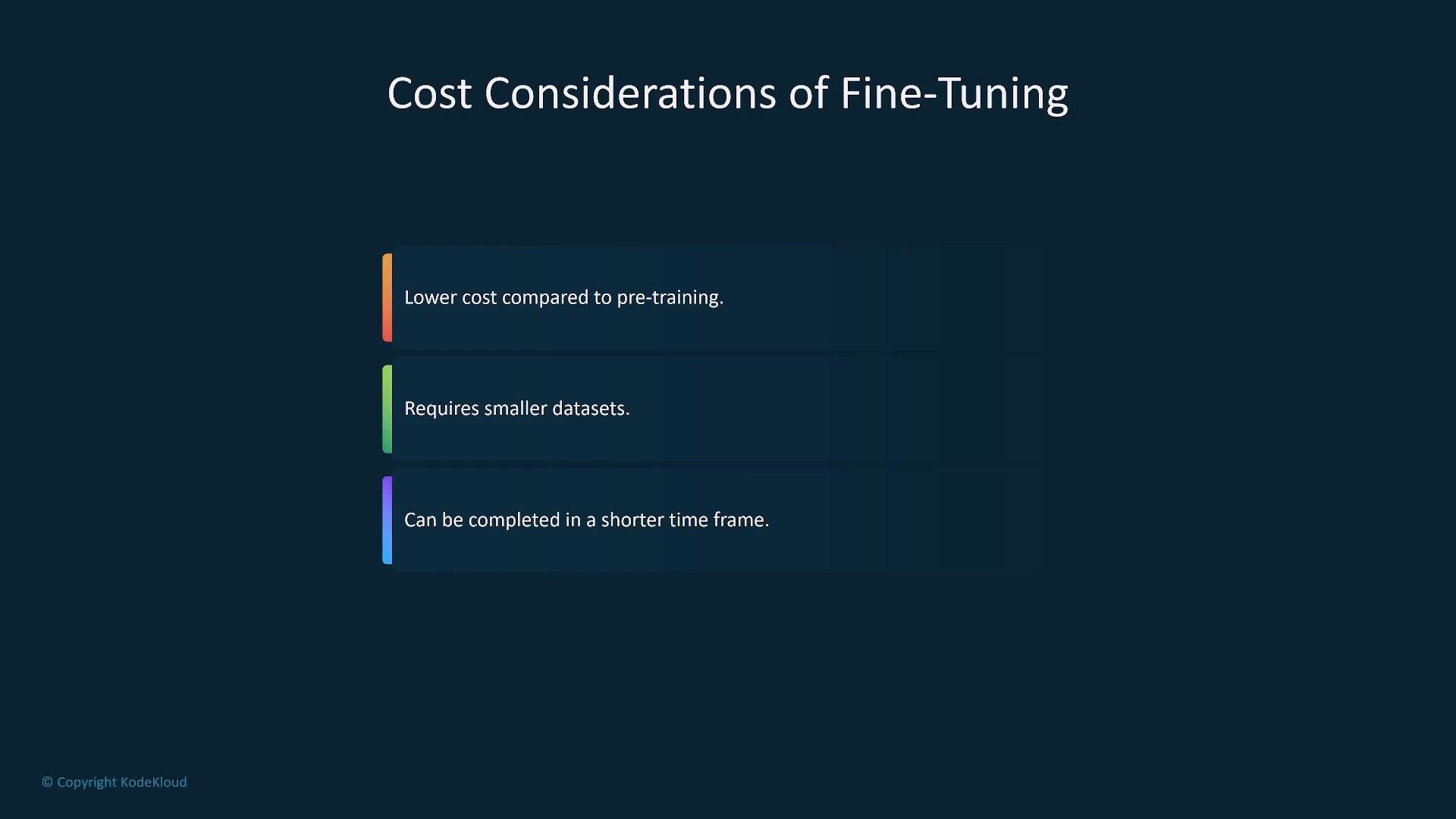
  • Lower cost and faster than pre‑training.
  • Requires much smaller datasets than pre‑training.
  • Strong option for domain-adaptation (legal, medical, finance, cloud).
  • Can yield high task-specific accuracy.
Trade-offs:
  • Requires compute for training and careful data management.
  • Needs hyperparameter tuning and validation to avoid overfitting.
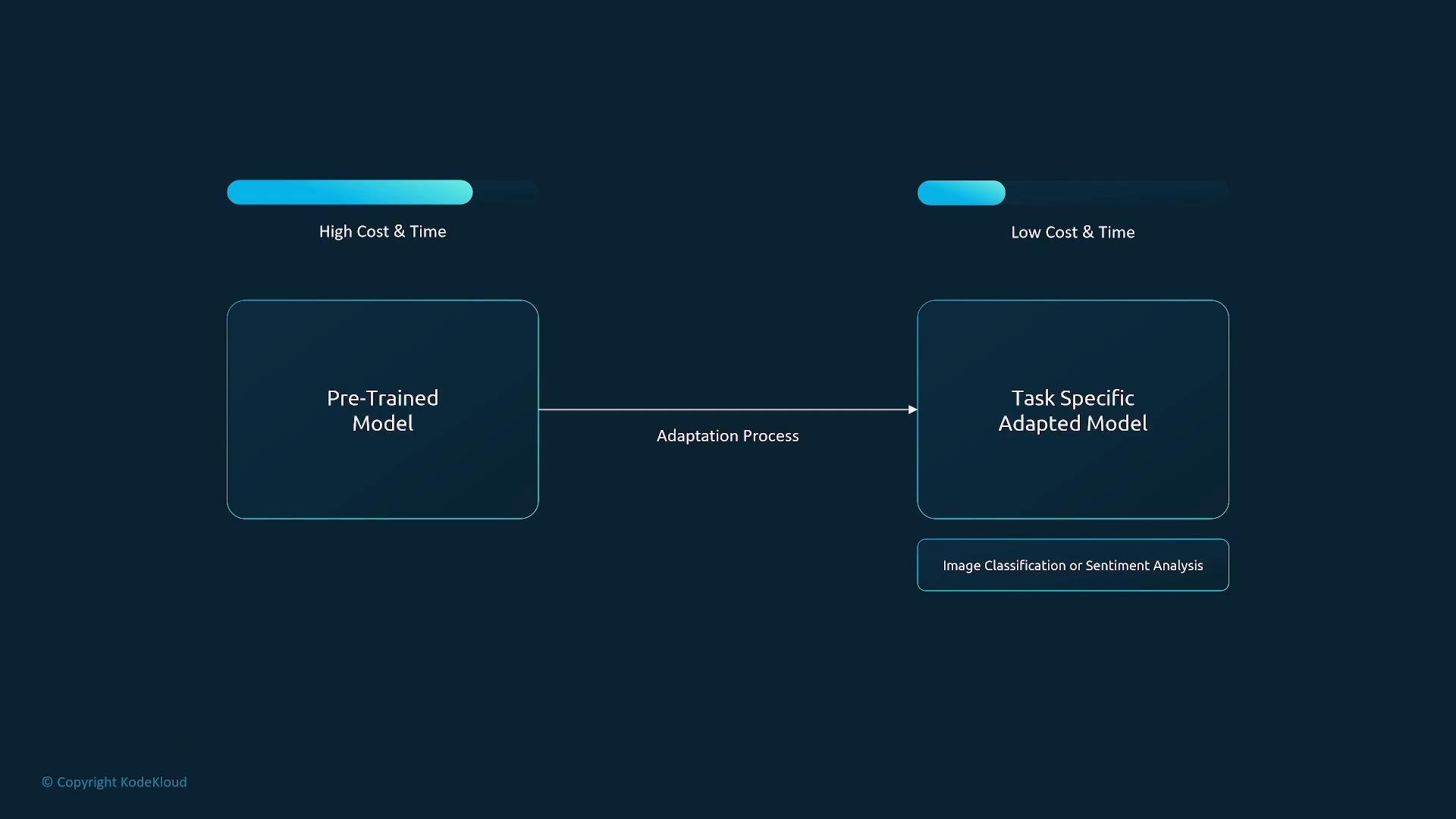
A dark-themed diagram showing a pre-trained model on the left transformed via an "Adaptation Process" arrow into a task-specific adapted model on the right. The graphic contrasts "High Cost & Time" for the pre-trained stage with "Low Cost & Time" for the adapted model and lists example tasks like image classification or sentiment analysis.
Fine‑tuning is a practical middle ground when you need better accuracy on a defined task but cannot justify full pre‑training.
A presentation slide titled "Cost Considerations of Fine-Tuning" showing three points: lower cost compared to pre-training, requires smaller datasets, and can be completed in a shorter time frame.

3. In‑context learning

In‑context learning (zero‑, one‑, or few‑shot) leverages the pre‑trained model at inference time by providing examples and instructions in the prompt. No parameters are updated. Advantages:
  • Lowest operational cost—no retraining needed.
  • Extremely fast for prototyping and experimentation.
  • Modify behavior by changing prompts and examples.
  • Ideal for chatbots, quick formatting, or lightweight QA tasks.
Trade-offs:
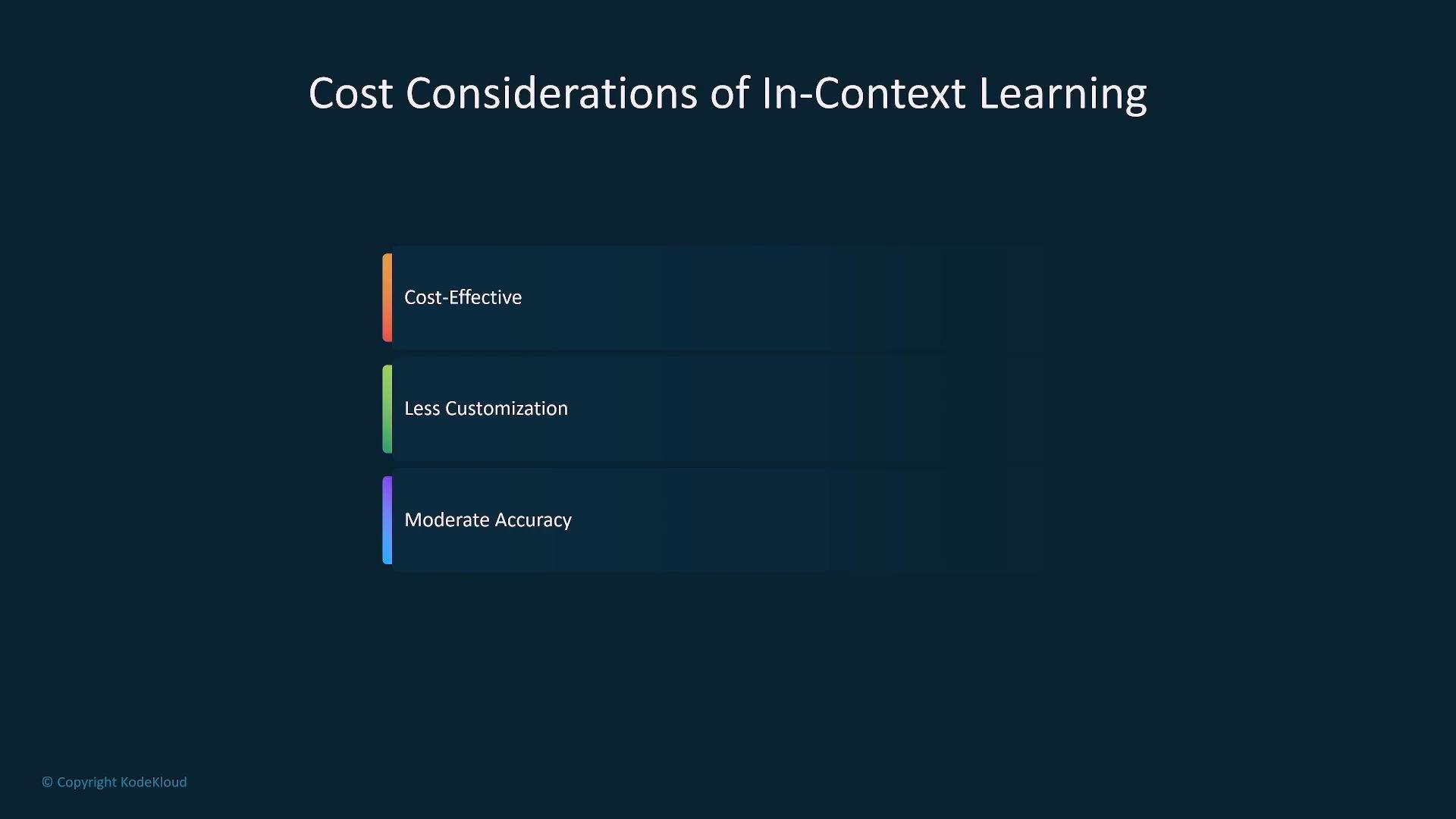
  • Limited customization compared to fine‑tuning or RAG.
  • Performance is sensitive to prompt design and example selection.
  • Not optimal for achieving the highest accuracy on highly specialized tasks.
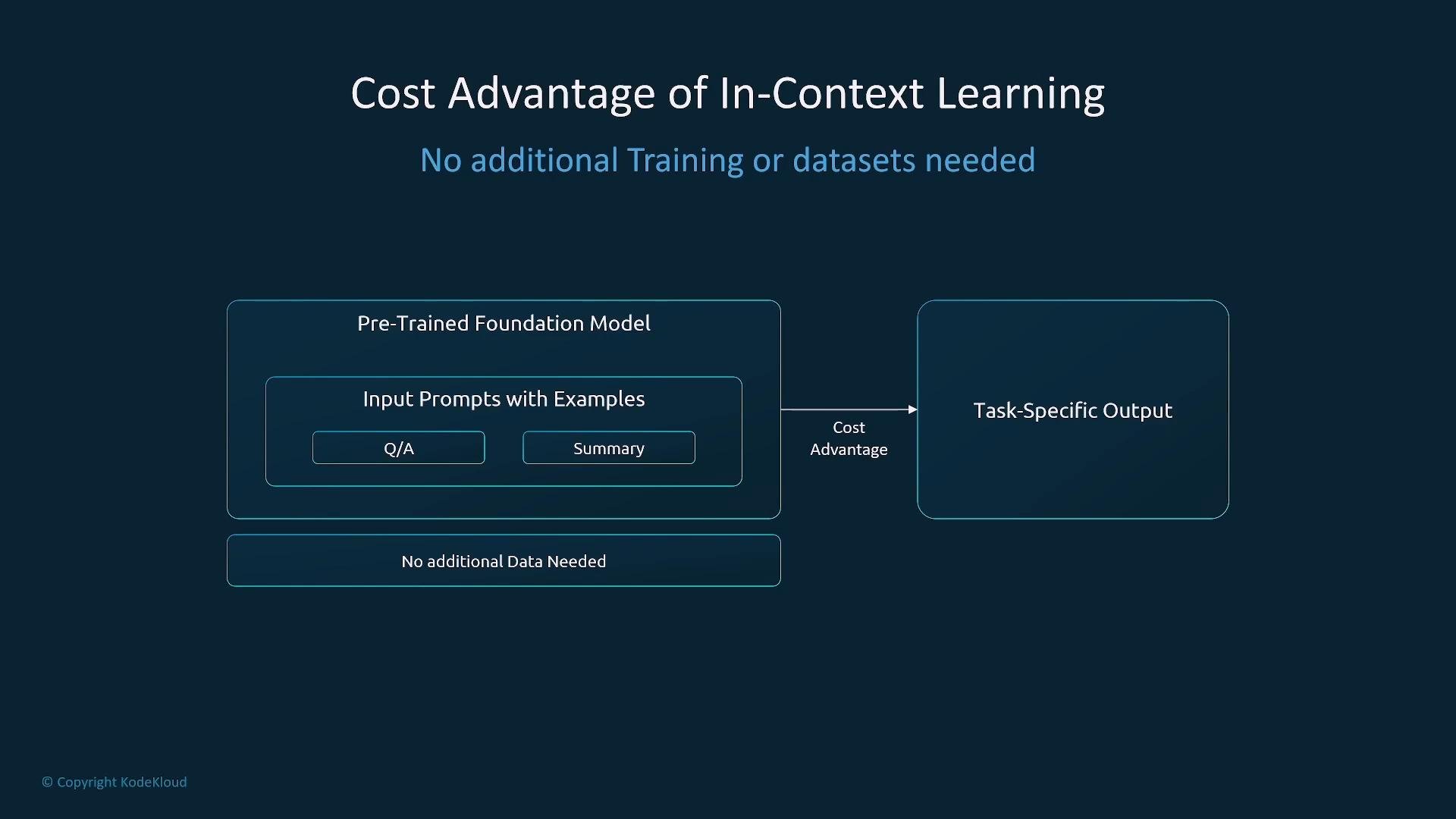
A dark-themed slide titled "Cost Advantage of In-Context Learning" showing a diagram where a pre-trained foundation model uses input prompts with examples (Q/A, summary) and no additional data to produce task-specific output. An arrow labeled "Cost Advantage" links the model to the task-specific output.
When you need the fastest path to results with minimal infrastructure, in‑context learning is often the right choice.
A slide titled "Cost Considerations of In-Context Learning" on a dark background. It lists three points as colored horizontal bars: "Cost-Effective", "Less Customization", and "Moderate Accuracy."

4. Retrieval‑Augmented Generation (RAG)

RAG augments model prompts at inference time with documents retrieved from an external knowledge base (typically using vector embeddings and an index). The model conditions on both the prompt and retrieved context to produce grounded, up‑to‑date answers. Advantages:
  • Improved factual accuracy and recency when the knowledge base is maintained.
  • Reduces hallucinations by grounding responses in retrieved documents.
  • Excellent for question answering, customer support, and document-centric tasks.
Trade-offs:
  • Requires retrieval infrastructure: indexing, embedding pipelines, and storage.
  • Adds latency and operational complexity.
  • Costs depend on storage, embedding generation, and retrieval frequency.
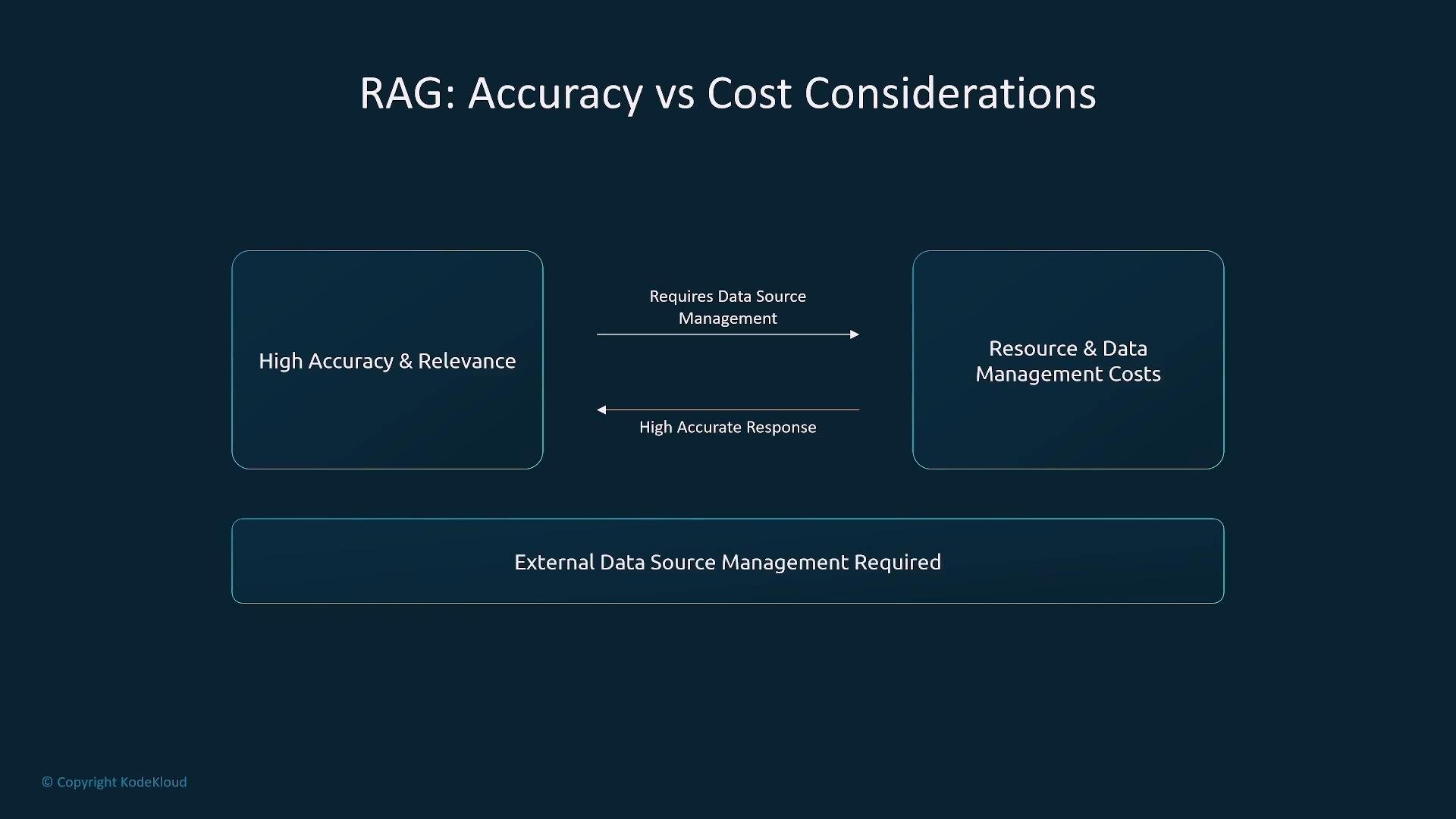
Slide titled "RAG: Accuracy vs Cost Considerations" showing two rounded boxes — "High Accuracy & Relevance" on the left and "Resource & Data Management Costs" on the right — with arrows between them labeled about data source management and accurate responses. A bottom bar notes "External Data Source Management Required."
RAG often sits between in‑context learning and fine‑tuning for production deployments: higher complexity and cost than prompting alone, but commonly higher accuracy and currency.
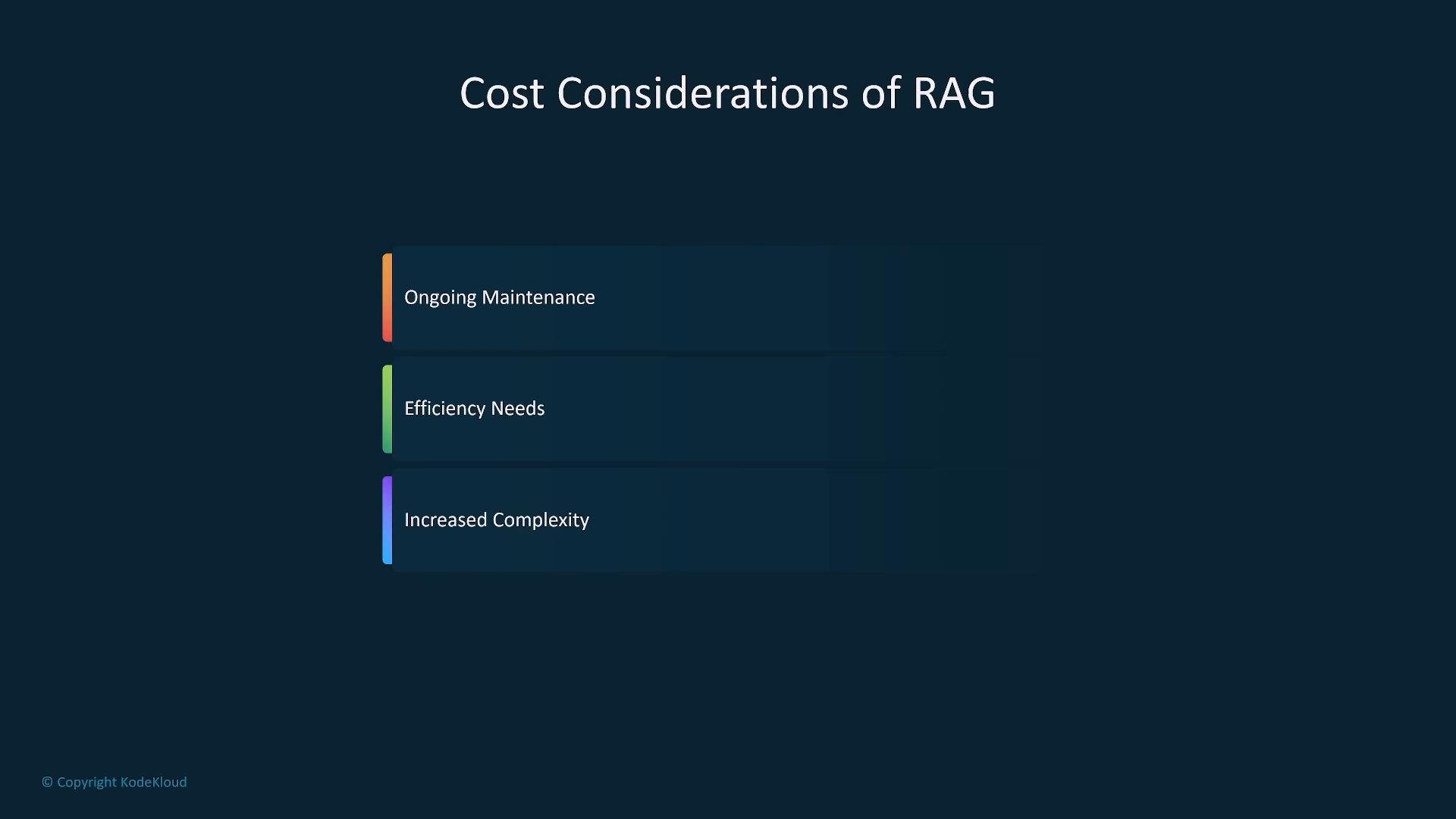
A dark-themed presentation slide titled "Cost Considerations of RAG" that lists three points: Ongoing Maintenance, Efficiency Needs, and Increased Complexity.
For a practical RAG primer, see this linked course: Fundamentals of RAG.

Quick comparison table

Comparing trade‑offs

From most to least resource‑intensive: pre‑training → RAG (varies with scale) → fine‑tuning → in‑context learning.
In terms of control and customization: pre‑training offers the most; fine‑tuning and RAG provide strong domain adaptation; in‑context learning provides rapid but limited customization.
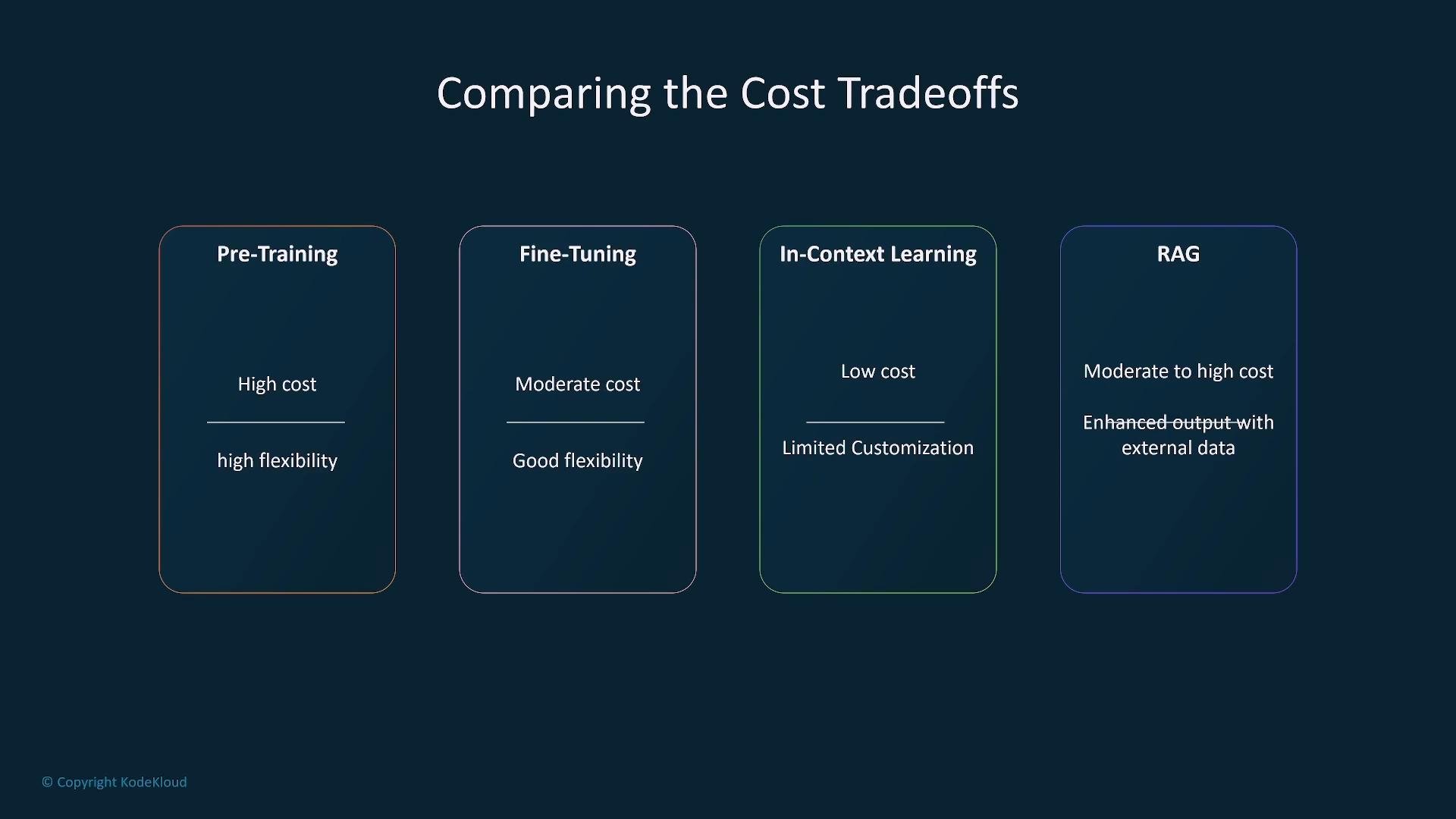
A slide titled "Comparing the Cost Tradeoffs" showing four columns: Pre-Training, Fine-Tuning, In-Context Learning, and RAG. Each column briefly notes relative cost and tradeoffs (e.g., pre-training: high cost/high flexibility; fine-tuning: moderate cost/good flexibility; in‑context: low cost/limited customization; RAG: moderate‑to‑high cost/enhanced output with external data).

When to choose each approach

  • Pre‑training: Only when you require a completely new foundation model tailored to large‑scale, unique objectives and you have the data, compute, and time. Avoid for short timelines or limited budgets.
  • Fine‑tuning: Use when you want to adapt an existing foundation model for a specific domain or supervised task and can invest in a moderate dataset and training effort. This balances performance and cost for many production systems.
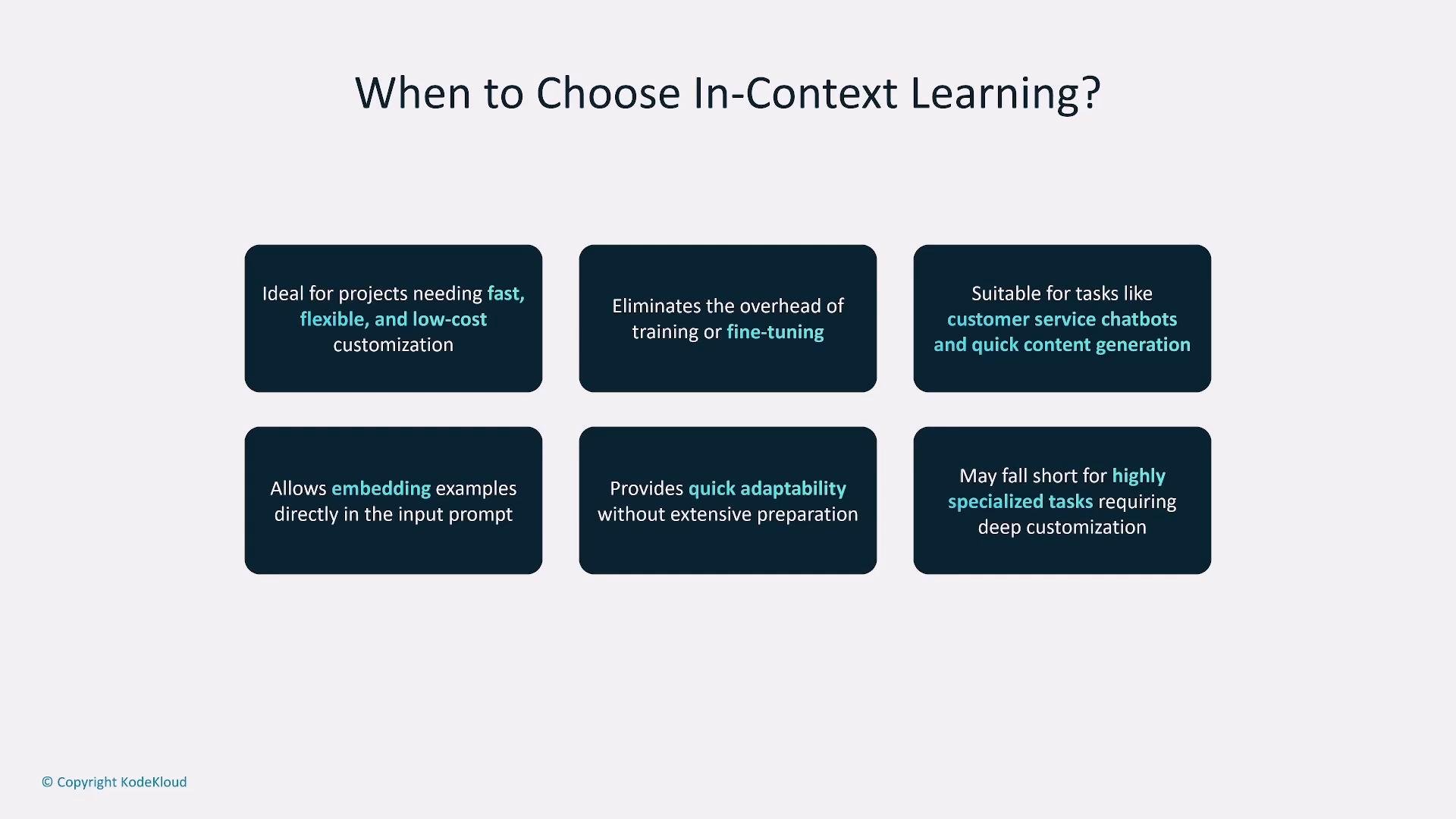
A slide titled "When to Choose In-Context Learning?" showing six dark rounded boxes that list advantages and limitations. The points mention fast, flexible, low‑cost customization, no fine‑tuning overhead, suitability for chatbots and quick content generation, embedding examples and quick adaptability, and that it may not suit highly specialized tasks.
  • In‑context learning: Best for rapid, low‑cost experiments or when you can supply relevant examples at inference time (few‑shot). Ideal for prototyping or workflows that must avoid retraining overhead.
  • RAG: Choose RAG when your application requires accurate, up‑to‑date answers that are grounded in an external corpus (knowledge base, documentation, or recent data). RAG is excellent for customer support and document QA—expect extra infrastructure and maintenance.
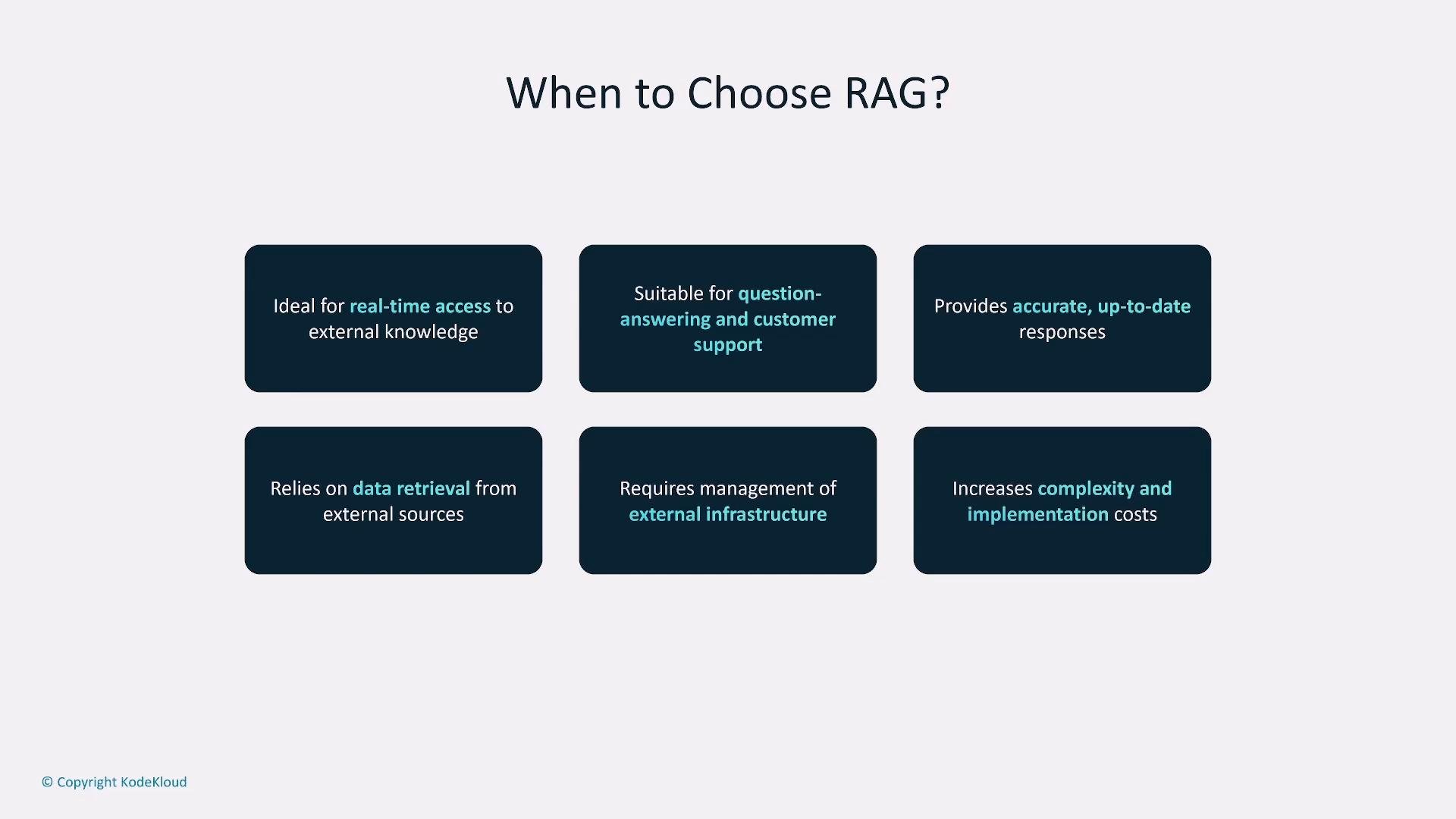
A slide titled "When to Choose RAG?" showing six dark rounded boxes.The boxes list pros and cons such as real-time access to external knowledge, suitability for question-answering/customer support, accurate up-to-date responses, reliance on external data retrieval, need for infrastructure management, and increased complexity/costs.
Hybrid strategies are common (for example, lightweight fine‑tuning paired with RAG, or advanced prompt engineering combined with retrieval). Understanding the core trade‑offs—cost, latency, data availability, and desired accuracy—helps you select the right path.
Choose the approach that matches your objectives: prioritize accuracy and recency with RAG, specialization with fine‑tuning or pre‑training, and speed/cost with in‑context learning. Often a hybrid approach (for example RAG combined with prompt engineering) delivers the best practical results.

Watch Video