Welcome — this is Michael. In this lesson we’ll explain Retrieval-Augmented Generation (RAG), how it works, and where it’s most effective. RAG improves the accuracy and relevance of large language model (LLM) outputs by combining generation with targeted retrieval from external knowledge sources.
A dark presentation slide titled "Introduction to Retrieval Augmented Generation (RAG)" showing three bullet panels: "What is RAG?", "Enhances language models with external data", and "Key for improving accuracy and relevance in AI tasks," each accompanied by a small icon.
What is RAG (short definition)
  • RAG combines two capabilities: (1) generation from an LLM, and (2) retrieval of semantically relevant external information.
  • At inference time, RAG retrieves documents or passages related to a user’s query and conditions the LLM on that external context to produce more accurate, current, and verifiable responses.
Why use RAG?
  • Inject up-to-date or domain-specific knowledge after an LLM’s training cutoff.
  • Reduce hallucinations by grounding answers in retrieved source material.
  • Support high-stakes or regulated domains (legal, finance, healthcare, cloud services) where factual correctness and traceability matter.
How RAG works (high-level flow)
  1. User submits a prompt (the query or task description).
  2. A retriever searches a vector index or database for semantically relevant documents.
  3. Top-ranked passages (or their embeddings/IDs) are assembled with the prompt.
  4. The LLM generates an answer conditioned on both the prompt and the retrieved context.
A slide titled "How RAG Works: The Basics" showing two numbered panels. The first panel reads "Combines language models with information retrieval" and the second reads "Retrieves external knowledge for response generation" with simple icons above each.
Core components (quick reference) Prompts and contextual data
  • The prompt is the user’s instruction or question.
  • You can augment prompts with contextual documents: product manuals, release notes, wikis, knowledge base articles, transcripts, and web pages.
  • High-quality, semantically relevant context helps the model produce domain-accurate outputs.
Practical example (conceptual)
  • An LLM trained only through October 2023 may miss product changes after that date.
  • RAG can retrieve recent release notes or docs and feed them to the LLM so it answers correctly about new features or deprecations.
Vector embeddings and vector databases
  • Embeddings are numerical vectors that capture semantic meaning of text (or images, audio, etc.).
  • An embedder (a neural model) maps each document or passage into a high-dimensional vector space.
  • A vector database performs efficient similarity search (nearest neighbor) to find documents closest to the query embedding.
  • Think of embeddings as semantic metadata and the vector store as a fast lookup for nearest neighbors.
A dark-blue slide titled "Machine Learning Models and Vector Databases" with two numbered panels. Panel 01 says ML models create vector embeddings and Panel 02 says vector databases store those embeddings for fast, accurate retrieval, each with a matching icon.
Business applications (examples)
A slide titled "RAG and Business Applications" showing two rounded cards labeled 01 and 02. The left card (magnifying glass) notes enhancing search recommendations and text generation, and the right card (headset) mentions improving customer support, document extraction, and more.
RAG in Amazon Bedrock Amazon Bedrock supports RAG-style workflows: you can build a knowledge base, store vectors in a vector store, and connect a retriever so the model receives retrieved context during inference. This centralizes semantic data and simplifies model augmentation.
A presentation slide titled "Amazon Bedrock: RAG in Action" showing two panels. The left panel says "Amazon Bedrock leverages RAG to enhance language models" with a flowchart icon, and the right panel says "Retrieves data from knowledge bases to improve responses" with a stack-of-documents icon.
Vector-enabled AWS services AWS offers managed services helpful for RAG architectures: vector-capable search, managed databases, storage for content ingestion, and ML services for embedding generation. Choose components based on throughput, latency, and security requirements. Cost and performance trade-offs
  • RAG adds infrastructure: embedder compute, a vector store, retrieval latency, and extra LLM calls.
  • You can apply retrieval at different points: during training (indexing annotated examples), at inference (retrieve-then-generate), or as an iterative feedback loop.
  • Trade-offs:
    • Fewer retrievals = lower cost, lower latency, but potentially less accuracy.
    • More retrievals and larger indices = higher relevance but higher cost and latency.
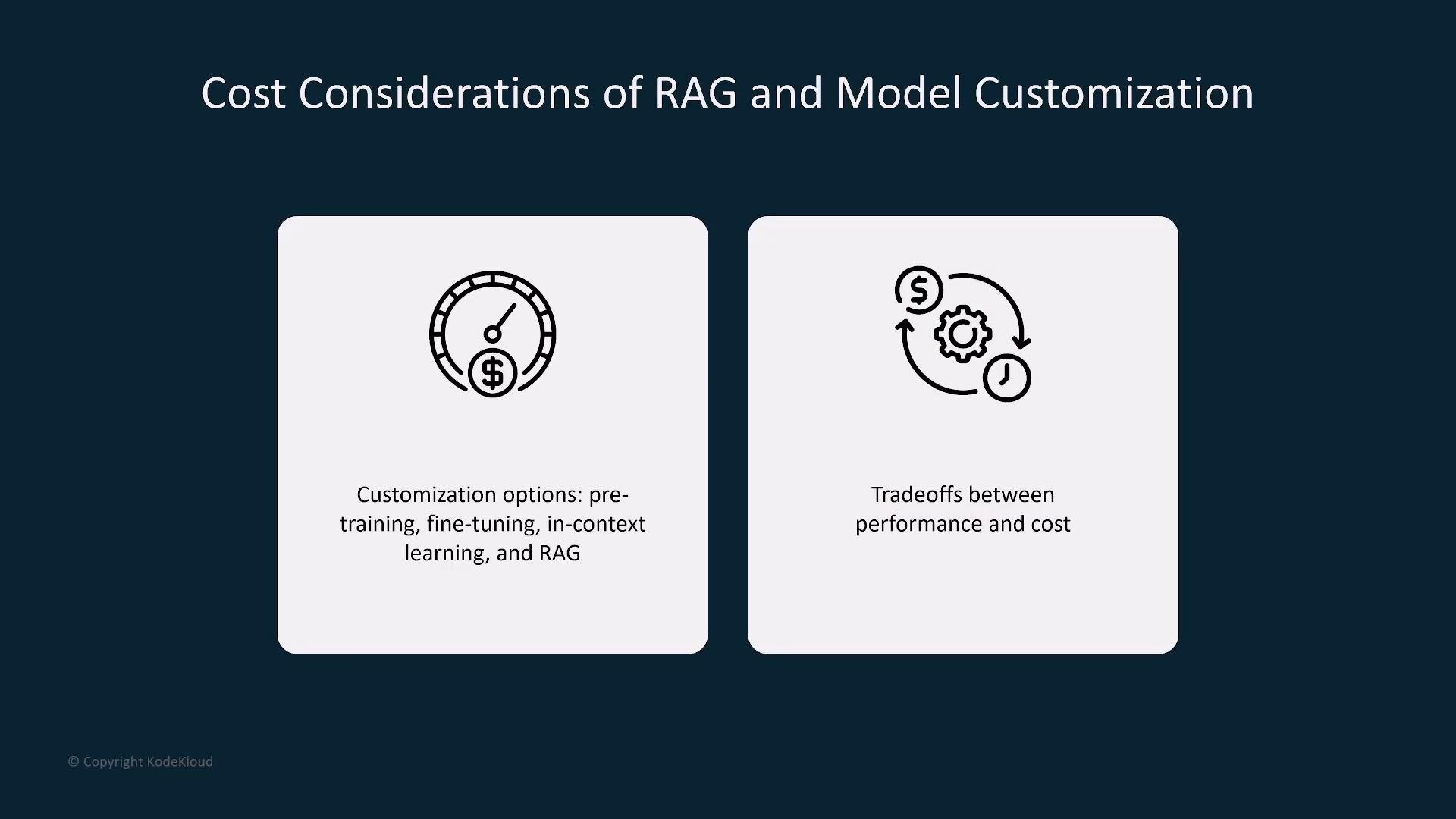
A slide titled "Cost Considerations of RAG and Model Customization" showing two cards: the left lists customization options (pre-training, fine-tuning, in‑context learning, and RAG) with a dollar/speedometer icon, and the right highlights tradeoffs between performance and cost with gear, clock, and dollar icons.
RAG and in-context learning
  • In-context learning (zero-shot, one-shot, few-shot) uses prompt examples to shape model behavior.
  • RAG complements in-context learning by supplying external examples and evidence from knowledge sources, improving grounding and reducing ambiguity.
A dark presentation slide titled "RAG and In-Context Learning." It lists two points: in-context learning uses examples in prompts to guide model behavior, and RAG enhances this by providing external knowledge.
Content generation and knowledge management
  • Use RAG to generate content that cites or is informed by the latest research, blogs, and public sources.
  • For knowledge management, RAG enables precise retrieval across evolving documentation (Kubernetes, cloud services, APIs) and helps teams surface the right information without heavy manual restructuring.
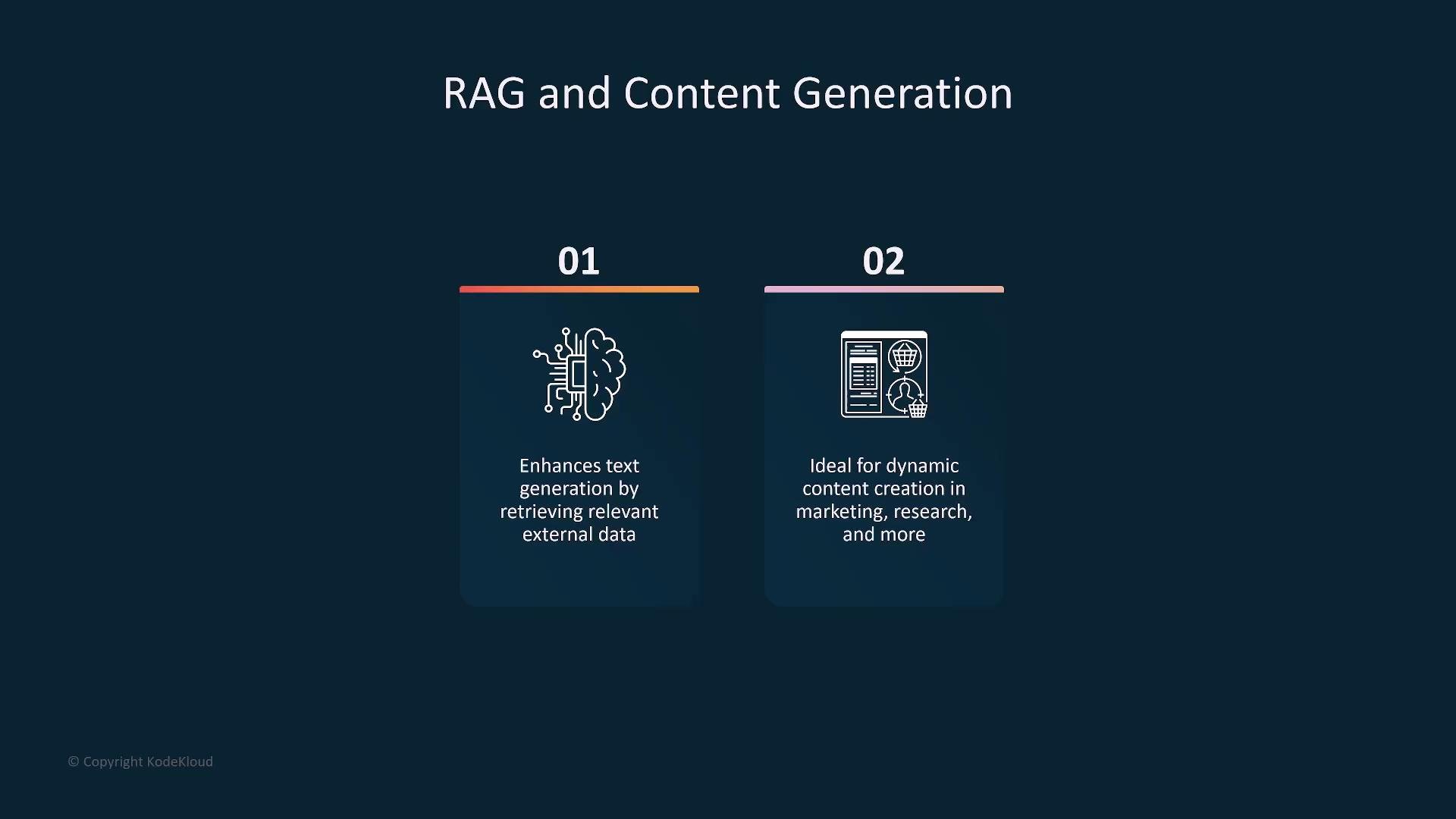
A dark slide titled "RAG and Content Generation" with two numbered panels. Panel 01 shows an AI/brain icon and notes enhancing text generation by retrieving external data; Panel 02 shows a content/marketing icon and says it's ideal for dynamic content creation in marketing, research, and more.
A slide titled "RAG for Knowledge Management Systems" showing two key points: it enhances knowledge management with fast, accurate retrieval and streamlines access to information in large organizations. The points are accompanied by icons of a head with gears and an open book.
Challenges, risks, and mitigations
  • Infrastructure: achieving sub-second retrieval needs well-architected vector stores and scalable compute.
  • Data quality & security: control what you index; filter sensitive content and validate sources.
  • Model poisoning & bias: avoid ingesting untrusted or adversarial data that can introduce errors or bias.
  • Operational complexity: implement monitoring, logging, provenance, and versioning for knowledge bases.
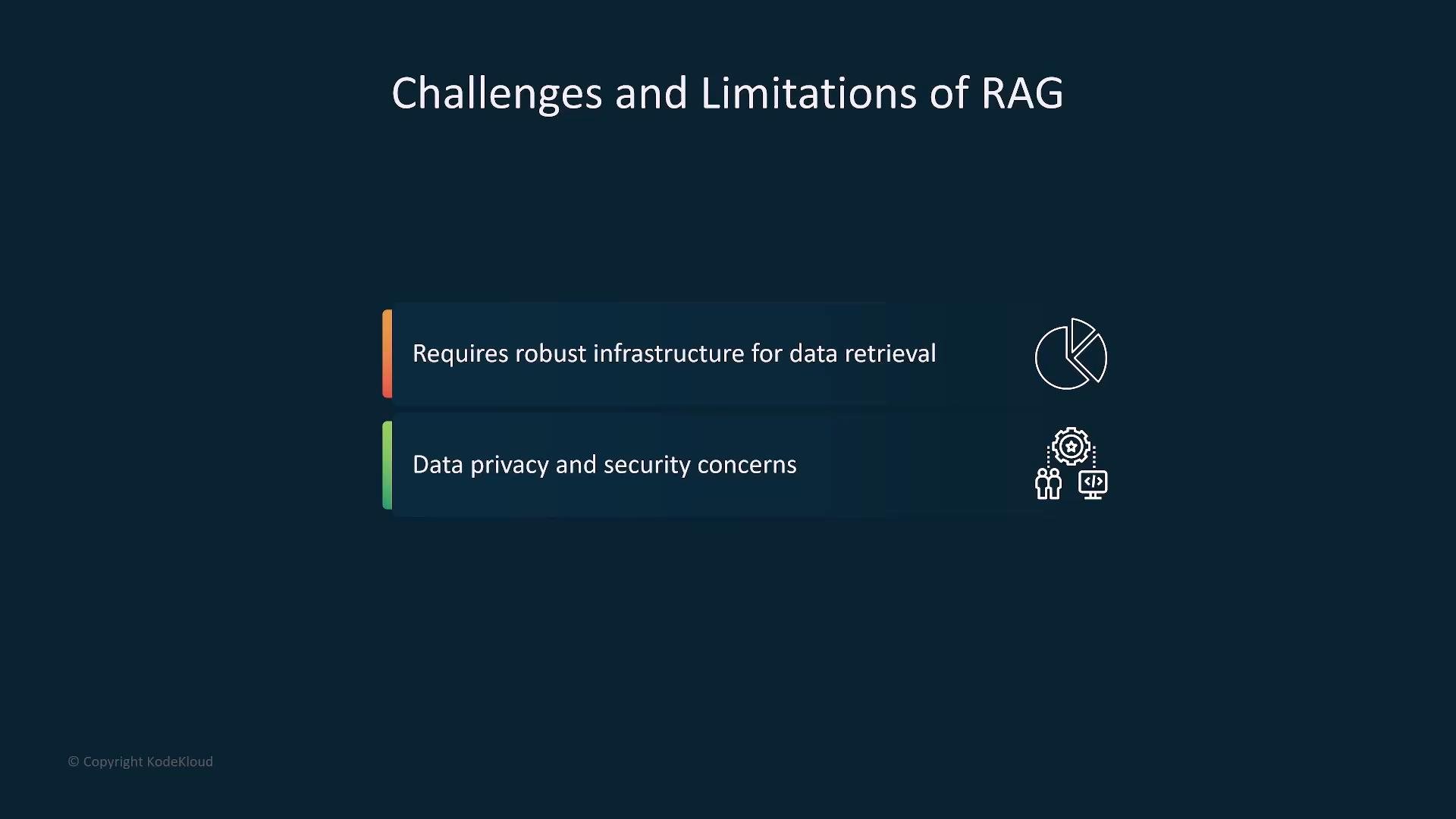
A presentation slide titled "Challenges and Limitations of RAG" listing two points: "Requires robust infrastructure for data retrieval" and "Data privacy and security concerns," with small icons (pie chart and gear/people) on the right.
Design RAG systems with provenance and traceability: store source metadata, document IDs, and links for retrieved passages so model outputs can cite or trace back to original documents.
Filter and review content before indexing. Do not ingest private, regulated, or sensitive data into your vector store without appropriate access controls, governance, and compliance safeguards.
Next steps For a deeper technical dive, explore vector databases, embedding models, index types (flat, HNSW, IVF), similarity metrics (cosine, dot-product), and architectural patterns for production-ready RAG systems. Links and references

Watch Video