

- Secure configuration for data and cloud infrastructure
- Data privacy: detection, classification, and removal of PII
- Access control and network-level protections
- Data integrity, versioning, and auditing
- Privacy-enhancing technologies and data quality for ML
This article highlights practical controls and patterns to reduce risk in data pipelines and ML workflows. Follow the least-privilege principle and audit your configurations regularly.
Network security and VPC configuration
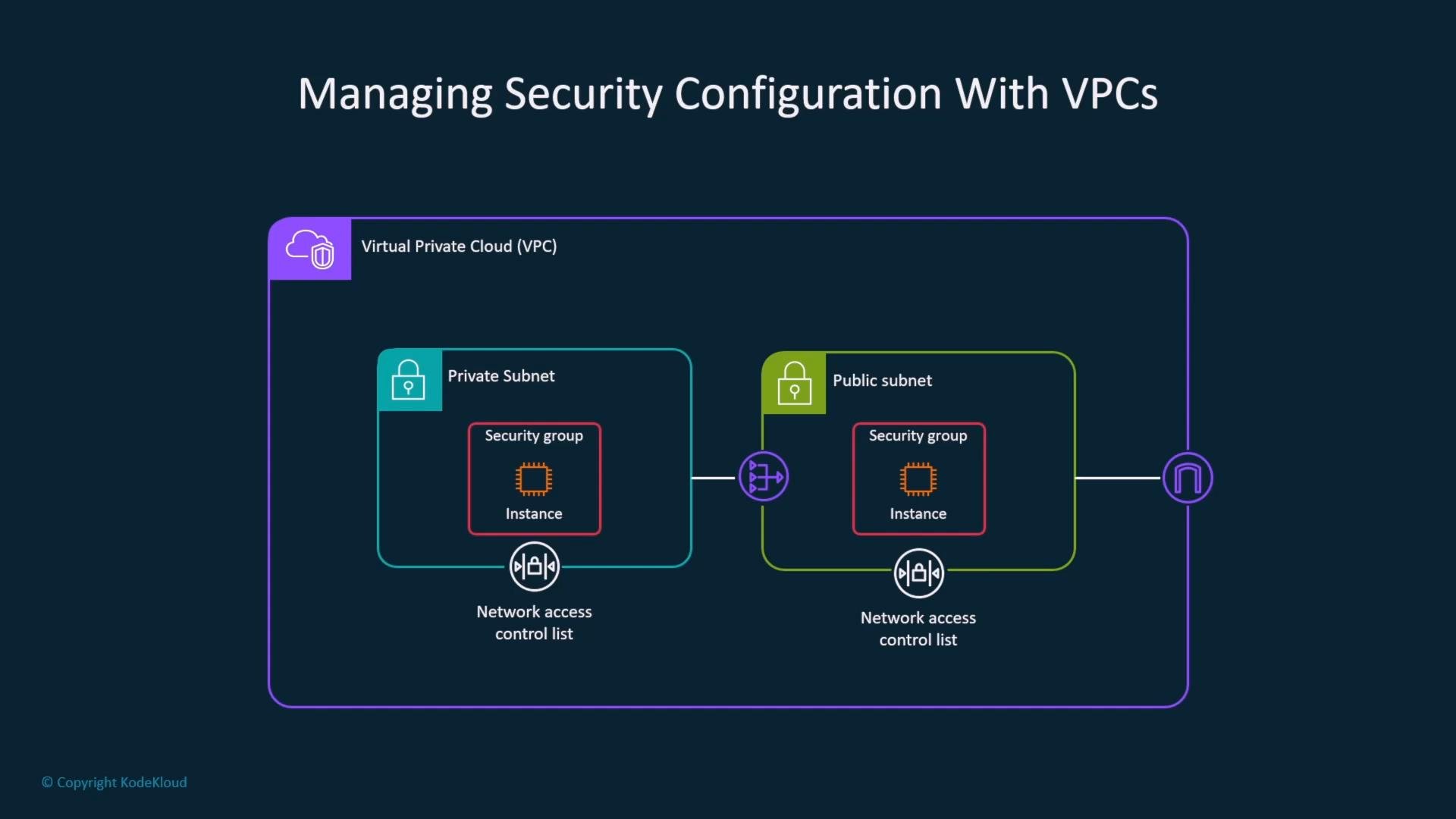
Isolate compute and storage inside a Virtual Private Cloud (VPC) and run sensitive workloads (data processing, notebooks, model training) in private subnets. Apply layered network controls so that only required traffic is allowed and service communications remain private. Key network controls and recommendations:- Use private subnets for managed compute (for example, SageMaker notebooks or training jobs) and restrict internet egress unless explicitly required.
- Attach security groups with the minimal ports and directions needed per workload.
- Use Network ACLs (NACLs) as an additional, stateless layer for subnet-level filtering.
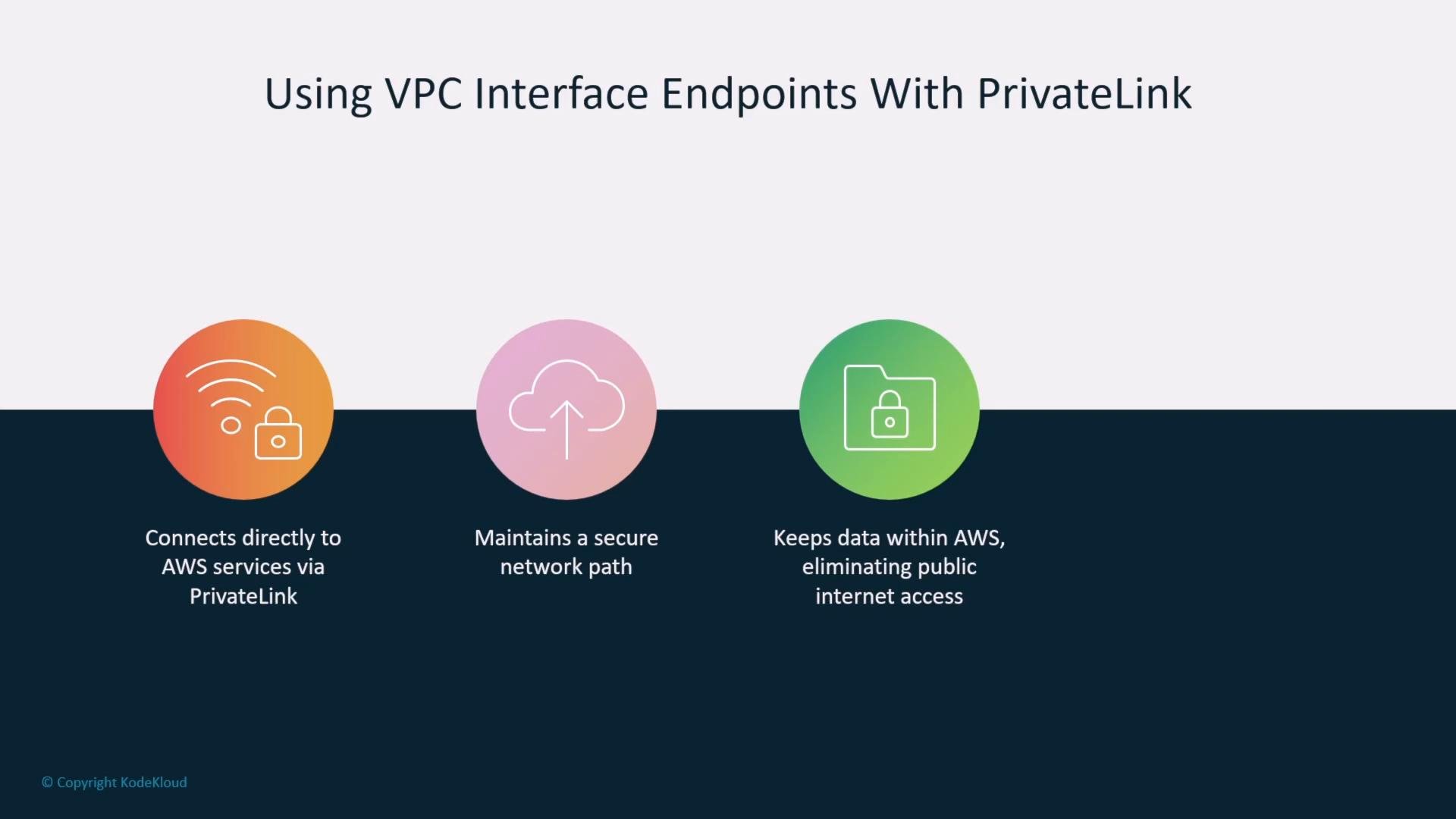
- Enable VPC endpoints to avoid sending service traffic over the public internet.
- Enforce encryption in transit (TLS) for service calls; for Direct Connect, enable MACsec or tunnel through an encrypted VPN if encryption is required.
- Prefer IAM roles for services (no long-lived credentials) and enable network isolation features where supported.
When launching managed compute, configure your service to run inside a VPC with minimal network reachability. For example, SageMaker supports VPC configurations and network isolation to restrict outbound access to public endpoints.
VPC interface endpoints and PrivateLink
Use VPC endpoints to keep service traffic on the provider’s network and off the public internet. Choose the endpoint type that fits the service:- Interface endpoints (AWS PrivateLink): for APIs such as SageMaker, CloudWatch, and many SaaS integrations.
- Gateway endpoints: commonly used for S3 and DynamoDB to avoid Internet Gateway routing.
- S3 access point interface endpoints: useful for fine-grained S3 access and network-control use-cases.
Data privacy: detection and response (Amazon Macie, AWS Config)
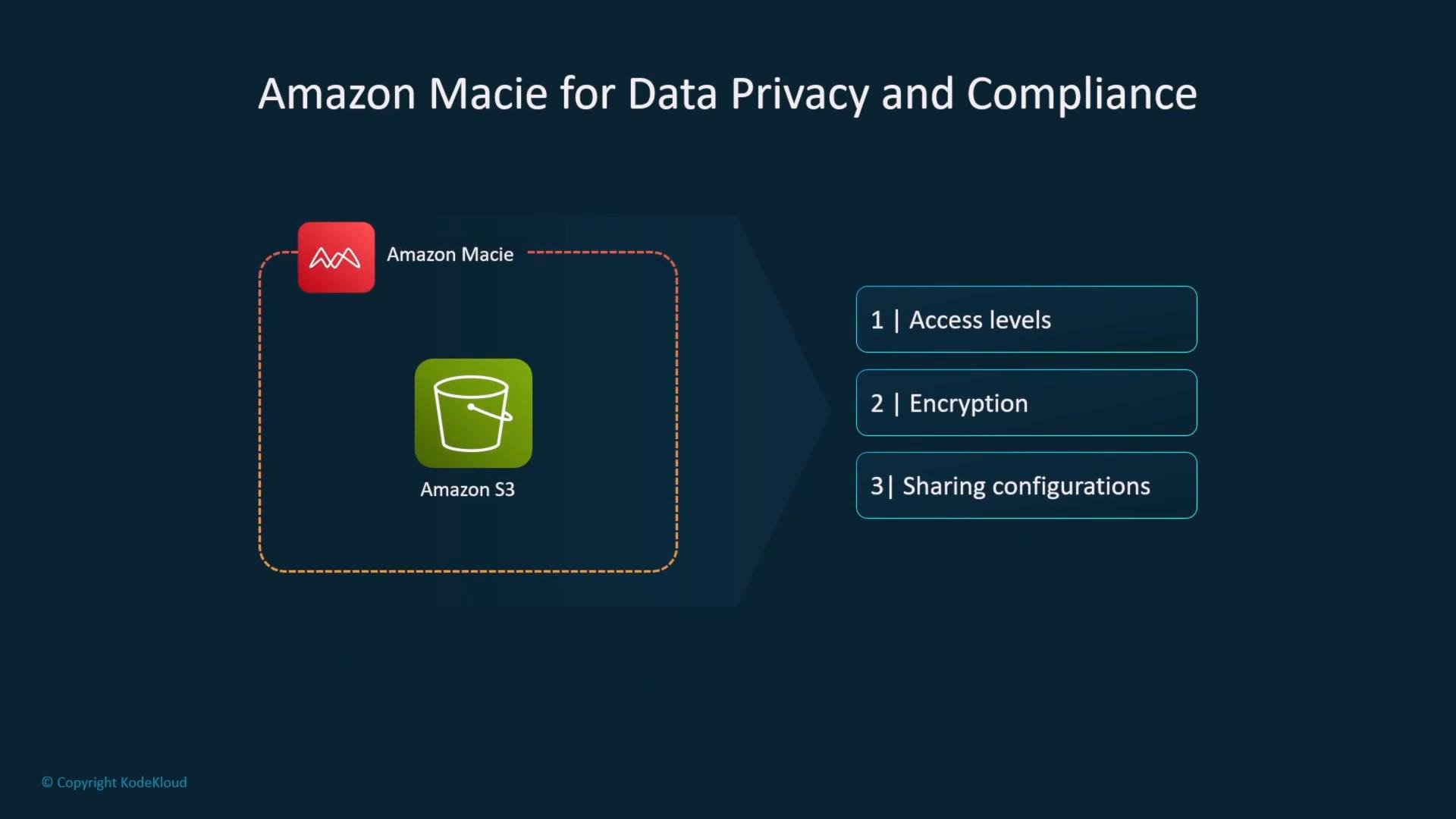
Detecting sensitive data early is critical. Use automated discovery and classification to identify PII and sensitive objects, and integrate findings with automated remediation:- Amazon Macie: monitors S3 objects and classifies PII and sensitive content.
- AWS Config / Config Rules: enforce compliance and trigger remediation playbooks when policies are violated.
- Automated responses: Lambda functions, Step Functions, or ticketing integrations can quarantine buckets, restrict access, or send alerts when sensitive data is discovered.
- Who can access the data and at what privilege level?
- Is the data encrypted at rest and in transit?
- Is the bucket or resource exposed or shared externally?
Remove PII during ingestion and feature engineering
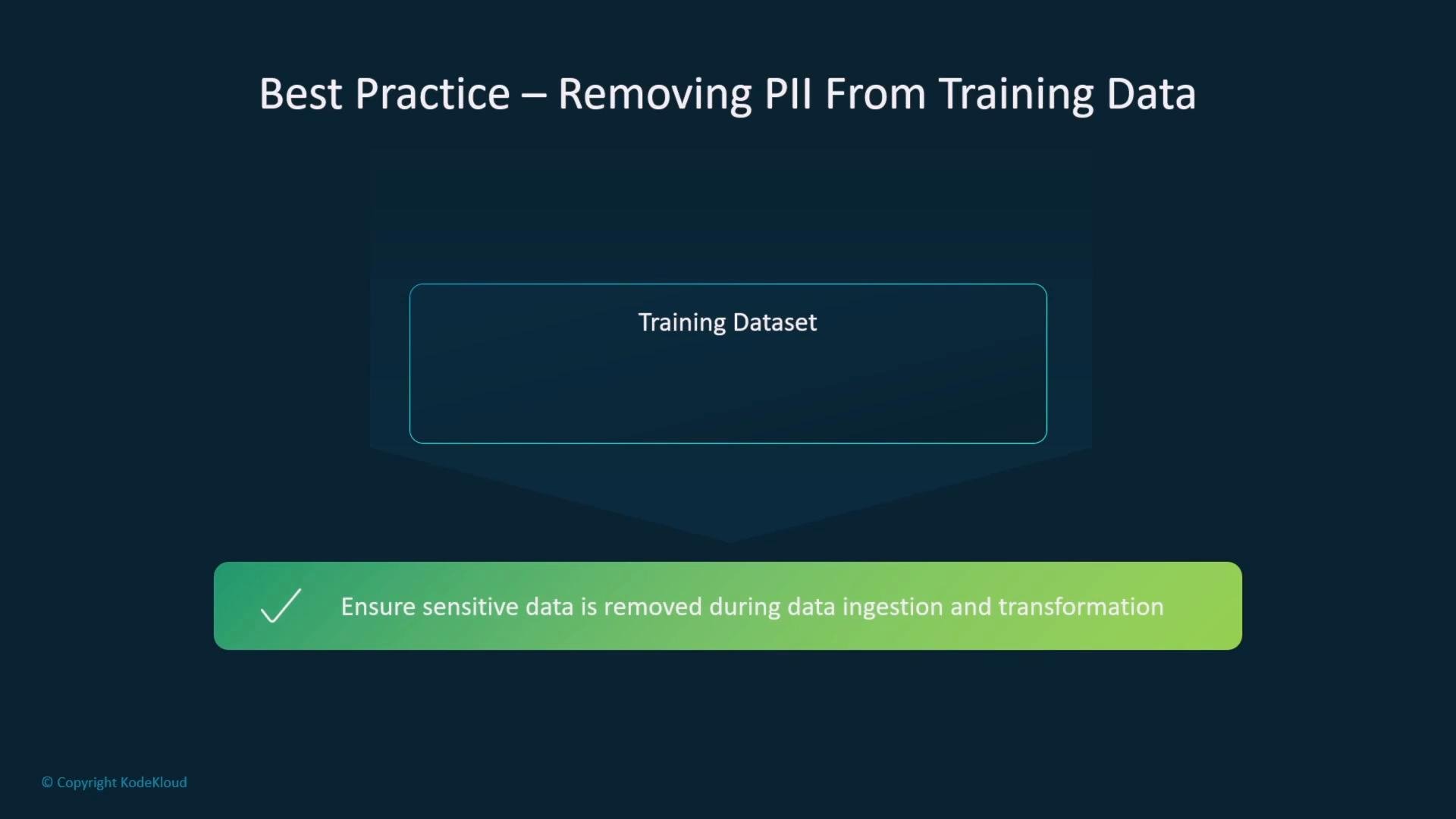
Training data should avoid containing unnecessary PII. Implement detection and transformation at the earliest stage (ingest) so downstream systems and models do not receive sensitive attributes. Best-practice checklist:- Detect PII at ingest time (Macie, custom classifiers) and trigger cleansing workflows automatically.
- Apply appropriate transformations: anonymization, irreversible hashing, tokenization, or redaction.
- Make transformations reversible only when absolutely required, and restrict/review access to any reversible keys or mapping stores.
- Log transformation actions and include them in audit trails for compliance.
Data access control: IAM and network controls
Combine identity-based policies with network controls to create layered authorization. Core principles:- Use IAM roles, not long-lived credentials, for services and compute (assume-role patterns).
- Grant least-privilege: start with deny/all, allow only required actions and resources.
- Combine IAM with security groups and NACLs to limit who can reach a service and from where.
- Centralize logging and auditing (CloudTrail, AWS Config) to track access and changes.
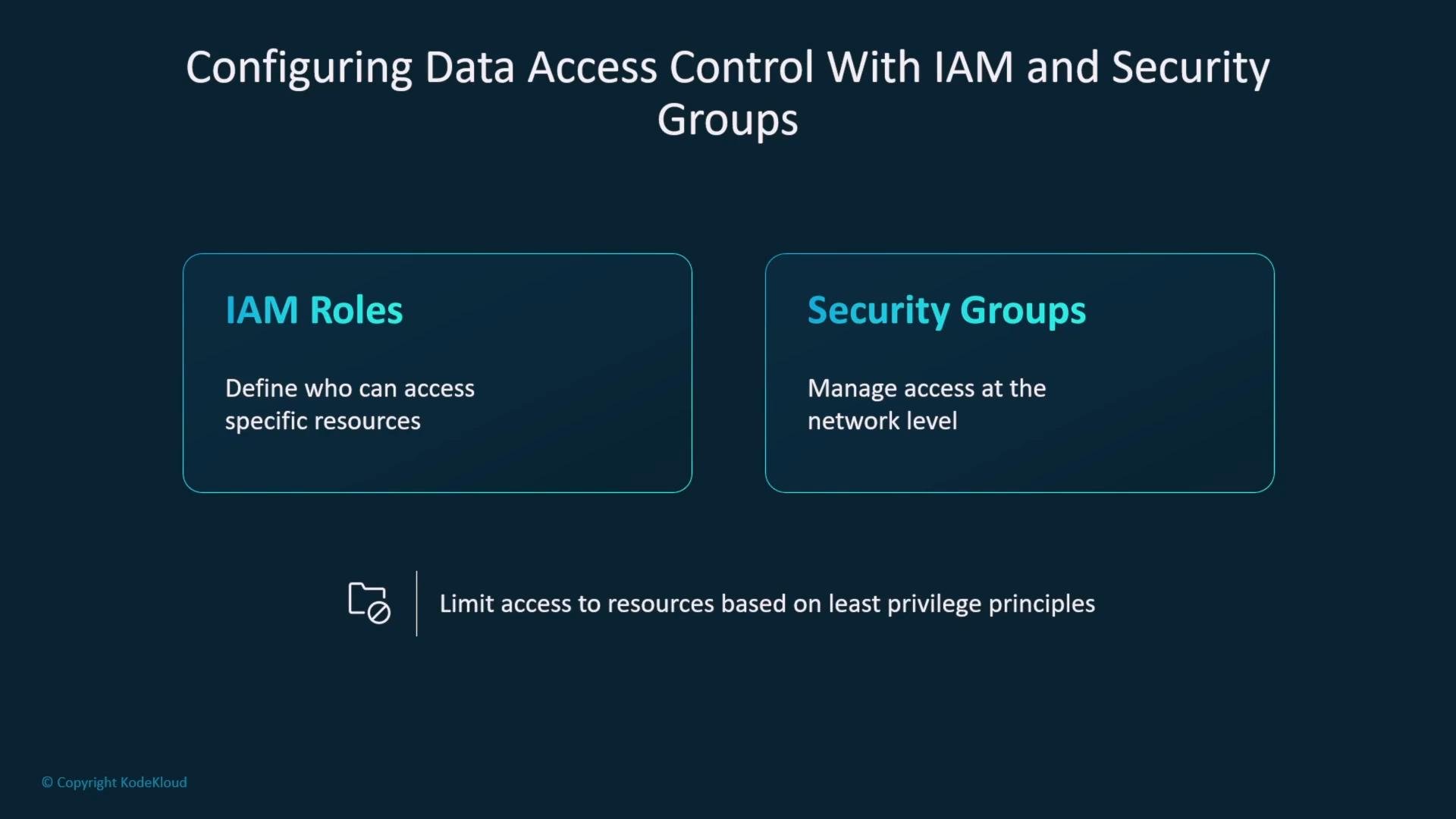
Avoid using overly broad IAM policies (for example, wildcard permissions). Regularly review and tighten permissions and rotate credentials. Enable centralized logging and auditing (CloudTrail).
Ensuring data integrity: encryption, version control, and logging
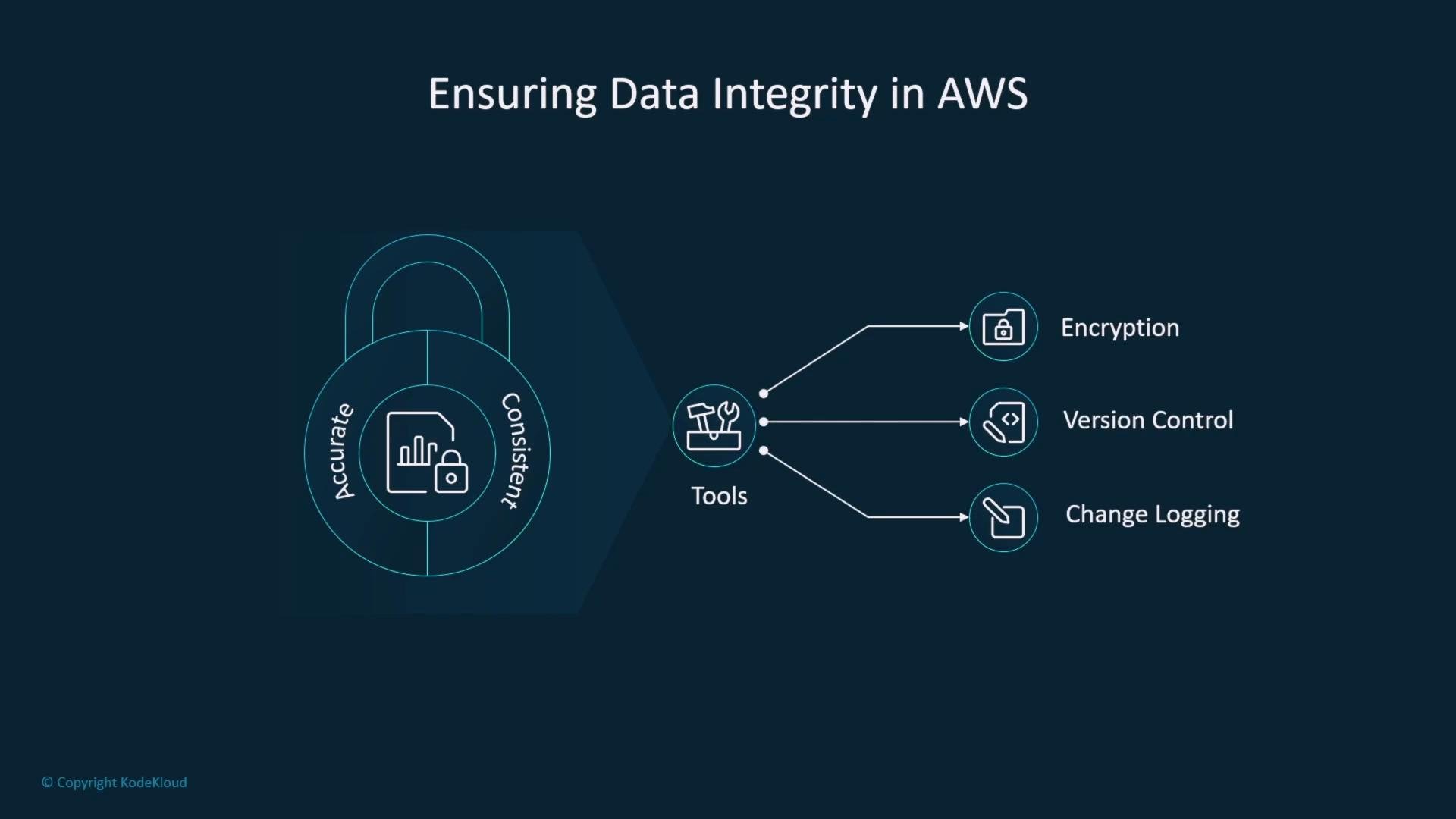
Data integrity ensures datasets are accurate, auditable, and recoverable. Apply controls across storage, processing, and access paths:- Encryption: enforce both at-rest (SSE for S3, KMS-managed keys) and in-transit (TLS).
- Version control: enable object versioning for S3 or use immutable artifact repositories for model/data snapshots.
- Audit logs: enable CloudTrail, S3 access logging, and application-level logging to capture who changed what and when.
Privacy-enhancing technologies (PETs)
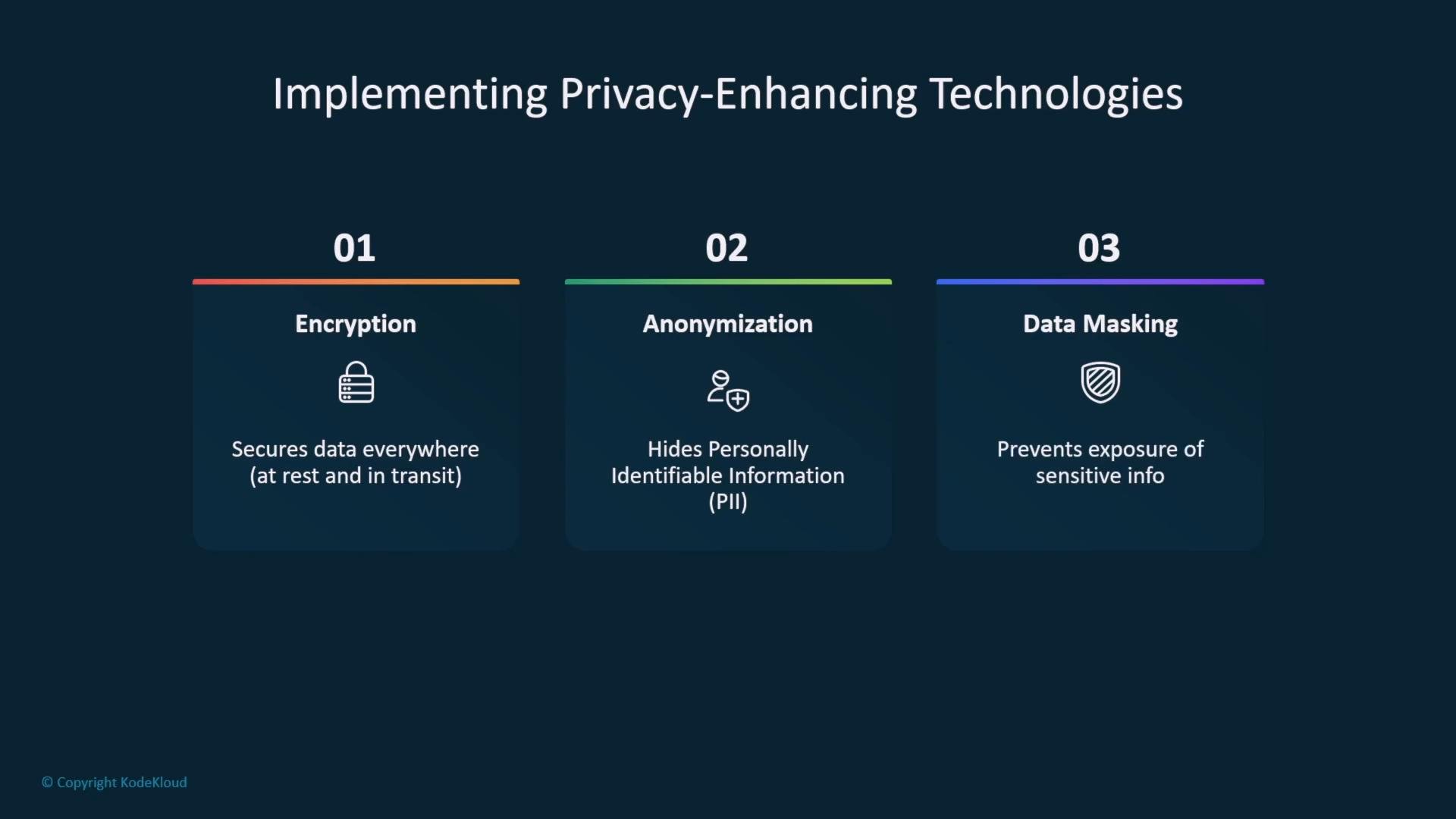
Apply PETs to reduce exposure of sensitive data while preserving analytical value. Choose the right technique based on risk profile, regulatory needs, and intended use. Common PETs:- Encryption — strong at-rest and in-transit protection using industry best practices and key management.
- Anonymization — remove or obfuscate identifiers to minimize re-identification risk.
- Data masking — hide sensitive values for non-privileged users or in lower environments.
- Tokenization — replace sensitive values with tokens while keeping mappings in a secure vault.
Data quality for ML: accuracy, completeness, and fairness
Security and privacy are essential but insufficient alone—data quality directly affects ML performance and fairness:- Validate accuracy, completeness, relevance, and schema at ingestion.
- Handle missing values, outliers, and skewed distributions with documented preprocessing.
- Assess and mitigate bias using fairness checks, counterfactual tests, and representative sampling.
- Implement data validation gates, unit tests for datasets, and monitoring to detect drift or degradation in production.
Summary
Apply layered controls across network, identity, data, and operations to secure data engineering and ML workflows:- Isolate resources in VPCs; use interface or gateway endpoints to avoid the public internet.
- Detect sensitive data with tools like Amazon Macie and automate remediation with AWS Config and Lambda.
- Remove or transform PII during ingestion and feature engineering; log all transformations.
- Use IAM roles and least-privilege policies combined with security groups for network segmentation.
- Preserve integrity with encryption, versioning, and comprehensive logging.
- Employ PETs where appropriate and enforce data quality checks for reliable ML outcomes.
- AWS VPC Endpoints and AWS PrivateLink
- Amazon Macie documentation
- AWS Identity and Access Management (IAM)
- AWS Key Management Service (KMS)
- AWS Config Rules