

Why pursue the AWS Certified AI Practitioner?
AI is no longer just hype — organizations across industries are deploying AI and generative models to deliver measurable business value. As cloud platforms and orchestration technologies (like Kubernetes) continue to evolve, generative AI and related tools are becoming force multipliers across many IT disciplines. If you want roles that leverage AI (engineering, product, security, or operations), signaling that capability now can put you ahead of peers.At launch, AWS offered an Early Adopter badge for AI to candidates who earned the AWS Certified AI Practitioner before February 2025 — a visible signal to employers that you pursue cutting-edge skills.
Industry timing and demand
- Generative AI and large language models (LLMs) are being integrated into applications, automation, analytics, and security tooling.
- Employers are looking for practitioners who understand practical AI patterns on the cloud, secure deployment, and responsible AI practices.
- Earning a foundational AI certification now helps demonstrate both interest and baseline competence.
Compensation and hiring advantage
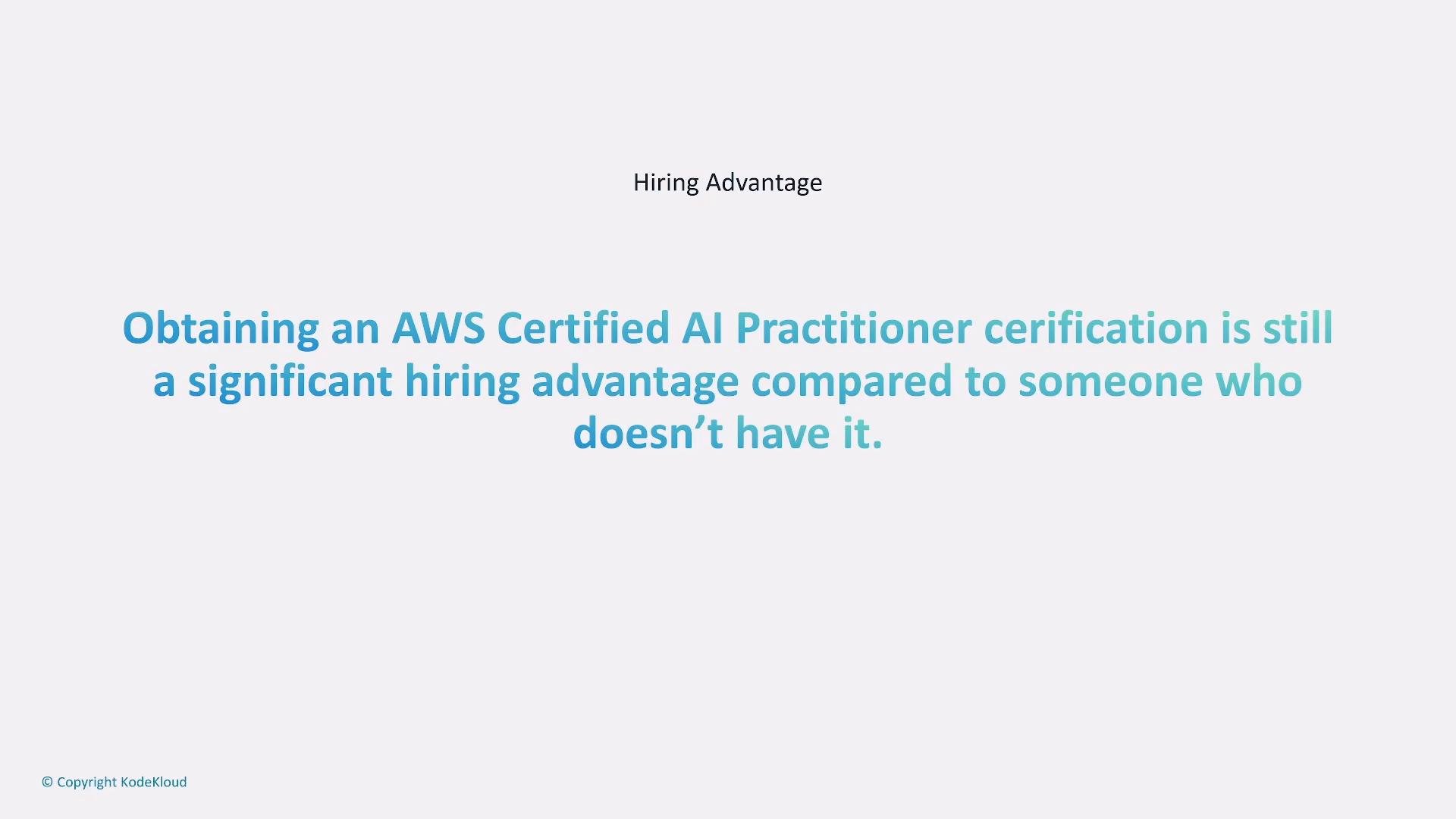
A certification alone does not guarantee an immediate pay raise — the context of your current role matters. However, adding the AWS Certified AI Practitioner to an existing, relevant skill set is a strong signal to hiring managers. It can open more interview opportunities and help you stand out among otherwise similar candidates.
Where this exam sits in the AWS certification roadmap
This is a foundational-level exam with a tighter focus than the broader AWS Cloud Practitioner (CLF-C02). Expect content to emphasize AI concepts, AWS AI/ML services, security considerations, and principles of responsible AI. Because of this specialization, many candidates find it more focused and in some cases more challenging than the general cloud practitioner exam.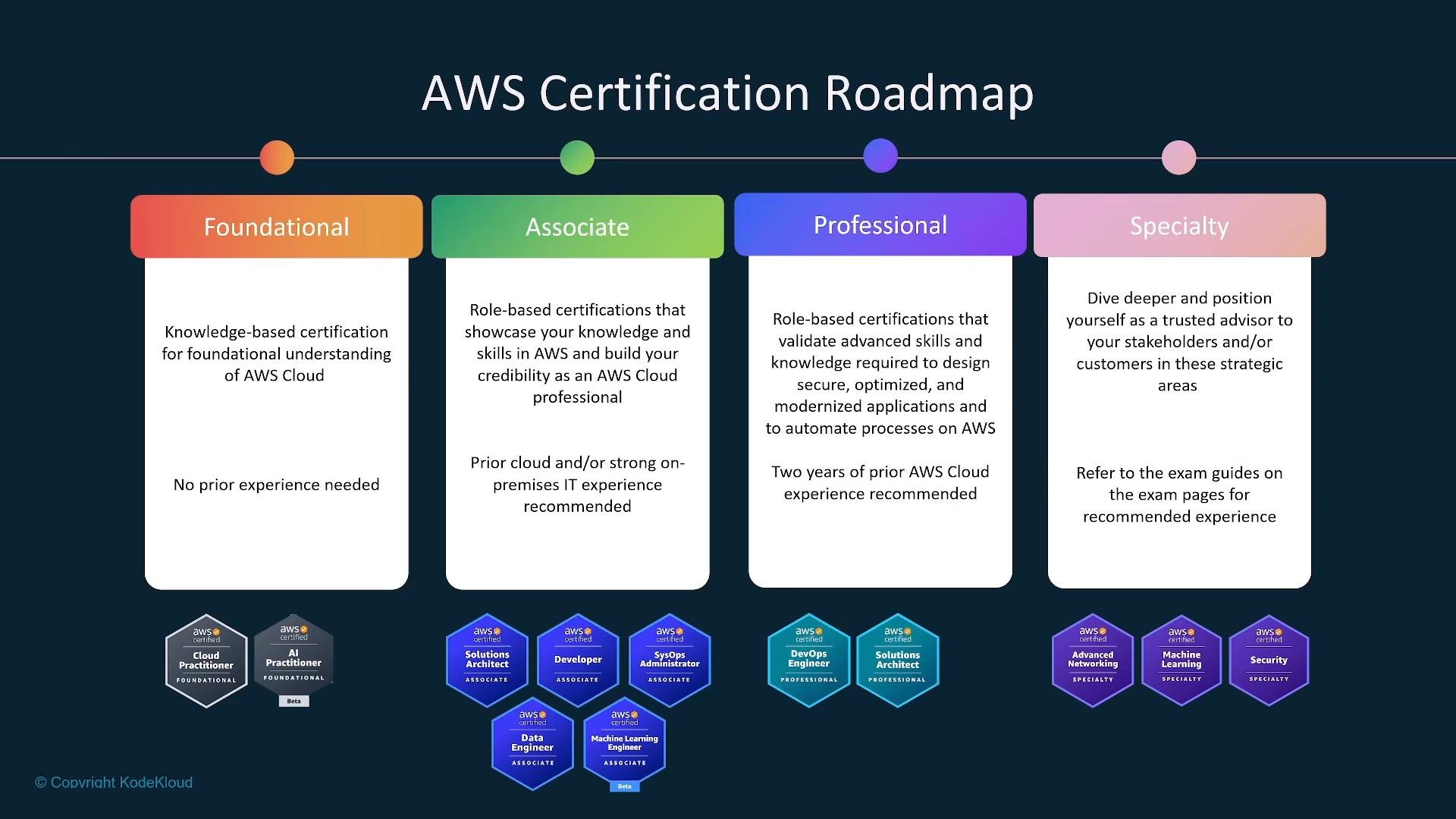
What being an AI practitioner means today
An AI practitioner on AWS typically:- Understands core ML/AI concepts (model types, training vs. inference, evaluation metrics).
- Knows which AWS services and managed tools to use for typical AI tasks (data ingestion, model hosting, inference, monitoring).
- Applies basic operational and security practices for AI systems (data privacy, access controls, model monitoring).
- Recognizes responsible AI principles (bias mitigation, transparency, and governance) and how they affect design choices.
Quick comparison: Certification role and value
About the instructor
I’m Michael Forrester. I entered the industry in 1996 and have worked in roles from engineer to CTO and CEO across organizations such as Red Hat, ThoughtWorks, and AWS Training and Certification. I started studying generative AI intensively after its rise in late 2022, and I had prior machine learning qualifications. I’ve helped many students prepare for and pass a wide range of AWS exams. My experience is focused on helping students succeed on AWS certification paths and apply AWS AI services responsibly.Summary — why take this course
- This course is an appropriate starting point to learn how AI is applied on AWS and to prepare for the AWS Certified AI Practitioner exam.
- Content maps to the official exam guide and includes contextual examples plus a mock exam for practice.
- Earning the credential signals recent AI learning and curiosity to employers, improving hiring prospects.
- The certification demonstrates familiarity with AI-related AWS services, operational basics, security considerations, and responsible AI principles — enough to make informed service and pattern choices.
By the end of this course you will be prepared to sit the AWS Certified AI Practitioner exam and better understand AWS services commonly used for AI projects, along with basic security and responsible-AI considerations.