

- AI: Broad field focused on creating systems that perform tasks requiring human-like intelligence (reasoning, perception, language understanding, planning).
- ML: Subset of AI that uses algorithms and statistical models to learn from data and improve performance over time.
- DL: Subset of ML that uses multi-layer neural networks to learn hierarchical representations, typically from large, unstructured datasets.
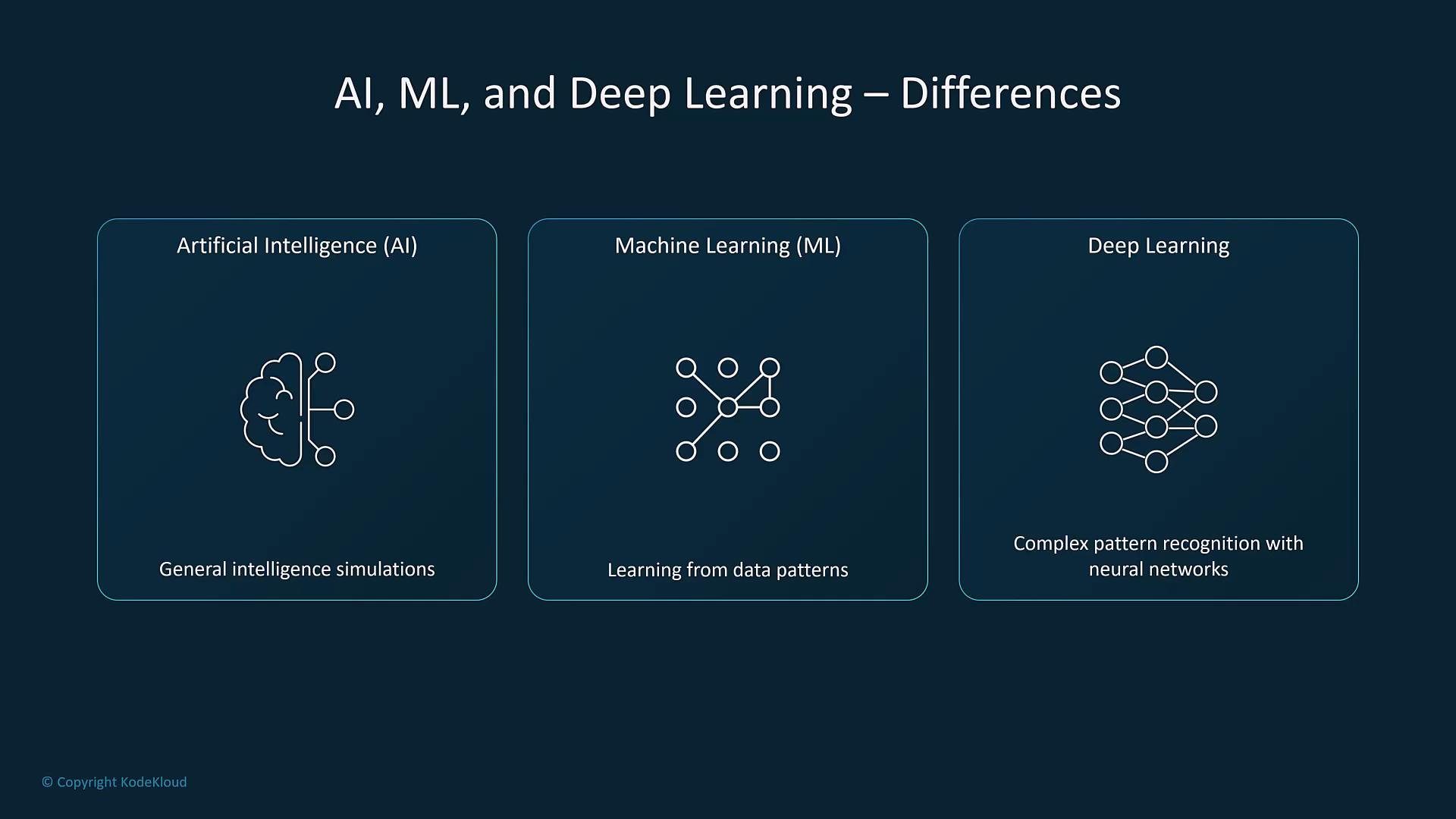
- Scope: The umbrella field encompassing any method that enables machines to mimic human-like intelligence and decision-making.
- Techniques: Rule-based systems (expert systems), planning/search, symbolic reasoning, knowledge representation, and learning-based methods.
- Typical goals and applications: Automation, decision support, perception, robotics, autonomous systems, and natural language understanding.
- Scope: A subset of AI focused on building models that learn patterns from data to make predictions or decisions.
- Techniques: Supervised learning (classification, regression), unsupervised learning (clustering, dimensionality reduction), and reinforcement learning.
- Common algorithms: Linear/logistic regression, decision trees, random forests, support vector machines, k-means clustering, gradient boosting.
- Typical workflow: Data collection → feature engineering → model selection → training/validation → deployment/monitoring.
- Typical use cases: Spam detection, fraud detection, recommendation systems, predictive maintenance, time-series forecasting.
- Scope: A subset of ML that models complex patterns using deep neural networks with multiple hidden layers.
- Strengths: Automatic hierarchical feature learning from large amounts of data, especially unstructured data (images, audio, text).
- Common architectures: Convolutional Neural Networks (CNNs) for vision, Recurrent Neural Networks / Transformers for sequences and language, Generative Adversarial Networks (GANs) for generation tasks.
- Resource needs: Often requires large labeled datasets and specialized hardware (GPUs/TPUs) for training.
- Typical applications: Image recognition, speech recognition, neural machine translation, large language models, generative models.
Choosing between ML and DL
Which approach is right depends on your problem, available data, and constraints:
-
Choose classical ML when:
- Data is structured/tabular and labeled examples are moderate.
- Interpretability and shorter development or inference time are important.
- Manual feature engineering can capture the signal effectively (e.g., business KPIs, sensor features).
-
Choose DL when:
- You have large volumes of data, especially unstructured (images, audio, text).
- The task benefits from hierarchical feature extraction (e.g., object detection, speech-to-text, machine translation).
- You can afford the compute and engineering needed for longer training and tuning.
Key practical considerations
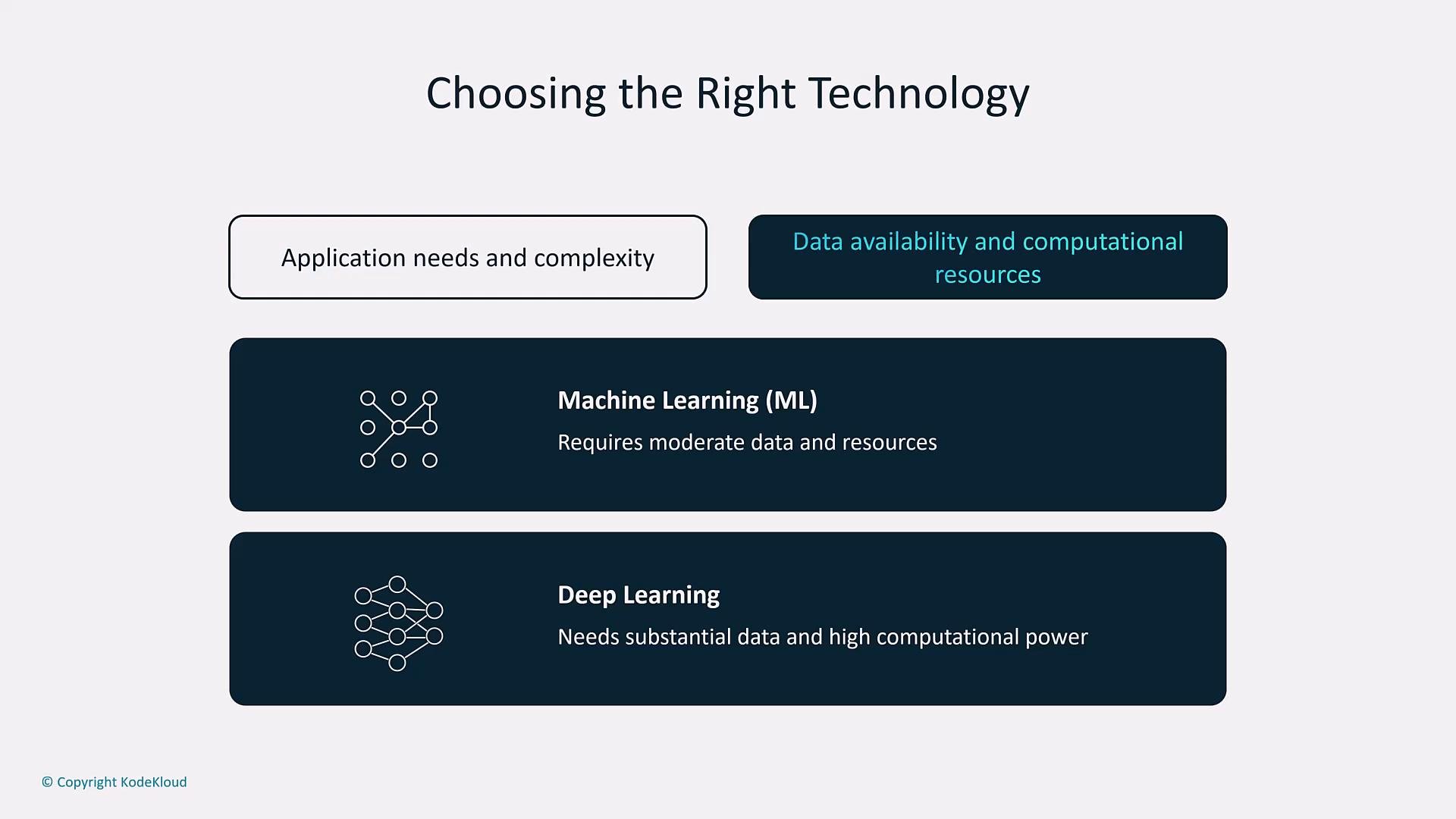
- Data quality and quantity: High-quality labels matter for both ML and DL. ML often performs well on smaller, curated datasets, while DL often needs much larger labeled datasets unless you use transfer learning or self-supervised approaches.
- Compute and infrastructure: DL training benefits from GPUs/TPUs and distributed training; ML often trains quickly on CPUs.
- Interpretability: Prefer classical ML (trees, linear models) when model explanations are required by stakeholders or regulation.
- Development time and engineering: DL can reduce manual feature engineering but usually increases time for model architecture search, tuning, and infrastructure setup.
- Hybrid approaches: Combine strengths — for example, use DL to extract features from images or text, then apply a classical ML model for downstream decision-making or to improve interpretability.
- Define the problem and metric(s) (accuracy, F1, latency, cost).
- Start with a simple baseline: a basic model and straightforward features.
- Iterate: improve data quality, feature engineering, and model selection.
- If baseline plateaus and you have data/compute, consider deep learning or hybrid models.
- Monitor models in production for drift and retrain as needed.
- scikit-learn (classical ML): https://scikit-learn.org/
- TensorFlow (deep learning): https://www.tensorflow.org/
- PyTorch (deep learning): https://pytorch.org/
- Practical guides:
- AI is the broad umbrella for systems that exhibit intelligent behavior.
- ML is the data-driven subset of AI that learns models from examples.
- DL is a subset of ML based on deep neural networks, ideal for complex tasks on large, unstructured datasets.
- Choose the technology based on task complexity, data availability, interpretability requirements, and compute budget. Start simple, measure, and scale up to DL or hybrid approaches when justified.
When in doubt, start with a simple baseline ML model and a clear evaluation metric. If performance plateaus and you have sufficient data and compute, consider moving to deep learning or hybrid approaches.