

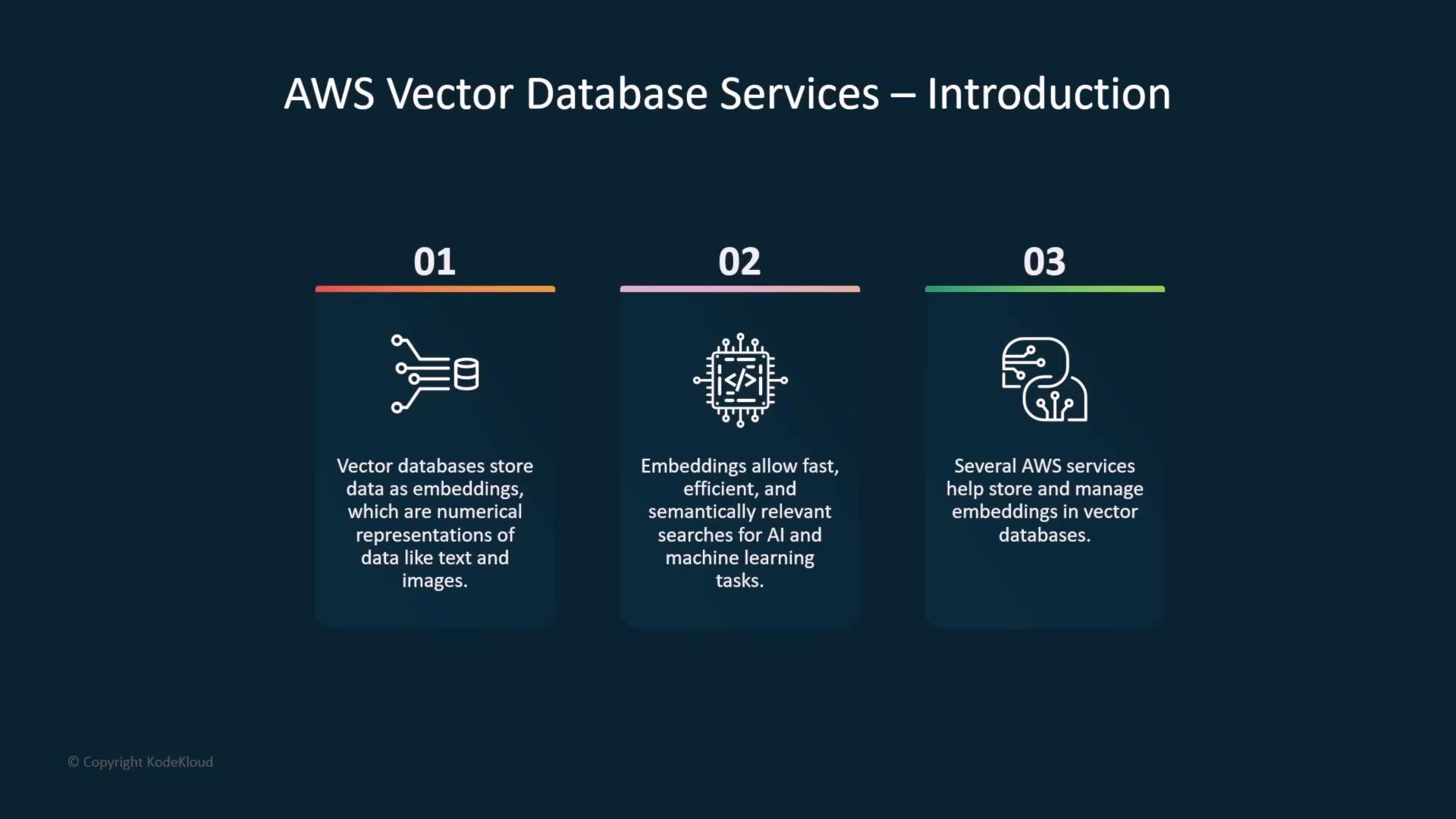
AWS options for vector embeddings
Amazon OpenSearch Service (vector search for generative AI)
Amazon OpenSearch Service (the managed successor to Elasticsearch on AWS) supports high-performance k-NN vector similarity search and can act as a vector store for generative AI workloads.- High-performance k-NN search for fast semantic retrieval.
- Real-time ingestion and indexing so newly generated embeddings become searchable immediately.
- Integrates with ML tooling such as Amazon Bedrock and AWS SageMaker for embedding generation and model inference.
- Serverless and managed deployment options allow auto-scaling to meet dynamic workloads.
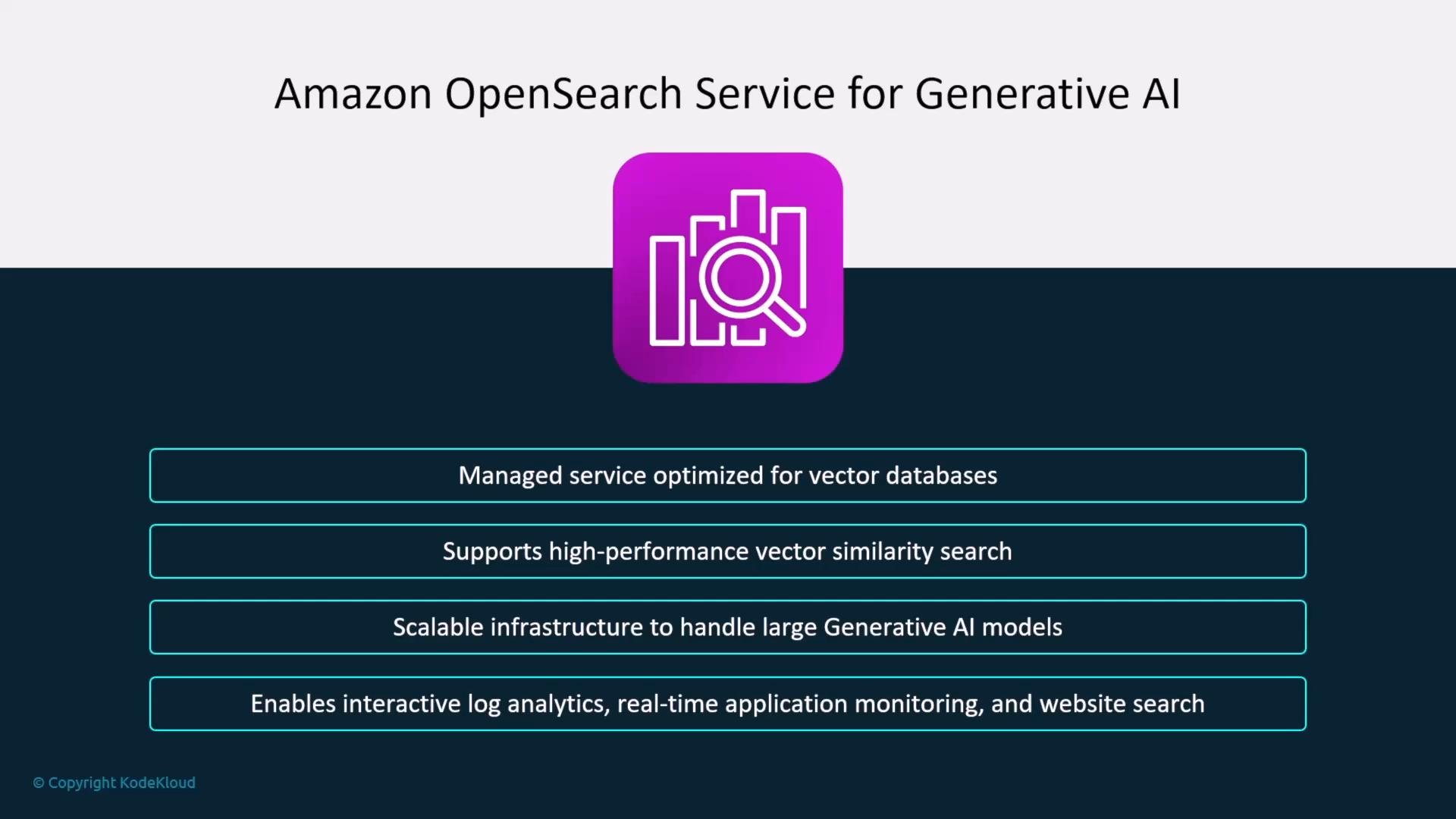
- k-NN vector search to find semantically similar items.
- Easy integration with Bedrock and SageMaker embeddings.
- Real-time ingestion and indexing to support interactive applications.
Amazon Aurora (PostgreSQL-compatible) & Amazon RDS for PostgreSQL (pgvector)
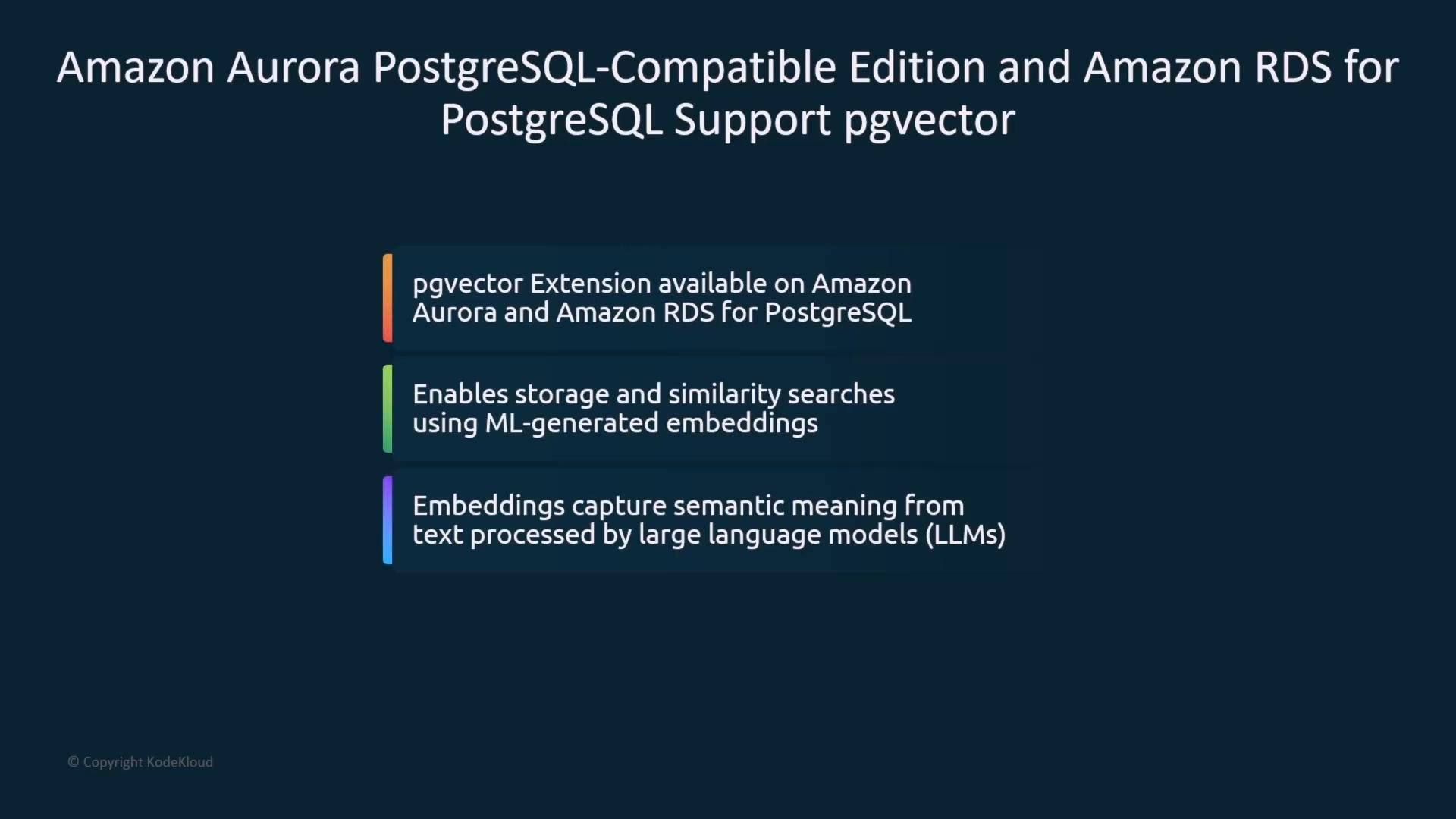
Both Amazon Aurora PostgreSQL-Compatible Edition and Amazon RDS for PostgreSQL support thepgvector extension, letting you store and query vector embeddings directly inside a relational database.
- Combine SQL capabilities (transactions, joins, indexes) with vector similarity search using
pgvector. - Store ML-generated embeddings from Amazon Bedrock, AWS SageMaker, or other LLMs and run vector queries alongside standard SQL operations.
- Good fit for catalogs, recommendation systems, and applications that need ACID guarantees plus semantic search.
Amazon Neptune ML (graph + Graph Neural Networks)
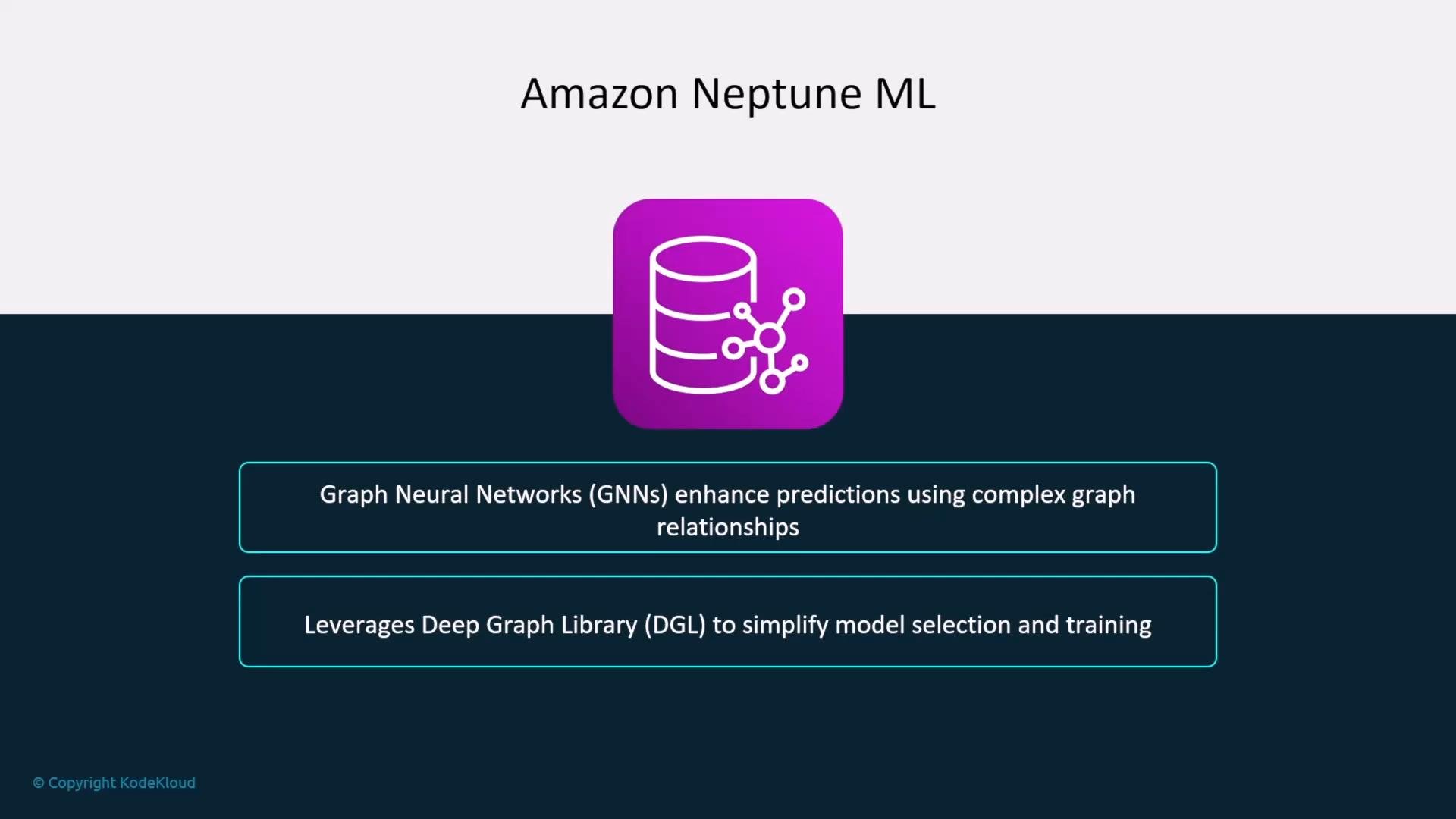
Amazon Neptune ML extends Neptune with Graph Neural Network (GNN) capabilities for graph-native ML tasks.- Leverages frameworks like the Deep Graph Library (DGL) to simplify model selection and training for graph ML.
- Ideal when relationships and topology matter: social graphs, knowledge graphs, fraud detection, or complex recommendations.
- GNNs improve predictions by combining node/edge features with graph structure.
Amazon MemoryDB (Redis-compatible, in-memory vector search)
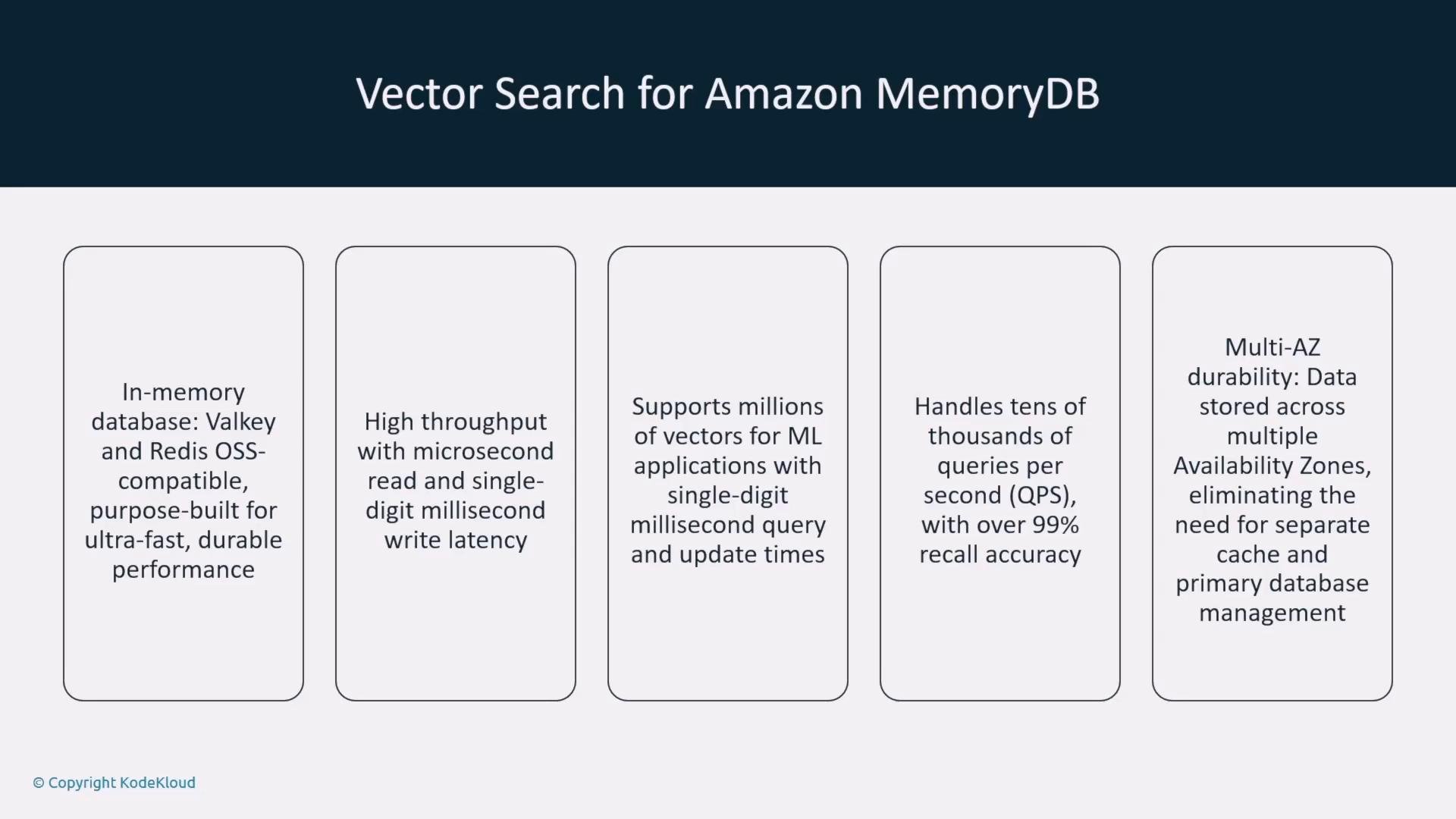
Amazon MemoryDB is a Redis-compatible, in-memory data store suitable for ultra-low-latency vector retrieval.- In-memory storage gives microsecond reads and single-digit millisecond writes.
- Scales to handle millions of vectors and high QPS workloads.
- Can be configured for Multi-AZ durability for production reliability.
Amazon DocumentDB (MongoDB-compatible) with vector search
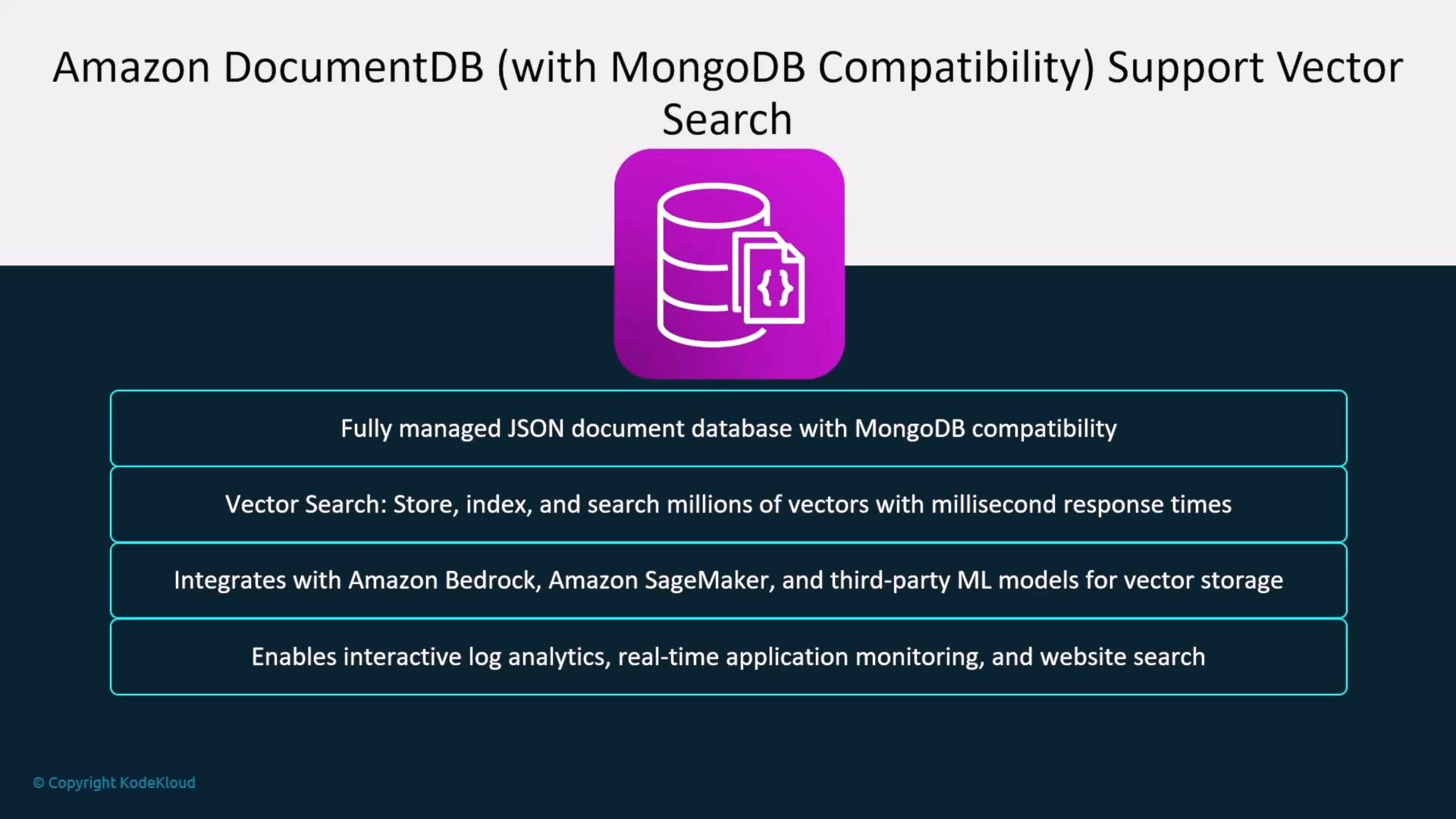
Amazon DocumentDB (MongoDB-compatible) adds vector search to a managed JSON document database.- Keeps the flexible document model (JSON) while enabling millisecond-range semantic retrieval.
- Works well for content-heavy or document-centric applications that combine full-text/document queries with semantic similarity.
- Integrates with Bedrock, SageMaker, and third-party models for embedding generation and retrieval.
Amazon Bedrock — custom knowledge bases and RAG
Amazon Bedrock supports retrieval-augmented generation (RAG) workflows and tooling for creating custom knowledge bases.- Store domain-specific documents and embeddings so RAG pipelines can retrieve relevant context at query time.
- Useful to keep model outputs domain-aware and current without retraining base models.
- Knowledge bases are updatable, improving recency and answer quality for generative apps.
Exam tip: Memorize the AWS services that support vector embeddings and vector search — OpenSearch, Aurora/RDS PostgreSQL with
pgvector, Neptune ML, MemoryDB, DocumentDB, and Bedrock (custom knowledge bases + RAG).Quick comparison
Choosing the right vector store
Consider these factors when selecting a vector store:- Latency requirements: real-time interactive apps often require in-memory or optimized search stores.
- Scale: expected vector count and QPS will influence managed service choice and architecture.
- Data model: relational joins, document structure, or graph relationships favor different services.
- Consistency/transactions: if ACID semantics are required, prefer Aurora/RDS.
- Integration with ML tooling: verify integrations with Bedrock, SageMaker, or your embedding pipeline.
Summary
Vector embeddings are foundational for semantic search, multimodal retrieval, recommendations, and conversational AI. AWS provides multiple managed services to store, index, and query embeddings — choose based on latency, scale, data model, and integration needs:- OpenSearch: managed, scalable vector search with real-time ingestion.
- Aurora/RDS PostgreSQL +
pgvector: SQL + vector search. - Neptune ML: graph-native GNNs for relationship-rich data.
- MemoryDB: in-memory, ultra-low-latency retrieval.
- DocumentDB: document-mode vector search for JSON-centric apps.
- Bedrock: RAG workflows and custom knowledge bases for generative AI.
Links and references
- Amazon Bedrock — Introduction course
- AWS SageMaker — Course
- Deep Graph Library (DGL): https://www.dgl.ai/
- pgvector (PostgreSQL extension): https://github.com/pgvector/pgvector