Welcome. This lesson introduces core artificial intelligence (AI) concepts and terminology to help you prepare for the AWS Certified AI Practitioner exam. We cover why AI matters to organizations, common application areas, differences between rule-based and ML systems, and the relationships between AI, machine learning (ML), and deep learning (DL). This course emphasizes practical business drivers for AI adoption: increasing efficiency, lowering operational costs, and accelerating data-driven decision-making. AI systems act as force multipliers—automating complex tasks and interactions such as customer support, fraud detection, and data analysis.
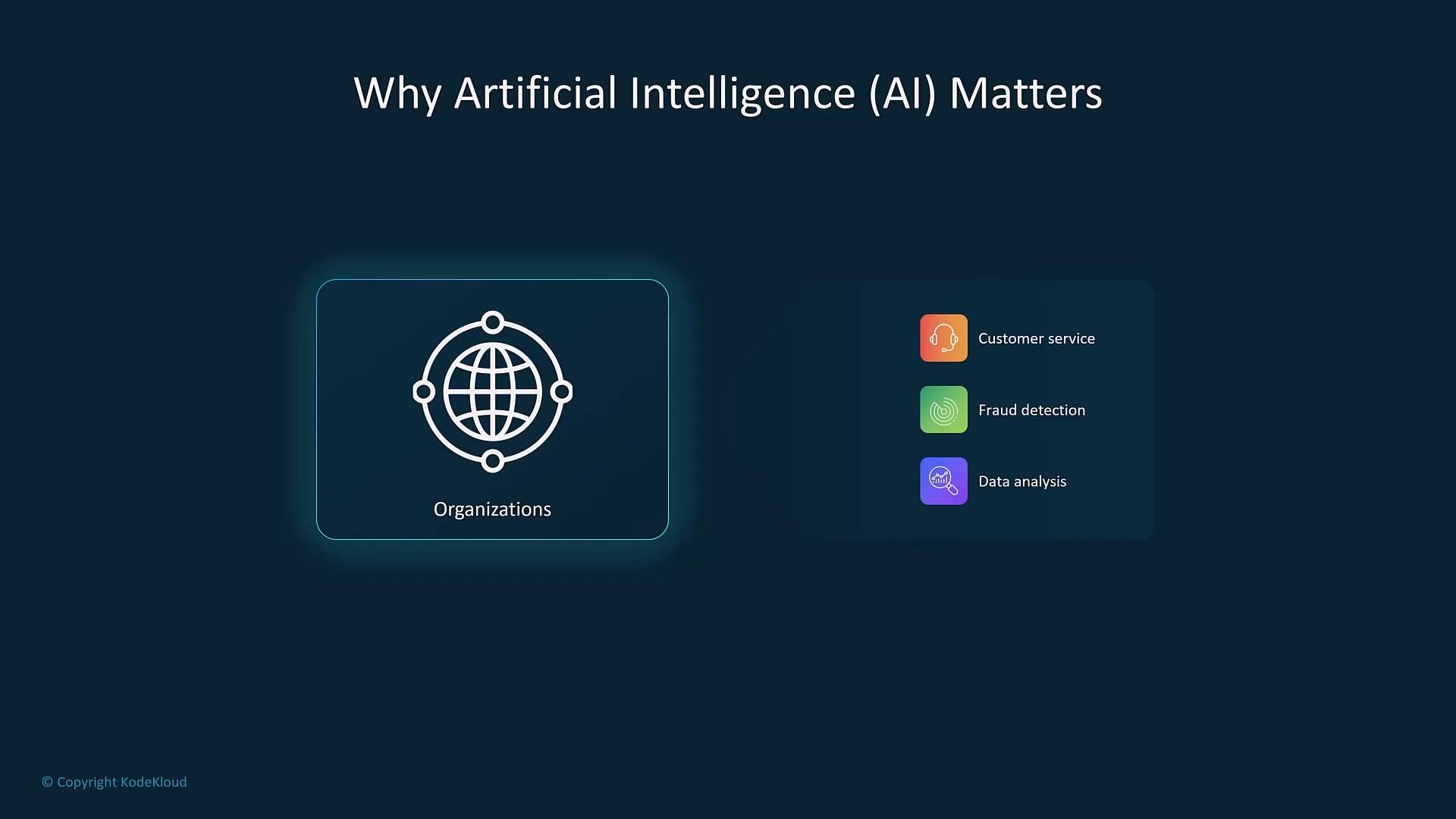
A presentation slide titled "Why Artificial Intelligence (AI) Matters" showing a large "Organizations" globe icon on the left. On the right are three colored icons labeled "Customer service," "Fraud detection," and "Data analysis."
AI adoption improves customer experience while reducing human workload. As demand for AI skills grows, businesses use AI to gain deeper insights and make faster, more accurate decisions. Common real-world examples include AI-powered chatbots, automated code generation, and analytics pipelines that surface actionable trends from large datasets. AWS provides a broad set of services to support ML and AI deployments. For example, Amazon SageMaker is a managed platform for building, training, and deploying models at scale, while Amazon Rekognition offers image- and video-analysis capabilities such as face and object detection.
Amazon SageMaker supports end-to-end ML workflows (build → train → deploy). For image/video analysis use cases, consider Amazon Rekognition; for speech-to-text, see Amazon Transcribe.
A presentation slide titled "Why Artificial Intelligence (AI) Matters" displaying icons for Amazon SageMaker and Amazon Rekognition. The slide has a dark header and footer with the icons centered on a pale background.

Rule-based systems vs. machine learning

Rule-based systems follow explicit, hand-crafted logic—for example, “approve loans when credit score > 750.” They are deterministic, simple to implement, and cost-effective when inputs and outputs are consistent and requirements are stable. Machine learning systems, by contrast, are probabilistic. They learn patterns from data and can generalize to unseen inputs, making them better suited to prediction, recommendation, and forecasting tasks where explicit rules would become complex or brittle. ML systems can be retrained with new data to adapt to changing conditions. Table: Rule-based vs ML comparison

What is Artificial Intelligence?

Artificial intelligence is the broad field of computer science focused on creating systems that perform tasks typically requiring human intelligence. The scope of AI ranges from simple automation to advanced capabilities such as perception, reasoning, and natural-language processing.
A presentation slide titled "Artificial Intelligence (AI)" showing the definition: AI is a branch of computer science focused on creating systems capable of performing tasks that typically require human intelligence.
Common AI capabilities include:
  • Visual perception: image and video analysis
  • Speech recognition and transcription
  • Decision-making and planning
  • Natural-language understanding and translation
A slide titled "Artificial Intelligence (AI)" with four colored circular icons along the bottom representing key capabilities: visual perception, speech recognition, decision-making, and language translation. Each icon has a simple line symbol and label beneath it.

Narrow AI vs General AI

  • Narrow AI (specialized): Systems built for a single task or domain—e.g., voice assistants, recommendation engines, or image classifiers.
  • General AI (broad): A theoretical system able to perform any intellectual task a human can. Despite advances in generative AI, true general AI remains a research goal and is not yet realized.
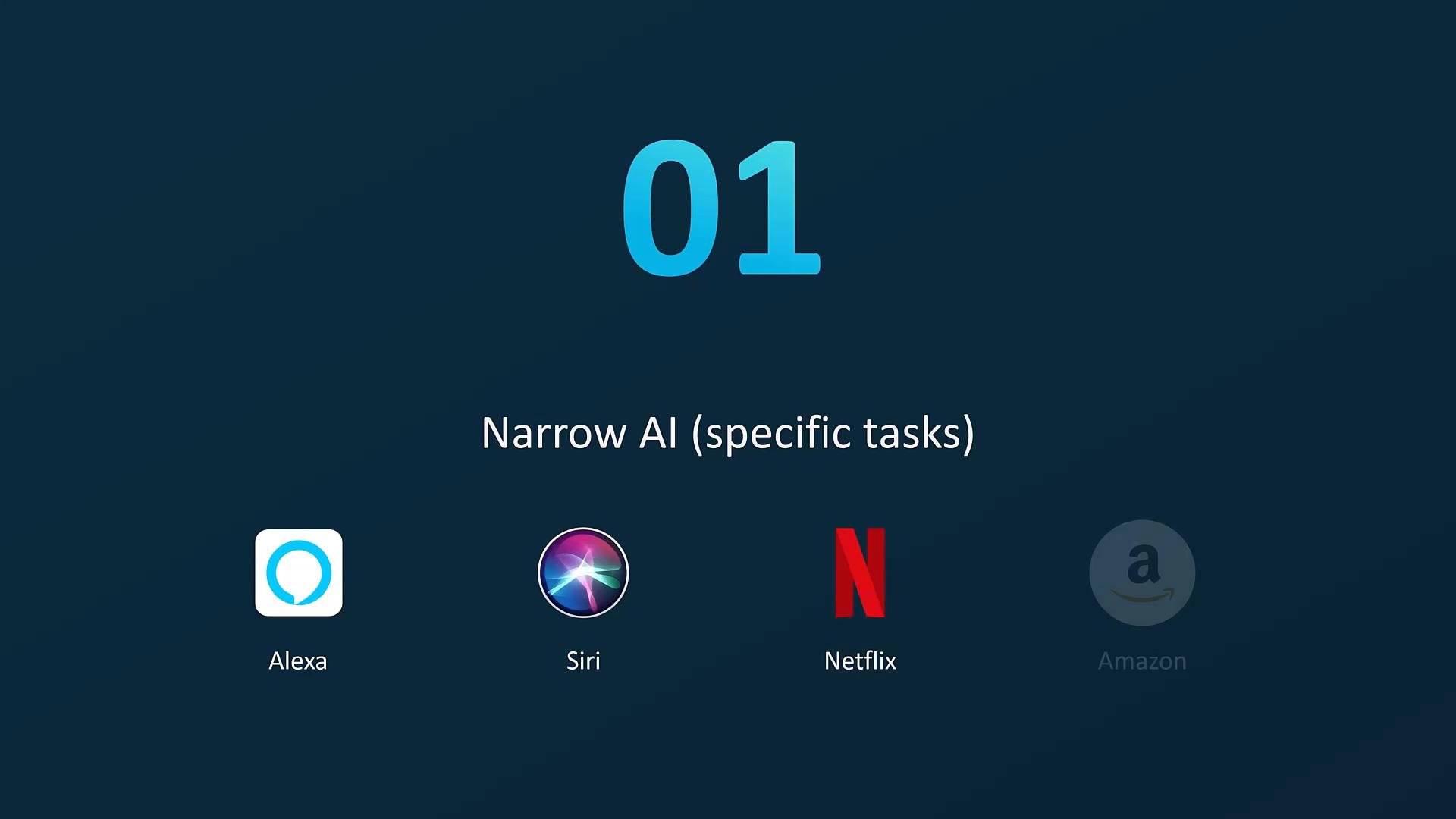
A presentation slide reading "01 Narrow AI (specific tasks)" with a large blue "01" at the top. Icons for Alexa, Siri, Netflix and Amazon are shown along the bottom.
A presentation slide showing a large "02" with the title "General AI (broad capabilities)" and a small icon of a head with circuitry and a gear. The caption below mentions a theoretical form of AI with broad problem‑solving abilities.
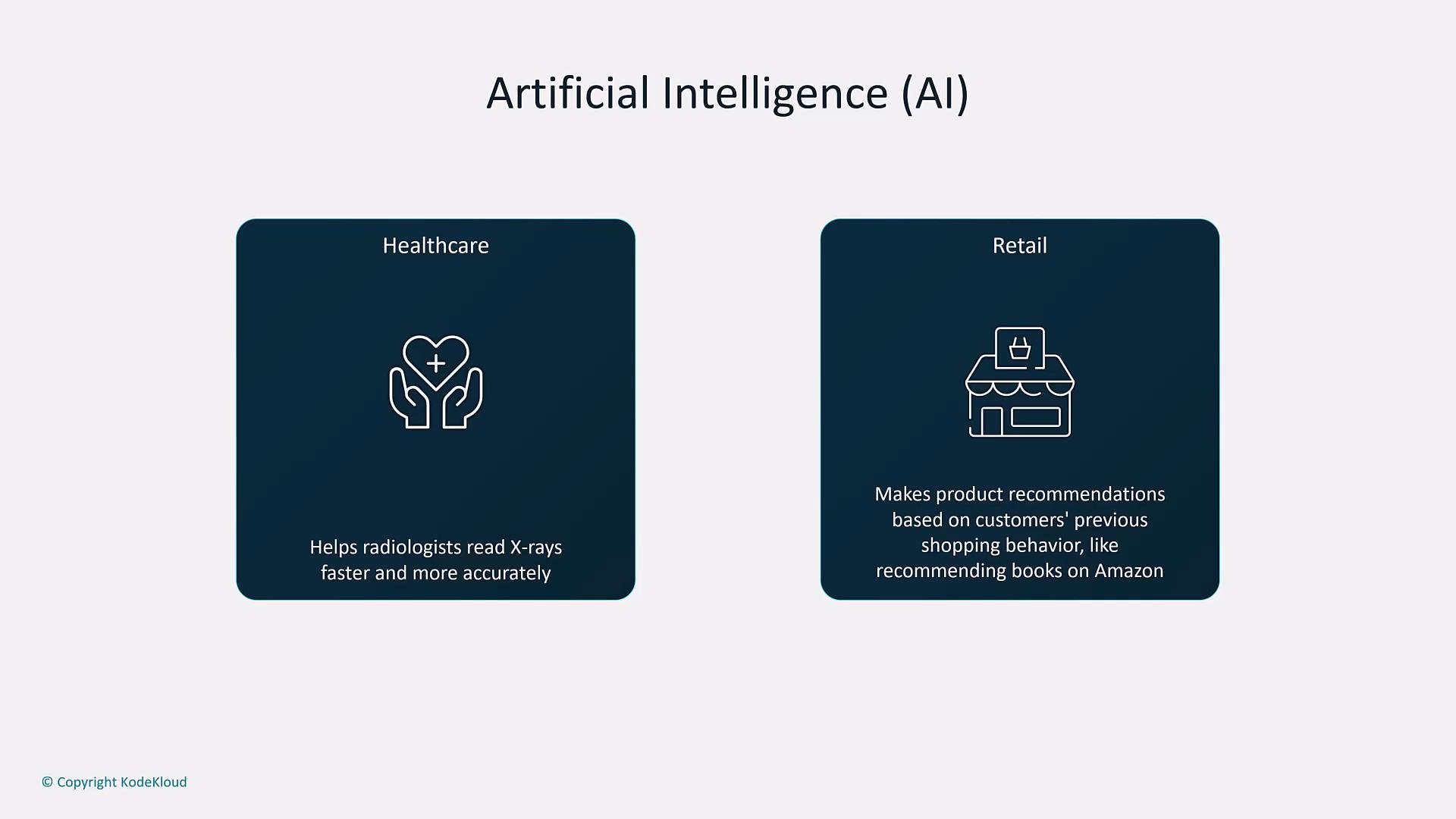
Practical examples: AI can help radiologists read X-rays faster or personalize retail product recommendations based on previous customer behavior.
A slide titled "Artificial Intelligence (AI)" showing two example applications: Healthcare and Retail. The Healthcare box says AI helps radiologists read X‑rays faster and more accurately, and the Retail box says AI makes product recommendations based on customers' previous shopping behavior.

Machine learning (ML) fundamentals

Machine learning is a subset of AI that uses algorithms, mathematical models, and statistics to learn patterns from data—structured and unstructured, labeled and unlabeled. After training, an ML model applies learned patterns to new inputs. Key concepts:
  • Training data: examples used to teach the model (often labeled).
  • Validation/test sets: used to evaluate generalization and tune hyperparameters.
  • Generalization: the model’s ability to perform well on unseen data.
Examples:
  • Spam filters learn features of spam emails from labeled examples.
  • Chatbots improve responses by learning from conversation logs and user feedback.
High-quality, correctly labeled training data is essential. Models trained on biased or noisy data will likely produce biased or unreliable predictions.

Deep learning and neural networks

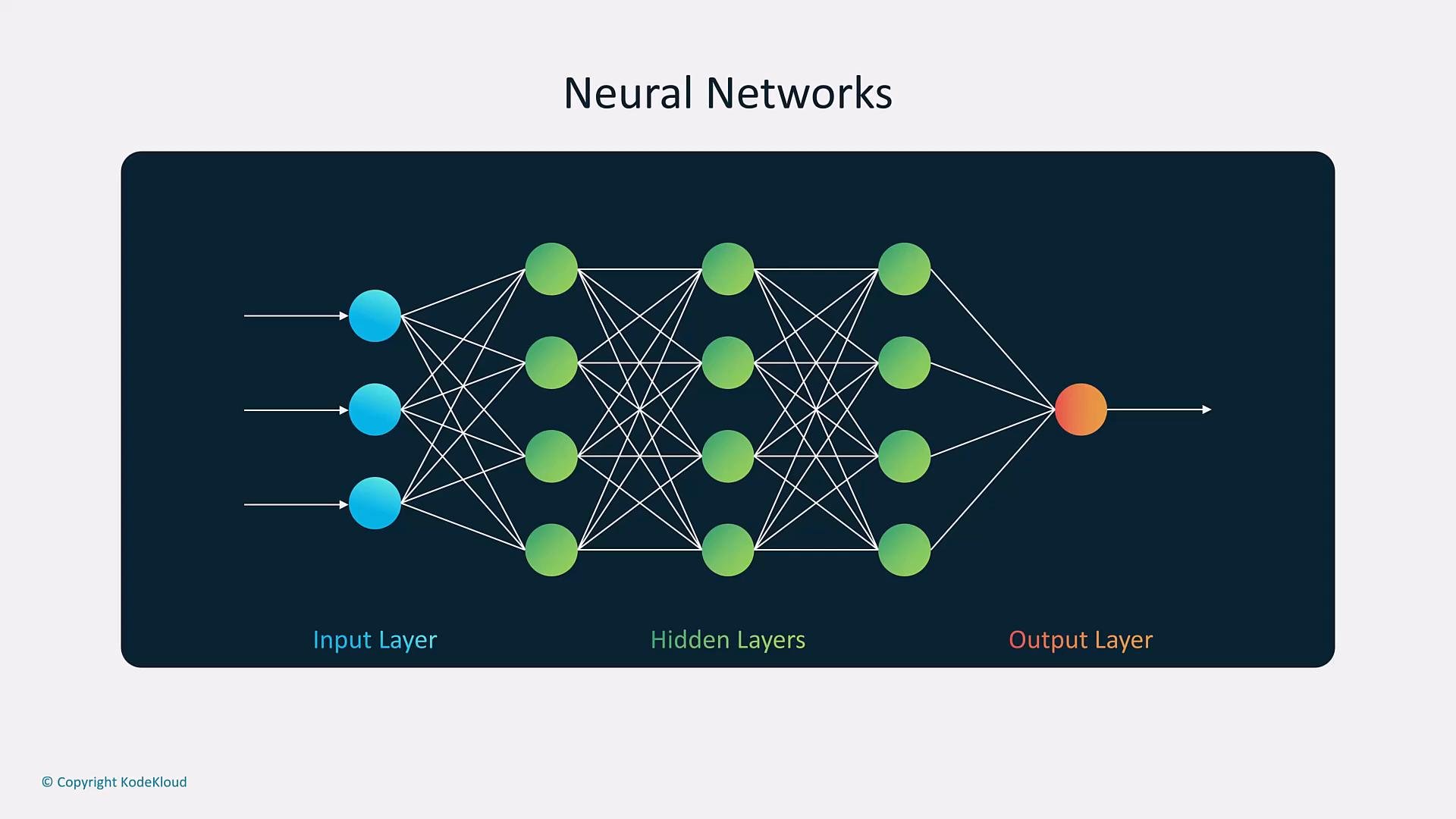
Deep learning is a subset of ML that uses multi-layered neural networks to learn hierarchical representations. Layers of artificial neurons transform input features through weighted connections and nonlinear activations. Deep networks automatically discover increasing levels of abstraction—useful for image recognition, speech recognition, and language modeling.
A presentation slide titled "Deep Learning" with large blue text reading: "Deep Learning is a subset of ML that uses multi-layered neural networks to model and solve more complex problems." A small "© Copyright KodeKloud" appears in the bottom-left corner.
Conceptual example: Given an image of a cat, early neural layers detect edges and textures, mid-layers combine these into shapes like ears and eyes, and later layers integrate shapes to predict “cat” with a confidence score.
A schematic diagram of a neural network titled "Neural Networks," showing layers of interconnected nodes. Three blue input nodes feed into multiple green hidden-layer nodes, which in turn connect to a single orange output node.

AI, ML, and Deep Learning — concise comparison
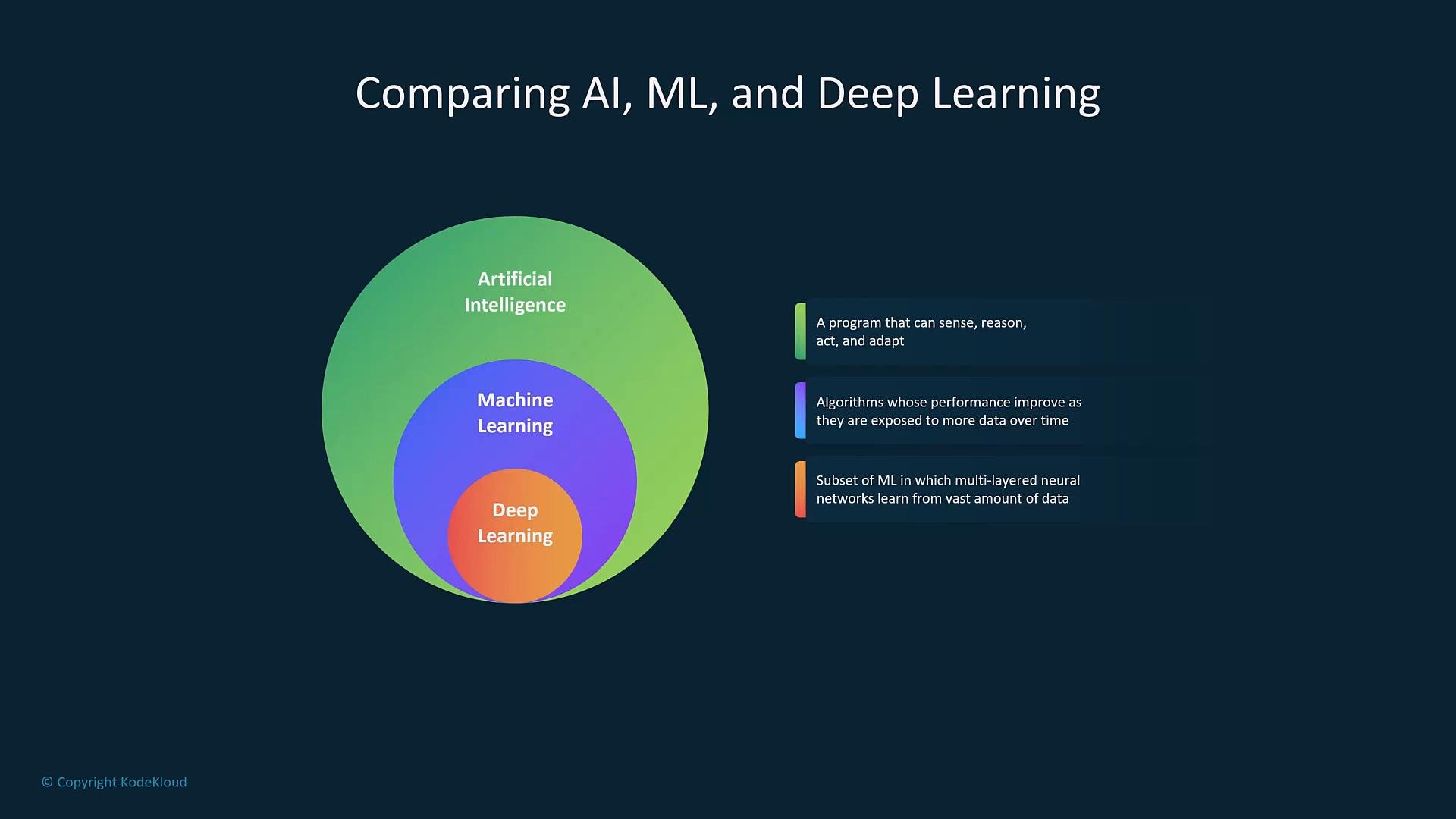
A dark-themed slide titled "Comparing AI, ML, and Deep Learning" showing three nested colored circles labeled Artificial Intelligence (largest), Machine Learning (middle), and Deep Learning (smallest). To the right are short definitions for each term explaining their relationships.
Thanks for reading this lesson.

Watch Video