

- Training from scratch is costly in time, data, and compute. Pre‑trained models provide a strong starting point and often enable transfer learning or fine‑tuning to solve specific tasks with far less effort.
- Use cases: domain adaptation, prototypes, multimodal tasks, and scenarios where labeled data is limited.
- Availability & compatibility
- Customization & extensibility
- Transparency: interpretability vs explainability
- Performance vs. explainability trade‑offs
- Hardware & operational constraints
- Data privacy, governance, and training approach
- Maintenance, bias, and fairness
Availability and compatibility
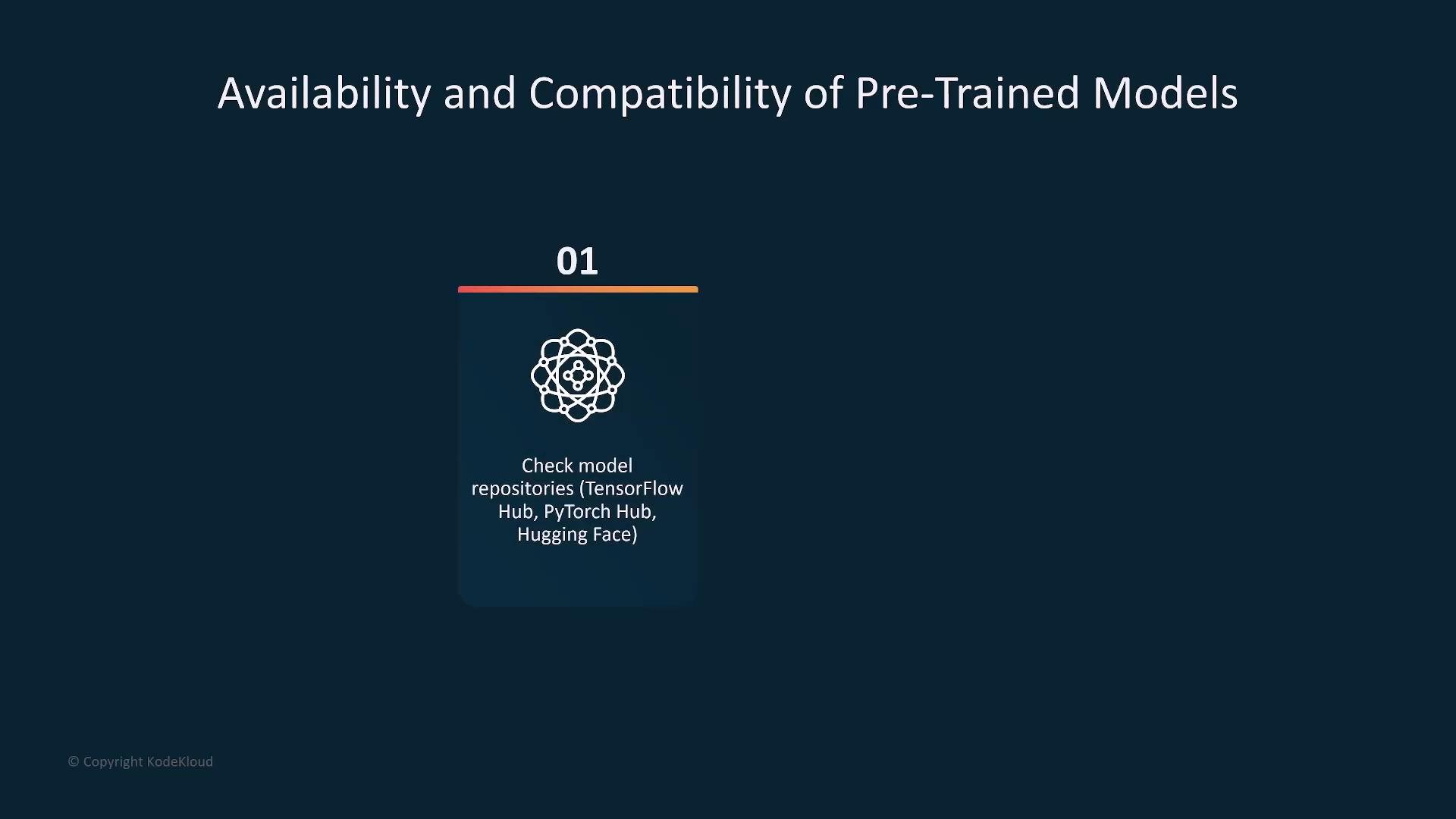
Before adopting a model, verify that it integrates with your stack and operational requirements:- Repositories: Hugging Face, PyTorch Hub, TensorFlow Hub.
- Compatibility checks:
- Framework and runtime support (PyTorch, TensorFlow, ONNX).
- Tooling and orchestration (e.g., LangChain or your serving platform).
- Model license and terms of use.
- Maintenance: Is the project actively updated? Are issues and release notes tracked?
- Known limitations: performance on specific data types, reproducibility, documented failure modes.
Customization and extensibility
Decide how much you can adapt the model for your task:- Fine‑tuning scope: full‑weight updates, adapters, LoRA, or prompt‑only approaches.
- Retrieval and context: do you need a retrieval‑augmented architecture (RAG) or expanded context windows to meet accuracy needs? See RAG examples at Hugging Face: https://huggingface.co/docs/transformers/main/en/model_doc/rag
- Tuning controls: temperature, attention or decoding controls, adapters, and other knobs.
- Impact: customization approach affects compute, latency, cost, and maintainability.
Transparency: interpretability vs explainability
- Interpretability: exact, human‑readable understanding of internal logic (realistic for simple models such as linear models or decision trees).
- Explainability: approximate or surrogate explanations for complex models (neural networks, large foundation models). These help produce human‑understandable rationales but are not the model’s internal reasoning.
- Prefer interpretable models for decisions that must be fully auditable.
- Use explainability methods for high‑performing, complex models when you need human‑facing insights.
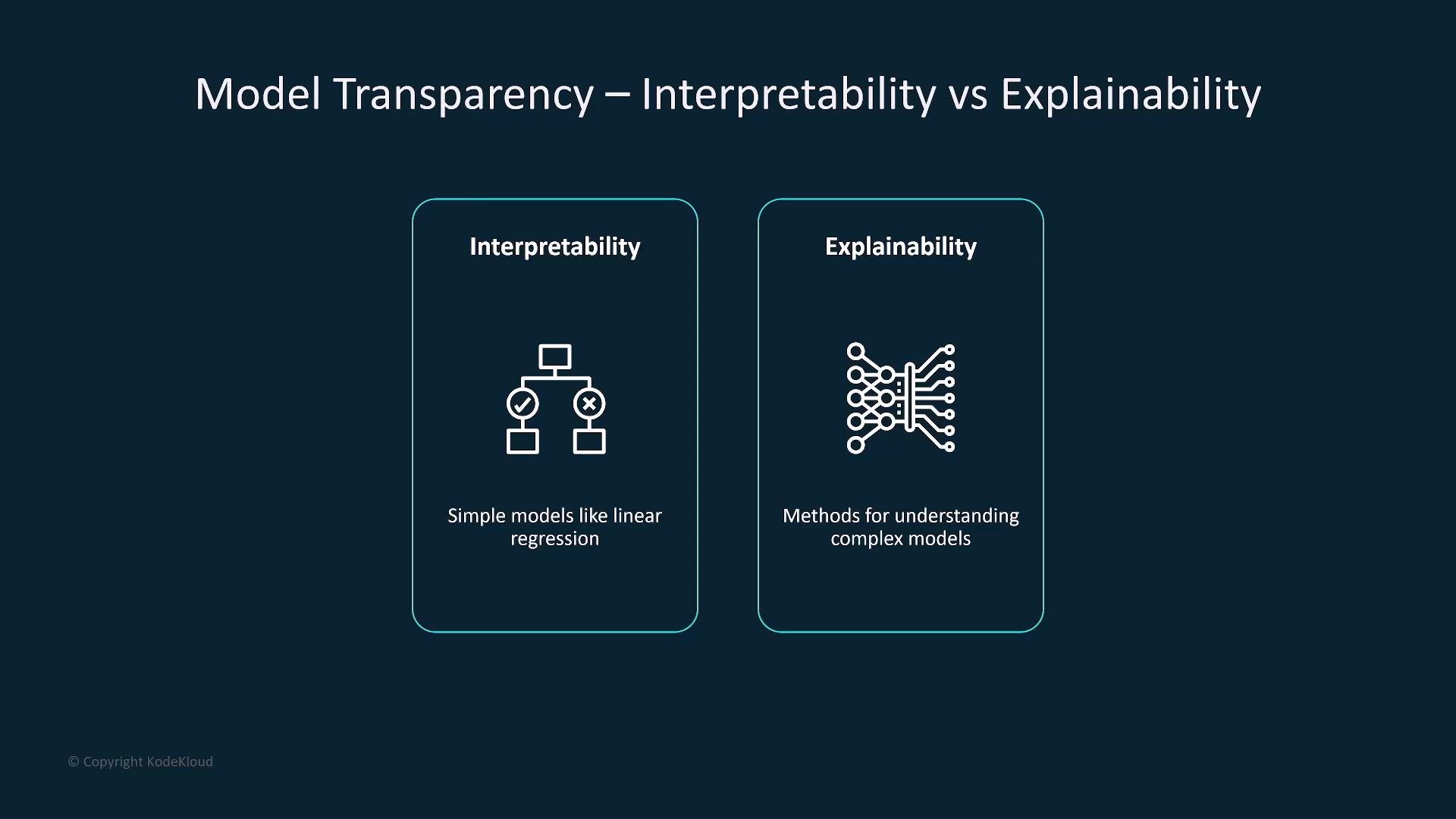
Use interpretable models when internal reasoning must be exact and auditable. For foundation models, apply explainability tools to create human‑readable insights without mistaking them for the model’s internal logic.
Explainability tools and their role
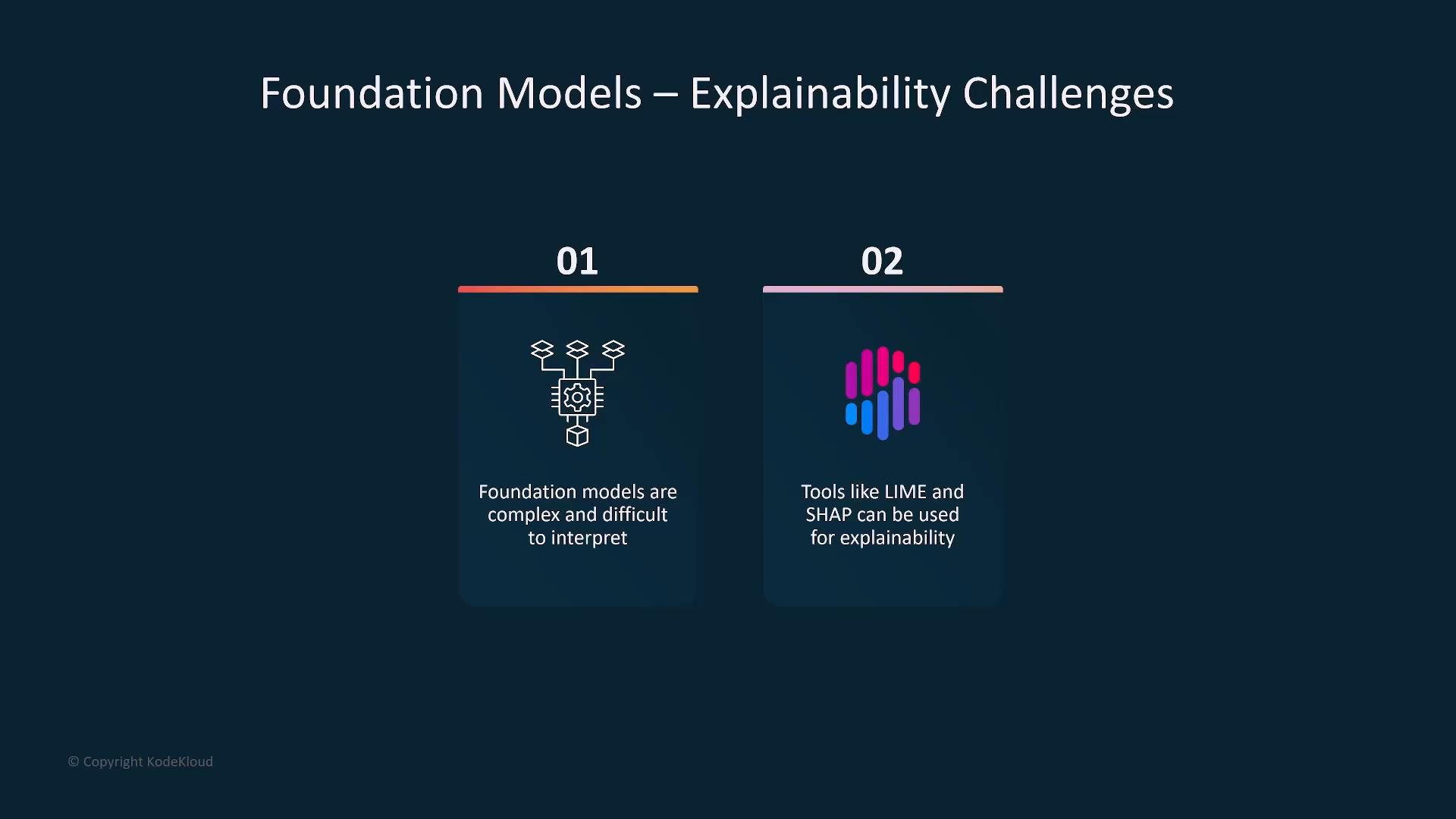
Common tools and patterns:- LIME (Local Interpretable Model‑agnostic Explanations): builds a local surrogate model around a prediction to highlight influential input features.
- SHAP (SHapley Additive exPlanations): uses cooperative game theory ideas to attribute feature contributions consistently across predictions.
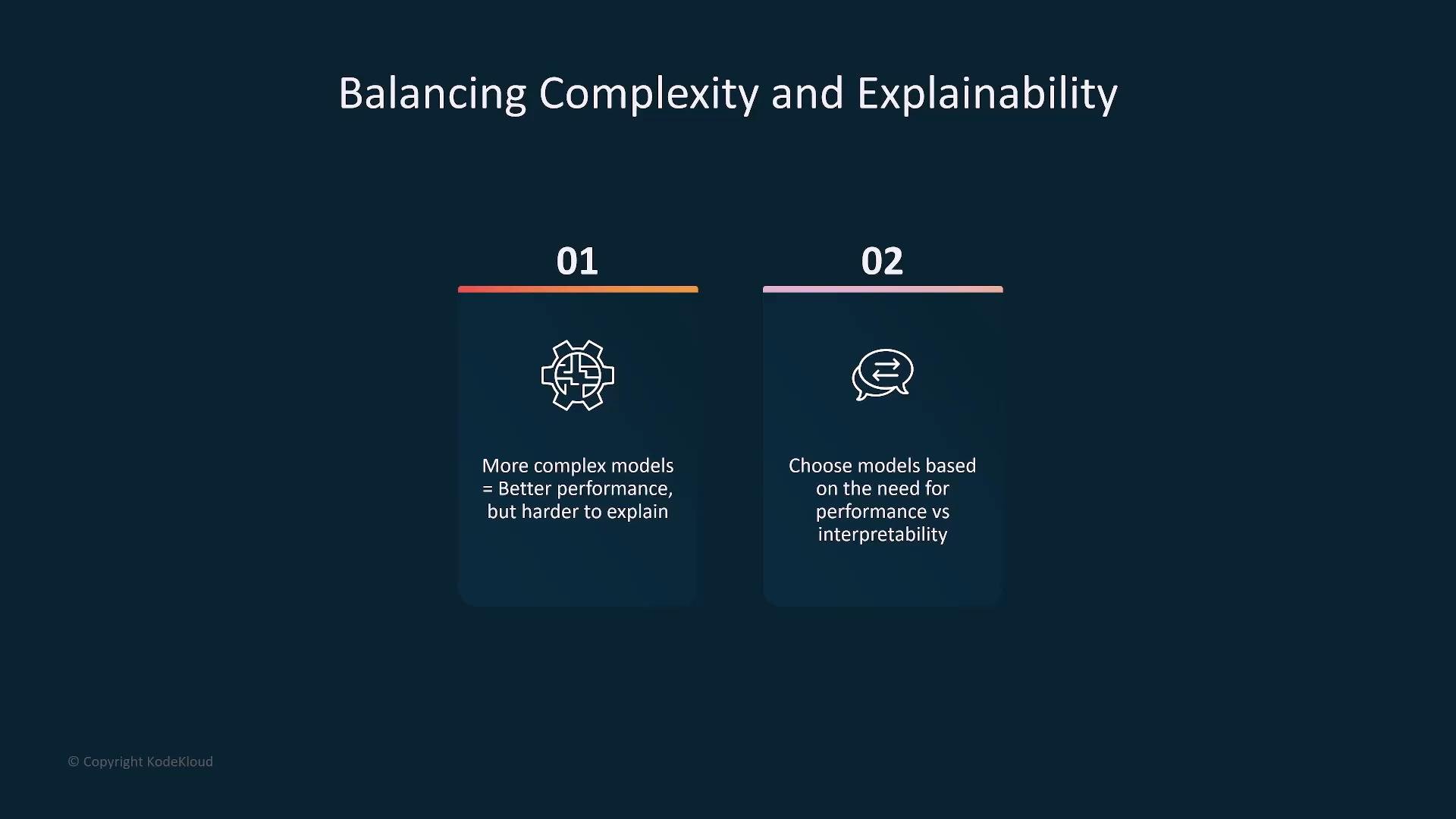
Performance vs. transparency trade‑off
- Complex models typically deliver higher accuracy but are harder to interpret.
- Choose based on your application’s risk tolerance and compliance needs:
- High performance with acceptable opacity plus explainability for internal or low‑risk features.
- Simpler, interpretable models when decisions need to be fully auditable or legally defensible.
Hardware and operational constraints
Assess infrastructure impact:- Training and inference compute: CPU, GPU, TPU requirements and available instances.
- Precision and memory: mixed precision, model sharding, tensor parallelism, memory footprint.
- Serving and SLOs: latency targets, autoscaling, and cost per inference.
- Maintenance: patching, model updates, retraining for drift, monitoring.
Data privacy and training approaches
If your data includes PII or regulated information, incorporate privacy‑preserving techniques early:- Federated learning: train across decentralized devices or silos without centralizing raw data.
- Differential privacy: add calibrated noise to protect individual records.
- Secure multiparty computation and homomorphic encryption for specialized setups.
- Data governance: access controls, data minimization, and retention policies.
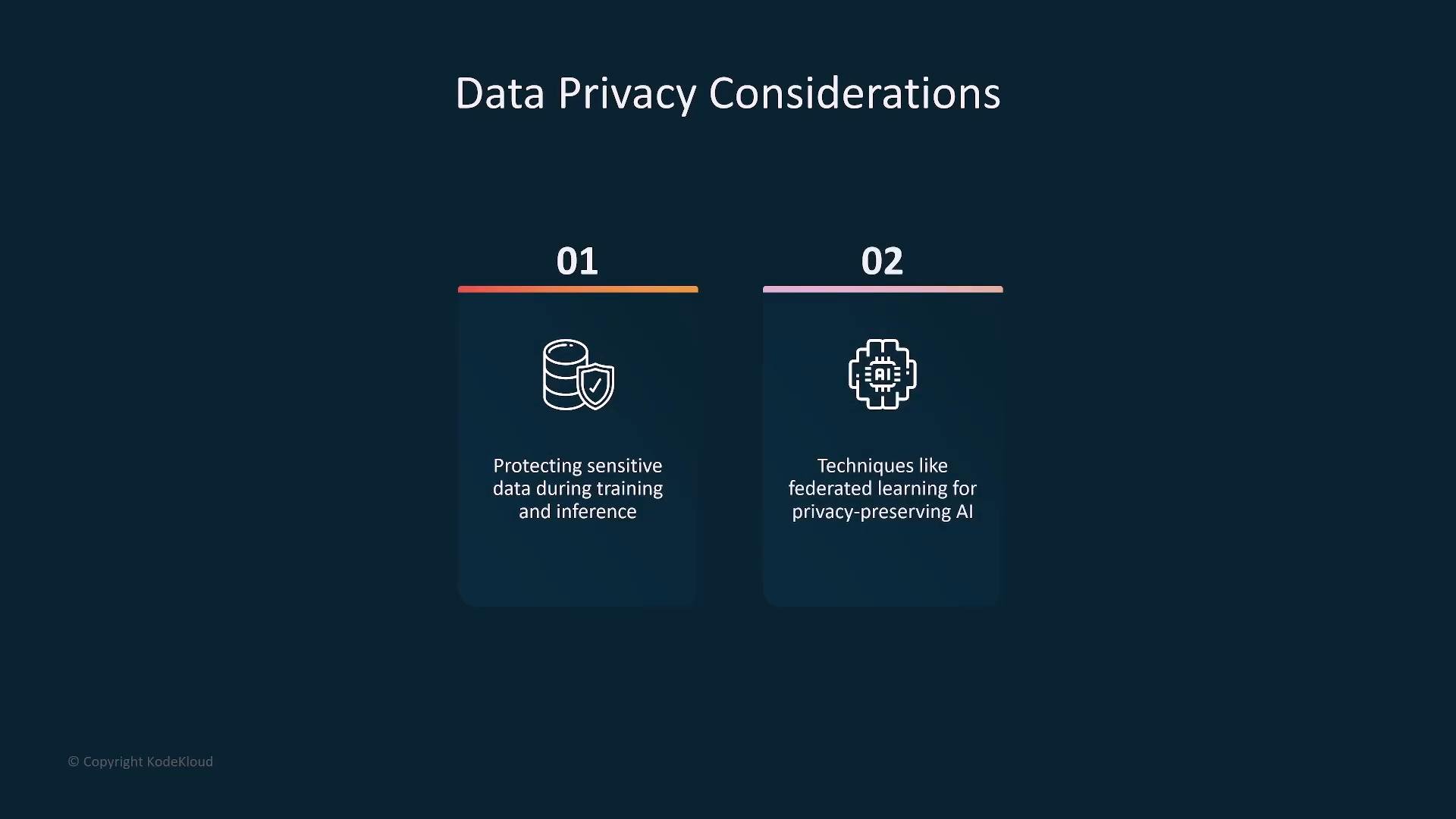
If you handle sensitive data, validate regulatory and contractual obligations before using third‑party pre‑trained models. Consider private hosting, on‑prem inference, or privacy‑enhancing training pipelines.
Transfer learning and fine‑tuning
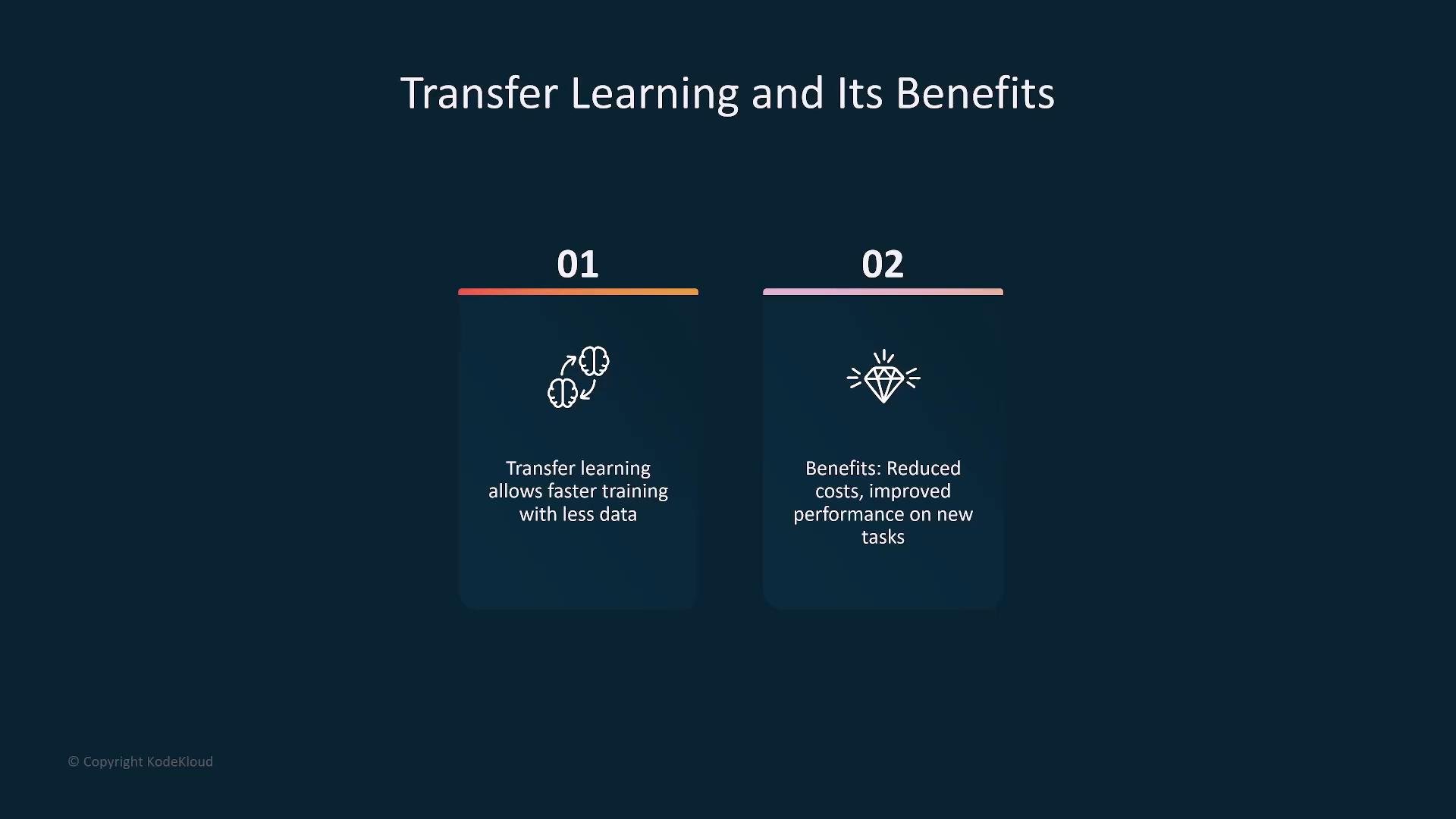
- Transfer learning lets you start from a model trained on broad data and adapt it for specific tasks, reducing training time and data needs.
- Fine‑tuning options:
- Full model fine‑tune (highest compute, best potential accuracy).
- Parameter‑efficient methods (adapters, LoRA) for lower cost and faster iteration.
- Prompt tuning or prompt engineering when weights cannot be modified.
- Choose the approach aligned to accuracy targets, compute budget, and deployment constraints.
Checklist: choosing a pre‑trained/foundation model
Summary
Selecting a pre‑trained model requires balancing technical, operational, and ethical factors. Use the checklist above to assess candidates, validate integration with your stack, and plan for monitoring and explainability in production. The right choice depends on your accuracy targets, compliance needs, available compute, and long‑term maintenance strategy.
Links and references
- Hugging Face: https://huggingface.co
- PyTorch Hub: https://pytorch.org/hub
- TensorFlow Hub: https://tfhub.dev
- LangChain: https://langchain.com
- RAG (retrieval‑augmented generation): https://huggingface.co/docs/transformers/main/en/model_doc/rag
- LIME: https://github.com/marcotcr/lime
- SHAP: https://github.com/slundberg/shap
- Amazon SageMaker & SageMaker Clarify: https://aws.amazon.com/sagemaker/ and https://aws.amazon.com/sagemaker/clarify/
- Federated learning (overview): https://en.wikipedia.org/wiki/Federated_learning
- Differential privacy (overview): https://en.wikipedia.org/wiki/Differential_privacy
- Secure multi‑party computation (overview): https://en.wikipedia.org/wiki/Secure_multi-party_computation