

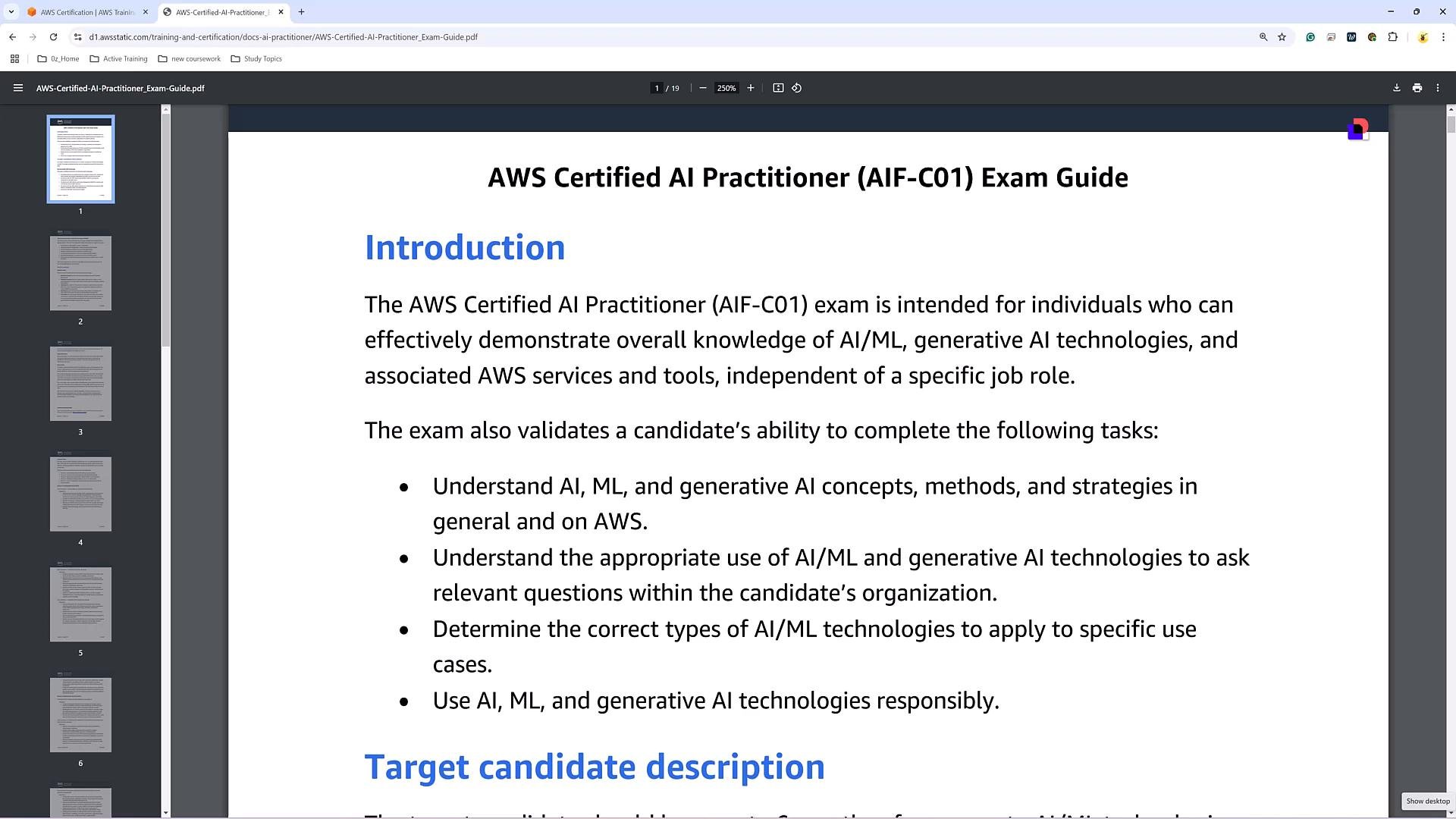
Overview and exam expectations
- Target audience: foundational-level AWS users with practical exposure to AI/ML concepts on AWS.
- Difficulty: a step up from the AWS Cloud Practitioner (CLF-C02). It assumes you already understand baseline AWS concepts.
- Recommended experience: roughly six months of hands-on AI/ML work on AWS (practical labs, building simple models, or using generative AI services).
- Scope and boundaries: the exam emphasizes understanding AI/ML concepts and generative AI use cases, design tradeoffs, and AWS services that support these tasks. It does not require building production ML pipelines or deep MLOps implementation details.
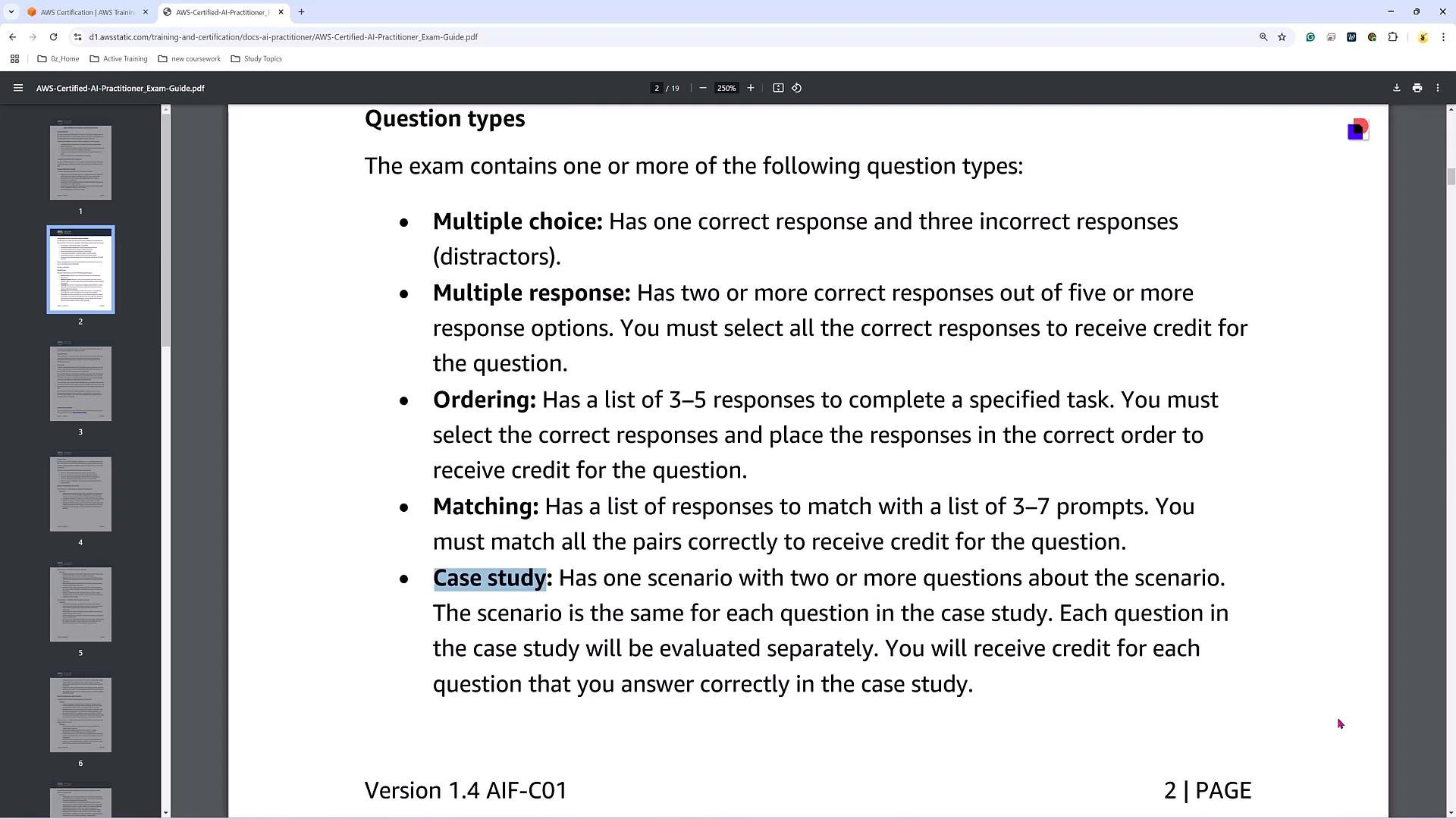
Question types and exam format
- Primary formats: multiple-choice and multiple-response questions.
- Other formats: ordering, matching, and case study questions are possible but uncommon.
- Tip: practice a mix of multiple-choice and scenario-based questions; prepare for an occasional matching or ordering item.
Length, scoring, and how scoring works
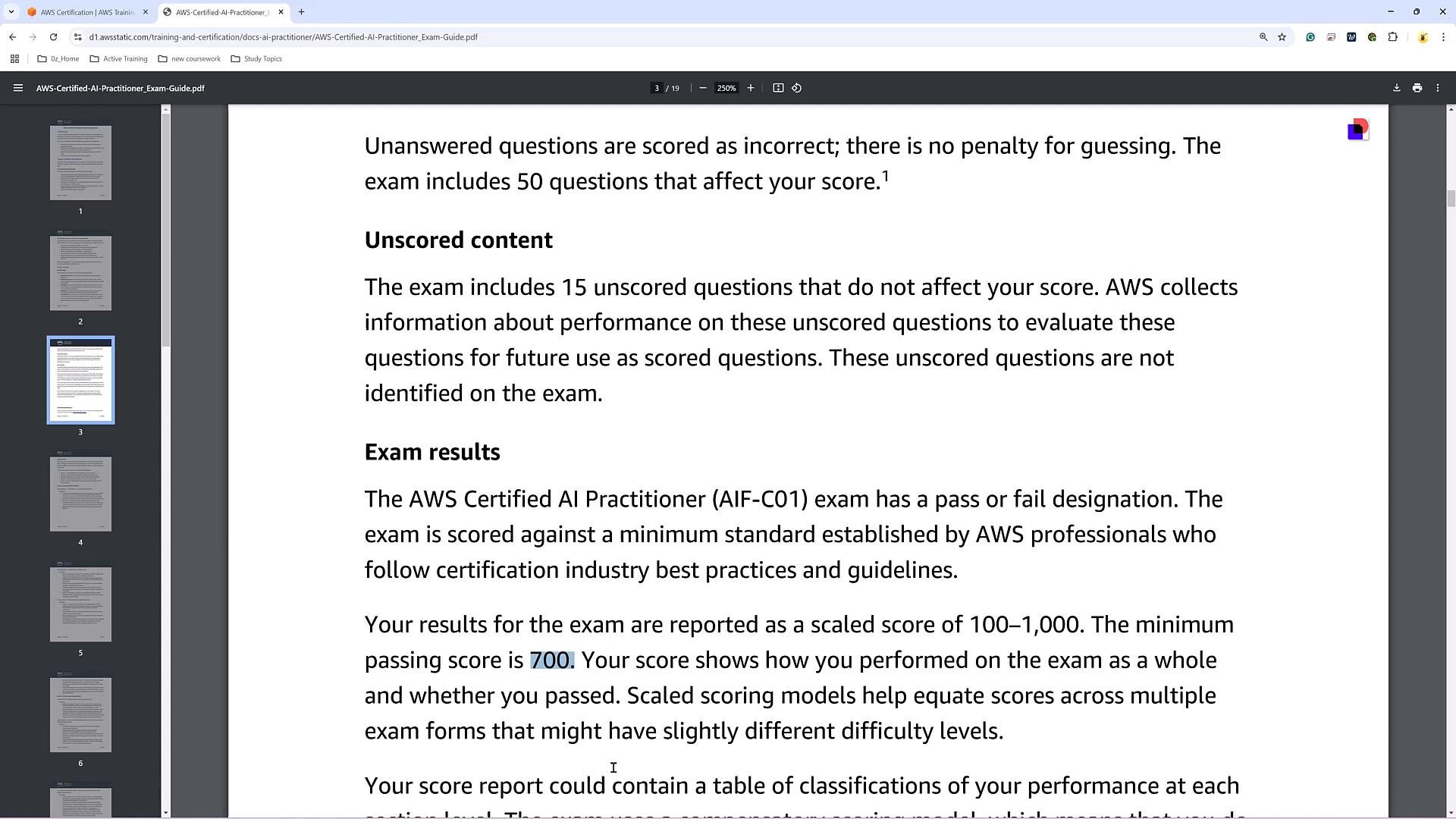
- Number of questions: up to 65 items (typically ~50 scored + up to 15 pre-test/unscored items).
- Passing score: 700 out of 1000.
- Scoring: questions have scaled weighting — some items may contribute more to the score than others. Treat every question seriously.
- Exam strategy: answer every question (you are scored only on correct answers) and pace yourself to review flagged items if time allows.
Study focus and domain weights — prioritize efficiently
The exam content is organized into five domains. The Applications of Foundation Models domain is the largest at ~28% of scored content (approximately 14–15 scored questions), so allocate study time accordingly.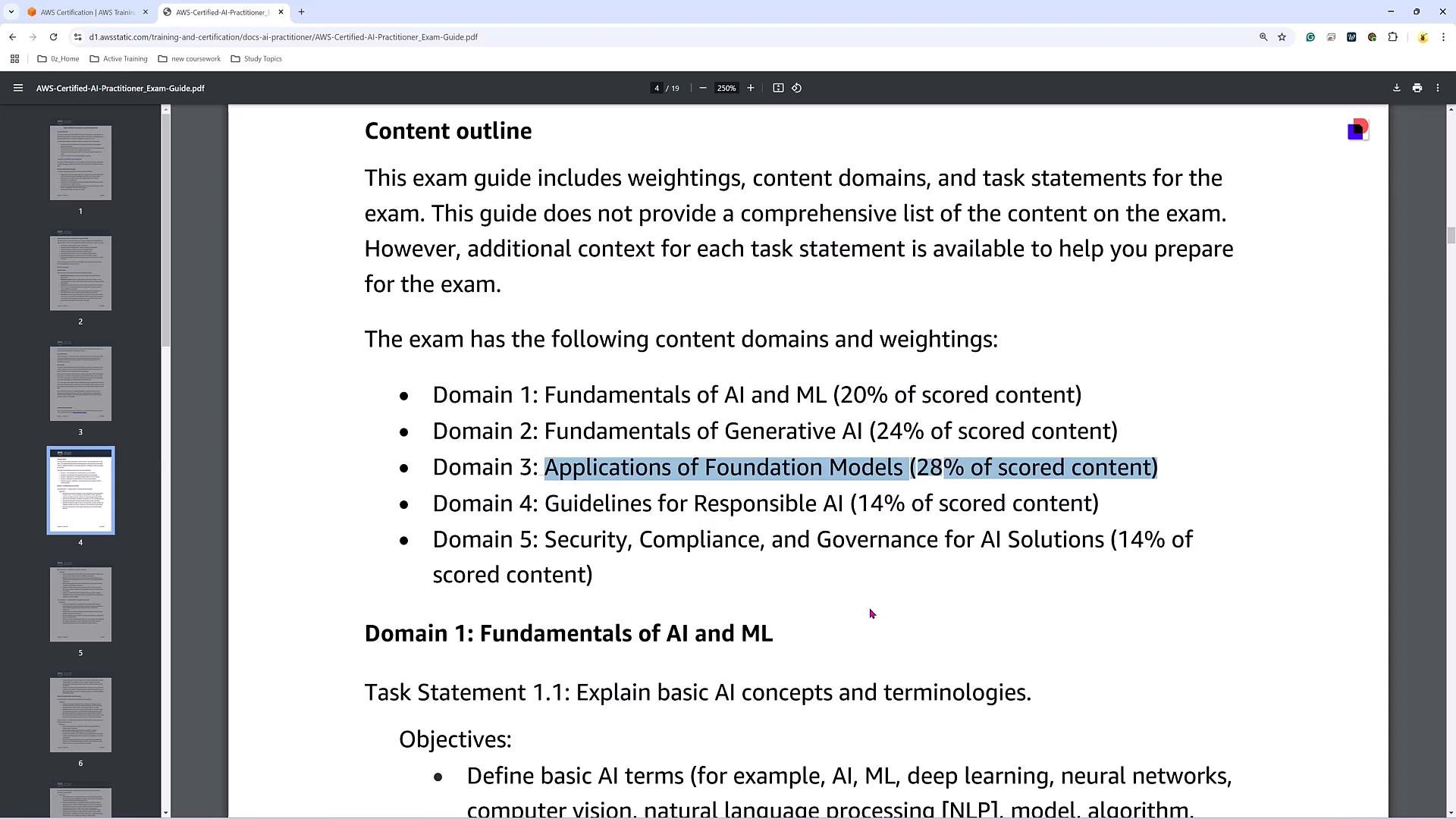
Domain summary table
Use the percentages to prioritize study time: focus most on foundation models and generative AI topics, then fundamentals, then responsible AI and governance.
How to use the exam guide effectively
- Use the task statements as a checklist: for each task, list unfamiliar terms and study them until you can both define and give a practical example.
- Key terms to master: embeddings, vectors, prompt engineering, instruction tuning, transfer learning, RLHF (reinforcement learning from human feedback), BLEU/ROUGE/BERTScore, inferencing, model drift, bias/fairness.
- Cross-check knowledge: if a task mentions “labeled vs. unlabeled data” or “structured vs. unstructured data,” be able to define, exemplify, and explain common uses and tradeoffs.
- Practice scenario-based questions: focus on selecting appropriate AI solutions and identifying risks, security controls, and governance measures.
Domain details and sample objectives
Fundamentals of AI/ML
- Topics: supervised vs. unsupervised learning, feature types (tabular, time-series, image, text), model evaluation basics, ML lifecycle and common pitfalls (overfitting, underfitting, data leakage).
- Expected skills: identify appropriate algorithms for basic tasks and explain evaluation tradeoffs.
Fundamentals of Generative AI
- Topics: vectors and embeddings, prompt engineering, key generative model capabilities and limitations.
- AWS services: familiarity at a foundational level with services such as Amazon SageMaker and Amazon Bedrock and when to use them.
- Expectation: explain tradeoffs (managed vs. self-hosted, cost, latency, data residency).
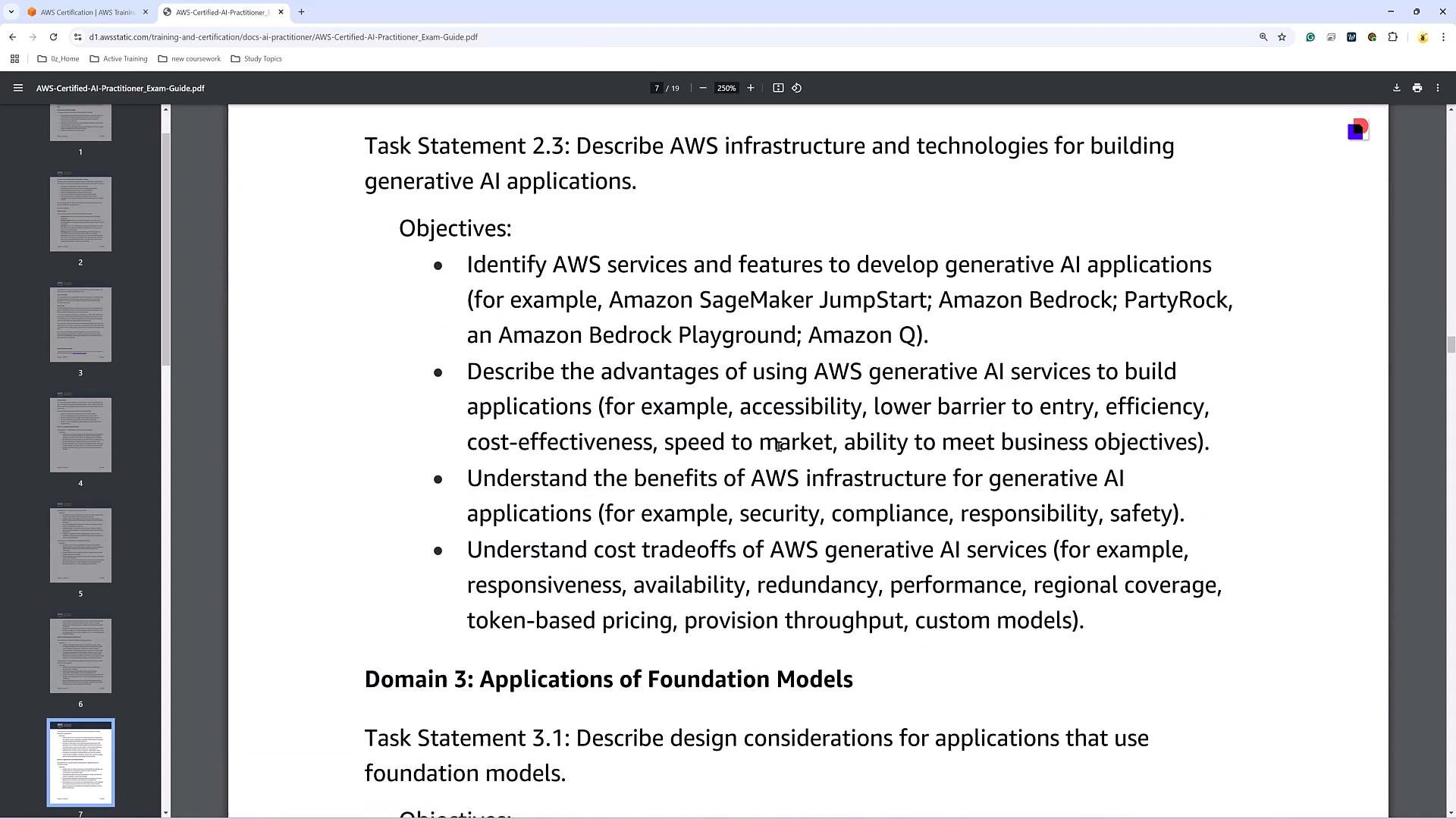
Applications of Foundation Models
- Topics: design considerations for systems using foundation models, prompt design and iterative prompt engineering, fine-tuning workflows (instruction tuning, transfer learning), data curation and labeling, and RLHF.
- Evaluation: model metrics and evaluation approaches for NLP/LMs (BLEU, ROUGE, BERTScore) — know what each metric measures and typical scenarios for each.
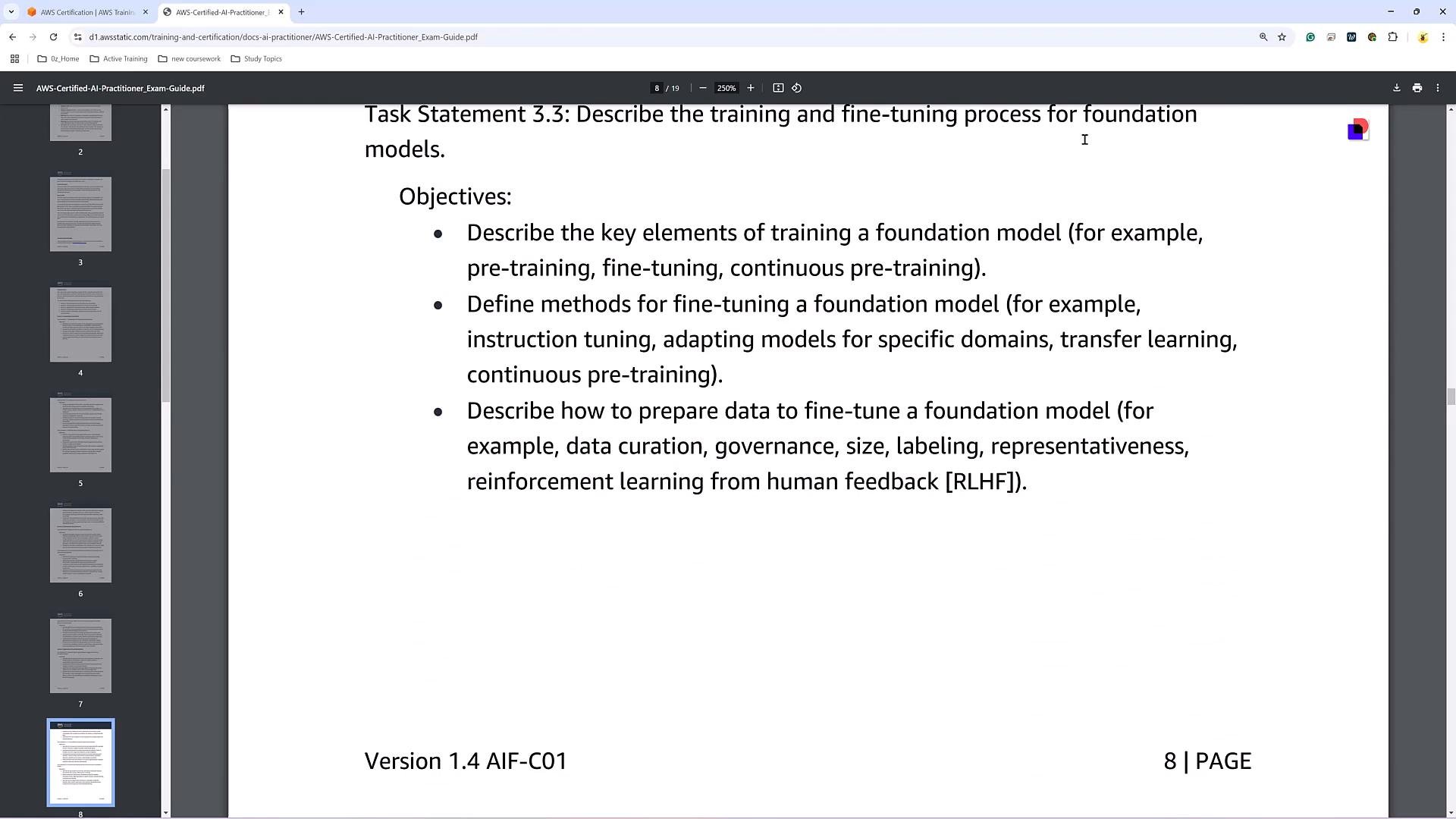
Guidelines for Responsible AI
- Topics: bias and fairness, robustness and safety, explainability and transparency techniques.
- Expectation: identify measures and tools to reduce bias, increase explainability, and manage legal/ethical risks.
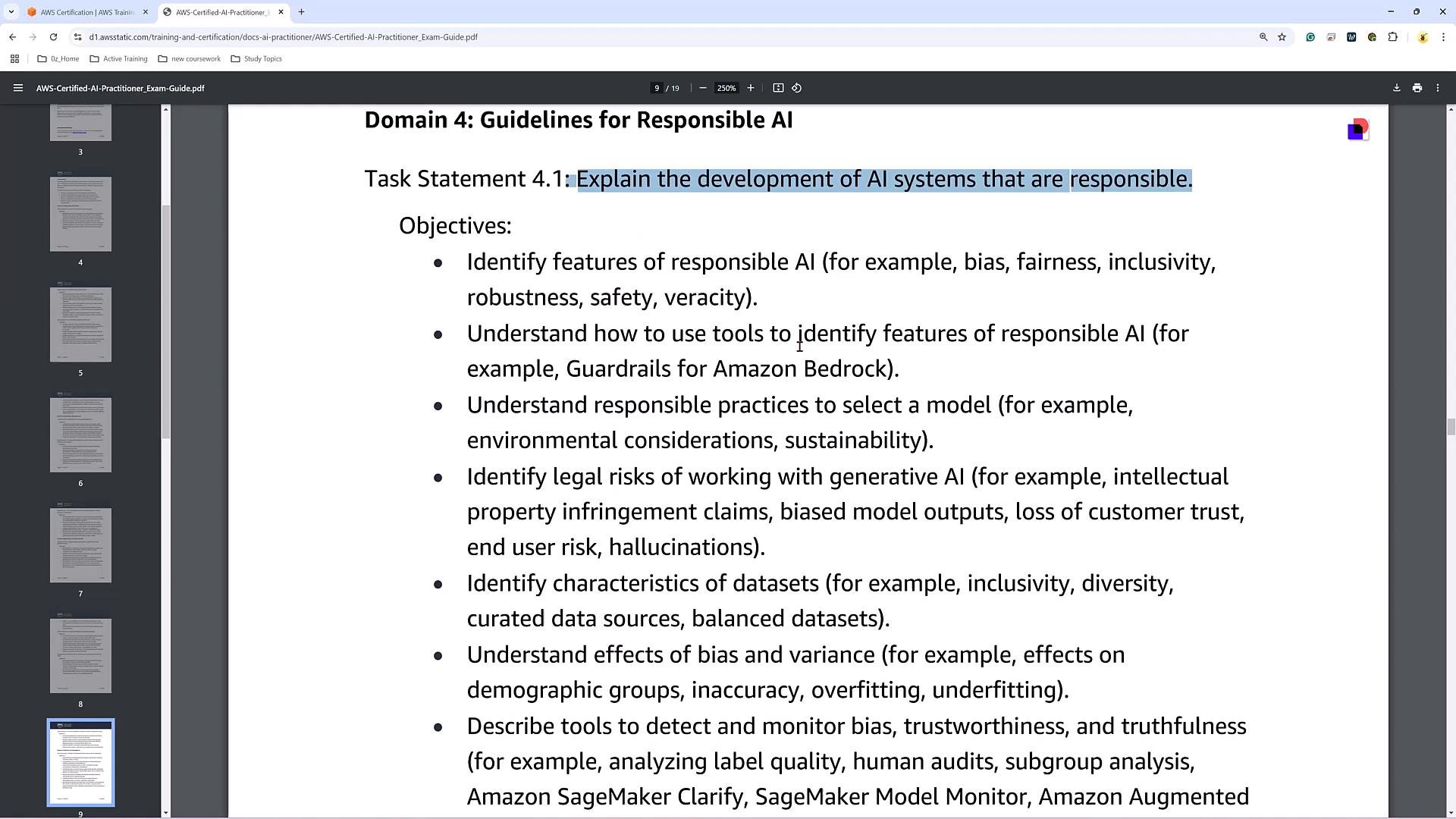
Security, compliance, and governance for AI
- Topics: data governance strategies, security controls for model artifacts and datasets, compliance frameworks and regulatory concerns relevant to AI.
- Expectation: be able to select AWS services and practices that support governance (encryption, IAM, audit logging, artifact management).
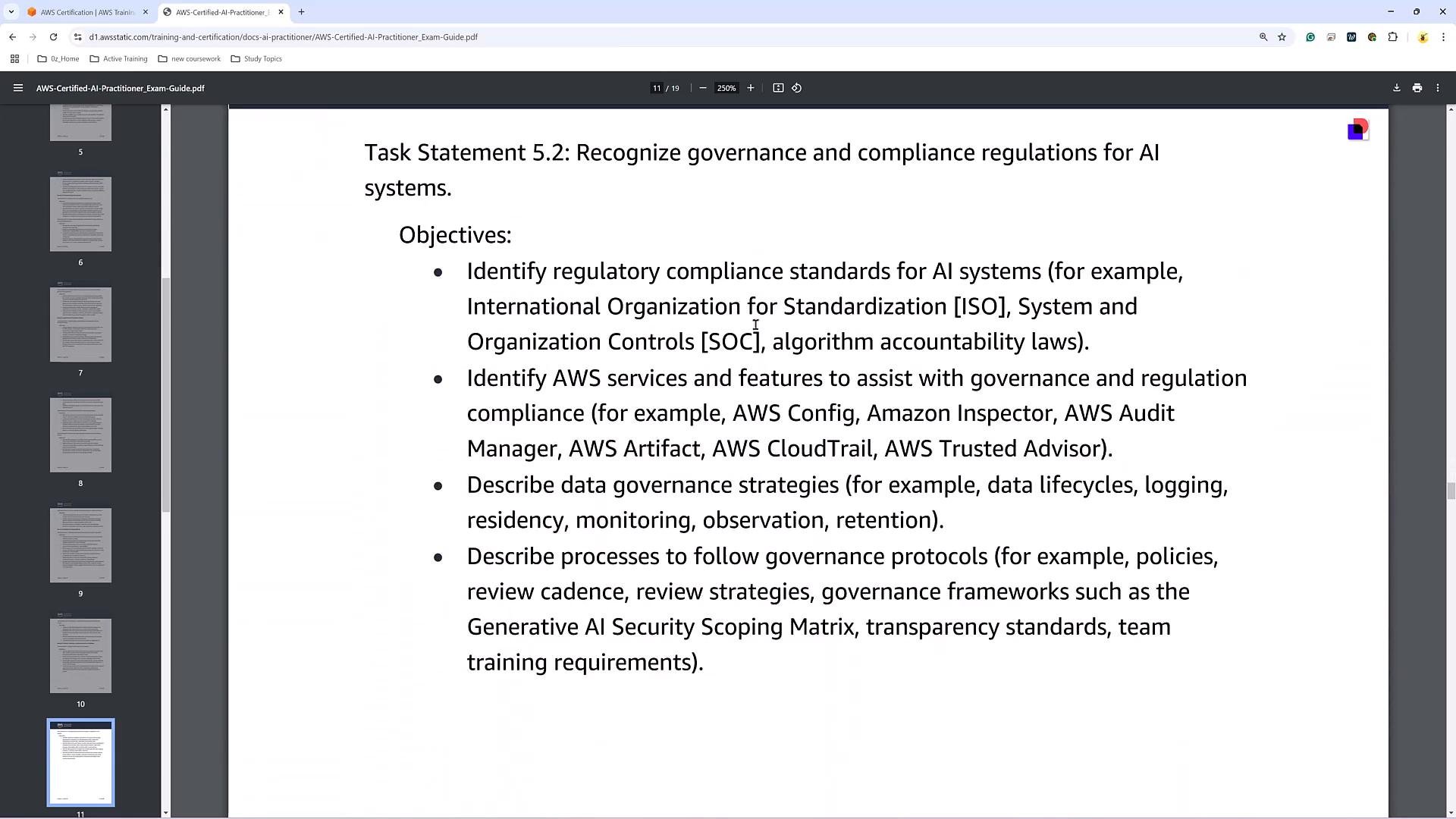
Which AWS services are in scope?
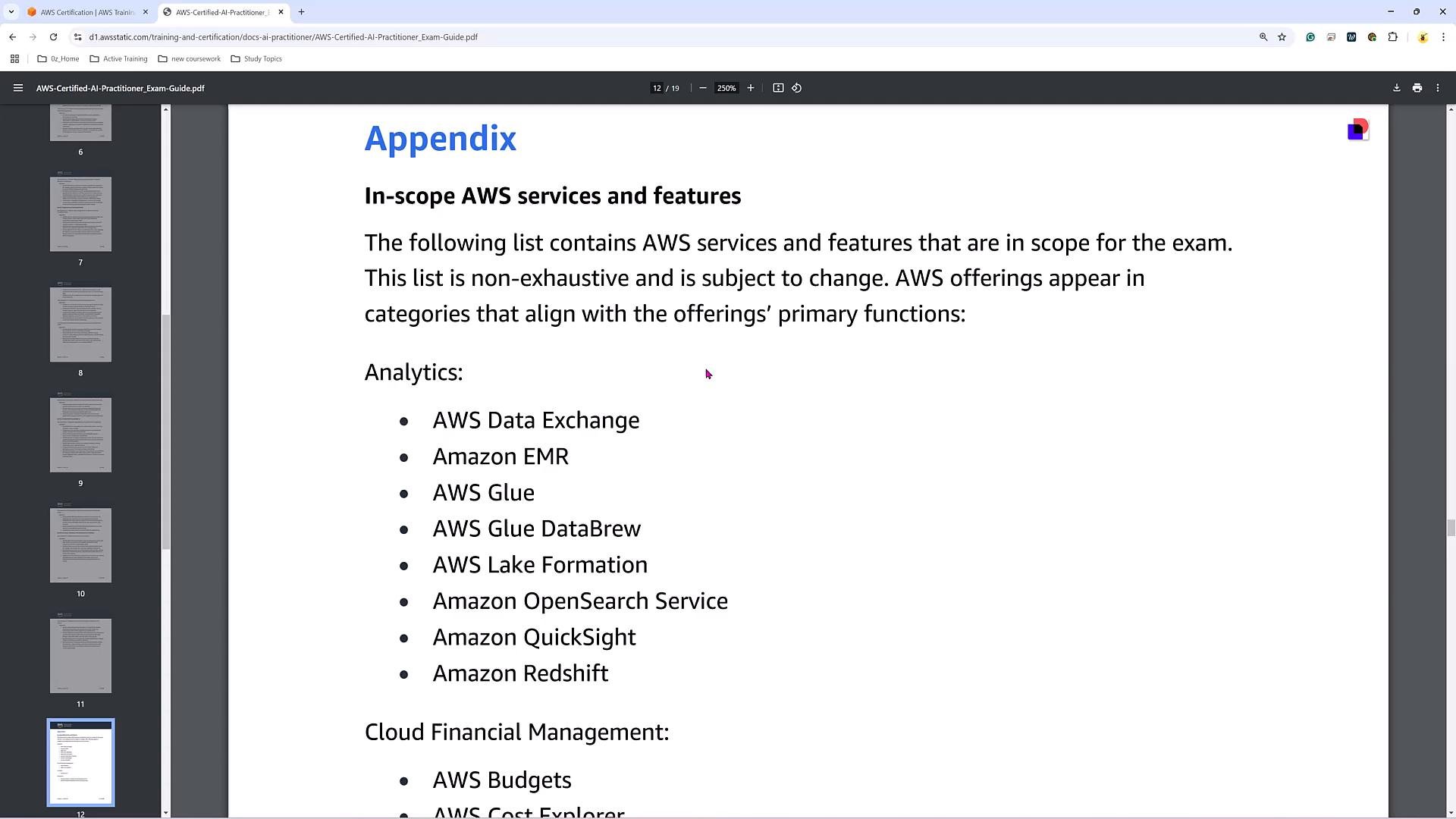
- The exam guide includes an appendix listing in-scope AWS services at a foundational level — review that appendix to focus your service-level study.
- Inclusion in the appendix indicates a service could appear on the exam, but not necessarily that it will.
Personal notes from my attempt (observations)
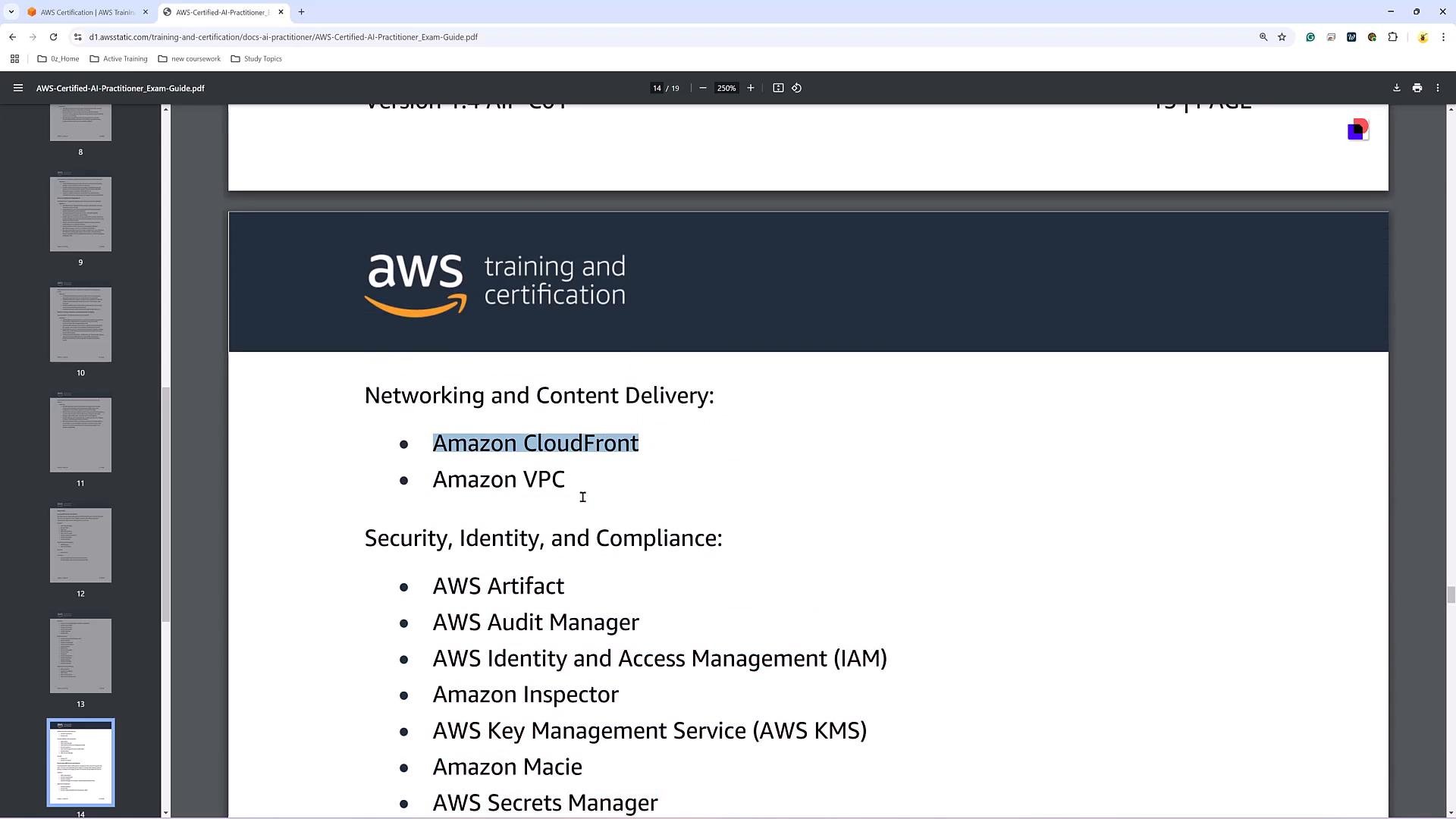
- Example services that appeared on my attempt: Audit Manager, AWS Artifact, IAM, and Amazon Inspector. These highlight that security, compliance, and identity topics can appear on the exam.
- I did not encounter CloudFront on my attempt, but the appendix shows how CloudFront fits into the broader scope.
Services largely out of scope
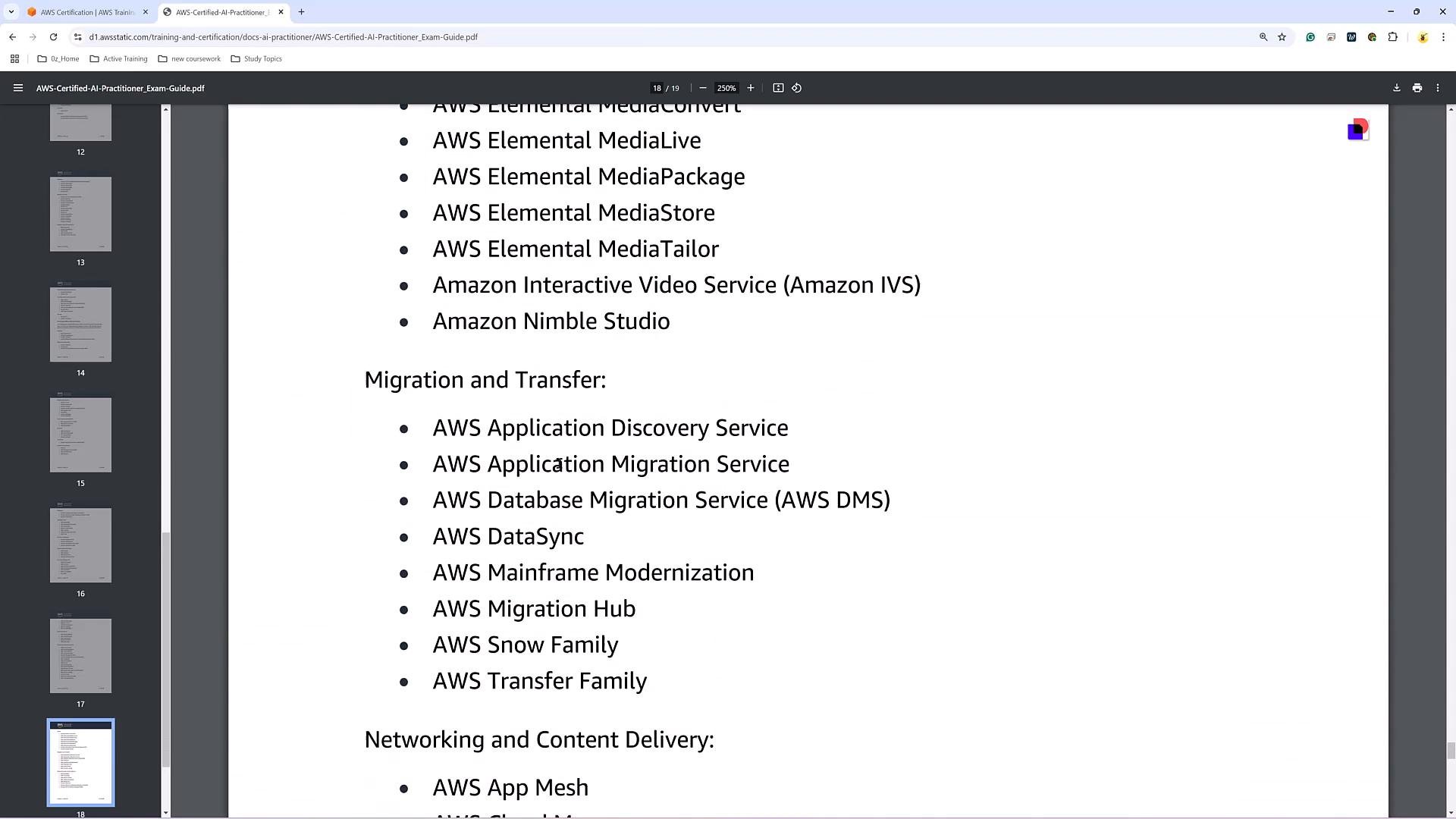
- Out-of-scope areas include many deep compute topics, developer toolchains, IoT, front-end web/mobile topics, most migration and media services, and many advanced management features. Check the appendix for specifics.
Final pages and additional resources
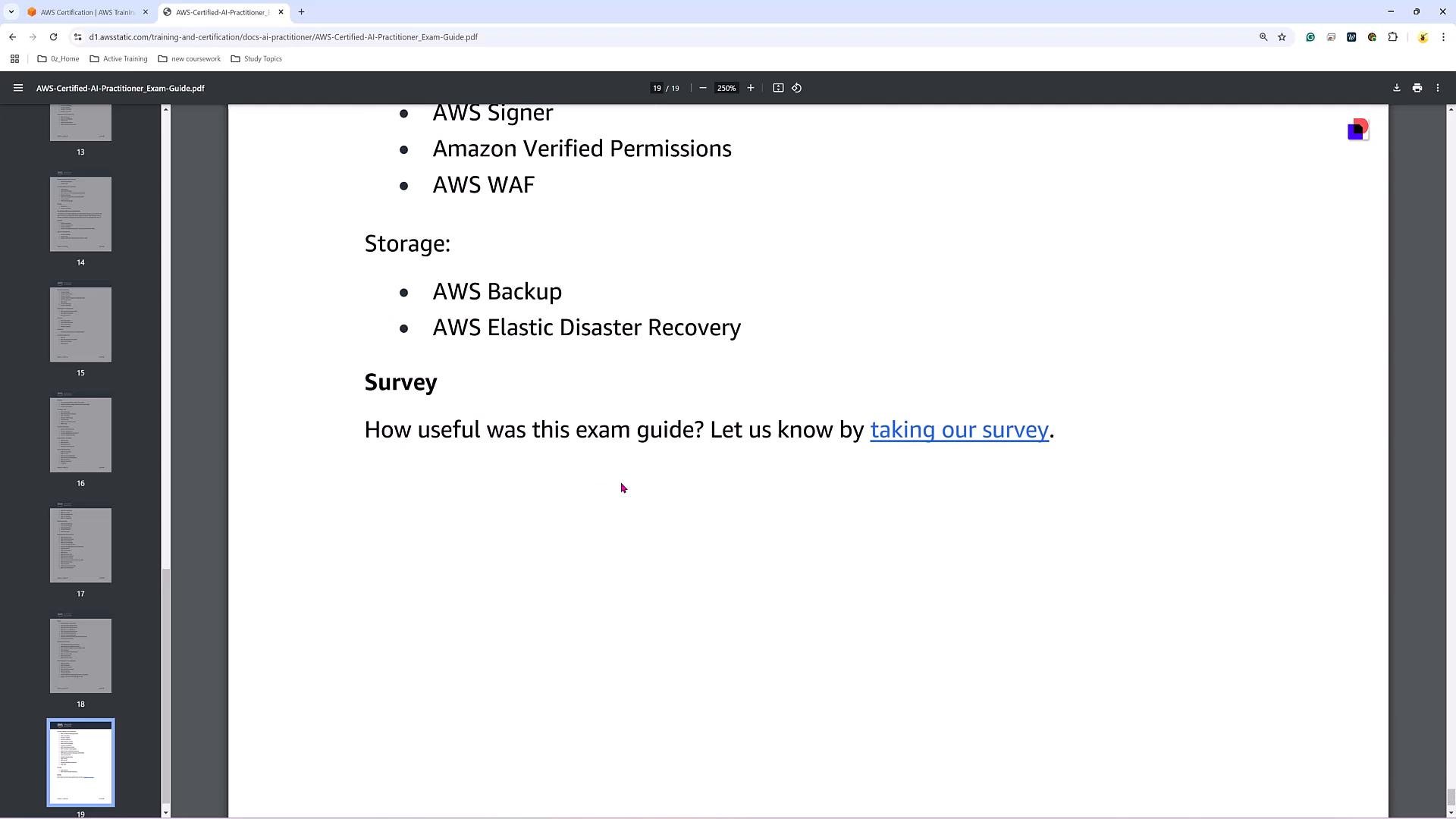
- The guide’s final pages contain links to additional resources, surveys, and details on how to view your exam score report and domain-level performance after the exam.
- Use your score report to prioritize future study areas if you need to retake the exam.
Use the exam guide as a checklist. For each task statement, list terms and concepts to learn (e.g., embeddings, RLHF, BLEU/ROUGE/BERTScore, prompt engineering). Study the in-scope service list and prioritize hands‑on practice with generative AI and foundation-model topics (SageMaker, Bedrock, model evaluation techniques). Practice scenario-based questions and treat every question as potentially scored.
Practical study recommendations and exam-day tips
- Build a short study plan keyed to domain weights: allocate more time to Applications of Foundation Models and Generative AI topics.
- Hands-on practice: use SageMaker Studio, experiment with embeddings and prompts, and test simple fine-tuning/instruction‑tuning workflows where possible.
- Vocabulary and examples: be able to explain and give simple examples for terms like labeled vs. unlabeled data, structured vs. unstructured data, supervised vs. unsupervised learning.
- Practice exams: do timed practice tests and review rationales for correct and incorrect answers.
- Exam strategy: read questions fully, watch for qualifiers (e.g., “best,” “most likely,” “least”), and manage your time so you can revisit flagged items.