

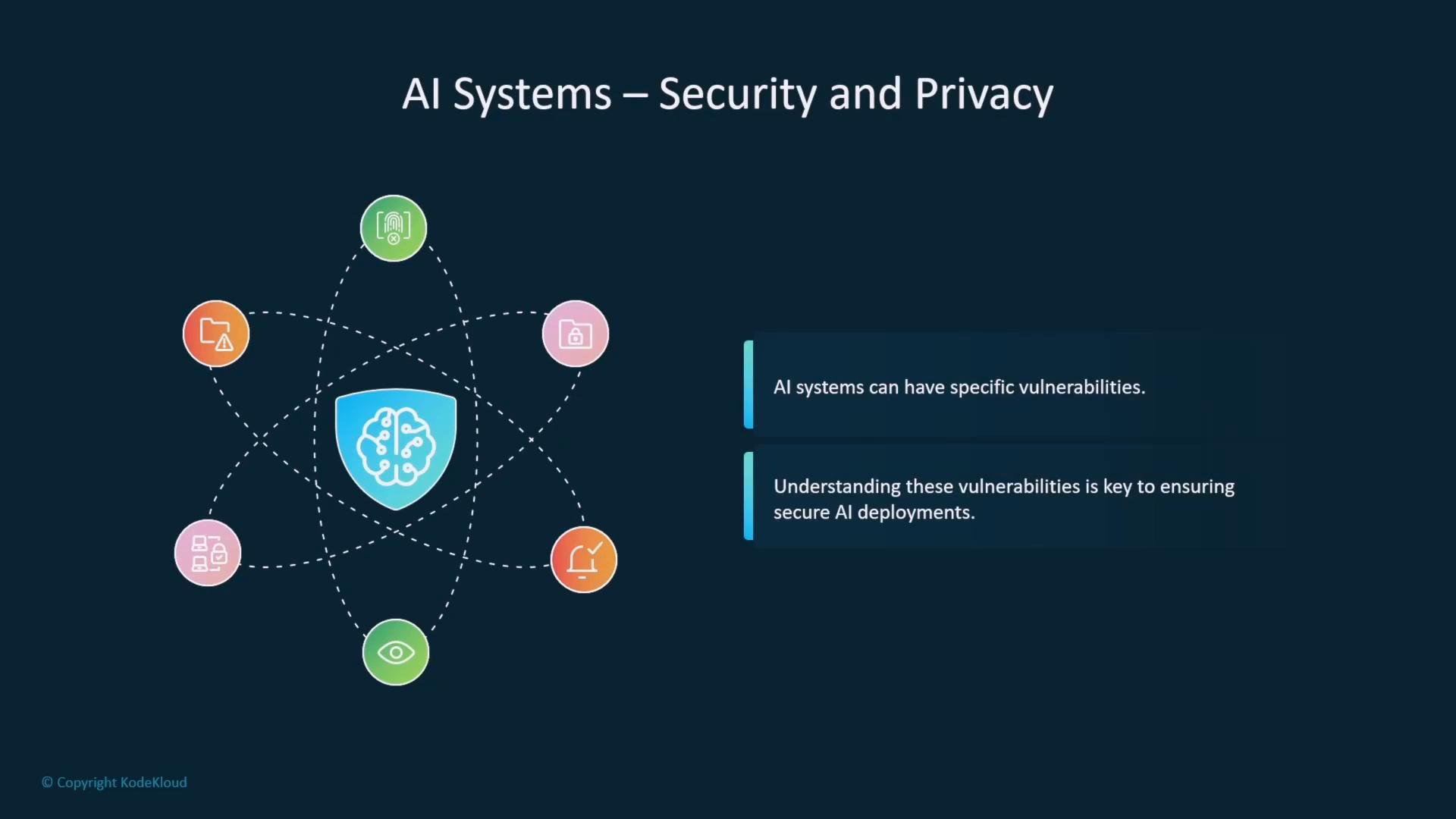
Common threats to AI systems
- Training-data attacks (data poisoning and backdoors)
- Adversarial inputs at inference time
- Model extraction, inversion, and membership inference
- Prompt injection and jailbreaks for large language models (LLMs)
- Data breaches and leakage of sensitive training data
Training-data integrity: poisoning and backdoors
Manipulation of training data can change model behavior in subtle or dramatic ways. Common techniques include label flipping, inserting maliciously crafted samples, or embedding backdoors—inputs that trigger attacker-chosen behaviors. Consequences range from misclassification (false negatives/false positives) to targeted failures in critical domains such as healthcare diagnostics, fraud detection, or autonomous systems.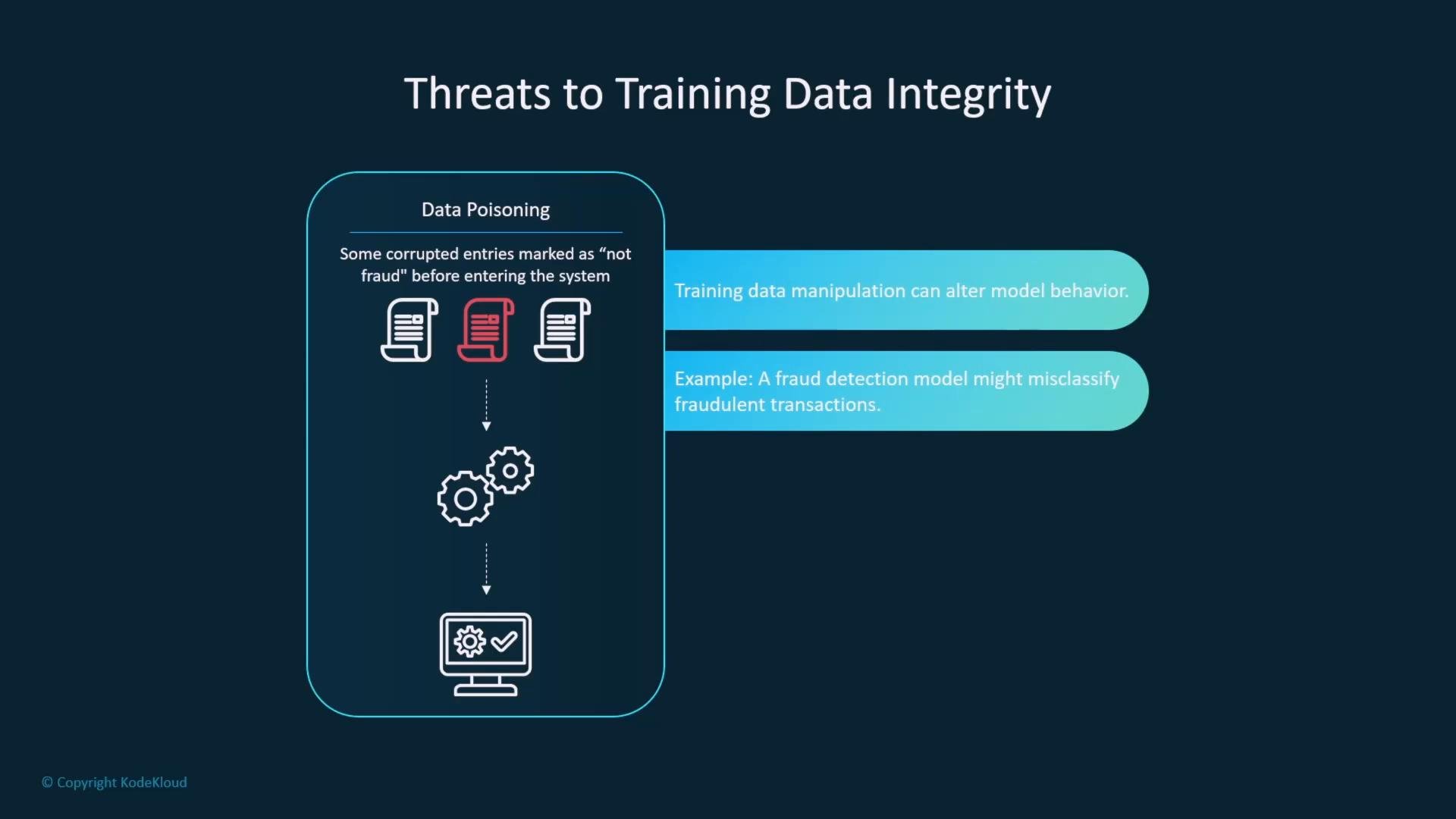
- Provenance, cataloging, and versioning of datasets
- Strict access controls and audit trails for data repositories
- Automated validation checks for outliers and anomalous labels
- Red-team testing and targeted adversarial/poisoning tests before deployment
Adversarial inputs and misclassification
Attackers can craft small perturbations to inputs (images, audio, or text) that cause models to misclassify. These adversarial examples exploit model sensitivity near decision boundaries—for example, altered face images that bypass facial recognition or slightly perturbed signals that degrade classifier performance.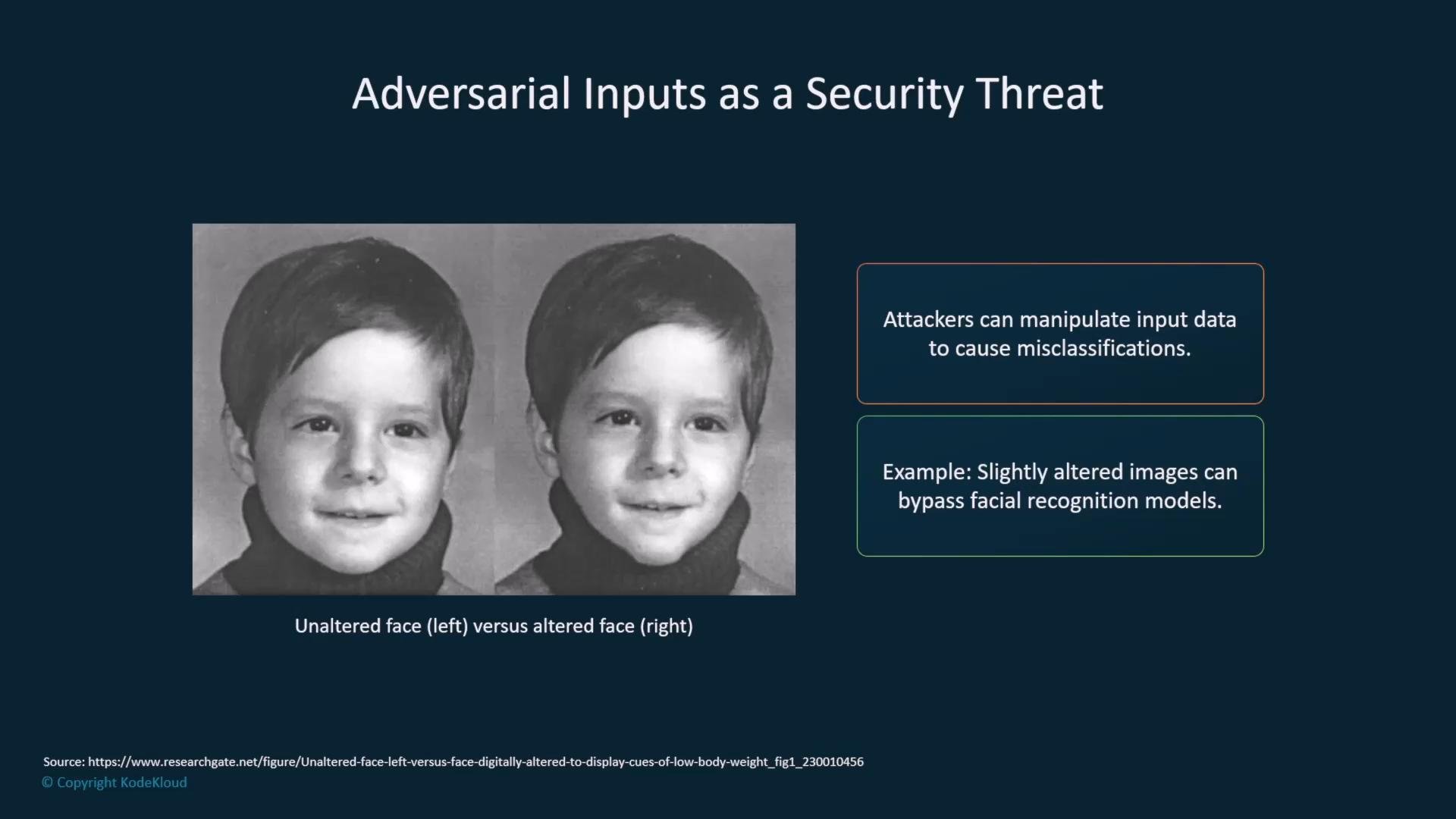
- Adversarial training and augmentation of datasets with adversarial examples
- Defensive techniques such as randomized smoothing, input preprocessing, and ensemble methods
- Runtime input filters and anomaly detection to flag suspicious inputs
Model inversion, membership inference, and extraction
Repeated or carefully crafted queries can allow attackers to infer training-data properties (model inversion), determine whether a specific record was in a training set (membership inference), or reconstruct a model’s decision surface (model extraction). These attacks can reveal sensitive training records or proprietary model behavior.
- Apply differential privacy or noise injection during training/fine-tuning
- Enforce rate limiting and query budgets to reduce extraction feasibility
- Monitor and detect anomalous query patterns
- Provide coarse-grained APIs rather than full model access where feasible
Prompt injection and jailbreaks for LLMs
Prompt injection is a class of attacks where crafted inputs manipulate an LLM to ignore system instructions or reveal sensitive information (internal prompts, data sources, credentials, etc.). These attacks can lead to disclosure of confidential material or the model producing harmful outputs.
Prompt injection attacks can bypass intended system prompts and policies. Treat user-supplied content as untrusted, apply layered defenses (policy enforcement, response filtering, and detection models), and avoid exposing sensitive system prompts to user-controllable contexts.
- Sanitize and normalize all user-provided text before including in prompts
- Use separate, immutable system prompts that are never concatenated directly with user inputs
- Apply output filters and classifiers trained to detect malicious prompt patterns
- Leverage managed-service guardrails when available (for example, Amazon Bedrock guardrails)
Threats and mitigations at a glance
Mitigations and best practices (detailed)
- Data hygiene and provenance: validate, catalog, and version training datasets; enforce access controls; maintain audit logs.
- Input validation and sanitization: use strict schema checks, token and size limits, and content filters for user-provided inputs.
- Adversarial training and robustification: incorporate adversarial examples and use defensive techniques appropriate for the modality.
- Differential privacy and noise addition: apply differentially private training or fine-tuning to reduce membership inference risk.
- Rate limiting and query monitoring: throttle requests and detect anomalous access patterns to limit model extraction.
- Guardrails and content filtering: implement policy-based filters, engineered system prompts, and response validators for LLMs.
- Access control and network isolation: enforce least privilege with IAM, use VPC endpoints and private subnets to restrict endpoint access.
- Encryption and key management: encrypt data at rest and in transit and manage keys centrally using a KMS.
Operational monitoring and detection
Continuous monitoring, drift detection, and alerting are essential. Early detection of data-distribution changes or model-performance degradation allows investigation of potential attacks (data poisoning, adversarial inputs) or natural drift and enables timely remediation (retraining, rollback, or throttling). Tools and patterns- Baseline profiling and continuous monitoring of incoming data and inference outputs
- Alerts and automated runbooks for detected anomalies
- Centralized logging and long-term retention for forensic analysis
Amazon SageMaker Model Monitor can automatically profile baseline data, monitor live production traffic, and alert on data drift or quality anomalies so you can act before issues become outages or security incidents.


Encryption, keys, and certificate management
Encrypt data at rest and in transit. Use a centralized key-management service (for example, AWS KMS) to manage encryption keys, and consider envelope encryption for large artifacts. Use AWS Certificate Manager (ACM) to provision and manage TLS certificates for supported endpoints. Combine encryption with strict IAM, network controls, and logging to reduce exposure.
- Encrypt training, validation, and production data at rest and in transit
- Use dedicated KMS keys per environment and rotate keys regularly
- Audit and log key usage and certificate issuance
- Limit who can decrypt model artifacts and training data via IAM policies
Summary
Securing AI systems requires layered, defense-in-depth approaches across the model lifecycle:- Preventive controls: data provenance, input sanitization, robust training practices
- Detective controls: model and data monitoring, logging, anomaly detection
- Mitigations and recovery: rate limiting, retraining, rollbacks, and incident response playbooks
- Foundational controls: encryption, IAM, network isolation, and key/certificate management