This walkthrough shows how to install the GitHub Actions Importer extension for the GitHub CLI (gh) on a virtual machine, authenticate gh, and verify the extension is available. The official documentation covers installation, credential configuration, and migration workflows for converting Jenkins pipelines to GitHub Actions: https://docs.github.com/en/actions/migrating-to-github-actions/about-migrating-from-jenkins-with-github-actions-importer Summary of steps:
  • Verify prerequisites
  • Install the GitHub CLI (gh) if missing
  • Authenticate gh with a GitHub Personal Access Token (PAT) or interactive login
  • Install and verify the gh-actions-importer extension
  • Configure the importer and run audit/dry-run/migrate commands

Prerequisites
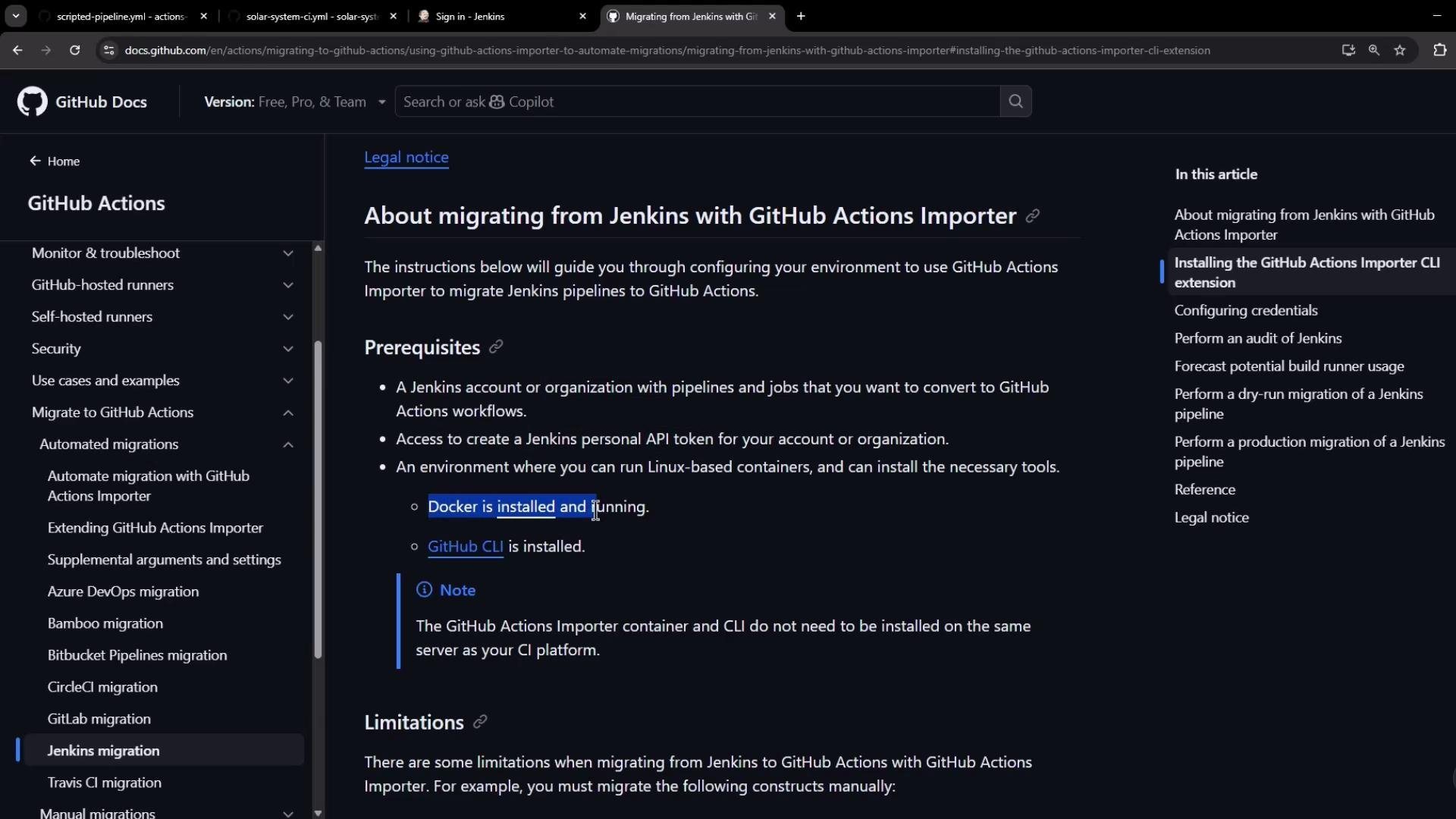
RequirementPurpose / Notes
Jenkins account/organizationPipelines/jobs you plan to convert
Jenkins personal API tokenUsed by the importer to access Jenkins
Docker installed & running on the VMImporter runs conversion containers
GitHub CLI (gh) installedRequired to install and run the importer extension
A screenshot of the GitHub Docs page titled "About migrating from Jenkins with GitHub Actions Importer," showing navigation on the left, a table of contents on the right, and prerequisites (like "Docker is installed and running") in the main content area. The page is displayed in a dark theme within a browser.

1. Check for GitHub CLI (gh)

Confirm whether gh is already installed:
root@jenkins in /home
 gh
bash: /usr/bin/gh: No such file or directory
If the command returns “No such file or directory,” install gh on Debian/Ubuntu using the official repository and keyring. This single-line script adds the repository, imports the GPG keyring, updates apt, and installs gh:
(type -p wget >/dev/null || (sudo apt update && sudo apt-get install wget -y)) \
&& sudo mkdir -p -m 755 /etc/apt/keyrings \
&& out=$(mktemp) && wget -nv -O$out https://cli.github.com/packages/githubcli-archive-keyring.gpg \
&& sudo tee /etc/apt/keyrings/githubcli-archive-keyring.gpg > /dev/null < $out \
&& sudo chmod go+r /etc/apt/keyrings/githubcli-archive-keyring.gpg \
&& echo "deb [arch=$(dpkg --print-architecture) signed-by=/etc/apt/keyrings/githubcli-archive-keyring.gpg] https://cli.github.com/packages stable main" | sudo tee /etc/apt/sources.list.d/github-cli.list > /dev/null \
&& sudo apt update \
&& sudo apt install gh -y
After installation, validate gh and inspect available top-level commands:
root@jenkins in /home
 gh help
CORE COMMANDS
  auth        Authenticate gh and git with GitHub
  browse      Open repositories, issues, pull requests, and more in the browser
  codespace   Connect to and manage codespaces
  gist        Manage gists
  issue       Manage issues
  org         Manage organizations
  pr          Manage pull requests
  project     Work with GitHub Projects
  release     Manage releases
  repo        Manage repositories

GITHUB ACTIONS COMMANDS
  cache       Manage GitHub Actions caches
  run         View details about workflow runs
  workflow    View details about GitHub Actions workflows

ADDITIONAL COMMANDS
  alias       Create command shortcuts
  api         Make an authenticated GitHub API request
  completion  Generate shell completion scripts
  config      Manage configuration for gh

2. Install the GitHub Actions Importer extension

Attempt to install the extension:
root@jenkins in /home
 gh extension install github/gh-actions-importer
To get started with GitHub CLI, please run:  gh auth login
Alternatively, populate the GH_TOKEN environment variable with a GitHub API authentication token.
If gh is not authenticated, it will prompt you to authenticate first. Continue to the authentication section below.

3. Authenticate gh (interactive or token)

You can authenticate in two ways:
  • Interactive login: gh auth login (recommended for interactive sessions)
  • Environment token: set GH_TOKEN to a Personal Access Token (PAT) to allow non-interactive usage
Interactive login example:
root@jenkins in /home
 gh auth login
? Where do you use GitHub? GitHub.com
? What is your preferred protocol for Git operations on this host? HTTPS
? How would you like to authenticate GitHub CLI? Paste an authentication token
Tip: you can generate a Personal Access Token at https://github.com/settings/tokens
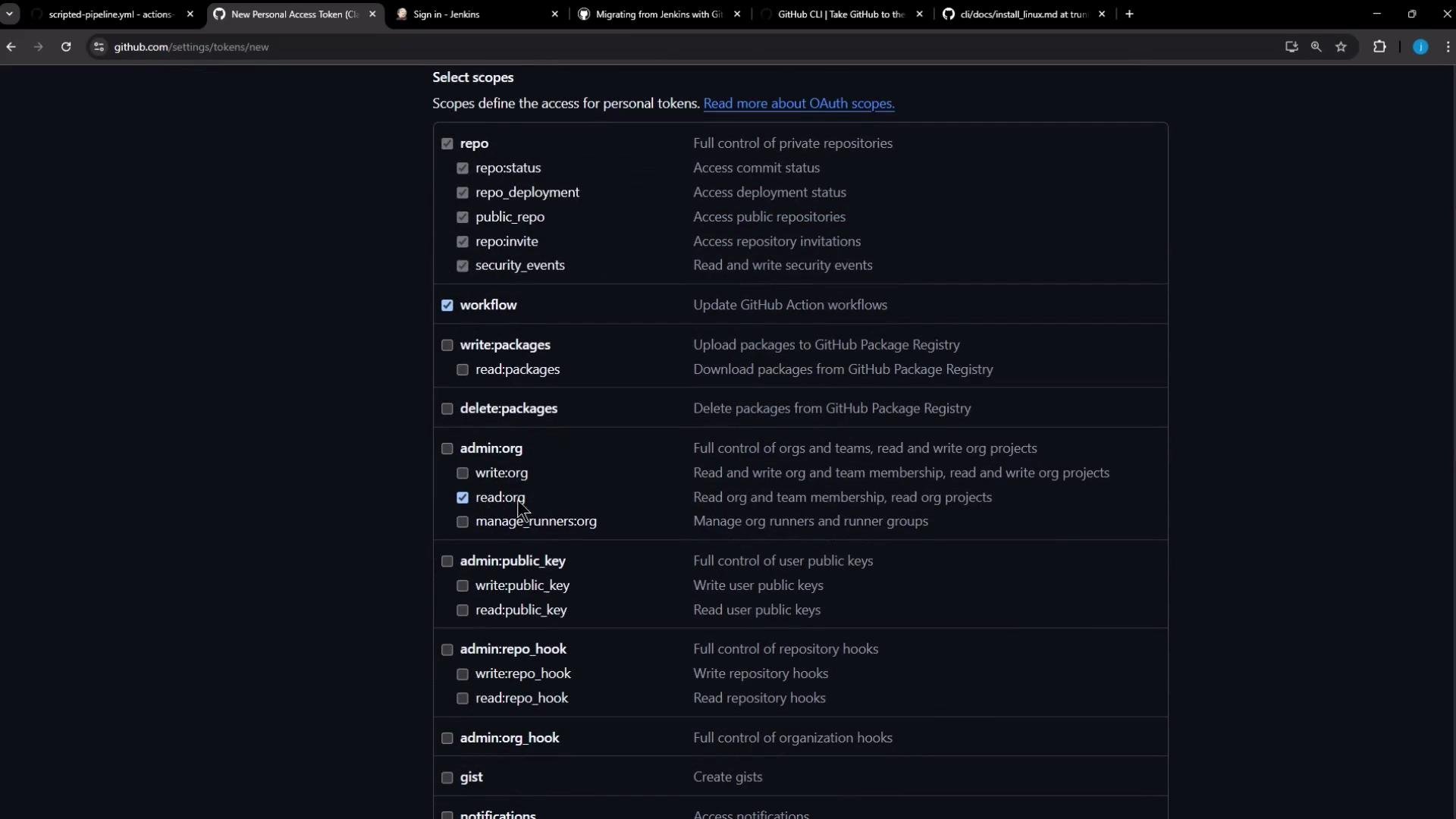
The minimum required scopes are: 'repo', 'read:org', 'workflow'.
? Paste your authentication token:
Generate a PAT in GitHub: Settings → Developer settings → Personal access tokens (classic). When creating the token, grant the importer the minimum required scopes.
Minimum required scopes for the importer are: repo, read:org, and workflow. Keep the token secure and consider setting an expiration.
To make scope/permissions clear, here’s a quick reference:
ScopeWhy it’s required
repoRead/write access to repository contents (needed for creating PRs during migrations)
read:orgRead organization membership & teams if importer needs org-level context
workflowInspect and manage GitHub Actions workflows
When you finish the interactive gh auth login flow, you should see confirmation:
root@jenkins in /home
 gh auth login
... (authentication steps) ...
 Configured git protocol
! Authentication credentials saved in plain text
 Logged in as <your-github-username>
Verify status:
root@jenkins in /home
 gh auth status
github.com
 Logged in to github.com as <your-github-username> (oauth_token)
 Git operations for github.com configured to use https protocol.

4. Install and verify the importer extension

With gh authenticated, install the importer extension:
root@jenkins in /home
 gh extension install github/gh-actions-importer
 Installed extension github/gh-actions-importer
Check gh and the extension versions to ensure everything is up-to-date:
root@jenkins in /home
 gh version
gh version 2.73.0 (2025-05-19)

root@jenkins in /home
 gh actions-importer version
gh actions-importer    github/gh-actions-importer    v1.3.6
actions-importer/cli:latest    v1.3.22397
It’s good practice to update the importer extension and its container image periodically:
root@jenkins in /home
 gh actions-importer update
Updating ghcr.io/actions-importer/cli:latest...
ghcr.io/actions-importer/cli:latest up-to-date

5. Explorer commands: what the importer can do

List available importer commands and options:
root@jenkins in /home
 gh actions-importer -h
Options:
  -?, -h, --help    Show help and usage information

Commands:
  update         Update to the latest version of GitHub Actions Importer.
  version        Display the current version of GitHub Actions Importer.
  configure      Start an interactive prompt to configure credentials used to authenticate with your CI server(s).
  audit          Plan your CI/CD migration by analyzing your current CI/CD footprint.
  forecast       Forecast GitHub Actions usage from historical pipeline utilization.
  dry-run        Convert a pipeline to a GitHub Actions workflow and output its YAML file.
  migrate        Convert a pipeline to a GitHub Actions workflow and open a pull request with the changes.
  list-features  List the available feature flags for GitHub Actions Importer.

6. Configure the importer for Jenkins

Run the interactive configuration to store CI provider credentials and base URLs:
root@jenkins in /home
 gh actions-importer configure
 Which CI providers are you configuring?: Jenkins
Enter the following values (leave empty to omit):
 Personal access token for GitHub: ***************
 Base url of the GitHub instance: https://github.com
 Personal access token for Jenkins: ***************
 Username of Jenkins user: admin
 Base url of the Jenkins instance: https://localhost
Environment variables successfully updated.
After configuring, you can run the following high-value commands:
  • gh actions-importer audit — analyze your Jenkins CI/CD footprint and identify migration candidates
  • gh actions-importer forecast — estimate GitHub Actions usage from historical pipeline data
  • gh actions-importer dry-run — convert a pipeline and output workflow YAML without creating changes
  • gh actions-importer migrate — convert a pipeline and open a pull request with the resulting workflow

7. Feature toggles

Inspect feature toggles that control importer behavior:
root@jenkins in /home
 gh actions-importer list-features
Available feature toggles:

actions/cache (enabled):
  Control usage of actions/cache inside of workflows. Outputs a comment if not enabled.
  GitHub Enterprise Server >= ghes-3.5 required.

composite-actions (enabled):
  Minimizes resulting workflow complexity through the use of composite actions. See https://docs.github.com/en/actions/creating-actions/creating-a-composite-action for more information.
  GitHub Enterprise Server >= ghes-3.4 required.

reusable-workflows (enabled):
  Avoid duplication by reusing existing workflows. See https://docs.github.com/en/actions/using-workflows/reusing-workflows for more information.
A screenshot of GitHub's "Select scopes" page for creating a personal access token. It shows a list of permission checkboxes (e.g., repo, workflow, write:packages, read:org) with some options checked.

Next steps

  1. Run gh actions-importer audit to analyze your Jenkins pipelines and generate a migration plan.
  2. Use gh actions-importer dry-run to preview converted workflow YAML files.
  3. When ready, run gh actions-importer migrate to create pull requests with the migrated workflows.
References:

Watch Video