GitHub Actions and Jenkins share many CI/CD concepts, so migrating pipelines is usually a matter of translating declarative constructs. This guide compares common Jenkins Declarative Pipeline directives with their GitHub Actions equivalents and provides concise, copy-ready examples to accelerate migration.
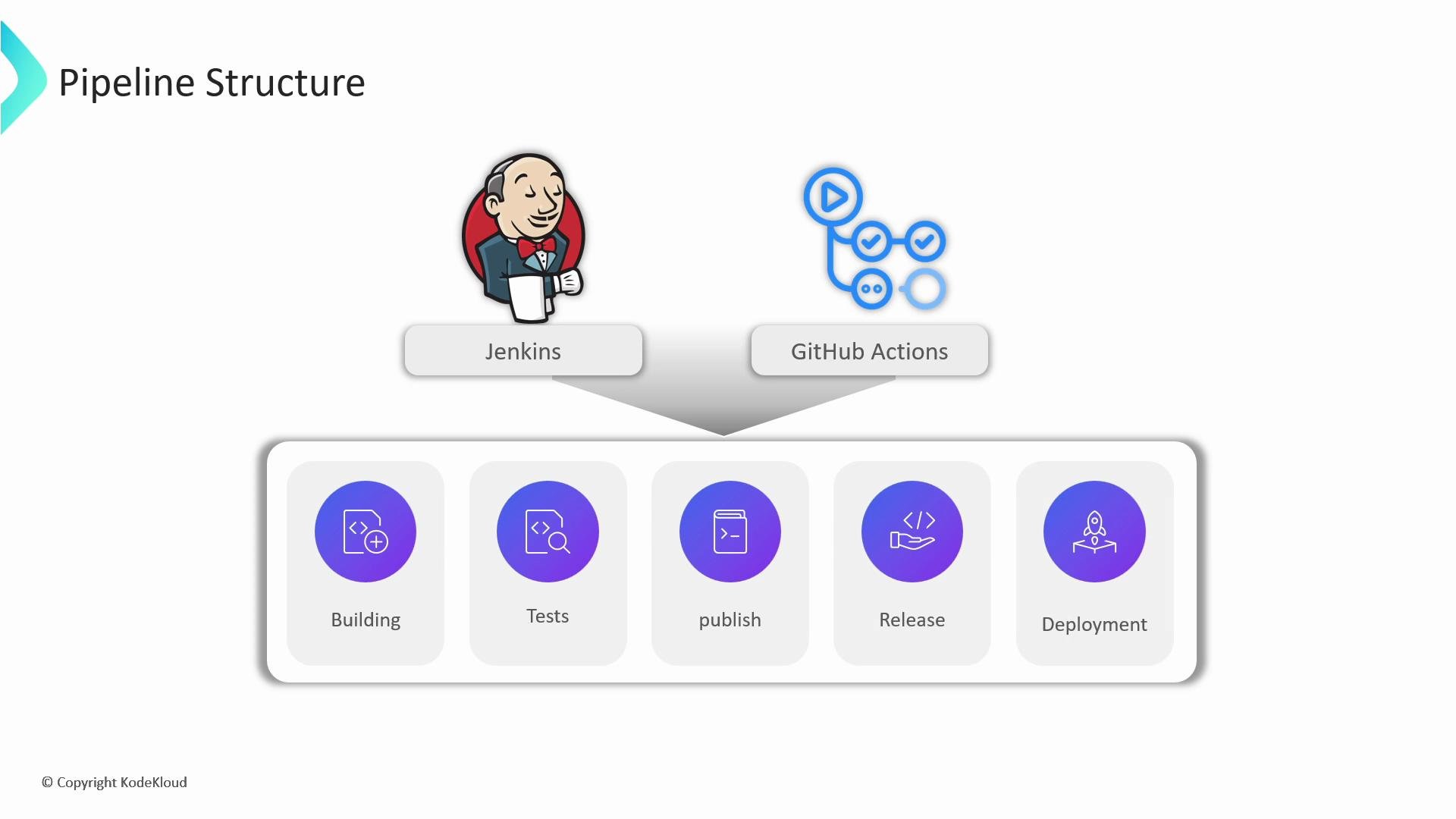
A diagram titled "Pipeline Structure" showing Jenkins and GitHub Actions at the top feeding into a CI/CD pipeline. The pipeline includes stages labeled Building, Tests, publish, Release, and Deployment.
Overview
  • Jenkins Declarative Pipelines are Groovy-based and organized into top-level sections such as agent, environment, and stages.
  • GitHub Actions workflows use YAML organized under on, jobs, env, defaults, and permissions.
  • Conceptual mappings:
    • Jenkins stages → GitHub Actions jobs
    • Jenkins steps → GitHub Actions steps (nested under a job)
    • Jenkins agent → GitHub Actions runs-on (and optionally container)
Quick mapping table
Jenkins conceptGitHub Actions equivalentNotes / example
pipeline / stagesworkflow / jobsJobs run independently; use job dependencies to sequence.
agentruns-on / containerExample: runs-on: ubuntu-latest or container: node:18.
environmentenvUse workflow-level or job-level env.
withCredentials${{ secrets.* }}Store secrets in repo/org settings.
whenifif works at job or step level.
Parallel stagesparallel jobs or strategy.matrixMatrix runs are ideal for multiple configs.
Triggers / cronon (schedule, push, workflow_dispatch)Use on.schedule for cron-based runs.
Links and references
  1. Top-level pipeline → jobs
Jenkins declarative pipeline (Groovy):
pipeline {
  agent any
  stages {
    stage('Build') {
      steps {
        sh 'npm install'
      }
    }
    stage('Test') {
      steps {
        sh 'npm test'
      }
    }
  }
}
Equivalent GitHub Actions workflow (YAML):
name: CI
on: [push, pull_request]

jobs:
  build:
    runs-on: ubuntu-latest
    steps:
      - name: Check out code
        uses: actions/checkout@v4

      - name: Install dependencies
        run: npm install

      - name: Run tests
        run: npm test
Jenkins stages are often sequential by default. In GitHub Actions, implement sequential phases by introducing job dependencies (using needs), or keep multiple sequential steps inside one job.
  1. Agents, runners, and containers
Mappings at a glance:
  • Jenkins agent anyruns-on: ubuntu-latest
  • Jenkins agent { label 'docker' }runs-on: [self-hosted, docker]
  • Jenkins agent { docker { image 'alpine' } }container: alpine (inside a job)
Jenkins example:
pipeline {
  agent { docker { image 'node:18' } }
  stages {
    stage('Test') {
      steps {
        sh 'node -v'
      }
    }
  }
}
GitHub Actions equivalent (runs the job inside a Node container on a GitHub-hosted runner):
jobs:
  build:
    runs-on: ubuntu-22.04
    container:
      image: node:18
    steps:
      - uses: actions/checkout@v4
      - name: Print Node version
        run: node -v
Explanation:
  • runs-on provisions the VM environment; container launches the specified container image inside that VM. All steps run within the container.
  1. Environment variables
Jenkins:
pipeline {
  agent any
  environment {
    NODE_ENV = 'production'
  }
  stages {
    stage('Build') {
      steps {
        sh 'echo $NODE_ENV'
      }
    }
  }
}
GitHub Actions (workflow-level and job-level env):
env:
  NODE_ENV: production

jobs:
  build:
    runs-on: ubuntu-latest
    env:
      APP_VERSION: "1.0.0"
    steps:
      - name: Print envs
        run: |
          echo "NODE_ENV=$NODE_ENV"
          echo "APP_VERSION=$APP_VERSION"
Notes:
  • Use env at the workflow level to set variables available to all jobs, and at job or step level for narrower scope.
  1. Credentials and secrets
Jenkins with withCredentials:
withCredentials([usernamePassword(credentialsId: 'db-creds', usernameVariable: 'DB_USER', passwordVariable: 'DB_PASS')]) {
  sh 'echo "User: $DB_USER"'
}
GitHub Actions (use repository or organization secrets):
jobs:
  deploy:
    runs-on: ubuntu-latest
    steps:
      - name: Deploy step
        env:
          DB_USER: ${{ secrets.DB_USER }}
          DB_PASS: ${{ secrets.DB_PASS }}
        run: |
          echo "User: $DB_USER"
          # Use $DB_PASS securely in commands that accept stdin or env vars
Never print secrets to logs. In GitHub Actions, reference secrets using ${{ secrets.YOUR_SECRET }} and avoid echoing them. Masked secrets are protected, but logging them exposes risk.
  1. Conditional execution
Jenkins example using when:
stage('Deploy') {
  when {
    branch 'main'
  }
  steps {
    sh 'deploy-script.sh'
  }
}
GitHub Actions uses if at the job or step level:
jobs:
  deploy:
    runs-on: ubuntu-latest
    if: github.ref == 'refs/heads/main'
    steps:
      - name: Deploy
        run: ./deploy-script.sh
Example: condition on PR comment body
jobs:
  conditional:
    runs-on: ubuntu-latest
    if: contains(github.event.comment.body, '/deploy')
    steps:
      - run: echo "Deploy triggered by comment"
  1. Parallelism and matrix builds
Jenkins parallel stages:
stage('Parallel Jobs') {
  parallel {
    stage('Build Frontend') {
      steps { sh 'npm install' }
    }
    stage('Build Backend') {
      steps { sh 'mvn -DskipTests package' }
    }
  }
}
GitHub Actions matrix strategy: run the same job across multiple OSes and Node versions
jobs:
  test:
    runs-on: ${{ matrix.os }}
    strategy:
      matrix:
        os: [ubuntu-latest, windows-latest]
        node: [16, 18]
    steps:
      - uses: actions/checkout@v4
      - name: Print matrix
        run: echo "OS: ${{ matrix.os }}, Node: ${{ matrix.node }}"
Notes:
  • GitHub Actions runs jobs in parallel by default. Use strategy.matrix for multiple configurations inside one logical job.
  1. Triggers
Jenkins triggers example (cron):
pipeline {
  agent any
  triggers {
    cron('H 2 * * *') // Run daily at ~2:00 AM (Jenkins H token)
  }
  stages { ... }
}
GitHub Actions equivalents:
  • Scheduled runs:
on:
  schedule:
    - cron: '0 2 * * *'  # Run at 02:00 UTC daily
  • Manual trigger (adds “Run workflow” button):
on:
  workflow_dispatch: {}
  • Event-based triggers with filters:
on:
  push:
    branches: [ main ]
  pull_request:
    branches: [ main ]
  issue_comment:
    types: [created]
Summary and migration checklist
StepAction
Convert high-level structureMap Jenkins stages to GitHub jobs; use needs to sequence jobs.
Choose runnersReplace agent with runs-on and container as required.
Move secretsMigrate credentials to GitHub secrets and reference with ${{ secrets.* }}.
Translate conditional logicConvert when blocks to if: expressions at job/step level.
ParallelizeUse multiple jobs or strategy.matrix for parallel/matrix runs.
Set triggersReplace Jenkins triggers with on: schedule, workflow_dispatch, or event filters.
These mappings cover the core patterns you’ll use when migrating Jenkins Declarative Pipelines to GitHub Actions workflows. For advanced migrations (pipeline libraries, custom shared libraries, or scripted pipelines), consider breaking large Groovy logic into smaller scripts or actions and leveraging reusable workflows in GitHub Actions. Further reading

Watch Video