In this guide you’ll convert a multi-stage Jenkins scripted pipeline into an equivalent GitHub Actions workflow that preserves the same pipeline semantics: Greet → Build → Result. We’ll use the same repository and trigger the workflow manually via workflow_dispatch.
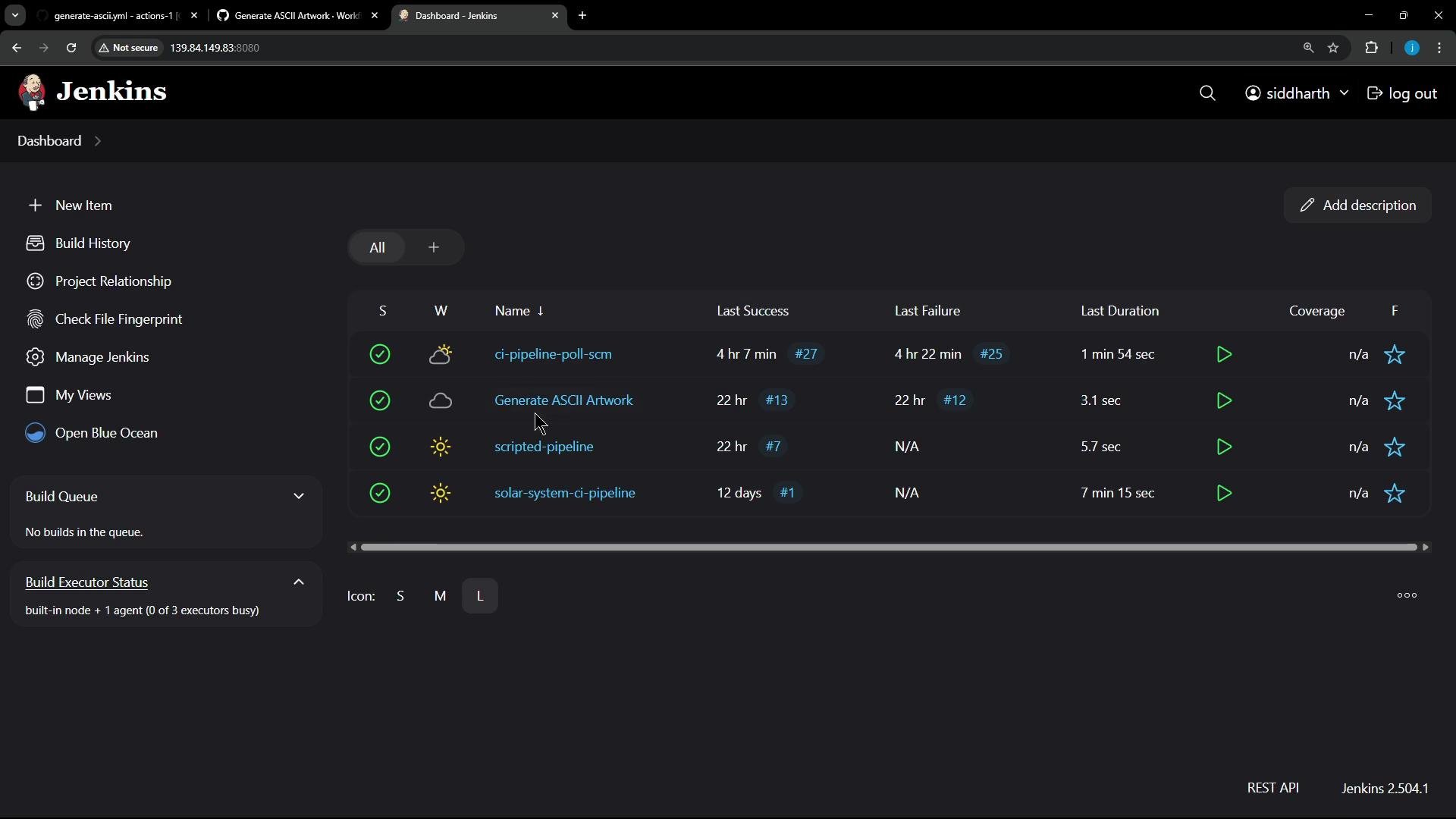
A dark-themed Jenkins dashboard screenshot showing a list of CI pipeline jobs with status icons, last success/failure times, and run durations. The left sidebar displays navigation options like New Item, Build History, and Manage Jenkins.
Original Jenkins scripted pipeline (runs on any available agent):
node { // Runs on any available agent
    stage('Greet') {
        echo 'Hello, World!'
    }

    stage('Build') {
        echo 'Pretending to build...'
        sleep 5 // Simulate work
    }

    stage('Results') {
        def now = new Date()
        echo "Job completed at ${now}"
    }
}
Goal: model these three Jenkins stages as three GitHub Actions jobs named Greet, Build, and Result. Each job will run on an ubuntu-latest runner. By default GitHub Actions runs jobs in parallel; to preserve sequential behavior use the needs keyword to declare dependencies. Job mapping (Jenkins stage → GitHub Actions job):
Jenkins StageGitHub Actions JobPurpose
GreetGreetPrint greeting message
BuildBuildSimulate a build step (sleep)
ResultsResultEmit completion timestamp
Save the following workflow as .github/workflows/scripted-pipeline.yml:
name: Scripted Pipeline

on:
  workflow_dispatch:

jobs:
  Greet:
    runs-on: ubuntu-latest
    steps:
      - name: Greet
        run: echo 'Hello, World!'

  Build:
    runs-on: ubuntu-latest
    needs: Greet
    steps:
      - name: Build (simulate)
        run: |-
          echo 'Pretending to build...'
          sleep 5s  # Simulate work

  Result:
    runs-on: ubuntu-latest
    needs: Build
    steps:
      - name: Results
        run: echo "Job completed at $(date)"
Quick tips:
  • YAML comments use #. // is NOT valid YAML and will break the workflow.
  • When using sleep in a shell step prefer an explicit time unit like 5s for portability.
  • Use needs to control job ordering; omit it to allow jobs to run in parallel.
If you prefer Greet and Build to run in parallel (and still have Result run after Build), remove the needs: Greet line from the Build job:
name: Scripted Pipeline (Parallel Greet & Build)

on:
  workflow_dispatch:

jobs:
  Greet:
    runs-on: ubuntu-latest
    steps:
      - name: Greet
        run: echo 'Hello, World!'

  Build:
    runs-on: ubuntu-latest
    # no needs -> runs in parallel with Greet
    steps:
      - name: Build (simulate)
        run: |-
          echo 'Pretending to build...'
          sleep 5s  # Simulate work

  Result:
    runs-on: ubuntu-latest
    needs: Build
    steps:
      - name: Results
        run: echo "Job completed at $(date)"
Behavioral notes:
  • With needs chaining (Greet → Build → Result), jobs execute serially; the total workflow time includes runner startup + each job’s runtime.
  • Allowing parallel jobs can reduce wall-clock time but consumes more concurrent runners.
  • If you want to avoid multiple runner spin-ups, combine multiple stages into a single job (multiple steps) to reuse the same runner instance.
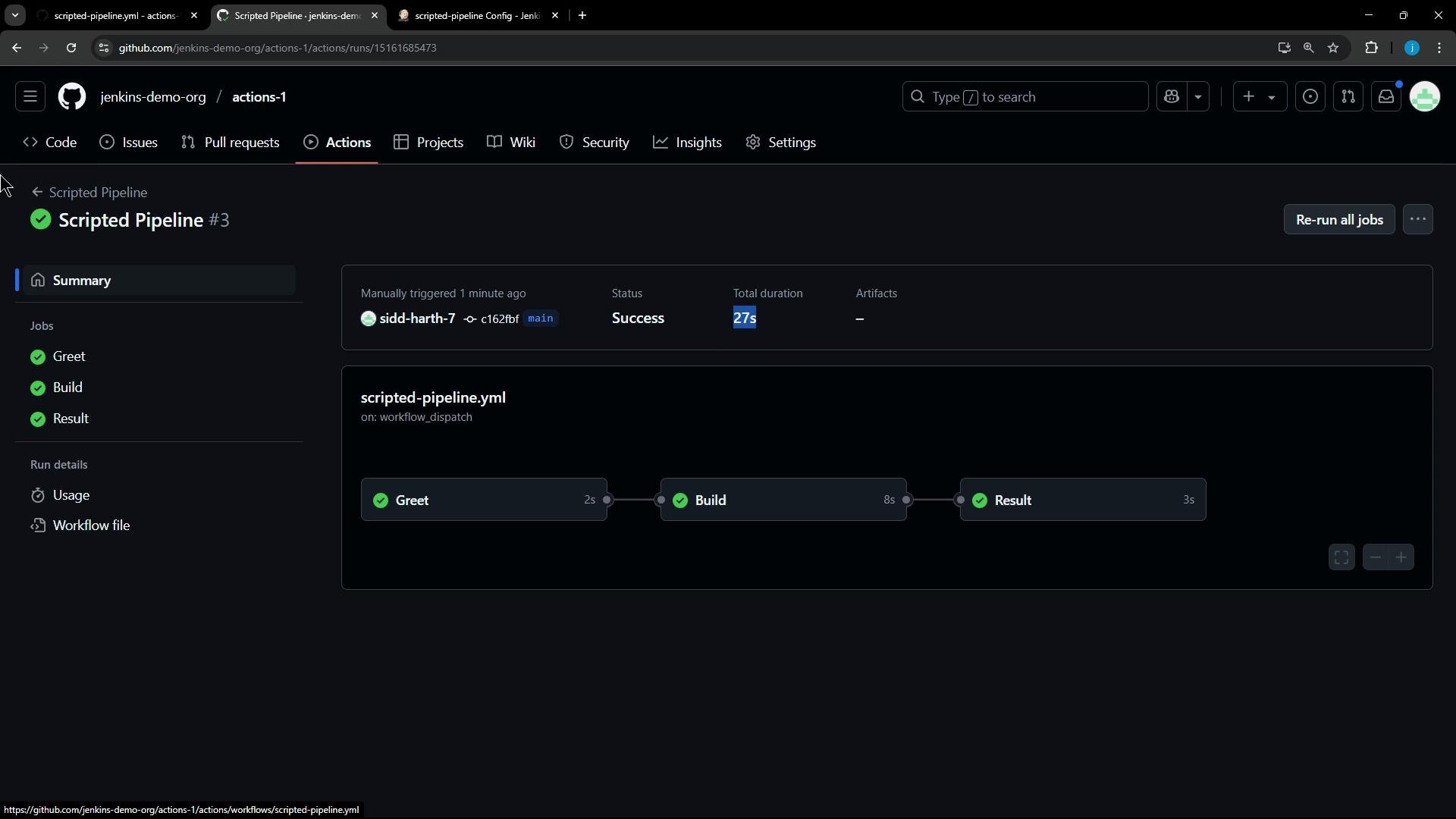
Example of the workflow result in the GitHub Actions UI (Greet, Build, Result):
A dark‑themed GitHub Actions run summary for a "Scripted Pipeline" showing three successful jobs — Greet, Build, and Result — with a total duration of 27s. The workflow diagram and run details are displayed on the page.
Console log snippets (what you should see in each job’s log):
  • Greet job:
Run echo 'Hello, World!'
Hello, World!
  • Build job:
Run echo 'Pretending to build...'
Pretending to build...
# pause for ~5 seconds
  • Result job:
Run echo "Job completed at $(date)"
Job completed at Wed May 21 12:05:44 UTC 2025
Summary and next steps:
  • Convert Jenkins stages into GitHub Actions jobs and use needs to preserve sequencing.
  • Omit needs to allow parallel execution where appropriate.
  • Validate YAML syntax (# comments) and shell step behavior (explicit sleep units).
  • For further optimization, consider merging stages into a single job to reduce runner provisioning time.
Helpful links and references:

Watch Video

Practice Lab