

- Cost-effective enterprise performance: Aurora delivers enterprise-class throughput and reliability while keeping pricing closer to open-source databases, making advanced capabilities accessible to small, medium, and large organizations.
- Fully managed service: AWS manages routine tasks such as automated backups, software patching, and failover, reducing operational overhead and accelerating time-to-market.
Performance and availability
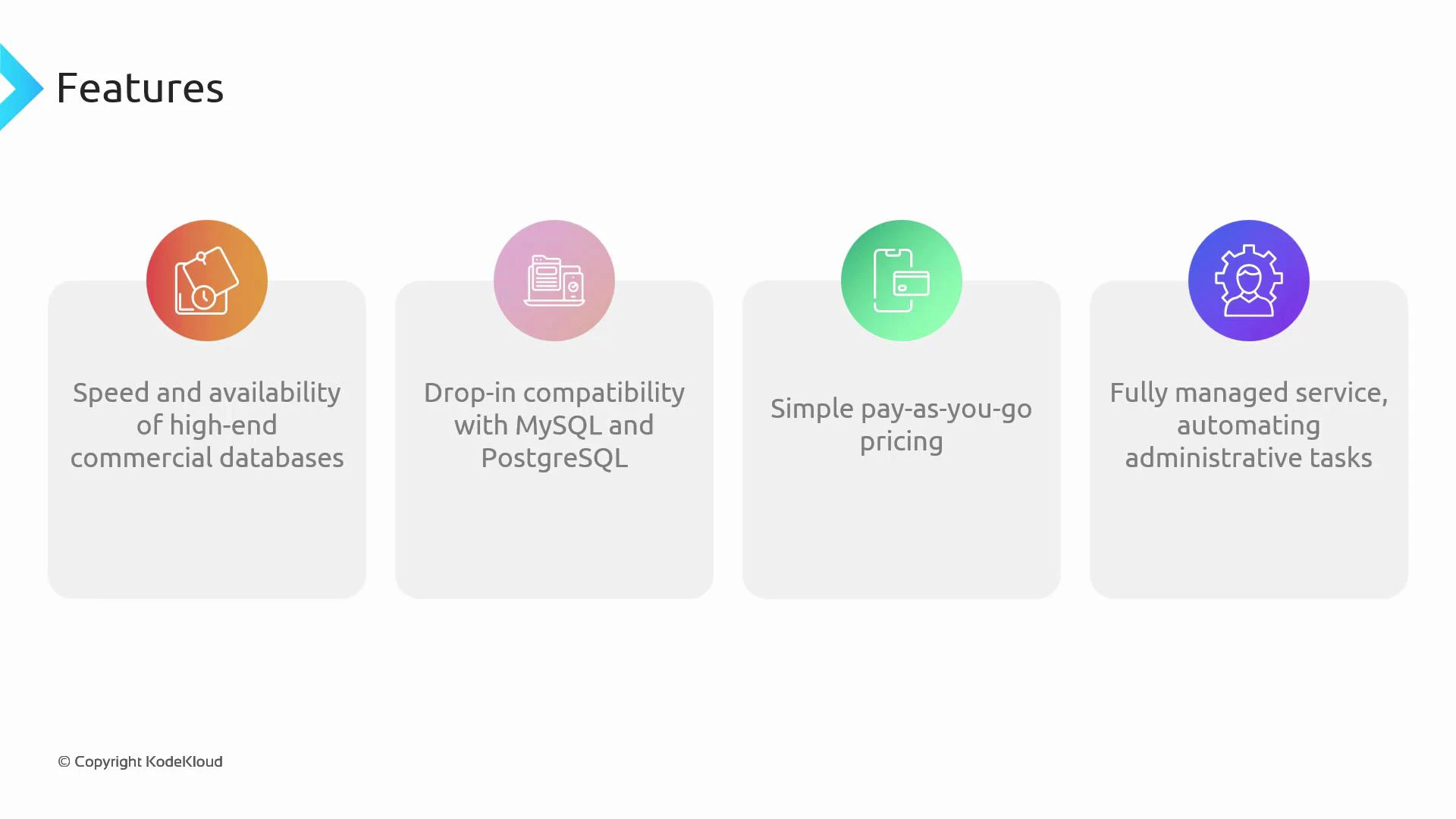
- High throughput: For many workloads, Aurora can deliver up to ~5x the throughput of standard MySQL and up to ~3x the throughput of standard PostgreSQL, depending on instance type and workload profile.
- Durable, distributed storage: Aurora’s storage layer is fault-tolerant, self-healing, and replicates data across multiple Availability Zones. Storage scales automatically as your dataset grows (subject to AWS service limits), enabling very large volumes without manual storage management.
- Continuous backups and fast recovery: Data is continuously backed up to Amazon Simple Storage Service (Amazon S3), and Aurora supports point-in-time recovery. The storage layer is designed to survive instance failures with minimal or no data loss.
- Drop-in compatibility: Aurora implements the MySQL and PostgreSQL wire protocols and supports the corresponding client libraries. In most cases you can migrate applications with minimal changes, continuing to use the same drivers, tools, and SQL (though engine-specific extensions and behaviors should be verified).
- Simplified migrations: Because of this compatibility, “lift-and-shift” migrations from MySQL or PostgreSQL are often straightforward and low-risk.
- Pay-as-you-go: Aurora uses a consumption-based model. You pay for DB instances (compute), storage, and I/O consumed — with no upfront licensing fees. This flexible model helps you align costs with actual usage and scale as demand changes.
- Fully managed operations: Aurora automates instance provisioning, software patching, backups, and failover. It also supports features such as read replicas, Multi-AZ failover, and Global Databases for cross-region replication and low-latency reads.
- Reduced operational overhead: By offloading routine database management to AWS, engineering teams can concentrate on features, performance tuning, and business logic.
When choosing between Aurora MySQL and Aurora PostgreSQL, evaluate engine-specific extensions, compatibility with your client drivers, and any database features your application depends on. Verify behavior for any critical extensions before production migration.
- Amazon Aurora — official docs: https://docs.aws.amazon.com/aurora/
- Amazon RDS overview: https://docs.aws.amazon.com/rds/
- Backup and restore for Aurora: https://docs.aws.amazon.com/AmazonRDS/latest/AuroraUserGuide/CHAP_AuroraBackup.html
- Migrating to Amazon Aurora: https://aws.amazon.com/dms/