

- Proven track record in production environments with high reliability and data integrity.
- Rich native data types (JSONB, arrays, geometric types) and strong constraint support.
- Powerful indexing options and query planner for maintaining performance as data grows.
- Extensible architecture (custom types, functions, procedural languages).
- Good fit for managed services like Amazon RDS for PostgreSQL.
-
Feature-rich data model
- Native support for rich data types (JSONB, arrays, hstore, range types, geometric types).
- Strong constraint mechanisms (CHECK, UNIQUE, FOREIGN KEY) and full ACID compliance for transactional integrity.
- Useful when mixing document-like payloads and relational data—common in modern web and analytics apps.
- See: PostgreSQL Data Types
-
Indexing and performance
- A variety of index types: B-tree for general use, GIN for JSONB/full-text, GiST for spatial/indexable searches, BRIN for very large, append-only tables.
- Index selection and careful schema design directly affect query performance at scale.
- See: PostgreSQL Indexes
-
Extensibility and ecosystem
- Installable extensions (PostGIS, pg_trgm, citext) extend functionality without changing core code.
- Ability to implement custom functions in PL/pgSQL, PL/Python, PL/Perl, etc.
- Enables domain-specific optimizations and complex business logic inside the database.
-
Scalability and managed deployments
- Horizontal and vertical strategies: partitioning, read replicas, connection pooling.
- Managed options such as Amazon RDS provide automated backups, patching, and simplified replica management.
- See: Amazon RDS for PostgreSQL
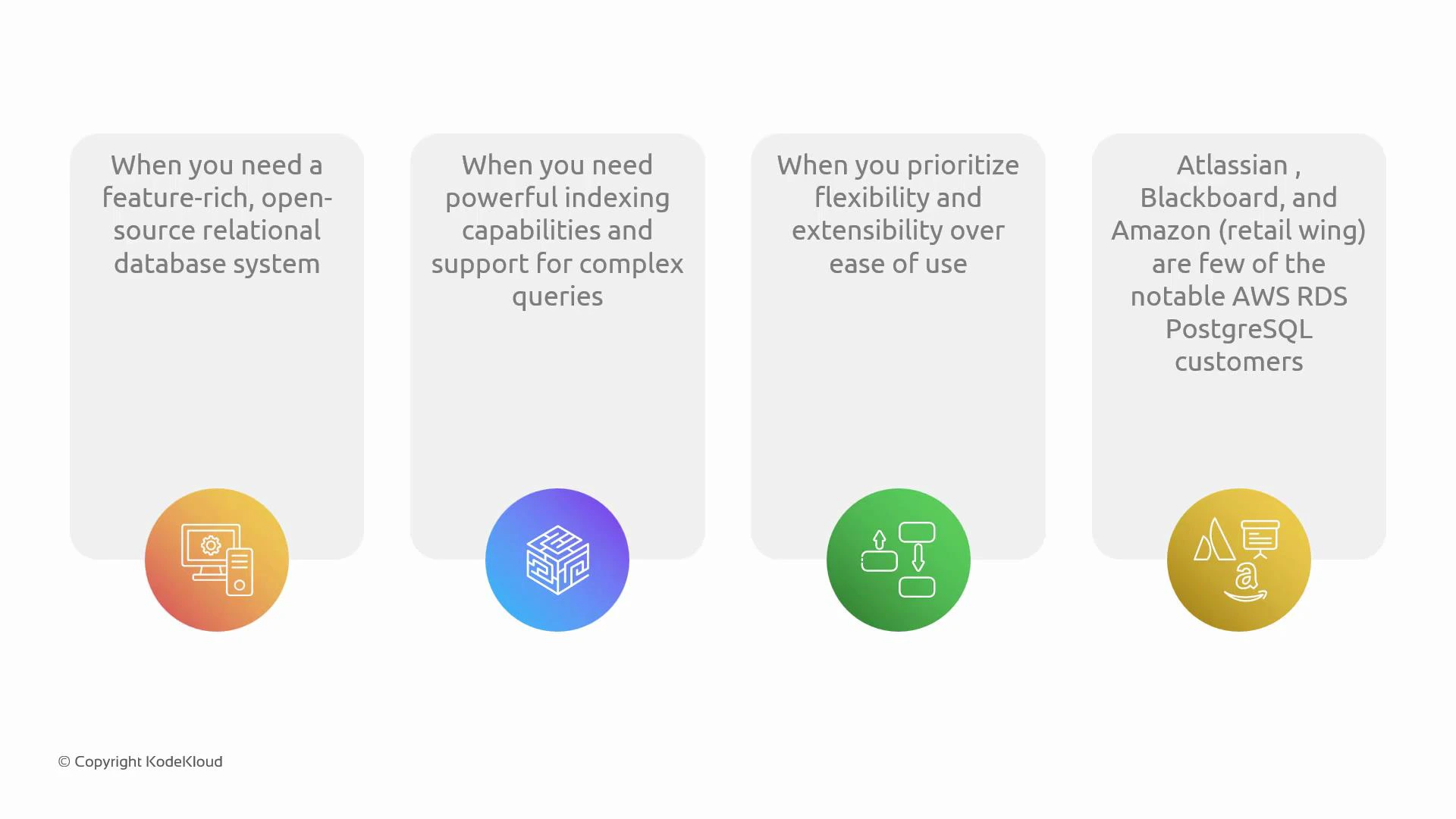
Choose PostgreSQL when your application needs robust relational features, flexible data modeling (including JSONB), advanced indexing, and the option to extend behavior with custom types or extensions. It’s particularly well-suited for analytics, geospatial systems, and applications requiring complex queries.
- PostgreSQL Official Documentation
- Amazon RDS for PostgreSQL
- PostGIS (Geospatial extension)
- JSONB in PostgreSQL