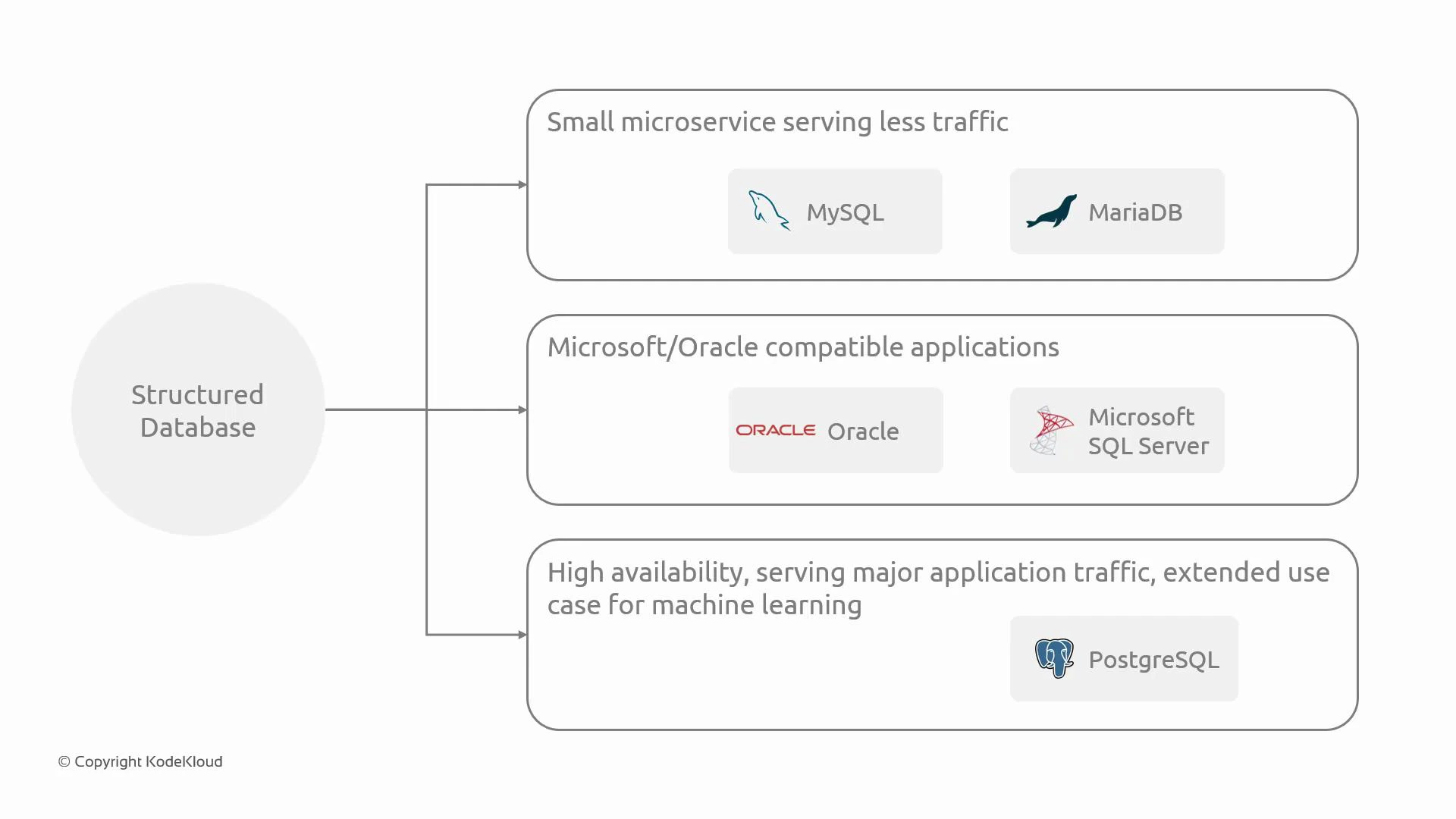
When selecting a database, evaluate these key factors first: expected traffic and concurrency, transactional guarantees (ACID vs eventual consistency), existing application dependencies (Oracle/MSSQL), scaling strategy (vertical vs horizontal), and any ML or analytical requirements.
-
Small or low-activity back-end services / microservices
For services with modest traffic and primarily OLTP (online transaction processing) needs, MySQL or MariaDB are reliable, easy-to-operate choices. They have broad ecosystem support and are well-suited to small-to-medium microservices where predictable transactional performance is required. If reducing operational overhead is a priority, consider managed offerings such as AWS RDS or Amazon Aurora. -
Applications that must integrate with Oracle or Microsoft SQL Server
If you have legacy applications or third-party software that depend on Oracle or MS SQL Server features, using the same engine (on a managed platform like AWS RDS) preserves compatibility and minimizes migration risk. This avoids costly rewrites and preserves application behavior when moving to the cloud. -
High-traffic, user-facing systems or ML-enabled workloads
PostgreSQL is a strong candidate for high-throughput, user-facing systems and workloads that benefit from advanced data types or ML-friendly extensions. PostgreSQL scales for many workloads and has a rich extension ecosystem—examples include PostGIS for geospatial data and pgvector for vector embeddings—making it a common choice for feature stores and ML pipelines. Managed PostgreSQL (and Aurora PostgreSQL) can simplify high-availability and scaling.
- Managed database services (RDS, Aurora) reduce operational effort for backups, failover, patching, and point-in-time recovery.
- Licensing and total cost: Oracle and SQL Server typically have licensing costs—factor these into migration and TCO analyses.
- For extreme horizontal scaling, very large analytical workloads, or highly specialized access patterns, consider purpose-built NoSQL or analytic databases. For most structured OLTP use cases, MySQL/MariaDB, Oracle/SQL Server (for compatibility), and PostgreSQL cover the common needs.
Summary
- Small/medium transactional services: MySQL or MariaDB (consider managed offerings).
- Legacy/compatibility-driven migrations: Oracle or SQL Server on managed platforms to minimize risk.
- High-traffic, ML-capable systems: PostgreSQL for extensibility and ML integration.
- Kubernetes Documentation
- PostGIS — geospatial extension for PostgreSQL
- pgvector — vector similarity for PostgreSQL
- AWS RDS — managed relational database service