

Overview
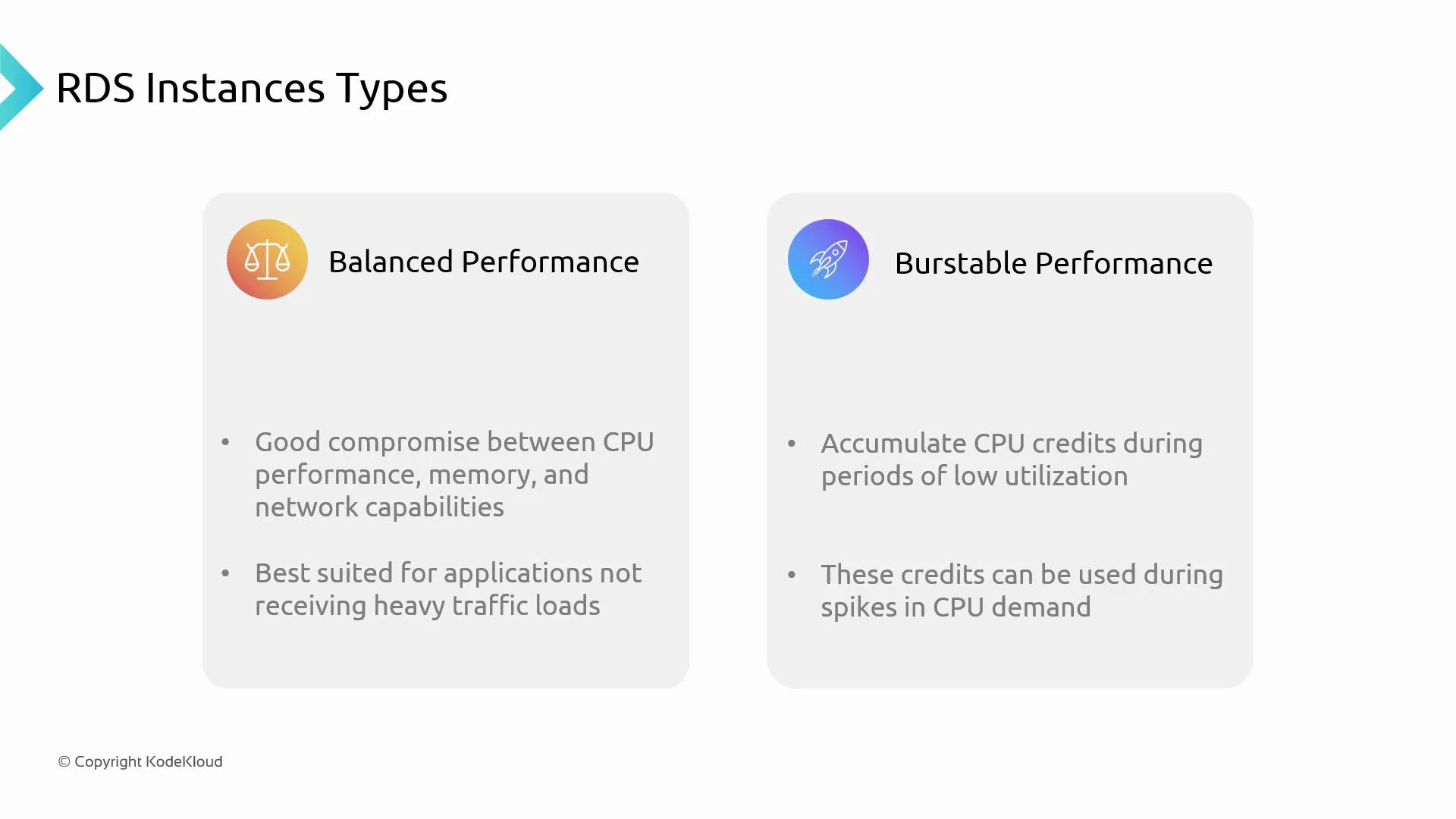
Amazon RDS provides multiple instance classes optimized for different workloads and resource profiles. The most common families are:- Burstable performance instances (T classes) — cost-effective for workloads with mostly low CPU usage but occasional bursts.
- General purpose instances (M classes) — balanced CPU, memory, and network; good default for steady workloads.
- Memory-optimized instances (R classes) — for memory-heavy workloads such as in-memory caches or analytics.
Instance family details
General purpose instances- Provide balanced CPU, memory, and networking.
- Recommended for moderate and consistent workloads, such as OLTP or small-to-medium web applications.
- Cost-effective when you need predictable capacity across multiple resource dimensions.
- Designed for workloads that are mostly idle or low-utilization but occasionally require short CPU bursts.
- Use a CPU credits model: when CPU utilization is below the baseline, credits accumulate; when utilization exceeds the baseline, credits are consumed to permit bursts.
- Best for workloads with unpredictable spikes where sustained high CPU is not common.
- Offer high memory capacity and memory throughput.
- Ideal for large in-memory caches, high-performance databases, and analytics workloads that are memory-bound.
Example scenario
Consider a coupon-generation service that normally sees low traffic but experiences large spikes when a campaign launches or when a partner integration triggers many requests. For this workload:- A burstable instance (T-class) can be economical because it handles short spikes by consuming CPU credits and keeps baseline costs low.
- If the spikes become frequent or prolonged, re-evaluate and consider a general purpose (M) or memory-optimized (R) instance depending on the bottleneck.
Quick decision table
Practical tips for choosing and validating
- Start with the family that matches your workload pattern. Use M for steady workloads, T for low baseline with spikes, and R for memory-bound workloads.
- Monitor these CloudWatch metrics to validate instance sizing:
- CPUUtilization
- FreeableMemory
- ReadIOPS / WriteIOPS
- DiskQueueDepth / BurstBalance (for burstable storage)
- If your T-class instance frequently runs out of CPU credits and performance degrades, migrate to an M-class or scale vertically.
- Consider storage type and IOPS separately — instance class handles compute and memory; storage choices (General Purpose SSD, Provisioned IOPS, Magnetic) affect disk throughput and latency.
Burstable T instances are not suitable for sustained high CPU workloads. If CPU credits are exhausted repeatedly, you will see degraded performance. Monitor credits and CPU metrics and plan a resize or family change if credits run low.
Example: list available DB instance classes (AWS CLI)
Use this AWS CLI command to list available RDS instance classes for a specific engine and region:--engine to your database engine (postgres, aurora, sqlserver, etc.).
Beyond instance class, tune storage type and provisioned IOPS for I/O-sensitive workloads. Always validate choices with production-like load tests and CloudWatch metrics before committing to long-term provisioning.
Summary
- Use M for balanced, steady workloads.
- Use T for low baseline, occasional spikes — but monitor CPU credits.
- Use R for memory-intensive workloads with high memory throughput.
- Monitor CloudWatch metrics to validate sizing and catch issues early.
Links and references
- Amazon RDS instance classes — AWS Documentation
- Amazon RDS pricing and instance types
- Amazon CloudWatch metrics for RDS