In this tutorial, you’ll learn what HashiCorp Vault is, explore various installation methods, and perform a hands-on deployment of Vault in a Kubernetes cluster using the official Helm chart.

What Is Vault?

Vault is a centralized secrets management tool designed for securely storing and accessing sensitive data such as:
  • Credentials for authenticating users or services
  • Encryption keys for data encryption and decryption
  • API tokens, TLS certificates, and other secret types
Vault offers:
  • A unified REST API for secret management
  • Fine-grained access control with policies
  • Detailed audit logging of all operations
For more, visit the HashiCorp Vault Documentation.

Installation Methods

You can install Vault using one of the following approaches:
MethodDescriptionExample Command
Linux Package ManagerInstall via APT or Yum on supported distrossudo apt-get install vault
Precompiled BinaryDownload and place in your PATHwget https://releases.hashicorp.com/vault
Build from SourceClone the repo and compile yourselfgo build github.com/hashicorp/vault
For production, run Vault in a highly available configuration across multiple hosts. Use a durable storage backend like Consul or AWS S3.

Installing via APT (Ubuntu/Debian)

curl -fsSL https://apt.releases.hashicorp.com/gpg | sudo apt-key add -
sudo apt-add-repository "deb [arch=amd64] https://apt.releases.hashicorp.com $(lsb_release -cs) main"
sudo apt-get update && sudo apt-get install vault

Deploying Vault with Helm

We’ll deploy Vault into Kubernetes using the official Helm chart. Ensure you have:
  • Kubernetes ≥1.14
  • Helm 3.x installed
  • kubectl configured to access your cluster

1. Add the HashiCorp Helm Repository

helm repo add hashicorp https://helm.releases.hashicorp.com
helm repo update

2. Review the Vault Helm Chart

Check the chart’s prerequisites and usage on GitHub:
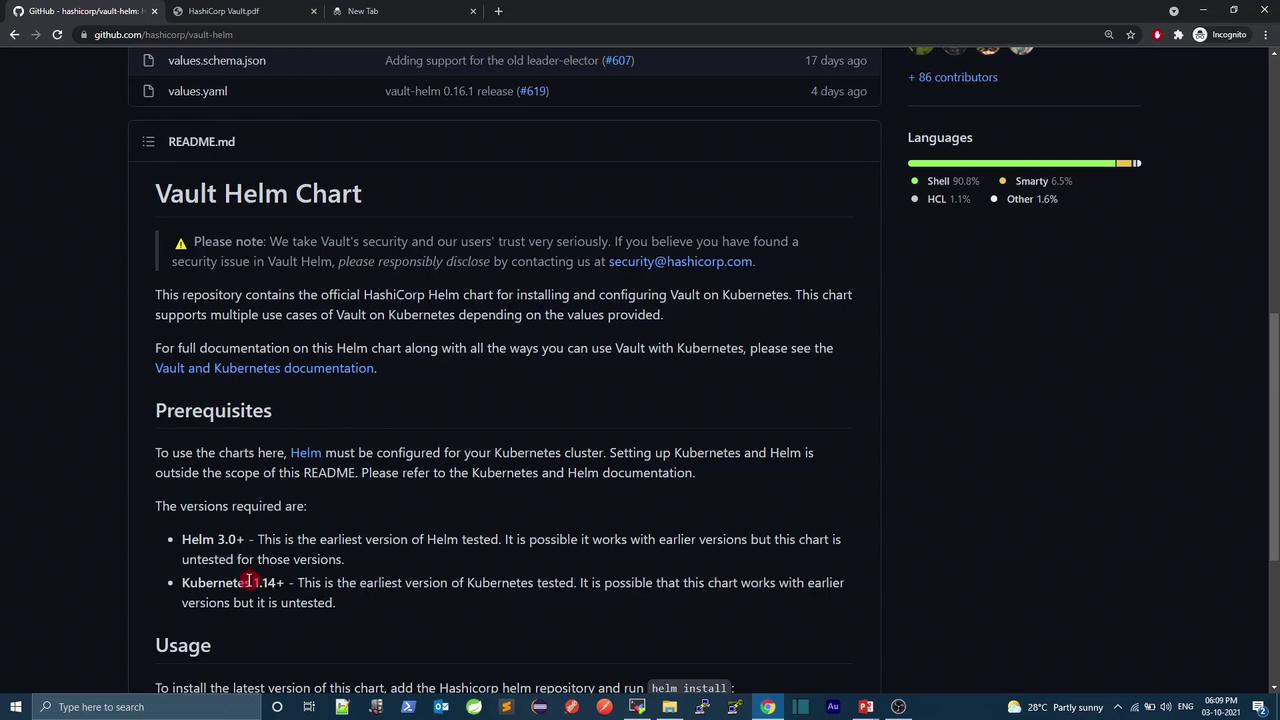
The image shows a GitHub page for the "Vault Helm Chart" repository by HashiCorp, detailing installation and configuration instructions for using Vault on Kubernetes. It includes sections on prerequisites and usage, with a sidebar showing language statistics.

3. Inspect Default Configuration

View the excerpt from values.yaml:
# values.yaml (excerpt)
ui:
  enabled: false
  serviceType: ClusterIP
  serviceNodePort: null

server:
  dataStorage:
    enabled: true
    size: 10Gi
In this demo, we’ll:
  • Enable the Vault UI
  • Expose the UI via NodePort
  • Disable persistent storage (for demo purposes)

Prerequisites Check

# Verify Kubernetes
kubectl version --short
# Verify Helm
helm version --short

Step by Step: Deploying to a Dedicated Namespace

  1. Create and switch to the demo namespace:
    kubectl create namespace demo
    kubectl config set-context --current --namespace=demo
    
  2. Install the Vault chart with custom settings:
    helm install vault hashicorp/vault --version 0.16.1 \
      --set ui.enabled=true \
      --set ui.serviceType=NodePort \
      --set server.dataStorage.enabled=false
    
  3. Verify Kubernetes resources:
    kubectl get all
    
    Wait until the vault-0 pod and related components are in the Running state:
    kubectl get pods
    

Checking Vault Status

Once the pods are running, access the Vault pod and check its seal status:
kubectl exec -it vault-0 -- vault status
You should see output similar to:
Key             Value
---             -----
Seal Type       shamir
Sealed          true
Version         1.8.3
Cluster Name    vault-cluster
Vault is sealed by default. You must initialize and unseal it using key shares and a threshold. These steps can be done via CLI or the UI.

Accessing the Vault UI

The Vault UI is exposed on a NodePort (e.g., 31272). Open your browser to:
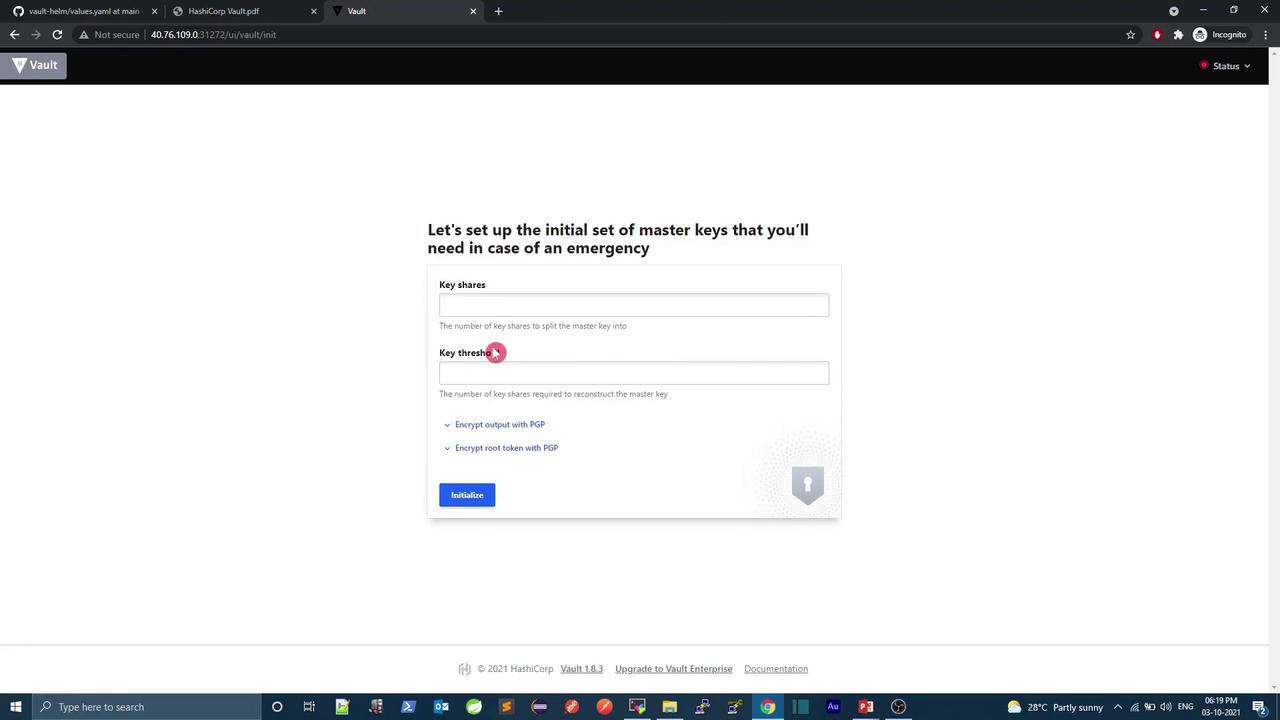
http://<your-node-ip>:31272
You will be prompted to set up master keys and a root token:
The image shows a web interface for setting up master keys in HashiCorp Vault, with fields for "Key shares" and "Key threshold," and options to encrypt output and root token with PGP.

References