

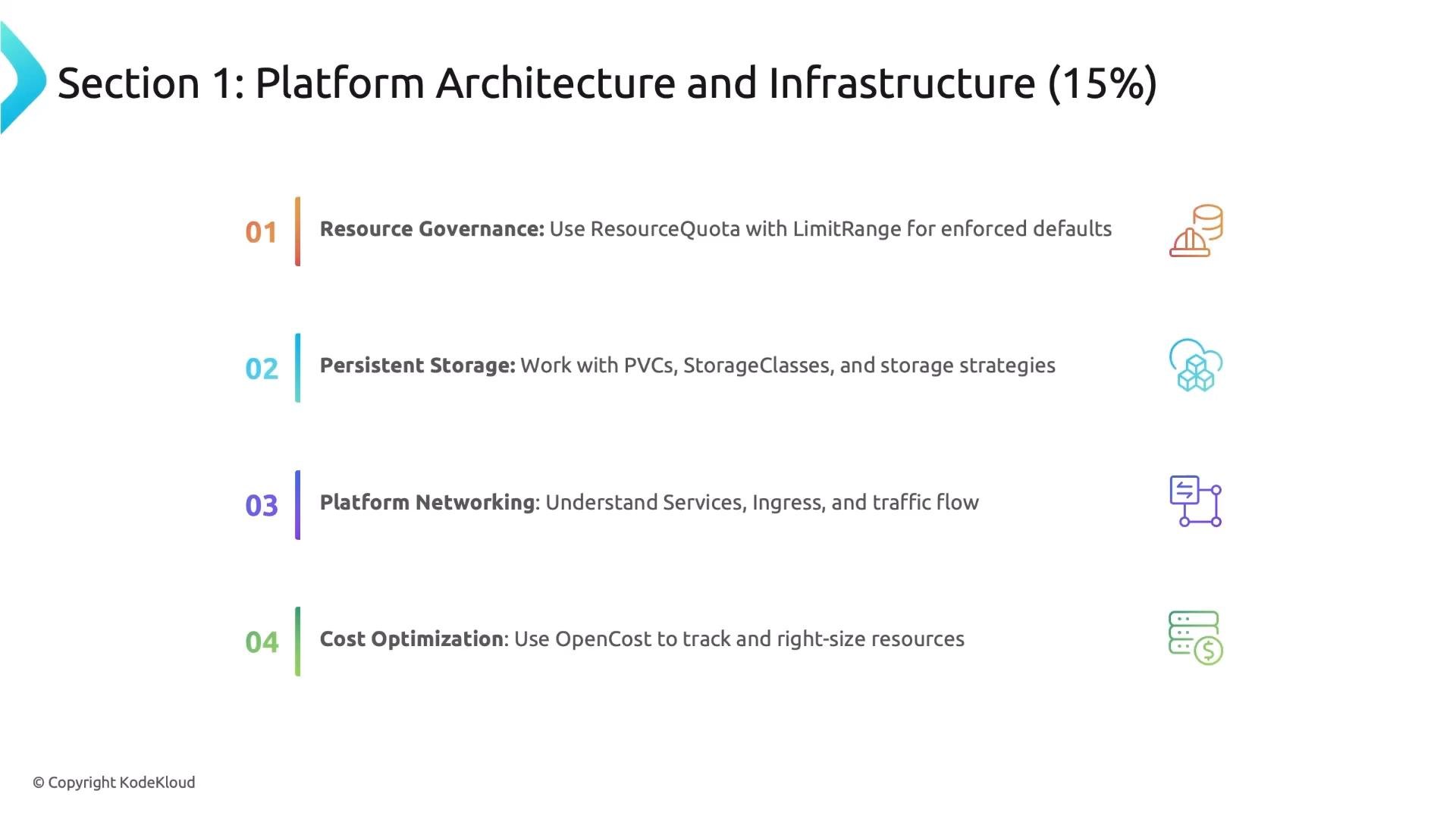
- Foundation concepts that support everything else on the platform.
- Resource governance: pair
ResourceQuotawithLimitRangeto control cluster‑ and namespace‑level resource consumption. - Persistent storage: manage lifecycle and reclamation using
PersistentVolumeClaim(PVC),StorageClass, and reclaim policies. - Platform networking: understand how
Service, Ingress / Gateway API, and service routing shape traffic flows. - Cost optimization: use tools such as OpenCost to identify waste and right‑size workloads for cost control.
- GitOps principles: desired state management, drift detection, and repository design for predictable deployments. See GitOps fundamentals for patterns and best practices.
- Argo CD: application objects, sync policies (manual vs automated), self‑heal and prune behaviors, and Helm/Helmfile integration.
- CI/CD with Tekton: tasks, pipelines, and workspaces to produce reproducible builds and deployments.
- Progressive delivery: implement canary releases and traffic shaping using Argo Rollouts and a service mesh such as Istio.
- Troubleshooting delivery failures: diagnose pipeline logs, image/tag issues, and sync errors.
- Treat APIs as products: design platform contracts and intuitive developer-facing APIs.
- CRDs: author CustomResourceDefinitions with validation schemas, shortNames, versioning, and conversion strategies.
- Operator patterns: implement reconcilers, handle exponential backoff, leader election, and common lifecycle patterns (example: cert‑manager).
- Workflow orchestration: use Argo Workflows for DAGs, parameters, artifacts, and reusable workflow templates.
- Crossplane compositions: map developer intent to real cloud infrastructure using Crossplane composites and claims.
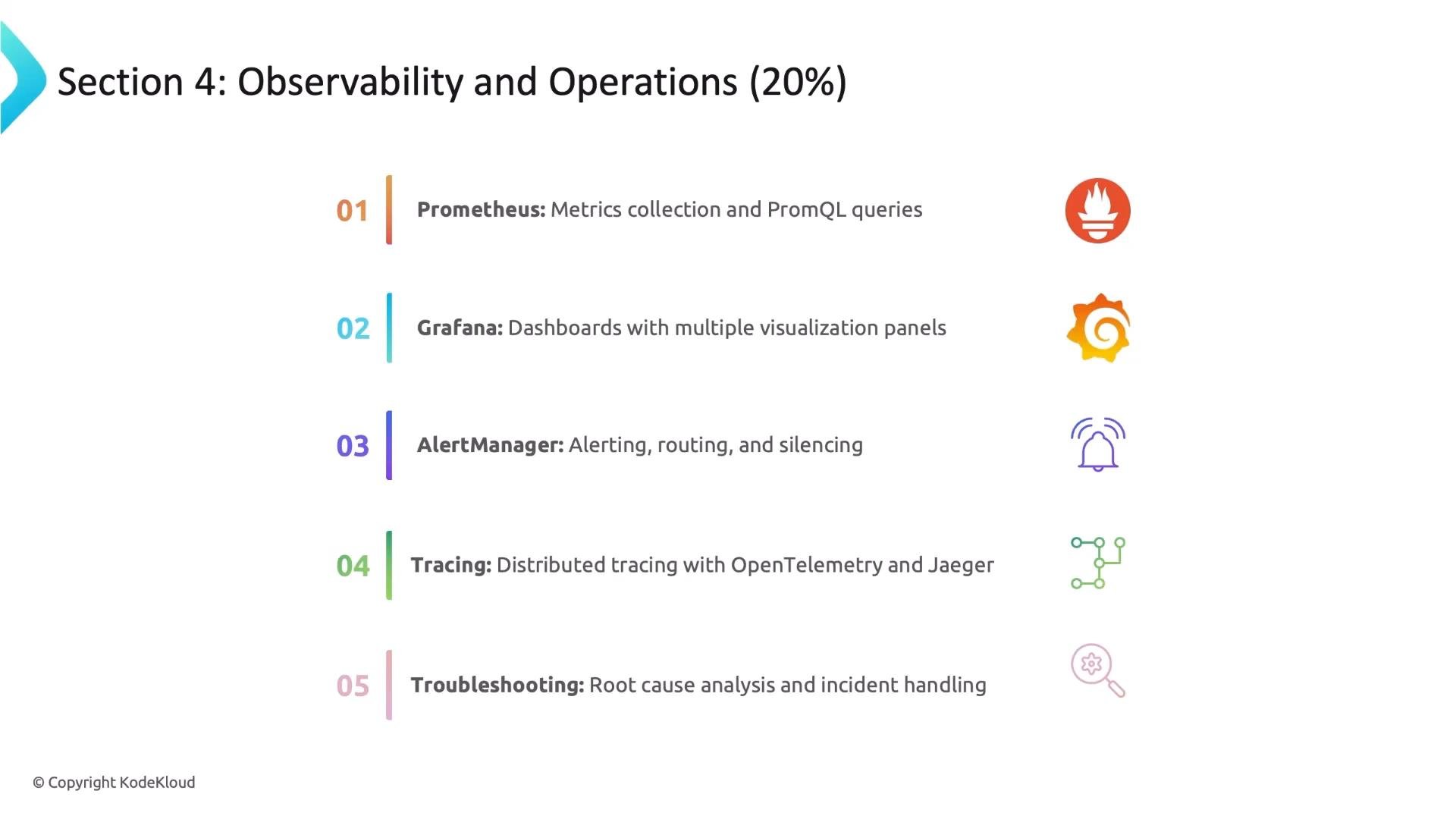
- Metrics: collect and query metrics with Prometheus and PromQL; design alertable metrics and scrape targets.
- Visualization: build operational and business dashboards with Grafana for signal‑based monitoring.
- Alerting: configure Alertmanager for routing, silencing, grouping, and notification policies.
- Tracing: instrument services with OpenTelemetry and analyze traces in Jaeger to understand request flows and latencies.
- Incident response: practice triage, root‑cause analysis, remediation, and post‑incident validation with runbooks.
- Identity and access: design fine‑grained RBAC roles and role bindings to enforce least privilege.
- Admission control and policy: use Gatekeeper for complex Rego policies and Kyverno for YAML‑native validation, mutation, and generation.
- Pod security: enforce Pod Security Standards (PSS) to restrict runtime privileges and capabilities.
- Service‑to‑service security: enable mTLS and identity enforcement with a service mesh like Istio.
- Supply chain security: scan images for vulnerabilities, implement signing for provenance, and enforce policies to reject unsigned or vulnerable images.
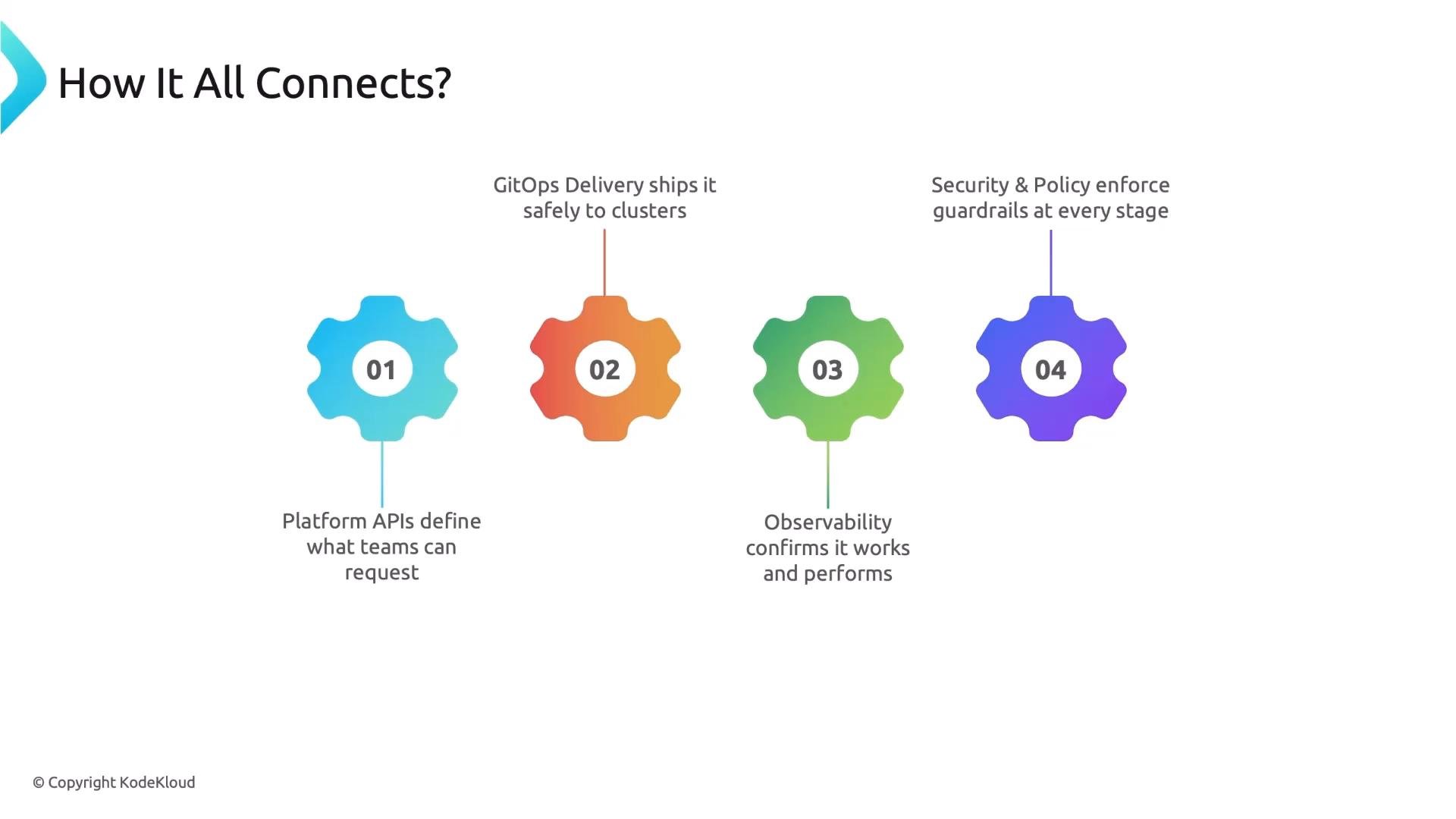
- These five domains create a continuous platform lifecycle:
- Platform APIs and CRDs expose developer‑friendly primitives.
- GitOps delivery (Argo CD + CI pipelines) applies desired state to clusters.
- Observability (Prometheus/Grafana/Tracing) validates behavior and SLA compliance.
- Security/policy (Gatekeeper/Kyverno/PSS/mTLS) enforces guardrails and least privilege.
- Platform architecture (governance, storage, networking, cost) provides the stable foundation.
- Developer experience: instead of tickets, developers request infrastructure via platform APIs; the platform reconciles the request and provisions cloud resources.
- Delivery validation: observability tools confirm deployment behavior; progressive delivery strategies reduce blast radius.
- Enforcement: admission controllers and policy engines prevent regressions and insecure configurations.
What to do next (practical steps)
Hands‑on practice is the most effective exam preparation. Run every lab, even those you think you’ve mastered — repetition improves speed, confidence, and recall under exam conditions.
- Complete any hands‑on exercises you skipped; exam tasks closely mirror lab scenarios.
- Practice for speed: time your labs, and aim to reduce completion time through repetition and checklisting.
- Focus mock exams on your weak areas to convert weaknesses into strengths.
- Review exam logistics and tips: time management, workspace navigation, and common pitfalls.
- Schedule the exam confidently: trust your preparation, adhere to exam strategy, and allocate time for verification.
- GitOps fundamentals: https://learn.kodekloud.com/user/courses/gitops-with-argocd
- Argo CD: https://learn.kodekloud.com/user/courses/gitops-with-argocd
- Tekton: https://tekton.dev/
- Argo Rollouts: https://argoproj.github.io/argo-rollouts/
- Istio service mesh: https://learn.kodekloud.com/user/courses/istio-service-mesh
- Prometheus & PromQL: https://prometheus.io/docs/prometheus/latest/querying/basics/
- Grafana: https://learn.kodekloud.com/user/courses/grafana-assistant
- Alertmanager: https://prometheus.io/docs/alerting/alertmanager/
- OpenTelemetry: https://opentelemetry.io/
- Jaeger tracing: https://www.jaegertracing.io/
- Gatekeeper (OPA): https://open-policy-agent.github.io/gatekeeper/
- Kyverno: https://learn.kodekloud.com/user/courses/learn-by-doing-kubernetes-policies-with-kyverno
- Crossplane: https://learn.kodekloud.com/user/courses/learn-by-doing-crossplane
- OpenCost: https://opencost.io/