

- Compare execution models and mental models for each tool.
- Identify sweet spots and anti-patterns.
- Match common problems to the right tool.
- Show how multiple tools can be combined in a platform architecture.
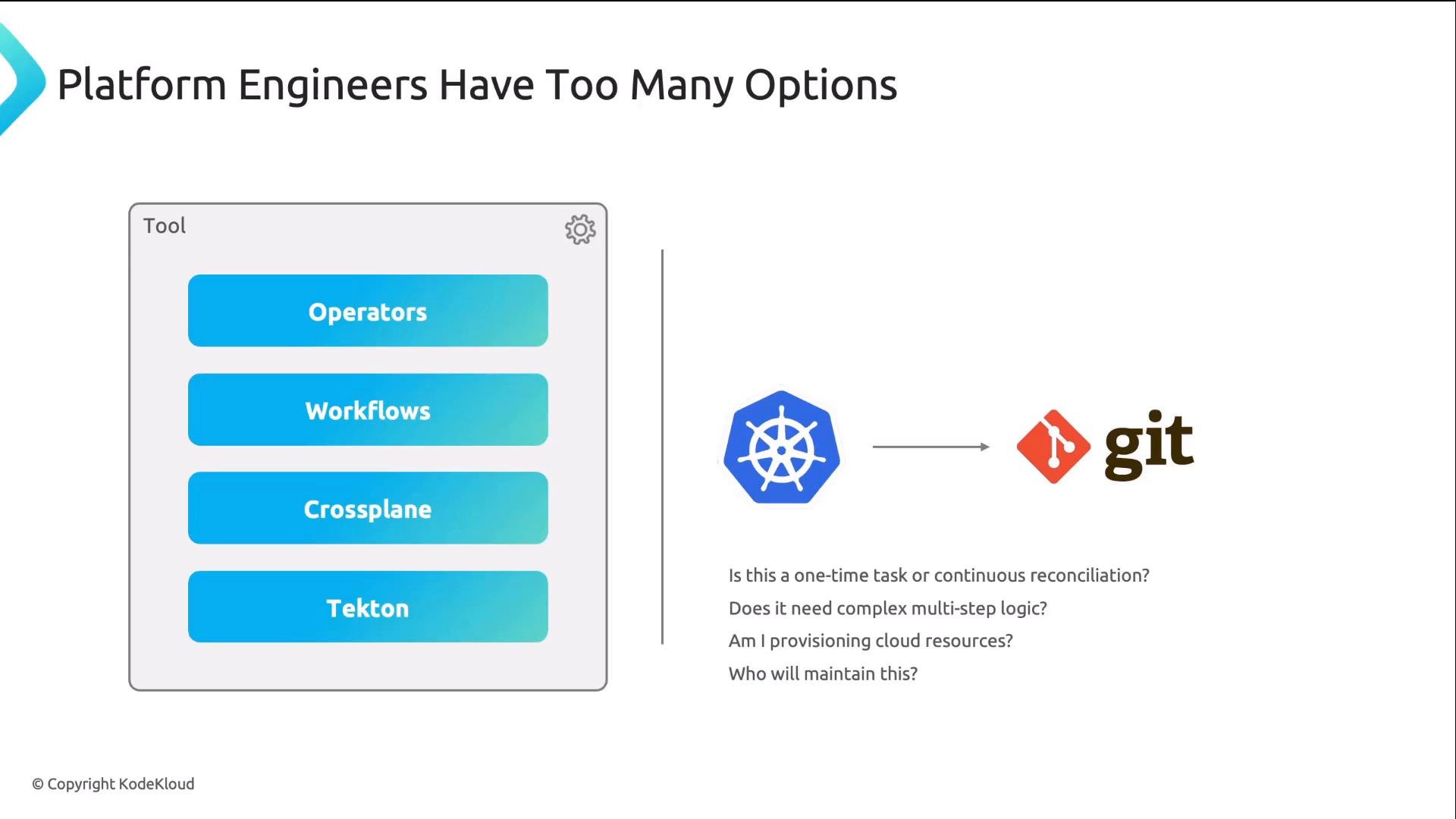
- Is this a one-time task or continuous reconciliation?
- Does it require complex, multi-step orchestration or simple steps?
- Who will maintain the automation, and what languages are they comfortable with?
- Is the primary goal provisioning cloud resources declaratively?
- A consultancy implemented a 2,000-line Go Operator to provision developer environments. The operator watched a custom DevEnvironment CR and performed multiple tasks: create a namespace, configure RBAC, deploy monitoring, and set up DNS.
- A colleague showed the same behavior could be implemented with Crossplane composition and a small function—about 80 lines of YAML. The operator’s continuous reconciliation was unnecessary because the workflow’s goal was “run to completion” (provision and leave) rather than long-term lifecycle management.
- Mental model: always-on controllers that watch resources and continuously reconcile cluster or application state until it matches the desired state.
- Use when:
- The application or resource needs ongoing lifecycle management (backups, upgrades, scaling, failover).
- Operational knowledge must be encoded (for example, orchestrating zero-downtime PostgreSQL upgrades).
- You want “set-and-forget” automation that heals and enforces desired state continuously.
- Avoid when:
- The problem is a one-off, multi-step task that should run to completion and exit.
- You prefer to avoid a language-specific implementation — operators are commonly written in Go (although SDKs exist).
- Real-world examples: PostgreSQL operators, Redis/Kafka operators, Prometheus operator, cert-manager.
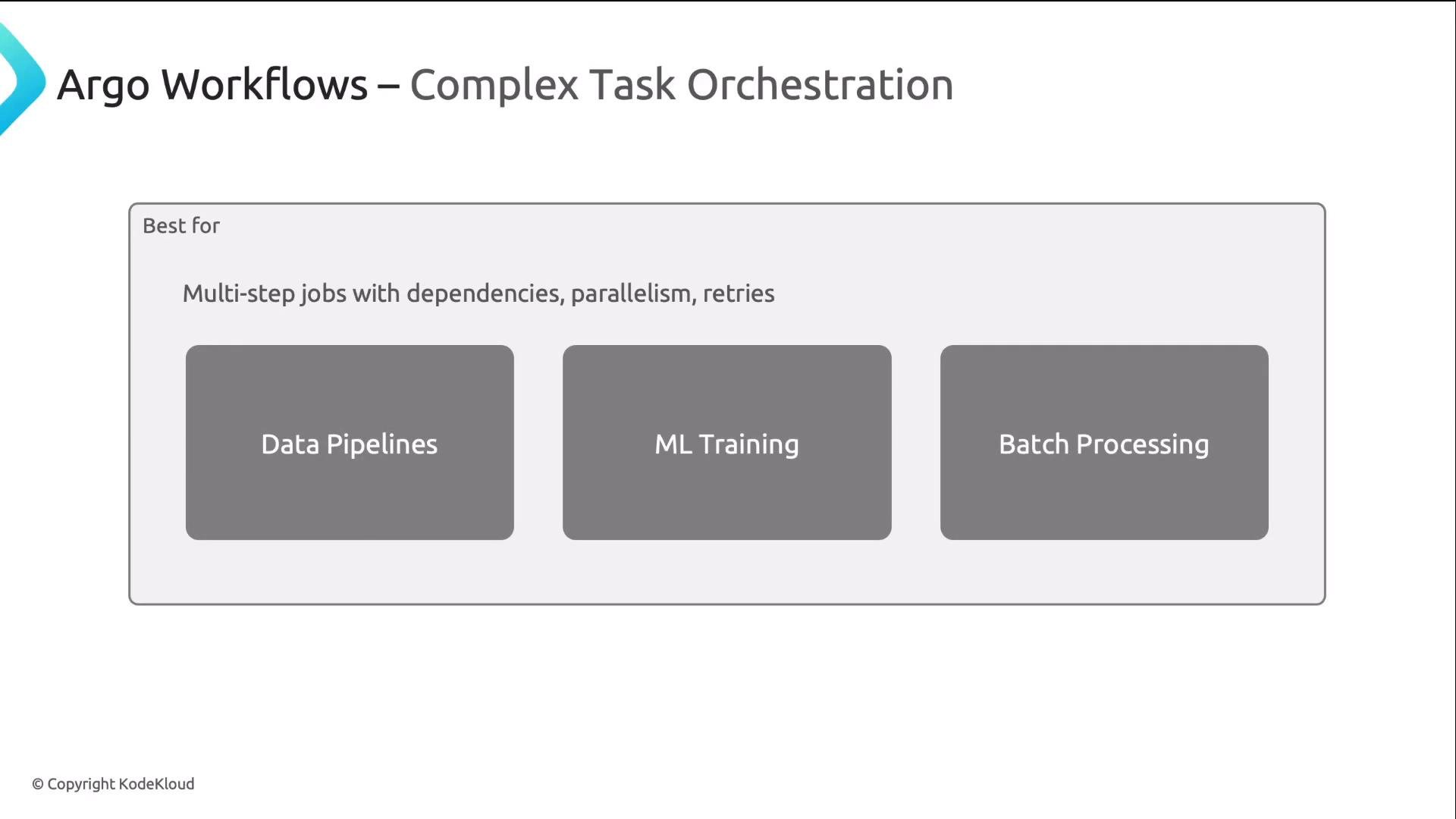
- Mental model: run-to-completion DAGs or step sequences. Execute tasks (containers, scripts) and exit when finished.
- Use when:
- You have complex multi-step jobs with dependencies and conditional logic (build -> test -> deploy).
- You need parallelism (run multiple test suites or data transforms simultaneously).
- Steps require retries with backoff and passing artifacts between steps.
- Avoid when:
- You need continuous reconciliation or drift correction — workflows do not watch resources after completion.
- The task is a simple container run — a Kubernetes Job may be sufficient.
- You are primarily provisioning cloud resources declaratively — Crossplane is a better fit.

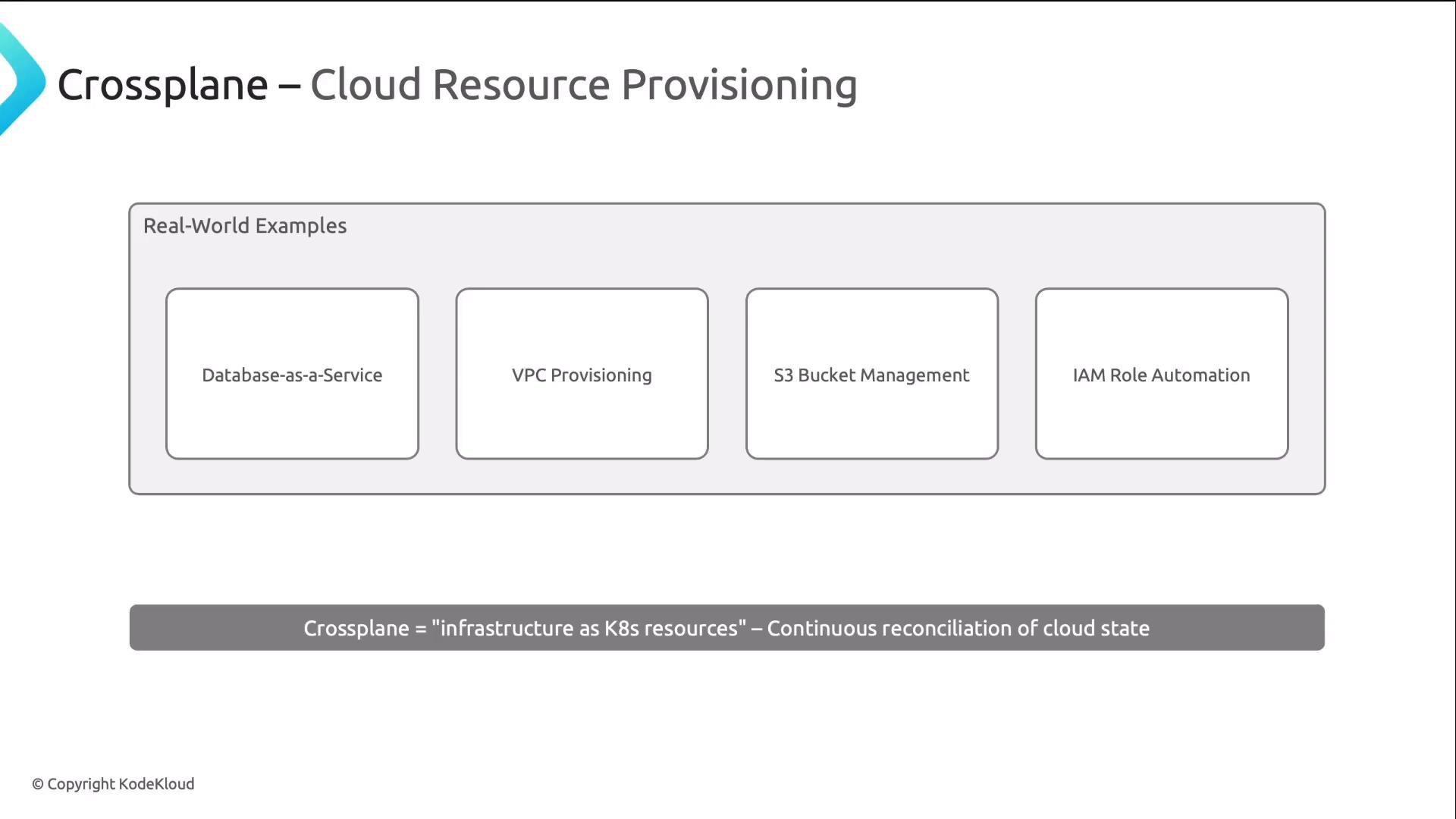
- Mental model: treat cloud infrastructure as Kubernetes resources. Crossplane exposes cloud APIs through CRDs and continuously reconciles cloud state to match the declared configuration.
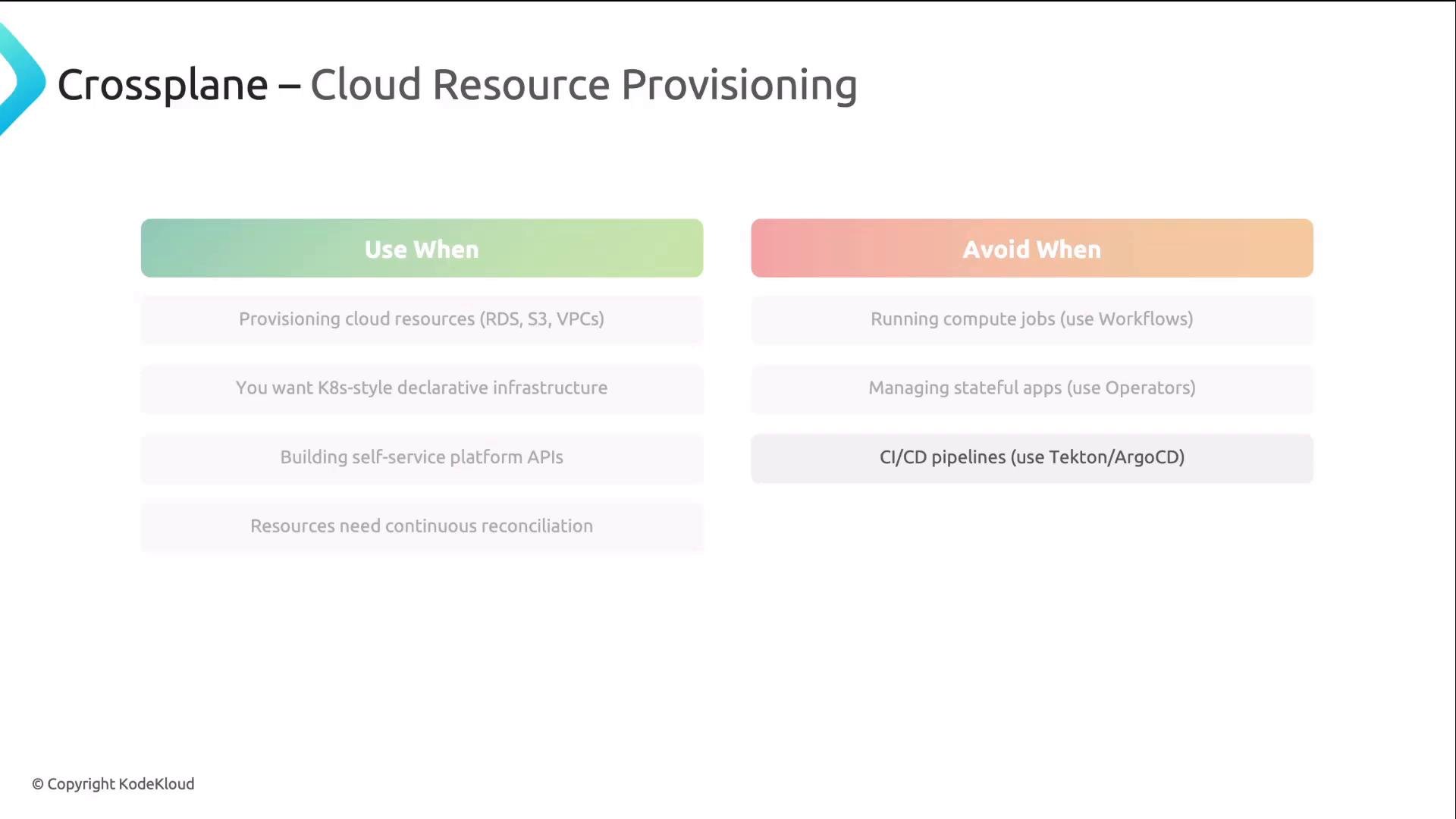
- Use when:
- You provision cloud resources (databases, VPCs, storage buckets, IAM roles).
- You want Kubernetes-style declarative infrastructure and
kubectl applysemantics. - You’re building self-service platform APIs: XRDs let developers request resources without learning cloud-specific APIs.
- Continuous reconciliation and drift correction of cloud state is required.
- Avoid when:
- You need to run compute jobs or complex data pipelines — workflows are a better fit.
- You need lifecycle management of stateful in-cluster applications — Operators are preferable.
- You are building CI/CD pipelines — use Tekton or Argo CD for CI/CD workflows.
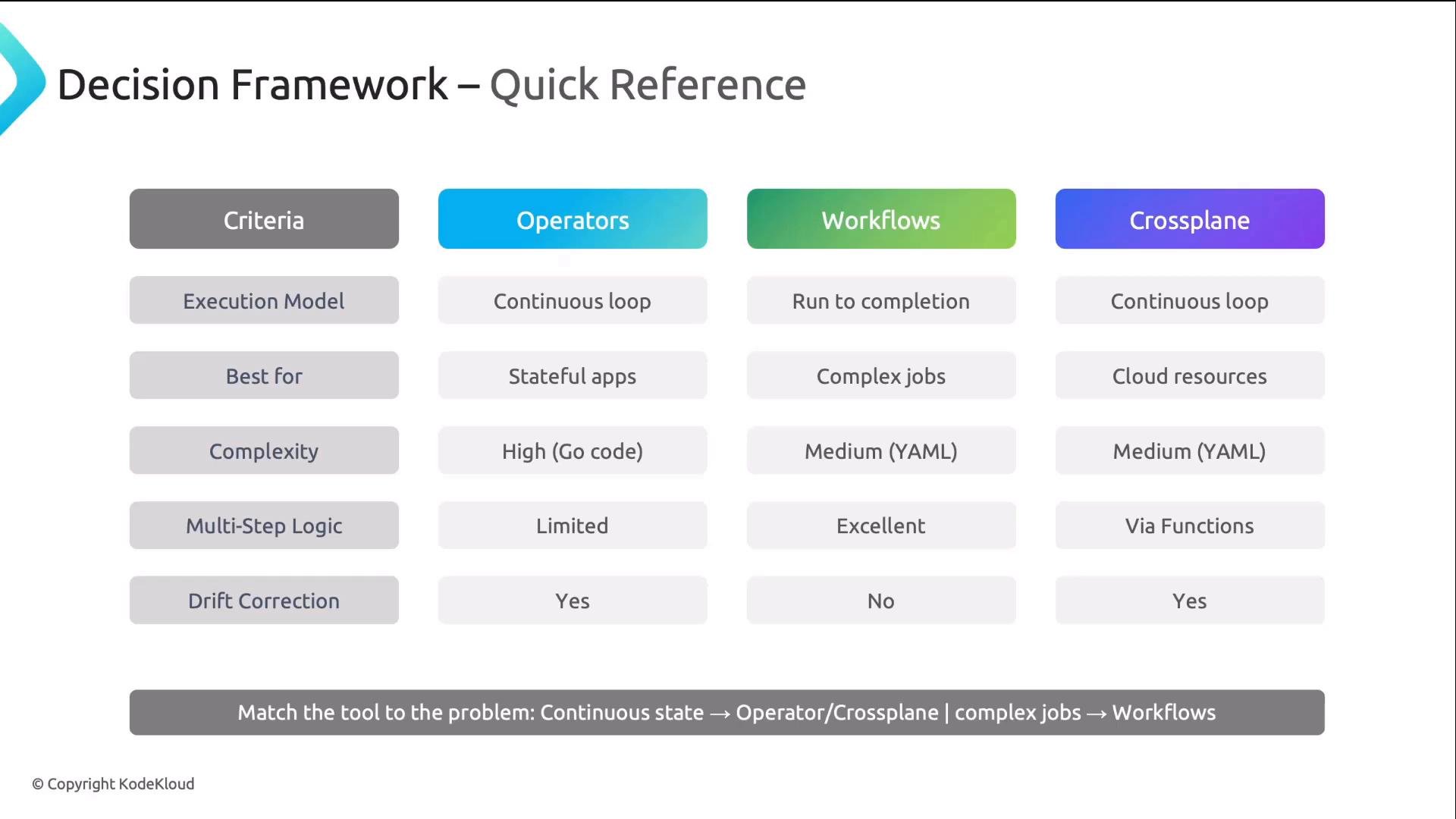
- The execution model is the primary discriminator:
- Operators and Crossplane: continuous reconciliation (long-lived controllers).
- Workflows: run-to-completion (execute and exit).
- Drift correction / continuous healing: Operators or Crossplane.
- Complex DAG / multi-step logic: Workflows.
- Stateful application lifecycle management: Operators.
- Declarative cloud resource provisioning / self-service APIs: Crossplane.
- For simple single-run tasks, prefer Kubernetes Jobs or lightweight scripts rather than a full workflow engine.
- Infrastructure layer: Crossplane for cloud resources (RDS, VPCs, S3 buckets).
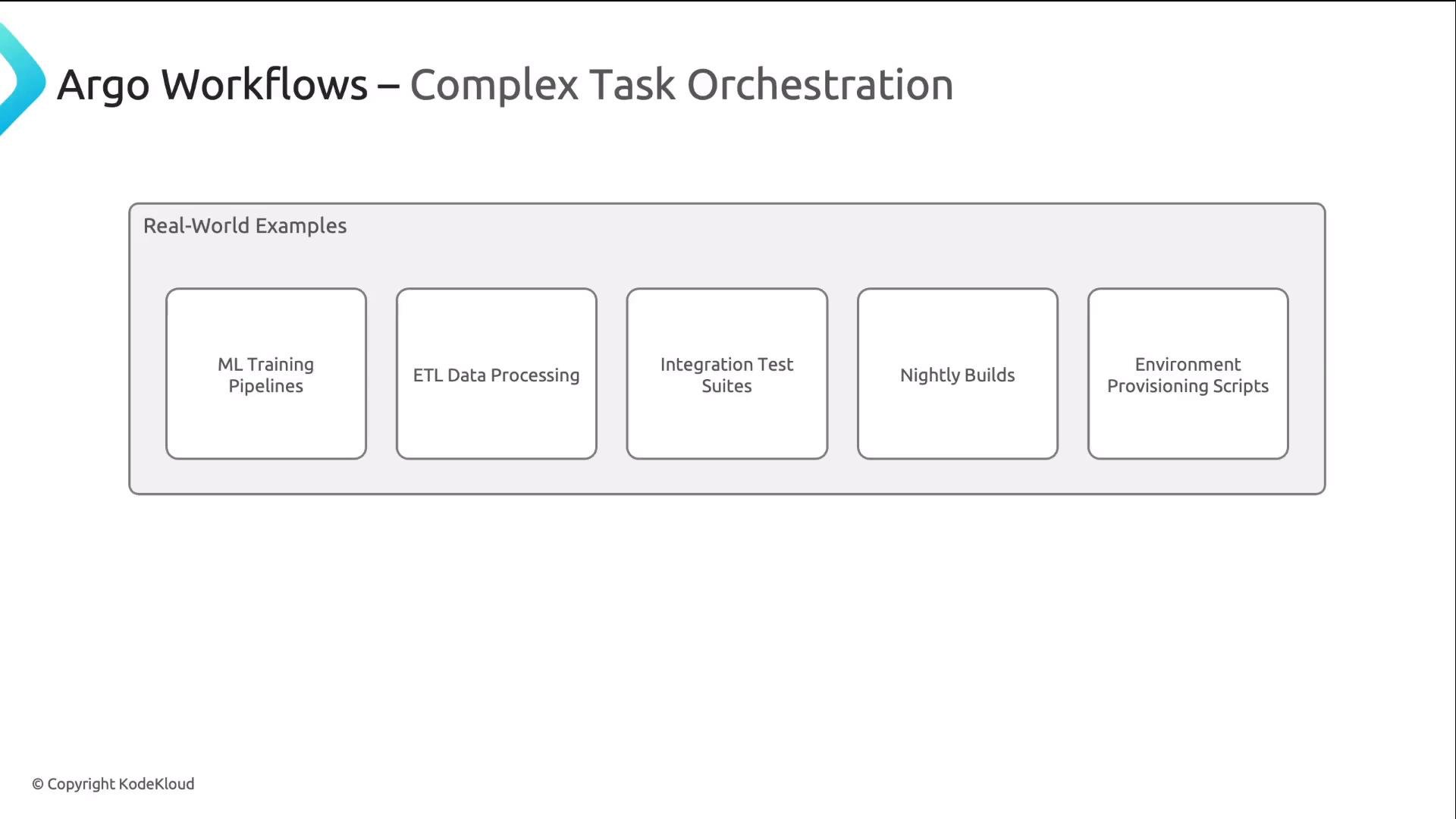
- Orchestration layer: Argo Workflows for pipelines, ETL, model training, and complex release gating.
- Runtime management: Operators for stateful application lifecycle operations and in-cluster self-healing.
- Deployment / GitOps: Argo CD for continuous delivery and Tekton for CI/build tasks.
- Database-as-a-Service: Crossplane provisions the RDS instance; a PostgreSQL Operator manages backups, failover, and schema migrations.
- ML platform: Crossplane provisions GPU nodes and object storage; Argo Workflows runs data fetch, training, evaluation, and model upload; Operators manage long-running model-serving instances.
- Self-service infra via GitOps: Argo Events detects a PR; Argo Workflows runs validations; a successful workflow triggers Crossplane to provision requested infrastructure; Argo CD ensures manifests are continuously deployed.
Use the execution model as your first filter: if automation must continuously watch and heal state, prefer Operators or Crossplane. If automation is a complex job that runs to completion, prefer Workflows. Then apply secondary criteria: complexity, maintainability, team language preference, and long-term support.
- Operators: best for managed, stateful applications that require continuous lifecycle operations and drift correction.
- Workflows (Argo Workflows): best for complex multi-step jobs, DAGs, parallelism, and artifact passing — these run to completion.
- Crossplane: best for declarative cloud resource provisioning and building self-service platform APIs that need continuous reconciliation.
- Most platforms combine tools: think in layers (infrastructure, orchestration, runtime, deployment) and choose the right tool for each layer.
- Argo Workflows: https://argoproj.github.io/argo-workflows/
- Crossplane: https://crossplane.io/
- Argo CD: https://argo-cd.readthedocs.io/
- Tekton: https://tekton.dev/
- Kubernetes Concepts: https://kubernetes.io/docs/concepts/overview/what-is-kubernetes/