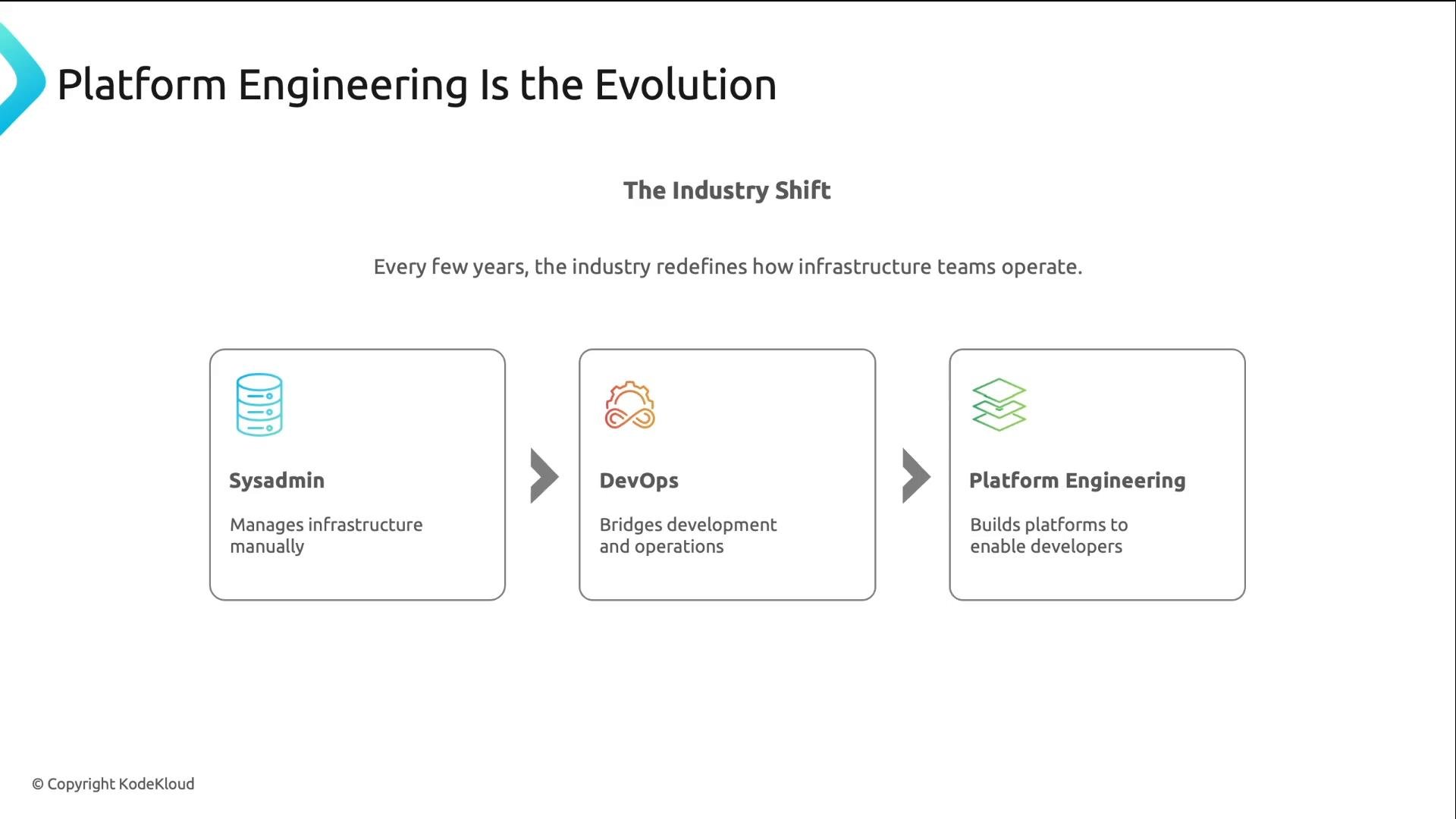
Welcome. In this lesson we explain why the CNPE (Certified Cloud Native Platform Engineer) matters and what this course will enable you to do. Whether you are transitioning from DevOps, already building internal platforms, or pursuing the Golden Kubestronaut track, this course gives you the practical platform engineering skills needed to design, build, and operate modern internal developer platforms. If you’ve worked in infrastructure, you’ve seen the evolution: system administrators managing servers manually → DevOps teams unifying development and operations → platform engineering teams building internal platforms that accelerate product delivery. Platform engineering is more than a job title; it’s a shift to building productized developer experiences and self-service platforms.
A presentation slide titled "Platform Engineering Is the Evolution" showing an industry shift: Sysadmin → DevOps → Platform Engineering with icons and short descriptions of each role.
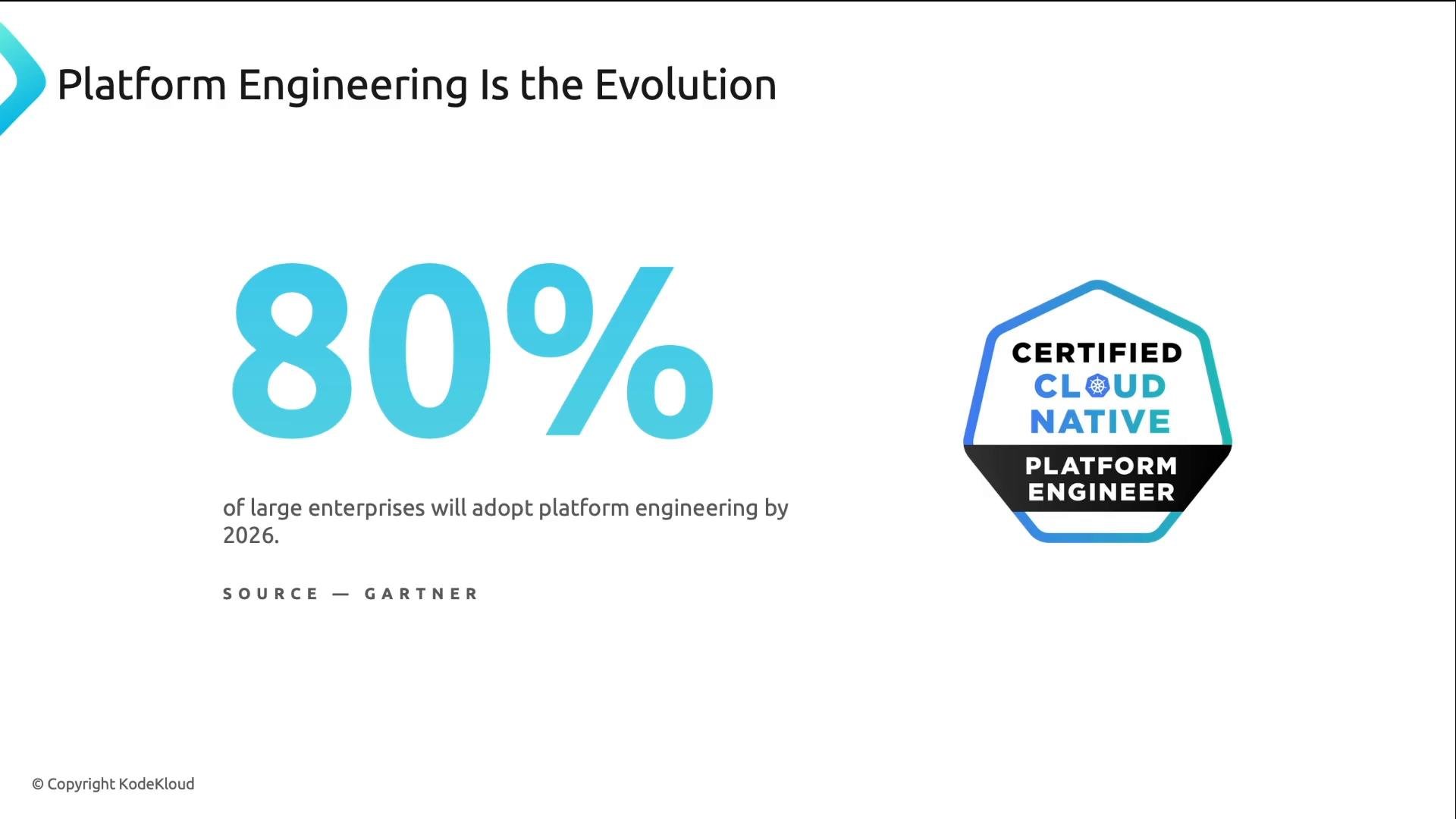
This movement is already mainstream. Gartner predicted that 80% of large software engineering organizations will establish platform engineering teams by 2026 — a change affecting hiring, tooling, and organizational design.
A presentation slide titled "Platform Engineering Is the Evolution" with a large "80%" statistic saying 80% of large enterprises will adopt platform engineering by 2026 (source: Gartner). To the right is a "Certified Cloud Native Platform Engineer" badge.
The CNCF created the CNPE certification to validate platform engineering skills. The CNPE is a performance-based, hands-on exam: you will build, configure, and troubleshoot in a live cluster environment. It tests your ability to do the work, not just to answer multiple-choice questions.
The CNPE exam is practical and scenario-driven. Expect real tasks in a live cluster environment, not multiple-choice theory.
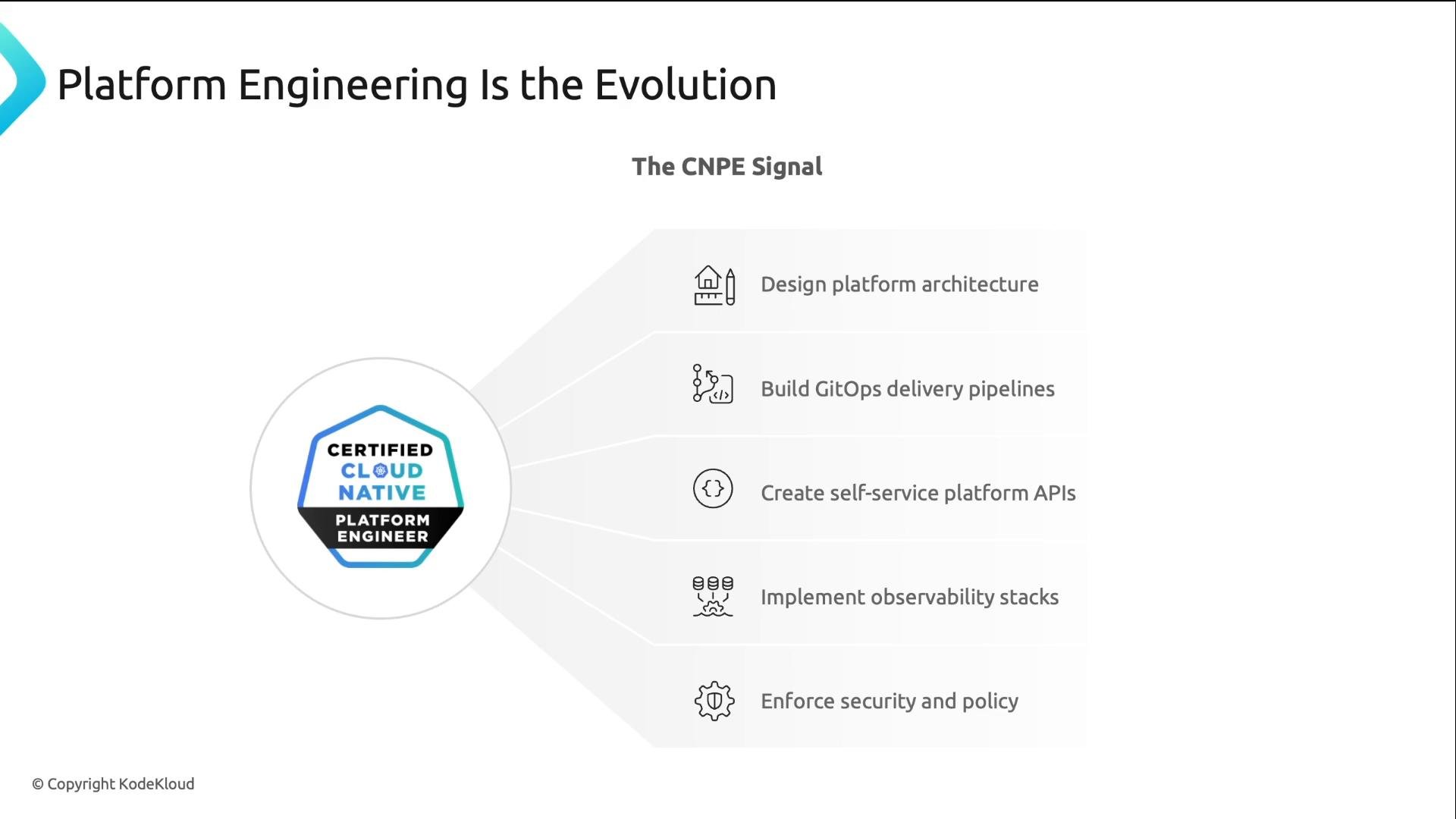
A presentation slide titled "Platform Engineering Is the Evolution" featuring a Certified Cloud Native Platform Engineer badge on the left. To the right is a list called "The CNPE Signal" with items like design platform architecture, build GitOps delivery pipelines, create self-service platform APIs, implement observability stacks, and enforce security and policy.
What this course provides
  • Hands-on platform engineering skills, backed by demos and labs.
  • Exam-aligned tasks mapped to the five CNPE domains so you practice the same formats you’ll see on the test.
  • Real-world patterns and trade-offs: platform architecture vs. cost, GitOps vs. security, and how observability supports operations and incident response.
  • End-to-end platform thinking — from infrastructure foundations to self-service APIs and operationalizing day-2.
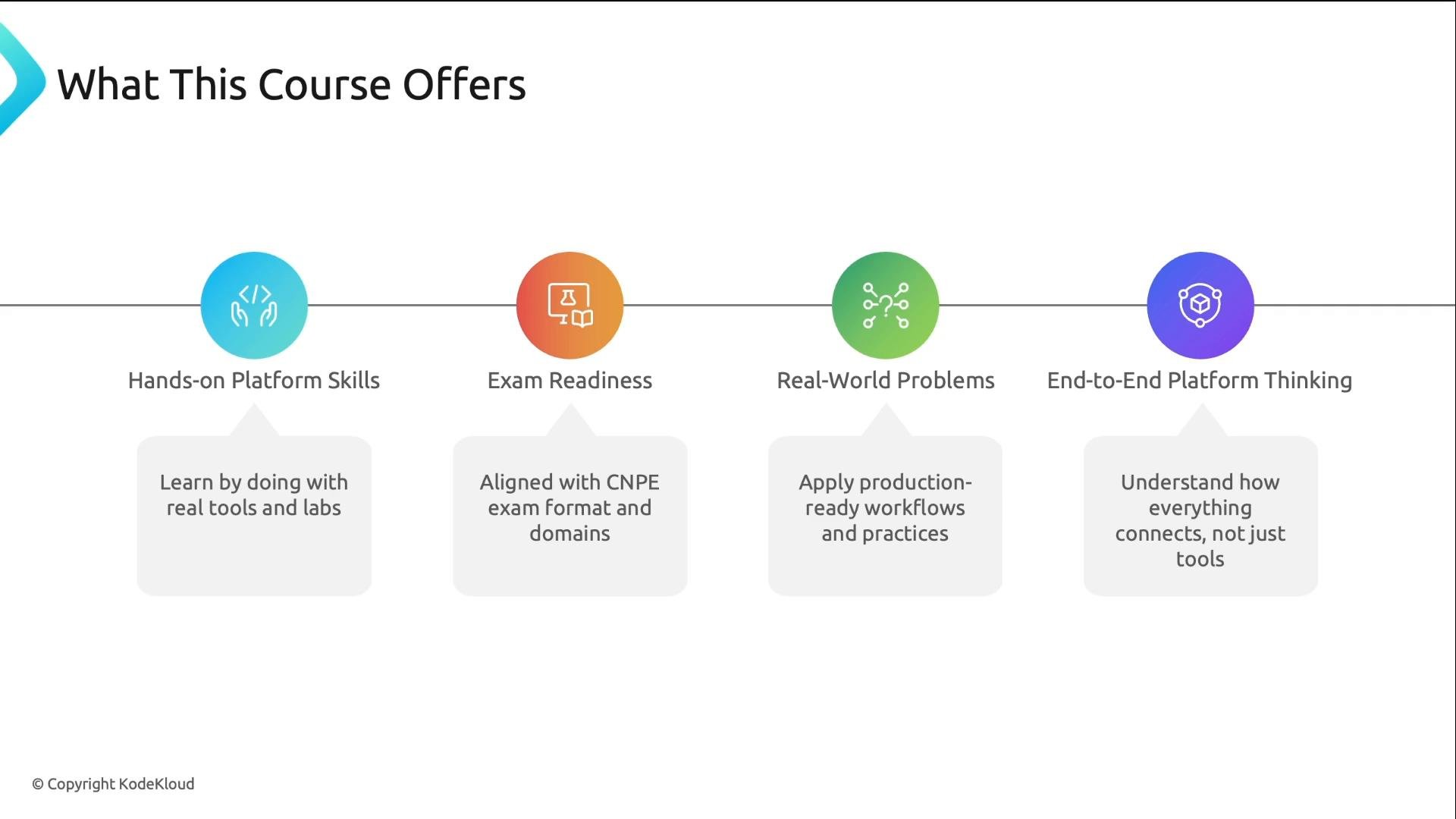
An infographic slide titled "What This Course Offers" that lists four key benefits. They are Hands‑on Platform Skills, Exam Readiness, Real‑World Problems, and End‑to‑End Platform Thinking, each shown with an icon and a short description.
Who should take this course
  • DevOps engineers moving into platform engineering — if you already know Kubernetes and CI/CD, this course adds product and platform design skills.
  • Platform enthusiasts who want a structured, practical path across the five CNPE domains.
  • Kubestronaut seekers — the CNPE is one of the certifications tied to the Kubestronaut title.
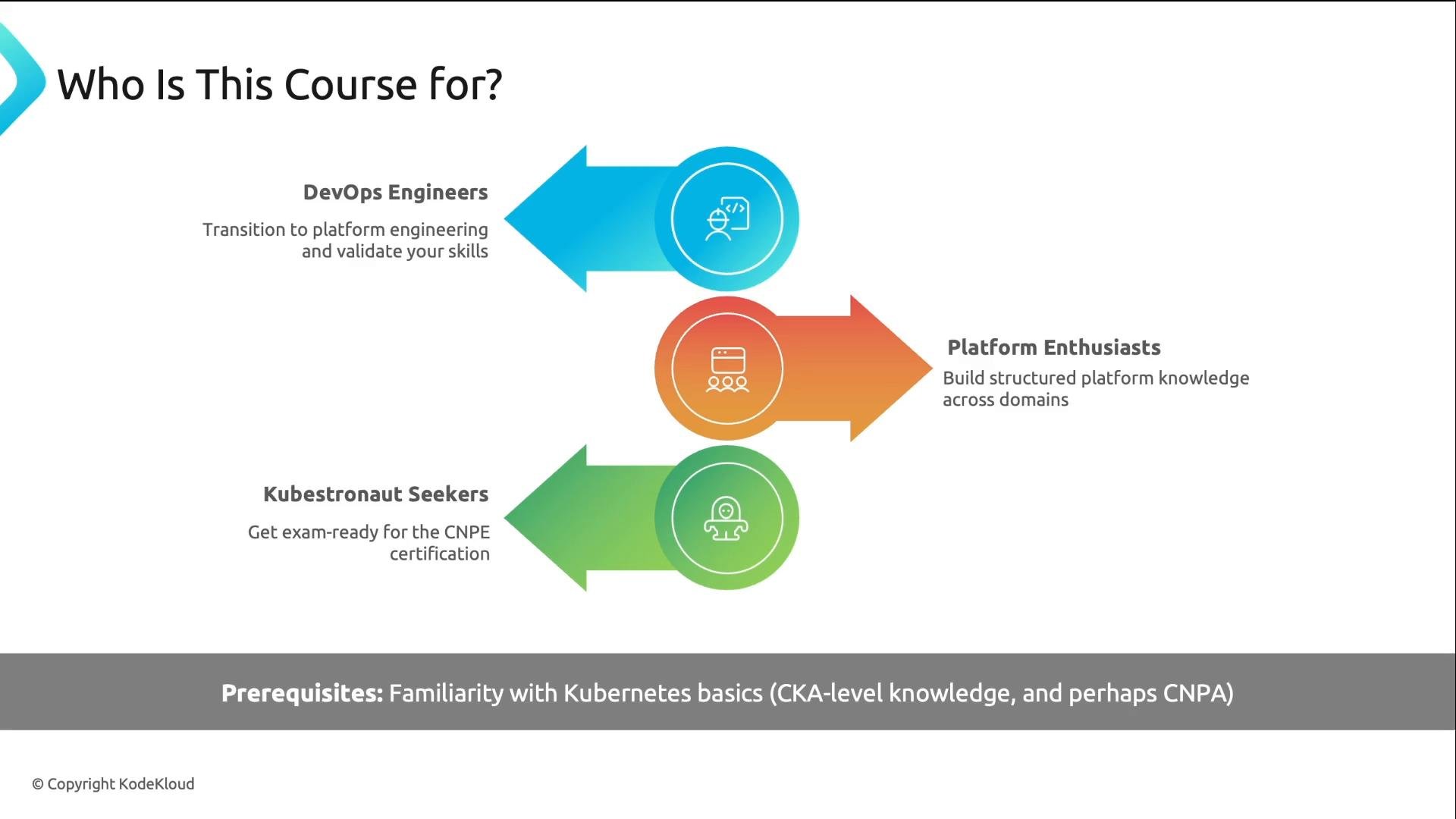
A presentation slide titled "Who Is This Course For?" showing three colored arrows identifying target audiences: DevOps Engineers, Platform Enthusiasts, and "Kubestronaut Seekers," each with a short description. A gray bar at the bottom lists prerequisites about familiarity with Kubernetes basics.
Prerequisites and recommendations
  • Familiarity with Kubernetes basics is strongly recommended; Certified Kubernetes Administrator (CKA)-level knowledge will make the content easier to follow.
  • You should have a basic understanding of tools and patterns (GitOps, CI/CD, CRDs/operators, observability stacks); the course covers these tools in depth.
  • A short readiness article and a knowledge check are available to help you identify gaps and recommended resources before you begin.
If you’re unsure about your Kubernetes foundation, review the official Kubernetes documentation or a CKA preparation course to solidify cluster concepts and kubectl usage before starting this course.
Course structure and how it maps to the CNPE exam The CNPE exam is organized into five weighted domains. This course mirrors those domains, mapping lectures, demos, and labs to the exam-style tasks you’ll encounter. Each section follows a consistent pattern:
  1. Conceptual overview with patterns and trade-offs.
  2. Demo showing how the tools and architecture fit together.
  3. Hands-on labs that mirror typical CNPE tasks.
  4. Exam-style tasks so you practice in a live environment and measure readiness.
Links and references End of lesson.

Watch Video