

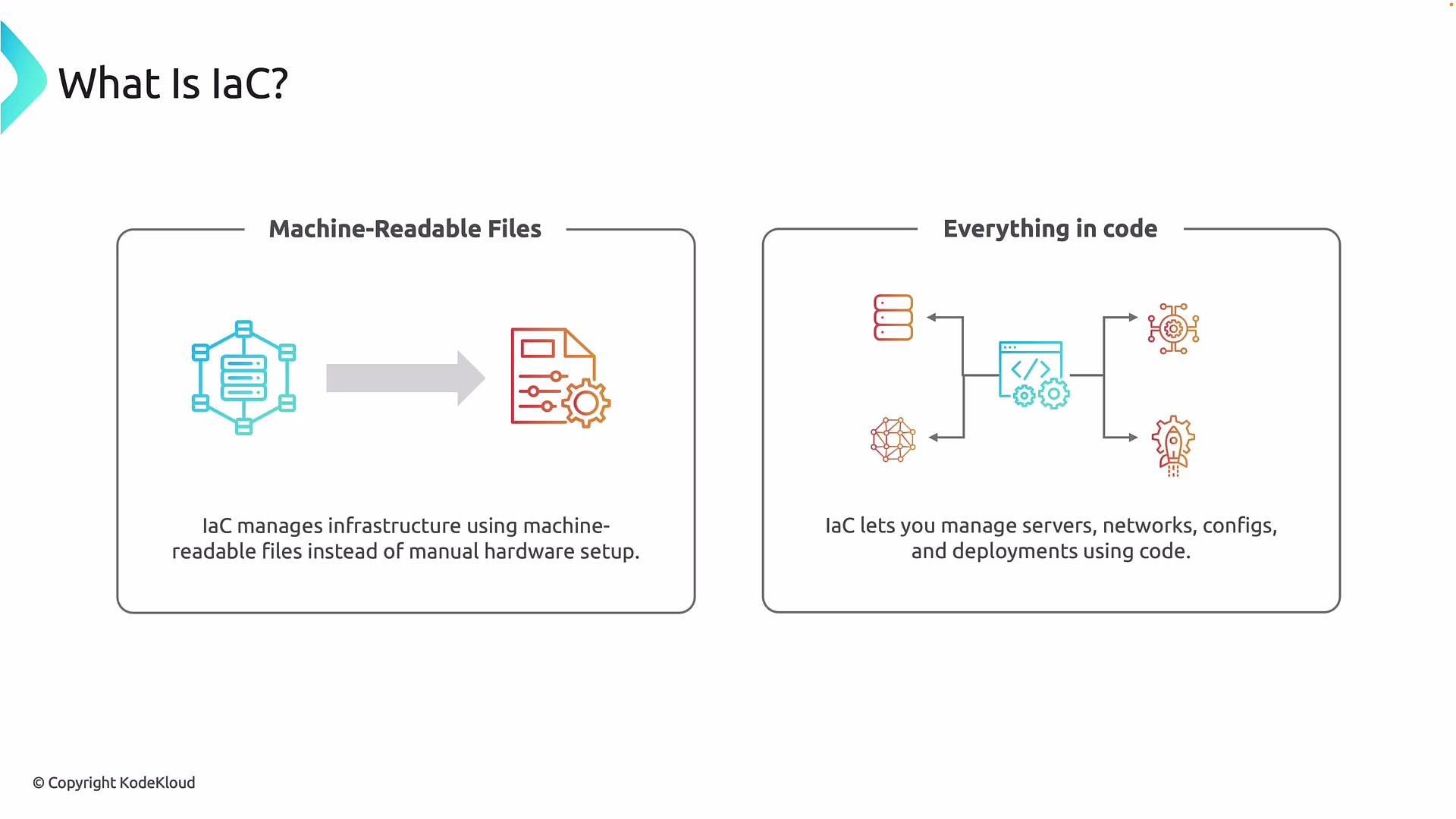
IaC can be declarative (you describe the desired end state) or imperative (you script the steps to get there). Most modern IaC tools favor declarative approaches because they simplify reconciliation and reduce complexity.
-
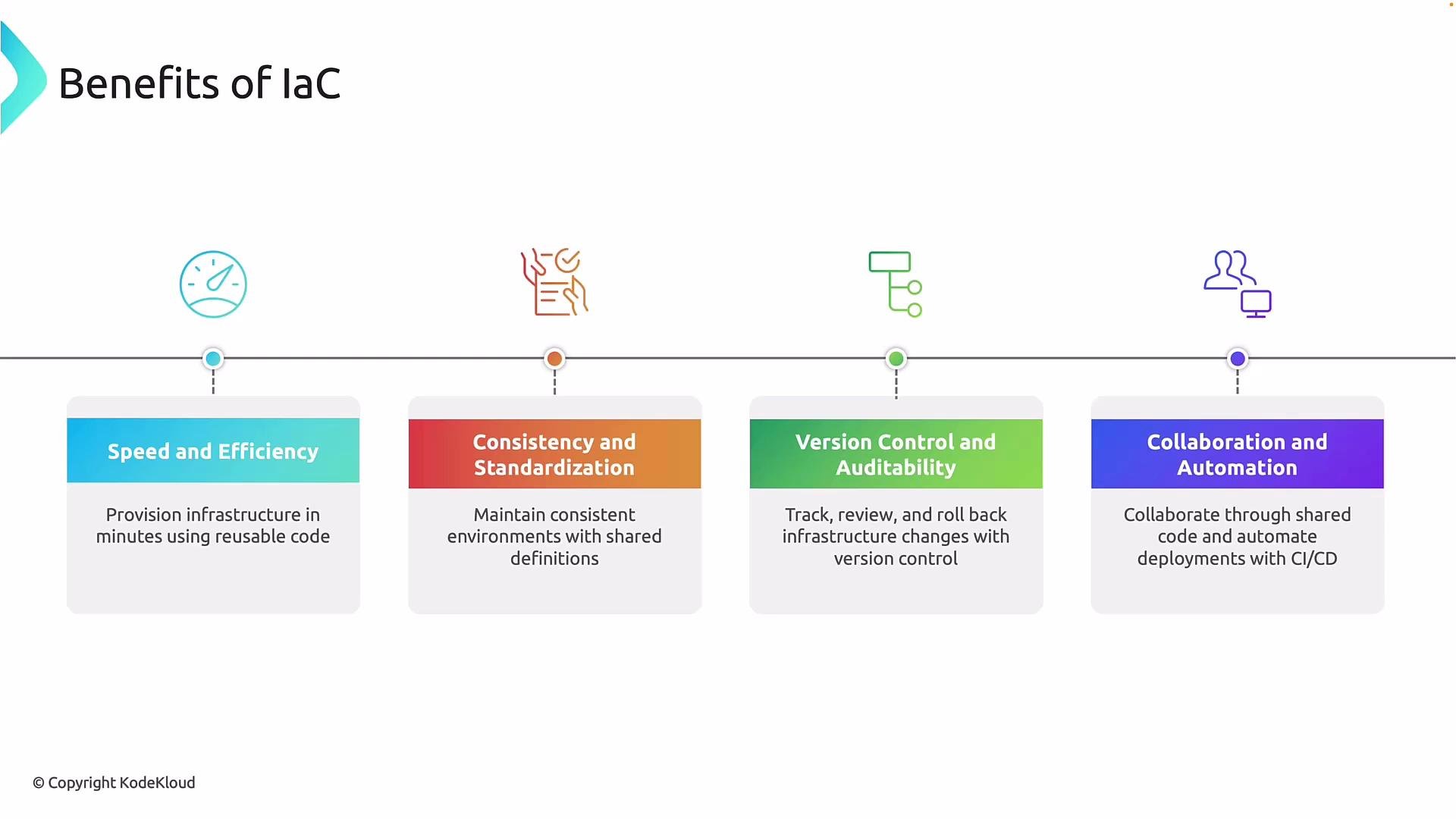
Speed and efficiency
Reusable definitions let you provision entire environments in minutes instead of hours or days, reducing manual effort and human error. -
Consistency and standardization
Shared configuration files ensure environments are built consistently, minimizing configuration drift and differences across environments. -
Version control and auditability
Storing infrastructure definitions in Git enables change tracking, code reviews, and controlled rollbacks. -
Collaboration and automation
Teams can collaborate on infrastructure changes and integrate provisioning into CI/CD pipelines, aligning infrastructure changes with DevOps practices.
Examples — configuration snippets
Terraform (HCL) example:
- Keep state and secrets secure: use remote state backends with encryption (e.g., Terraform state in S3 with DynamoDB locking) and secret stores (HashiCorp Vault, AWS Secrets Manager).
- Modularize configurations: create reusable modules or templates for common patterns (VPCs, networks, databases).
- Enforce code review and CI: apply linters, validation, and plan/review steps in pipelines before applying changes.
- Implement drift detection and monitoring: schedule checks or use automation to detect and correct drift.
- Test infrastructure code: use unit tests, integration tests, and ephemeral test environments to validate changes.
Be careful with state, locking, and secrets. Mismanaged state files or unencrypted secrets in configs can lead to security risks or resource conflicts. Always use remote state locking and secure secret storage.
- Terraform: https://www.terraform.io/
- Pulumi: https://www.pulumi.com/
- AWS CloudFormation: https://docs.aws.amazon.com/cloudformation/
- Azure Resource Manager (ARM) templates: https://docs.microsoft.com/azure/azure-resource-manager/
- Ansible: https://www.ansible.com/