

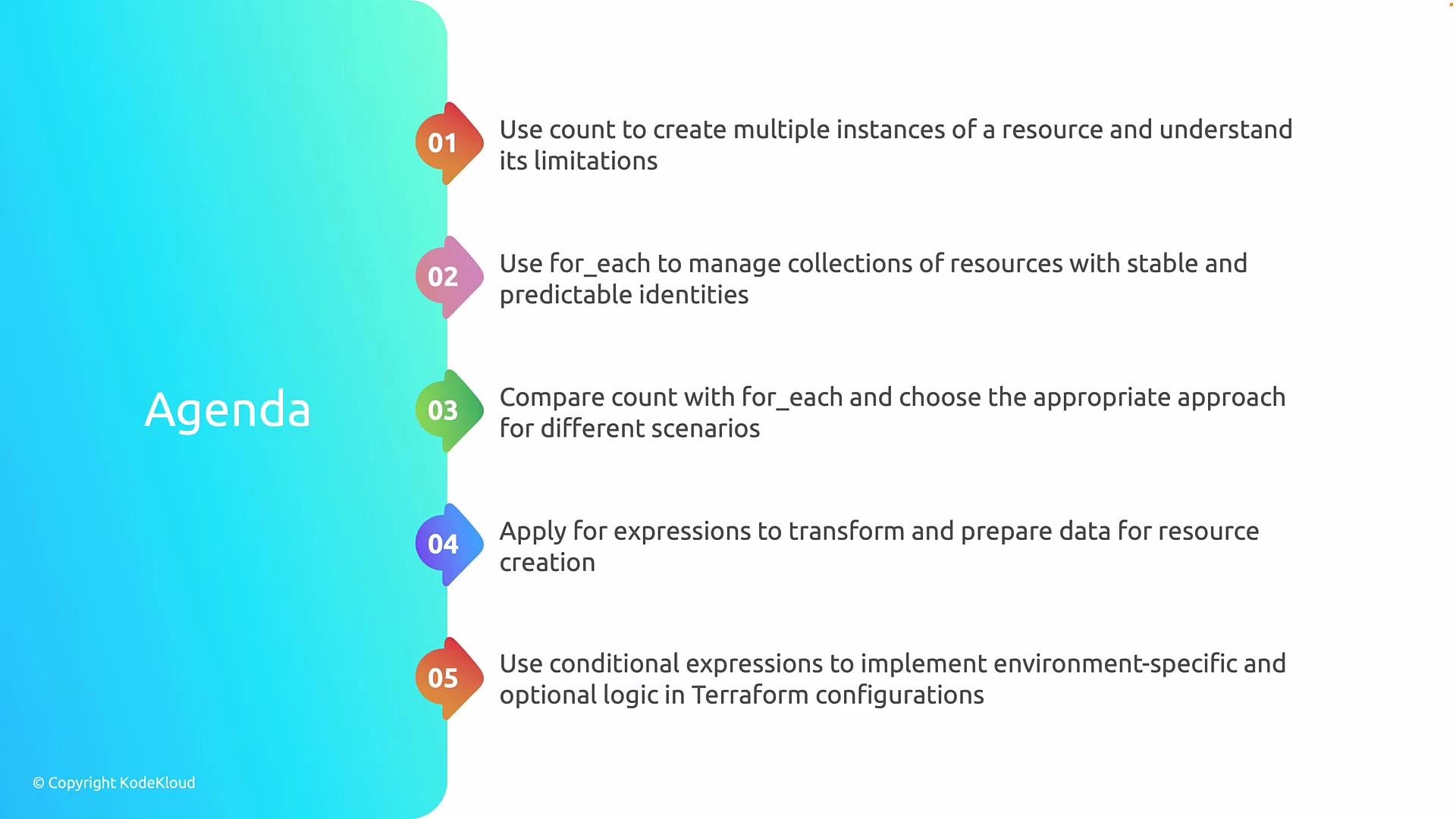
count and when to prefer for_each, how to reshape data with for expressions, and how to apply conditional expressions for environment-specific or optional logic.
- Understand
countand its limits for predictable resource addresses. - Master
for_eachfor stable identities and safer state management. - Compare
countvsfor_eachto choose the right approach for long-term maintenance. - Use
forexpressions to transform collections. - Use conditional expressions to implement environment or optional logic.
Use
count when you need simple repetition of identical resources. Prefer for_each for collections where each instance needs a stable address or when keys/identities matter for the Terraform state.Quick overview: when to use each pattern
What you’ll learn in this lesson
count— how it creates multiple instances and where it becomes limiting.for_each— why it provides stable resource identities and predictable state addresses.- Side-by-side comparison — how changing between patterns affects state and resource replacement.
forexpressions — reshaping data for use in resources.- Conditional expressions — gating resources and settings by environment or flags.
Changing between
count and for_each (or changing keys used by for_each) can force Terraform to recreate resources. Test changes in a safe environment and plan before apply to avoid unexpected replacements.Links and references
- Terraform documentation: count
- Terraform documentation: for_each
- Terraform documentation: for expressions
- Terraform documentation: conditional expressions