

Key concerns
- Idempotency
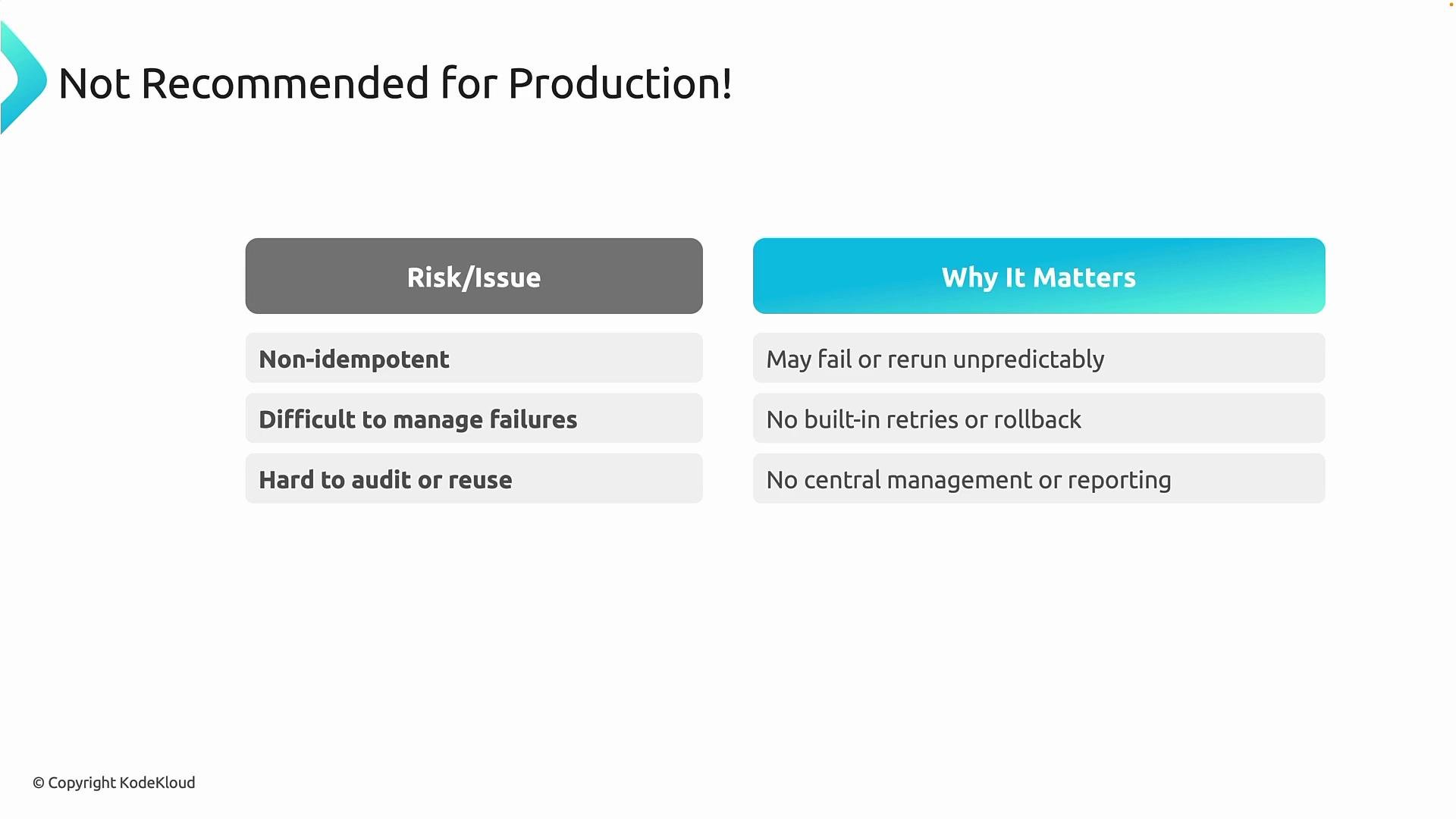
- Provisioner scripts are often non-idempotent unless you explicitly design them to be. Terraform does not enforce idempotency for arbitrary scripts. Re-running Terraform or recreating a resource can cause a provisioner to:
- reinstall software,
- duplicate configuration,
- overwrite or corrupt existing state,
- or fail unexpectedly during re-execution.
- Failure handling and recoverability
- If a provisioner fails partway through, Terraform provides limited retry logic and no automatic rollback. This can leave resources partially configured and difficult to audit or recover. Embedding ad-hoc scripts in Terraform also reduces centralized reporting and versioned configuration tracking compared to dedicated configuration management tools.
- Tight coupling to Terraform
- Putting configuration logic inside Terraform runs mixes infrastructure provisioning with configuration management. This tight coupling reduces modularity, makes testing and reuse harder, and blurs separation of concerns between infrastructure and configuration.
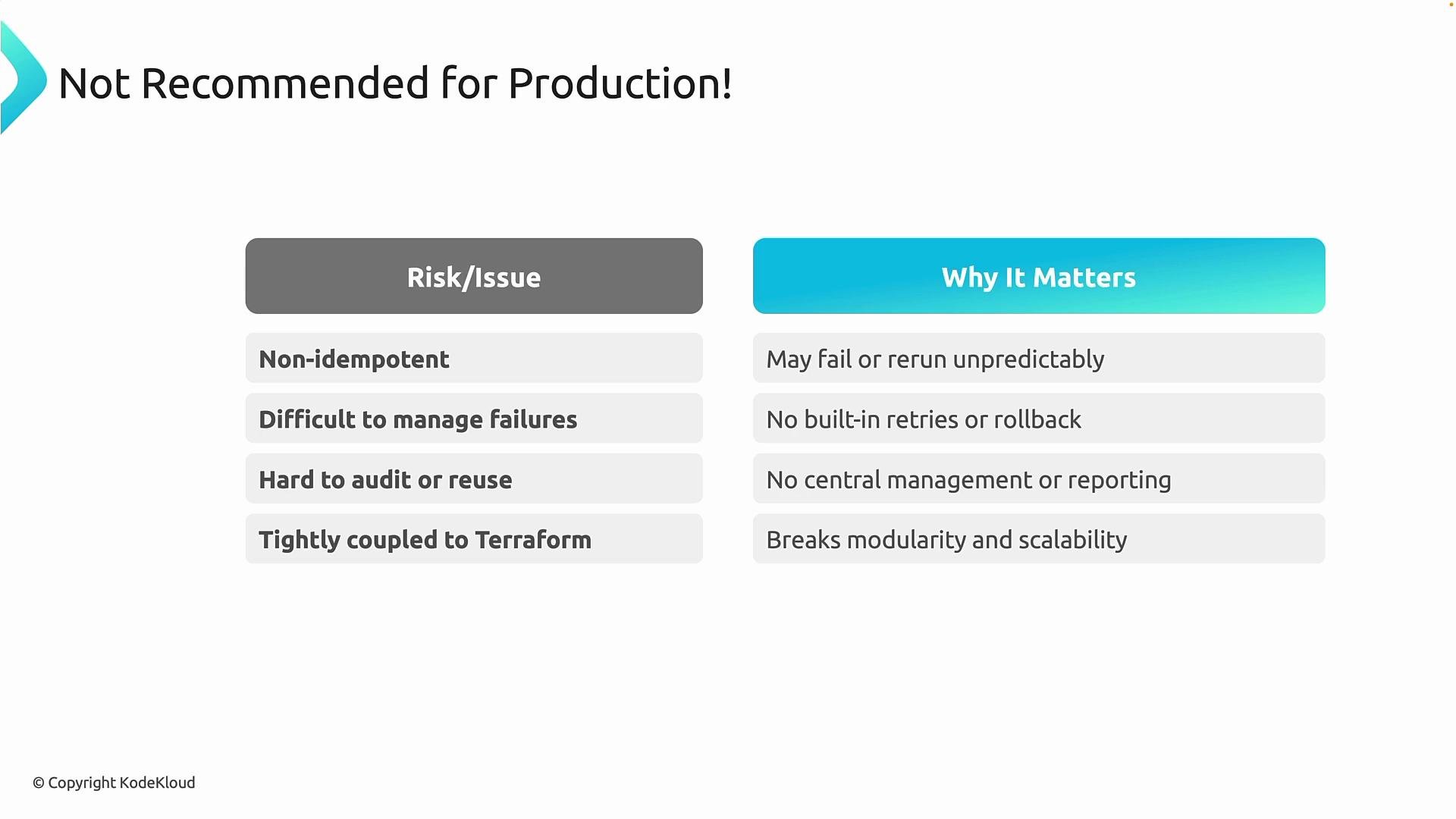
Summary of risks
Best practices
- Use provisioners only for temporary, non-critical, or development/test automation (quick setup tasks, proof-of-concepts, lightweight initialization).
- Keep provisioner scripts small and make them idempotent whenever possible.
- Avoid embedding complex configuration logic in Terraform; do not use provisioners for ongoing configuration management.
- Azure VM extensions: use the VM Custom Script Extension or other Azure-native extensions for better lifecycle and retry semantics. See: https://learn.microsoft.com/azure/virtual-machines/extensions/custom-script-extension
- Configuration management tools: adopt Ansible, Chef, Puppet, or Azure Automation Desired State Configuration (DSC) for repeatable, auditable configuration. See:
- Image-based approaches: bake required configuration into VM or container images so instances boot fully configured.
Provisioners are a last resort. For repeatable, auditable, and reliable configuration, prefer platform-native extensions, configuration management tools, or image-based pipelines over Terraform provisioners.
Links and references
- Terraform Provisioners (HashiCorp docs)
- Azure VM Custom Script Extension
- Ansible Documentation
- Chef Documentation
- Puppet Documentation
- Azure Automation DSC Overview