

- Prometheus forwards alerts to Alertmanager using its API (for example, the
/api/v1/alertsendpoint) or via itsalertingconfiguration. - You can configure many Prometheus servers to send alerts to a single Alertmanager instance or to an Alertmanager cluster.
alerting config
Dispatcher / Receiver (grouping and deduplication)
- Incoming alerts are grouped and deduplicated based on labels and the Alertmanager configuration.
- Important grouping settings:
group_by: list of labels to group alerts by (alerts with the same values are sent as one notification).group_wait: how long to wait to collect initial alerts for a group before sending the first notification.group_interval: how long to wait before sending a new notification for an ongoing group.
- Inhibition is rule-based conditional suppression: when an alert X is firing, it can suppress alert Y.
- Use
inhibit_rulesto match on labels and define which alerts should be silenced when others are active (useful for suppressing downstream noise when upstream problems exist).
- Silences are explicit, time-limited rules created via the Alertmanager UI or API to mute notifications (e.g., planned maintenance).
- A matching silence prevents notification delivery but does not alter alert firing state in Prometheus.
- The routing tree maps alerts (by label match) to one or more receivers (team-specific channels, on-call services, or webhook endpoints).
- Routes may include matchers, continue flags, and sub-routes to implement complex delivery rules and escalation paths.
- After routing, the notification engine renders templates and dispatches notifications to configured integrations.
- The engine handles retries, backoff, rate limiting, and repeat intervals for unresolved alerts (for example,
repeat_intervalin a receiver).
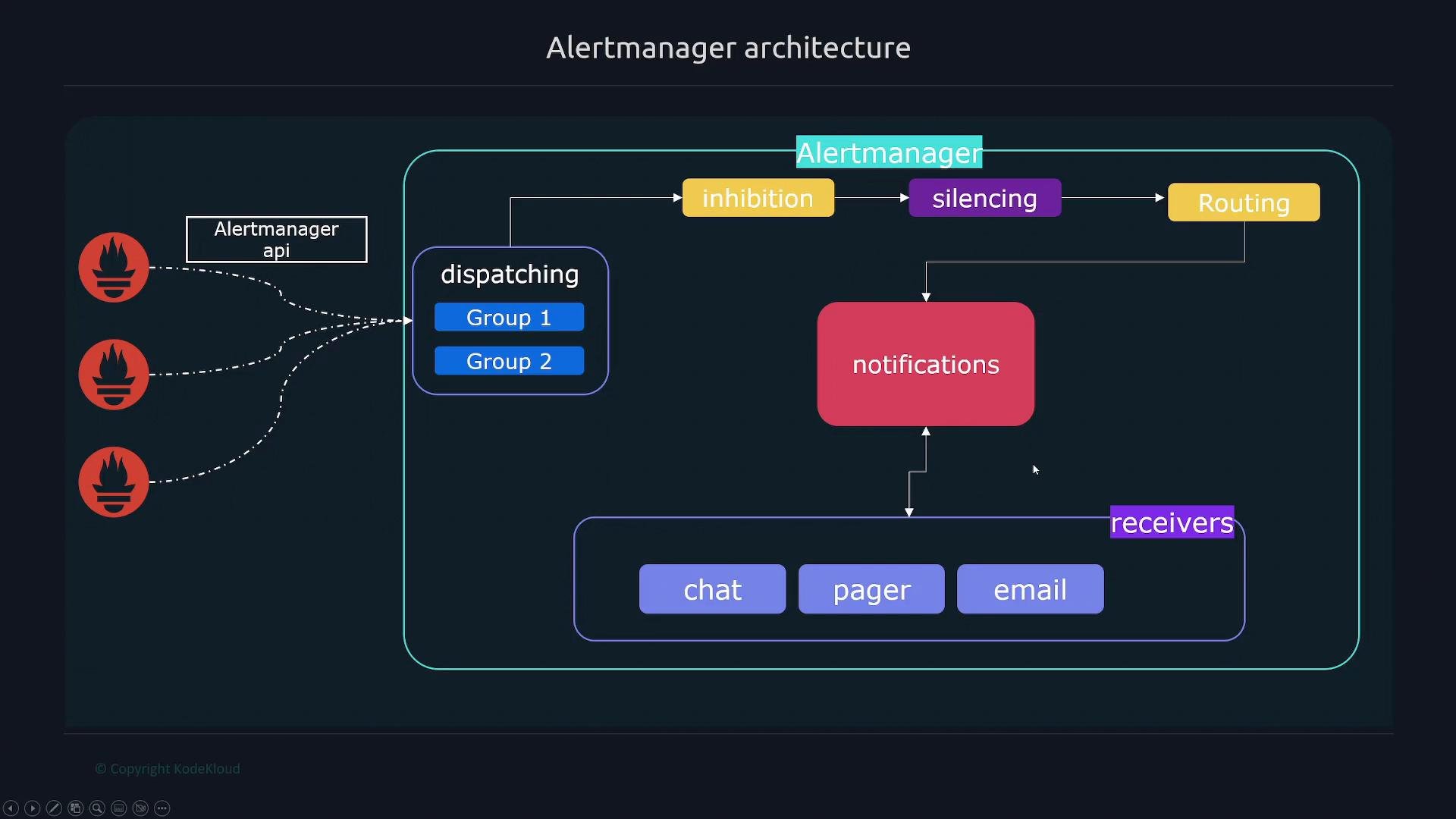
- Delivery details: Alertmanager observes receiver-specific settings (PagerDuty integration keys, webhook URLs, email configs), repeat intervals for unresolved alerts, and retries with backoff on failure.
- High availability: Alertmanager supports a gossip-based clustering mode so multiple instances can share state (silences, notifications, routes) and avoid duplicates or missed notifications. In HA setups, ensure network connectivity and consistent configuration across instances.
- Centralize Alertmanager for an environment to unify routing, silences, and deduplication.
- Keep
group_byandgroup_waittuned so related alerts are combined into meaningful notifications. - Use inhibitions to reduce noise from downstream systems during upstream outages.
- Create silences for planned maintenance windows via API or UI, not by muting alerts in Prometheus rules.
- Test receiver configurations (webhooks, PagerDuty, email) and monitor Alertmanager logs for delivery failures.
Note: Inhibition and silences are different mechanisms. Inhibition is conditional suppression based on other active alerts (rule-based). Silences are explicit, time-bound muting rules you create manually or via API.