

MCP (Model Connector Protocol)
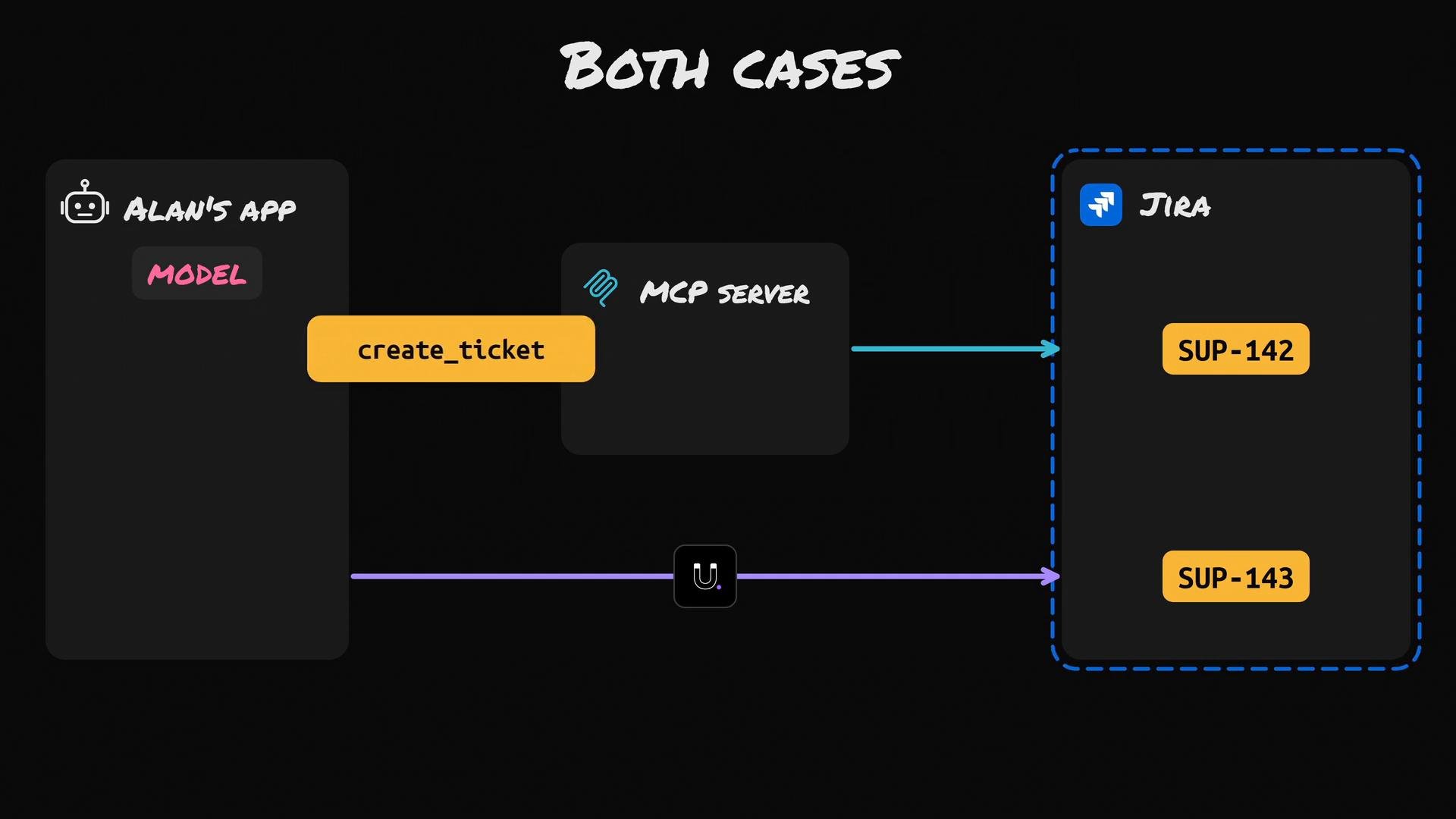
With MCP, Alan installs an MCP client inside his application. That client talks to an MCP server (either hosted by the service provider or ran by Alan). The server exposes a standardized set of actions (tools) that the model can select. How it works:- When Alan’s app connects, the MCP client asks the MCP server which actions are supported. The server responds with a list such as “search tickets”, “create ticket”, “update ticket”.
- The model chooses the “create_ticket” tool and the application sends that request through the MCP client to the MCP server.
- The MCP server performs the work on Alan’s behalf (using Alan’s authorized credentials) and returns the response (for example, a ticket number) back through the MCP client.
UTCP (Universal Tool Calling Protocol)
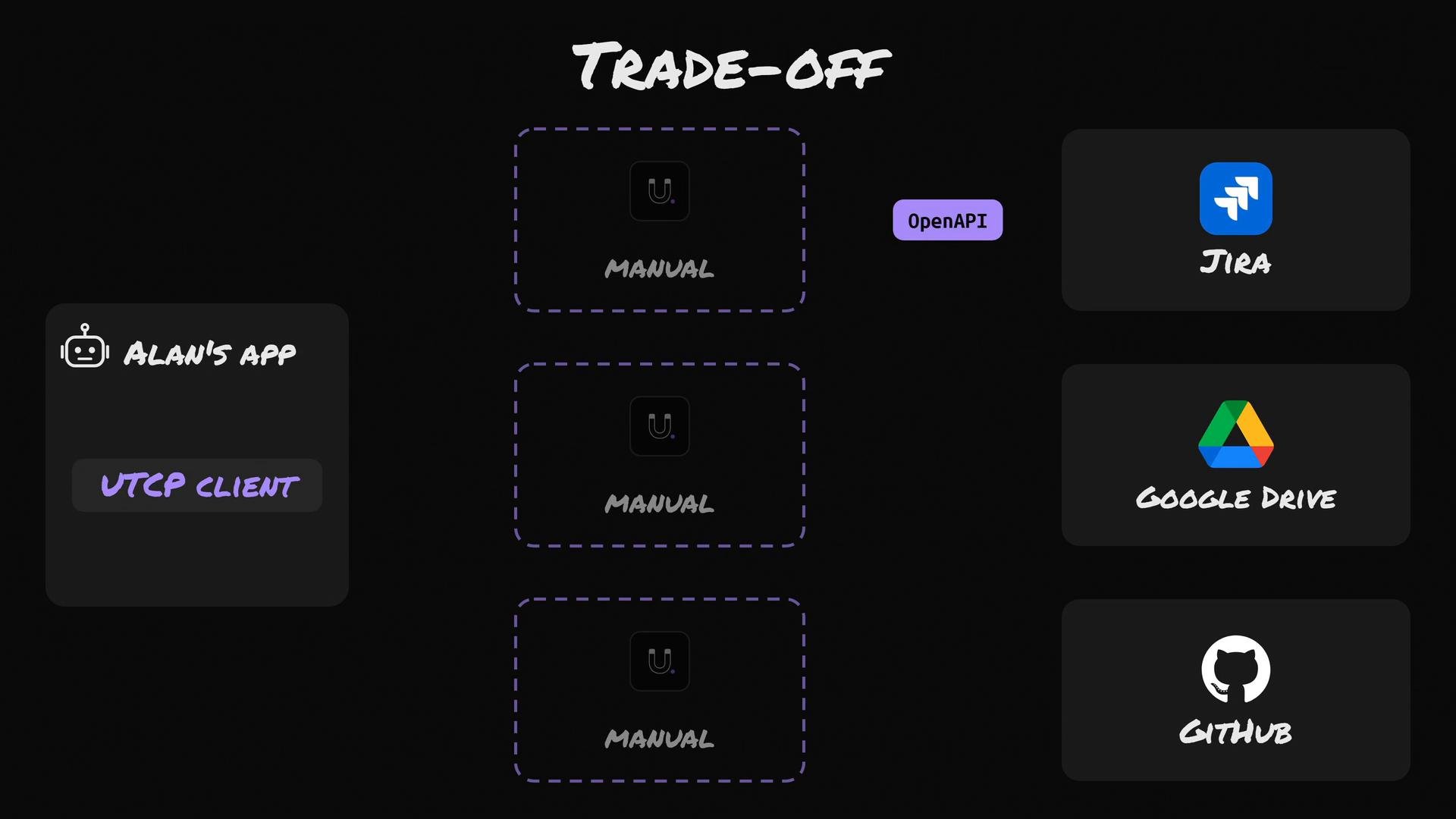
UTCP (Universal Tool Calling Protocol) lets the application call services directly. Instead of a central MCP server, UTCP relies on a local “manual” — a JSON description that tells a UTCP client how to construct requests for a target service, often derived from the service’s machine-readable API (for example, an OpenAPI spec). A simplified UTCP manual (single tool entry) looks like:- The UTCP client loads the manual at startup and exposes the described actions to the model.
- When the model selects “create_ticket,” the UTCP client fills the request template (substituting credentials from Alan’s configuration, e.g.
JIRA_API_TOKEN) and sends the HTTP request directly to Jira. - Jira responds directly to Alan’s app — there is no intermediary MCP server.
Trade-offs and comparison
- MCP: Presents a single, standardized server-side adapter that can expose a uniform tool surface for many services (Jira, Google Drive, GitHub). The application only needs to implement the MCP client and rely on the server to translate to each service’s API.
- UTCP: Lets the application call third‑party services directly using per-service “manuals.” It avoids a central server but requires accurate service descriptions (OpenAPI or authored manuals).
When to choose which
-
Choose MCP if:
- You want a standardized, centralized adapter that can support many services uniformly.
- You prefer to offload API evolution and adapter maintenance to the MCP server operator.
- You want to minimize per-service client logic in the application.
-
Choose UTCP if:
- You want direct client‑to‑service calls and lower latency.
- Services publish accurate machine-readable specs (e.g., OpenAPI) or you can reliably generate manuals.
- You prefer to keep service credentials and call logic local to your application.
Use MCP when you prefer a standardized server-side adapter for multiple services. Use UTCP when you want direct client-side calls and can rely on accurate API documentation (or generate the manual reliably).