

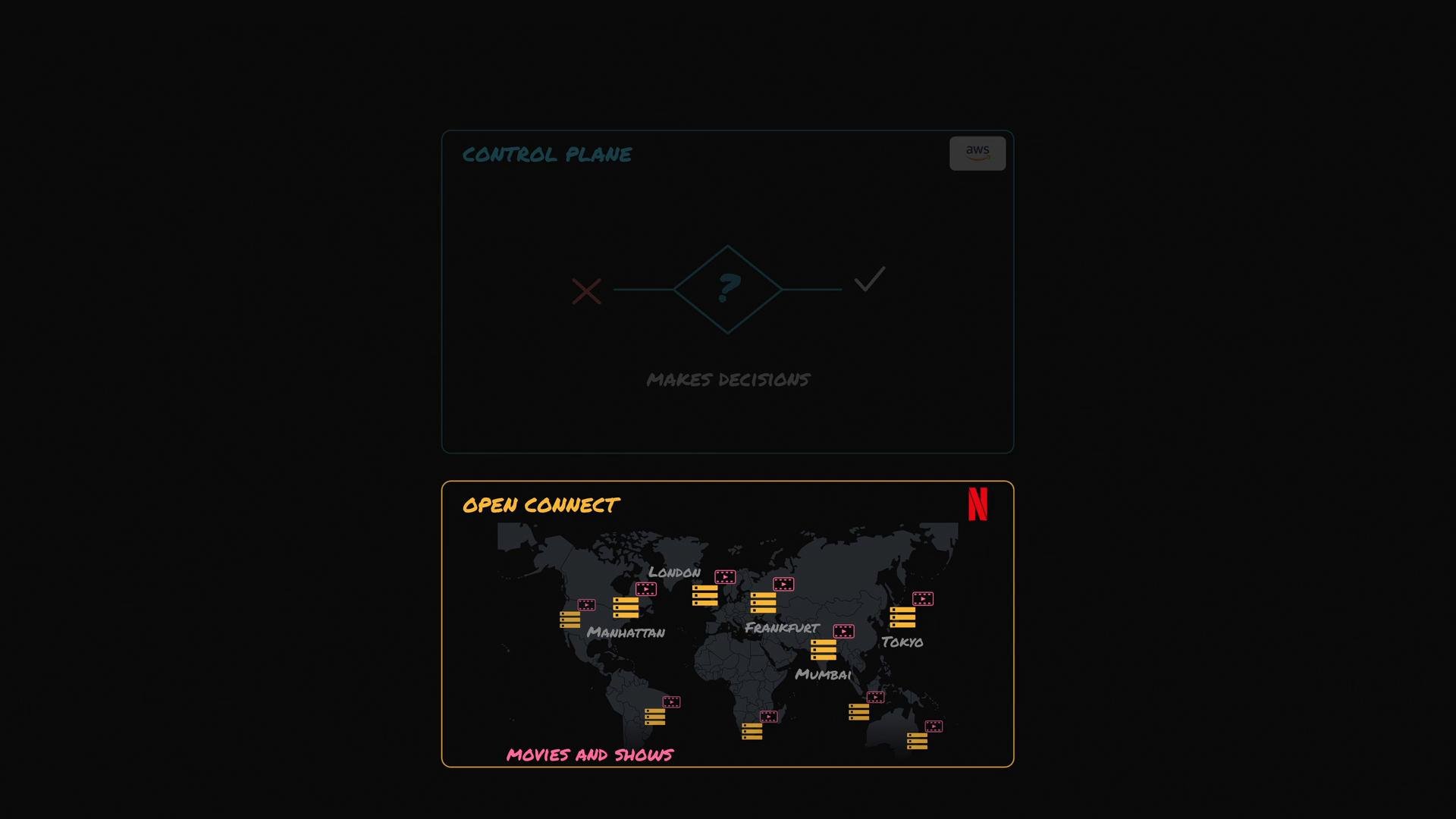
- The control plane — responsible for decision-making, metadata, authentication, and analytics.
- The data plane — responsible for delivering the actual video bytes to viewers from caches and storage appliances close to users.
- Control plane: Runs on AWS and handles authentication, authorization, device capability parsing, content selection, server ranking, telemetry ingestion, and analytics.
- Data plane: Netflix Open Connect — a global set of storage appliances and caches deployed in ISPs and exchange points that serve encoded video files directly to viewers.
-
Viewer starts playback
- Example: Alan in Manhattan presses Play on his smart TV. The device sends a request that includes device capabilities (supported resolutions, codecs, HDR, audio tracks, subtitle preferences).
-
Request hits an AWS load balancer
- The load balancer distributes incoming API requests across many backend servers to avoid bottlenecks.
-
Edge gateway (Zuul) performs initial checks
- Zuul verifies authentication, subscription status, licensing for the requested title in the viewer’s region, and any device or DRM requirements.
- Reference: Zuul (Netflix edge gateway) performs routing and policy enforcement.
-
Play API selects a representation and origin
- The Play API inspects device capabilities and selects an appropriate encoded representation among hundreds (multiple resolutions, bitrates, codecs, audio/subtitle tracks) to support adaptive bitrate streaming.
- It also queries Open Connect state and ranks nearby appliances by proximity, current load, and network performance, returning a ranked list of preferred origins.
-
Playback begins from Open Connect (data plane)
- Alan’s TV connects directly to the top-ranked Open Connect appliance and starts streaming the video bytes from that appliance.
- Direct video delivery: The video stream flows directly from the selected Open Connect server to Alan’s TV; the heavy video traffic does not traverse AWS long-haul links.
- Telemetry to control plane: Alan’s device continuously sends playback telemetry to Netflix’s control plane on AWS — metrics such as received bitrate, buffering events, and playback actions (pause, seek). These signals are used for analytics and to drive future cache placement and replication decisions.
- Netflix does not stream video from AWS. AWS hosts the control plane: decision logic, APIs, and telemetry/analytics processing.
- Netflix Open Connect appliances (the data plane) deliver the actual video bytes from locations placed as close to viewers and ISPs as possible.
Control plane = decision-making, metadata, and analytics (runs on AWS).
Data plane = content delivery (Open Connect appliances placed near ISPs and IXPs).
- Latency reduction: Serving from caches inside ISPs or local exchange points minimizes round-trip times and avoids long-haul backbone traversal.
- Bandwidth efficiency: Offloading video traffic to Open Connect reduces transit costs and backbone congestion.
- Resilience and scale: A distributed cache footprint (tens of thousands of appliances) scales to hundreds of millions of simultaneous viewers and isolates failures.
Links and references
- Netflix Open Connect — architecture and deployment program overview
- AWS — cloud platform used for Netflix’s control plane
- Zuul (Netflix) — edge gateway and routing layer
Open Connect appliances are part of a managed distribution program and require partnerships and deployment agreements with ISPs and exchanges. Direct access and placement decisions are controlled by Netflix.
- Netflix separates decision-making (control plane) from bulk delivery (data plane) to optimize performance, cost, and scalability.
- The Play API and edge gateway decide what should be served and from where; Open Connect delivers the bytes as close to the viewer as possible.
- Continuous telemetry closes the loop: playback metrics inform replication, placement, and encoding strategies to improve quality for future viewers.