

- Consistency (C) — After a successful write, every subsequent read returns the latest value, no matter which node serves the request.
- Availability (A) — Every request receives a response (success or failure); the system does not hang or refuse to respond.
- Partition tolerance (P) — The system continues to operate despite arbitrary message loss or network failures between nodes.
- Serve reads and writes on both sides despite divergence. This choice preserves availability but sacrifices strict consistency.
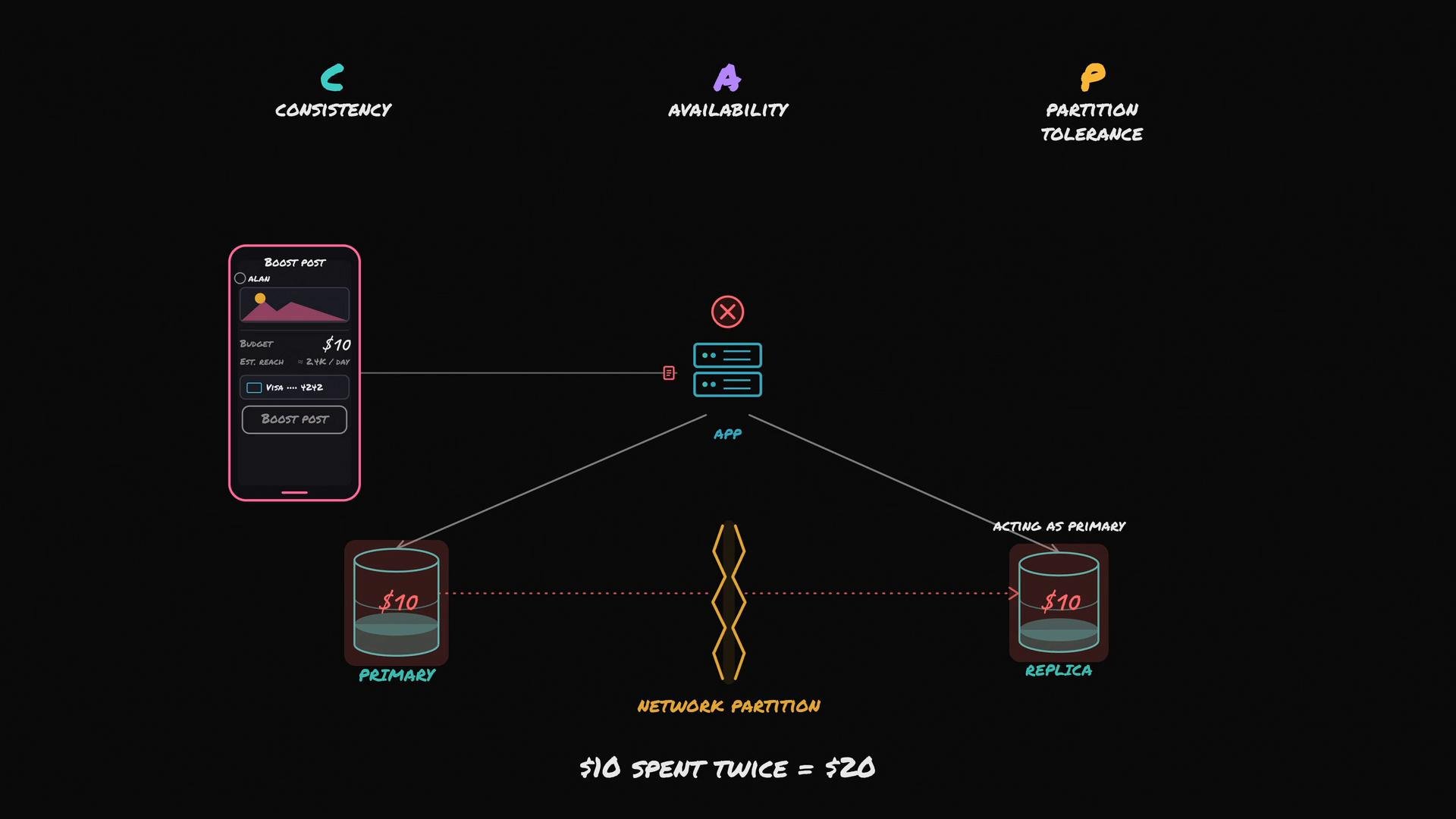
- Block or reject some operations until nodes can coordinate. This preserves consistency but reduces availability.
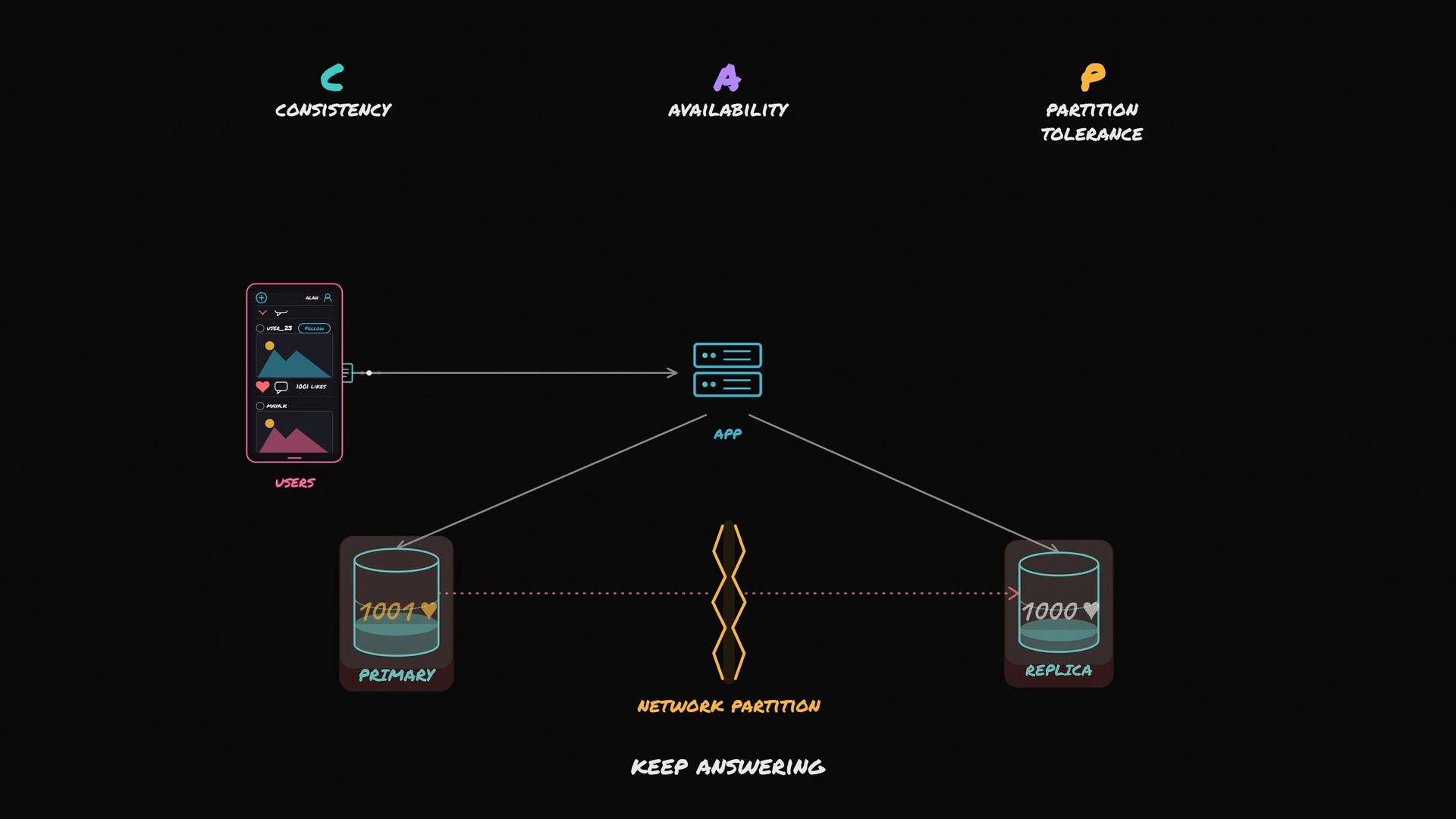
- Favor Availability (AP) when temporary divergence is acceptable and responsiveness is critical. Social feeds, counters, and many user-facing features tolerate eventual consistency and can reconcile later.
- Favor Consistency (CP) when correctness is critical and must never be violated, even if that means refusing requests during a partition. Examples include banking, inventory management, and other systems where double-spend or over-commitment would be catastrophic.
Design guidance
- Classify each data type by correctness requirements (e.g., eventual consistency OK vs. strict correctness required).
- Use techniques that match your choice:
- For AP systems: eventual consistency, conflict-free replicated data types (CRDTs), last-write-wins, background reconciliation.
- For CP systems: distributed locking, consensus protocols (e.g., Raft, Paxos), strong leader-based replication, two-phase commit.
- Consider hybrid approaches: use CP for transactional data and AP for less-critical, high-throughput data. Many real-world systems mix strategies depending on the operation.
CAP does not require permanently forgoing either consistency or availability; it only means you cannot guarantee both during a network partition. Choose the trade-off based on data correctness requirements and the acceptable tolerance for temporary unavailability or inconsistency.
- CAP theorem — Wikipedia
- Eric Brewer’s original talk (Brewer’s conjecture) and follow-ups
- “Dynamo: Amazon’s Highly Available Key-value Store” — an example of an AP-oriented design
- Raft Consensus Algorithm — practical approach for CP systems