

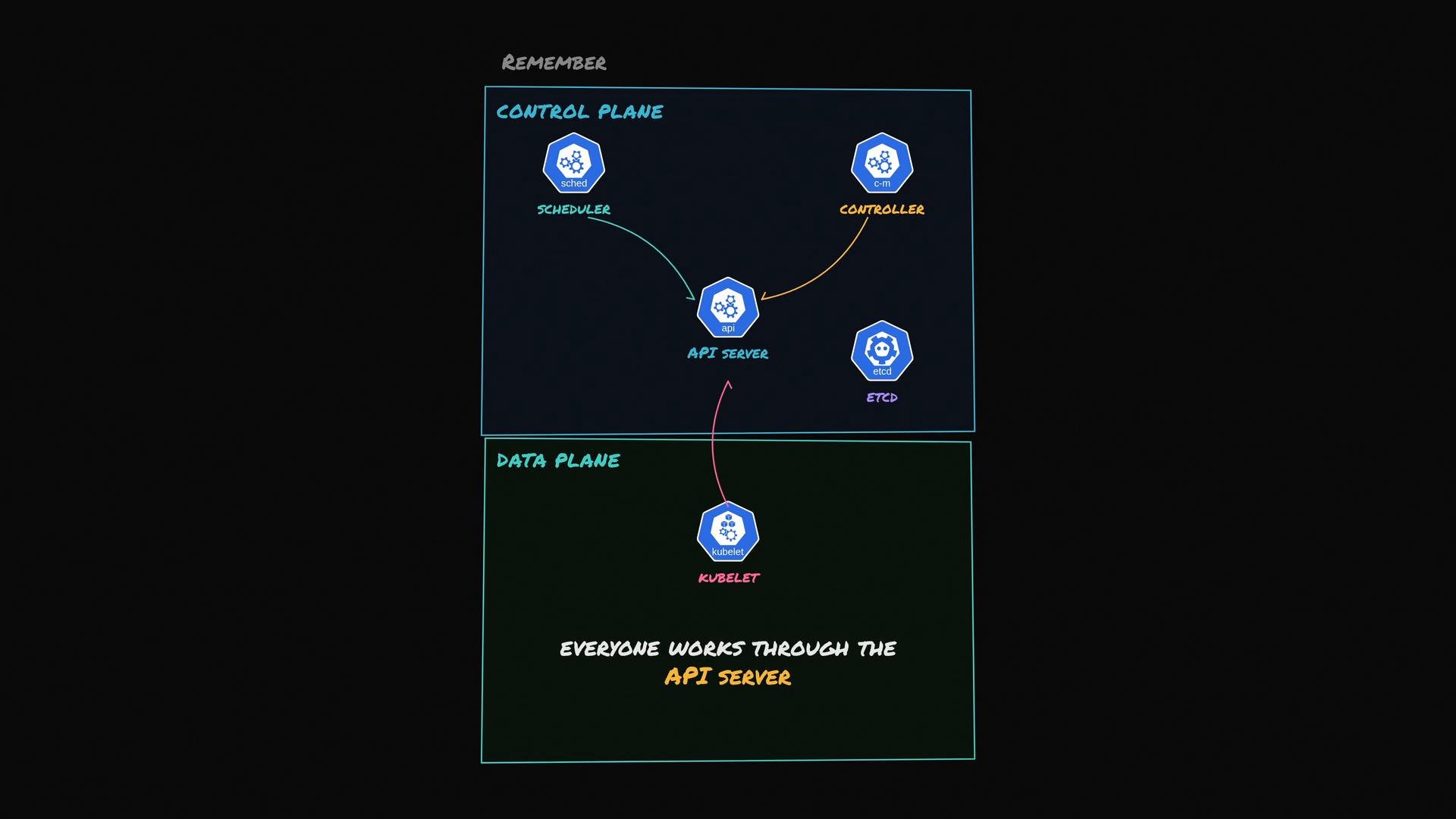
- Data plane
- Where your applications run: nodes, pods, and containers.
- Pod-to-pod traffic flows across the pod network machine-to-machine and does not traverse the API server. Running containers keep communicating even when the API server is down.
- Control plane
- Contains the API server, scheduler, controller manager, and etcd.
- These components coordinate desired state and cluster configuration.
How components coordinate (two examples)
- Scheduler
- When a new Pod is created, the scheduler watches the API server for Pods without an assigned node.
- The scheduler selects an appropriate node and writes that node assignment back to the API server.
- The kubelet on that node watches the API server, sees the Pod assigned to it, and starts the container.
- The scheduler never talks directly to kubelets — all coordination happens via the API server.
- Controller manager (replica controller / deployment controller)
- If you request three replicas and one Pod dies (leaving two), the controller reads the current state from the API server and notices the shortfall.
- The controller writes a new Pod object to the API server.
- The scheduler sees the new Pod (it has no node), picks a node, and writes the assignment to the API server.
- The kubelet on the chosen node picks up the Pod and starts the container, restoring the desired replica count.
- What continues:
- Existing Pods and Services continue to run and serve traffic.
- Node-level processes (kubelet, container runtime) continue managing the containers they already know about.
- What stops:
- Create, update, or delete Kubernetes objects (via
kubectlor controllers). - Scheduling new Pods or reassigning Pods to different nodes.
- Scaling Deployments or changing configurations.
- Reading fresh cluster state via
kubectl(it queries the API server).
- Create, update, or delete Kubernetes objects (via
- Run the API server highly available: multiple API server replicas behind a load balancer.
- Run etcd as a clustered datastore with an odd number of members distributed across failure domains.
- Regularly backup etcd and test restores.
- Monitor API server health and etcd quorum closely; use alerting for control-plane failures.
Note: In production, API servers are typically run highly available (multiple replicas) and etcd is run as a clustered data store to avoid a single point of failure. Ensuring API server and etcd availability is essential for cluster manageability, even though running workloads can continue during an outage.
- Kubernetes control plane overview: https://kubernetes.io/docs/concepts/overview/components/
- Running etcd in production: https://etcd.io/docs/