

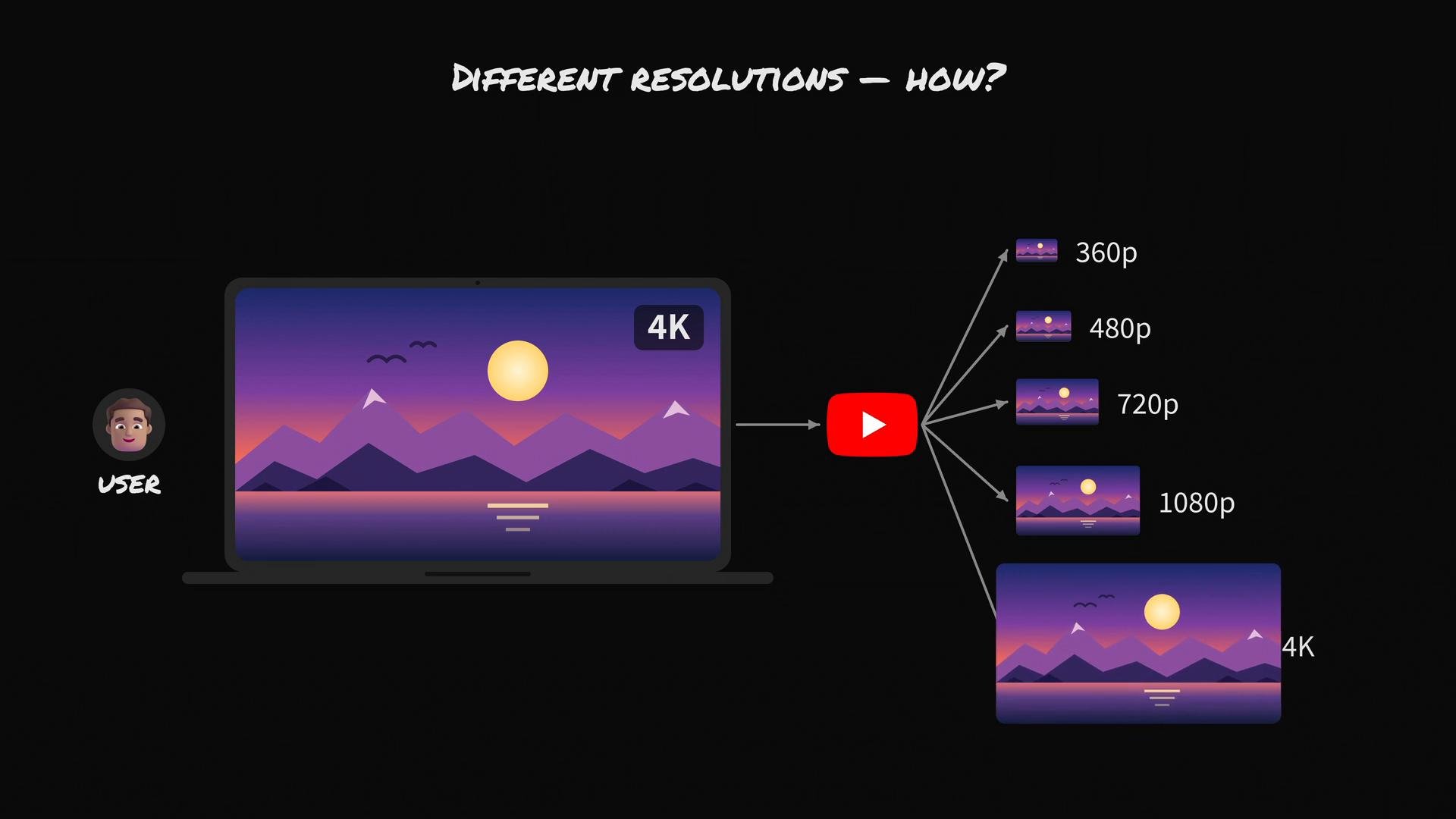
- FFmpeg is the ubiquitous open-source multimedia framework used in many workflows: https://ffmpeg.org
- Production deployments often combine FFmpeg with hardware encoders (for example, NVENC or Intel QuickSync) and orchestration to meet throughput and cost targets.
FFmpeg is widely used, but at scale you’ll typically see a mix of optimized software/hardware encoders (e.g., NVENC, QuickSync), tuned encoder settings, and distributed workers to meet latency and cost requirements.
- Store the original upload
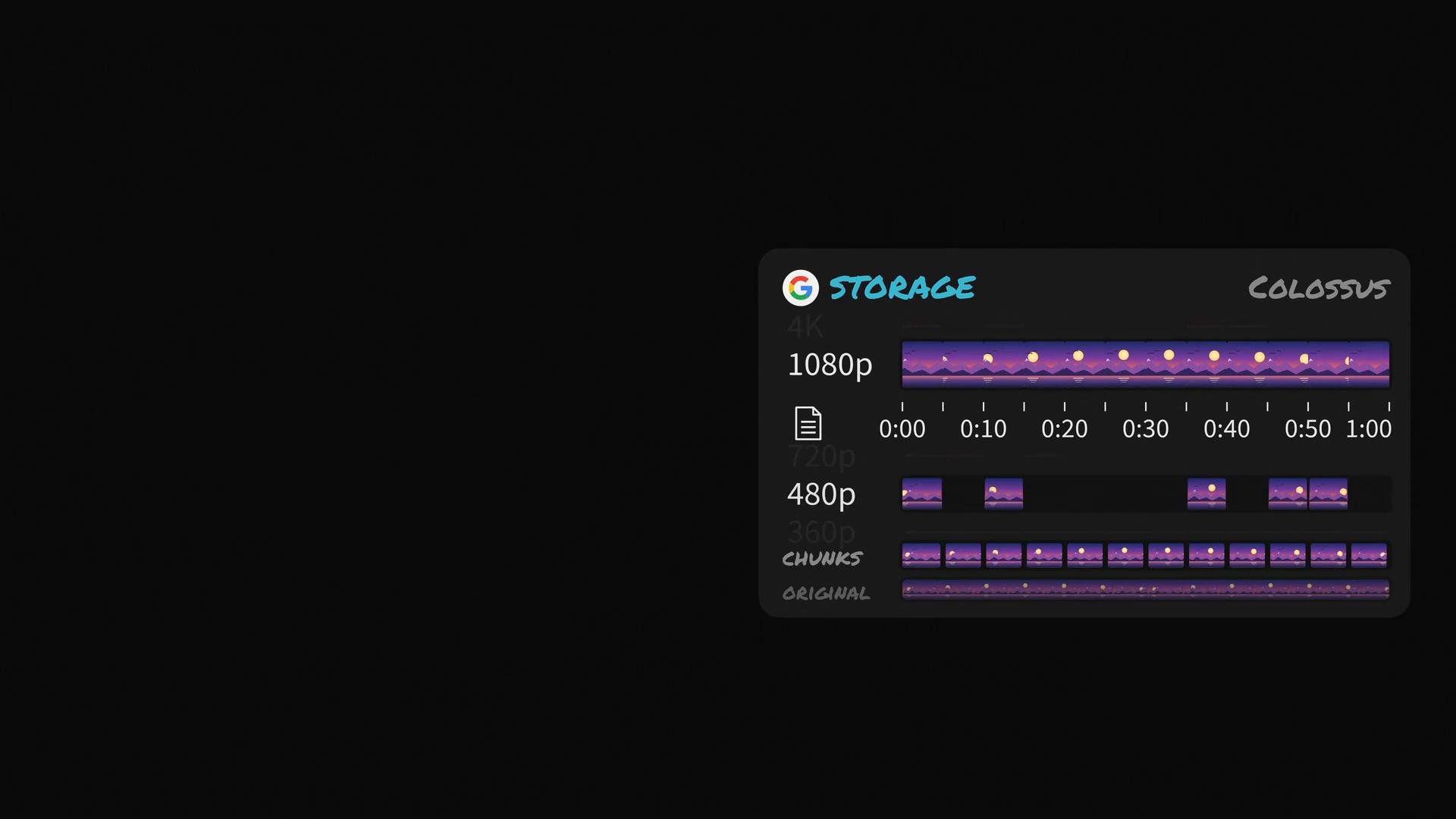
- Immediately after upload, the original 4K master is stored in durable object storage (YouTube internally uses Colossus). Storing the original allows re-transcoding later (new codecs, formats, or quality ladders) without forcing the user to re-upload.
- Link: Colossus — https://en.wikipedia.org/wiki/Colossus_(file_system)
- Scheduler and splitter
- A scheduler service tracks jobs, assigns work to workers, and records progress and retries.
- A splitter (also called a segmenter) breaks the original into short independent chunks — commonly ~5 seconds per chunk. The splitter aligns segment boundaries to keyframes (GOP/IDR boundaries) so each chunk can be decoded independently. If necessary, the splitter will re-encode a tiny region to force an IDR/keyframe at the cut point.
- Example: a 1-hour video → 60 × 60 / 5 = 720 chunks saved back to storage.
- Link: Keyframes/GOP/IDR — https://en.wikipedia.org/wiki/Key_frame and https://en.wikipedia.org/wiki/Group_of_pictures
- Jobs per chunk
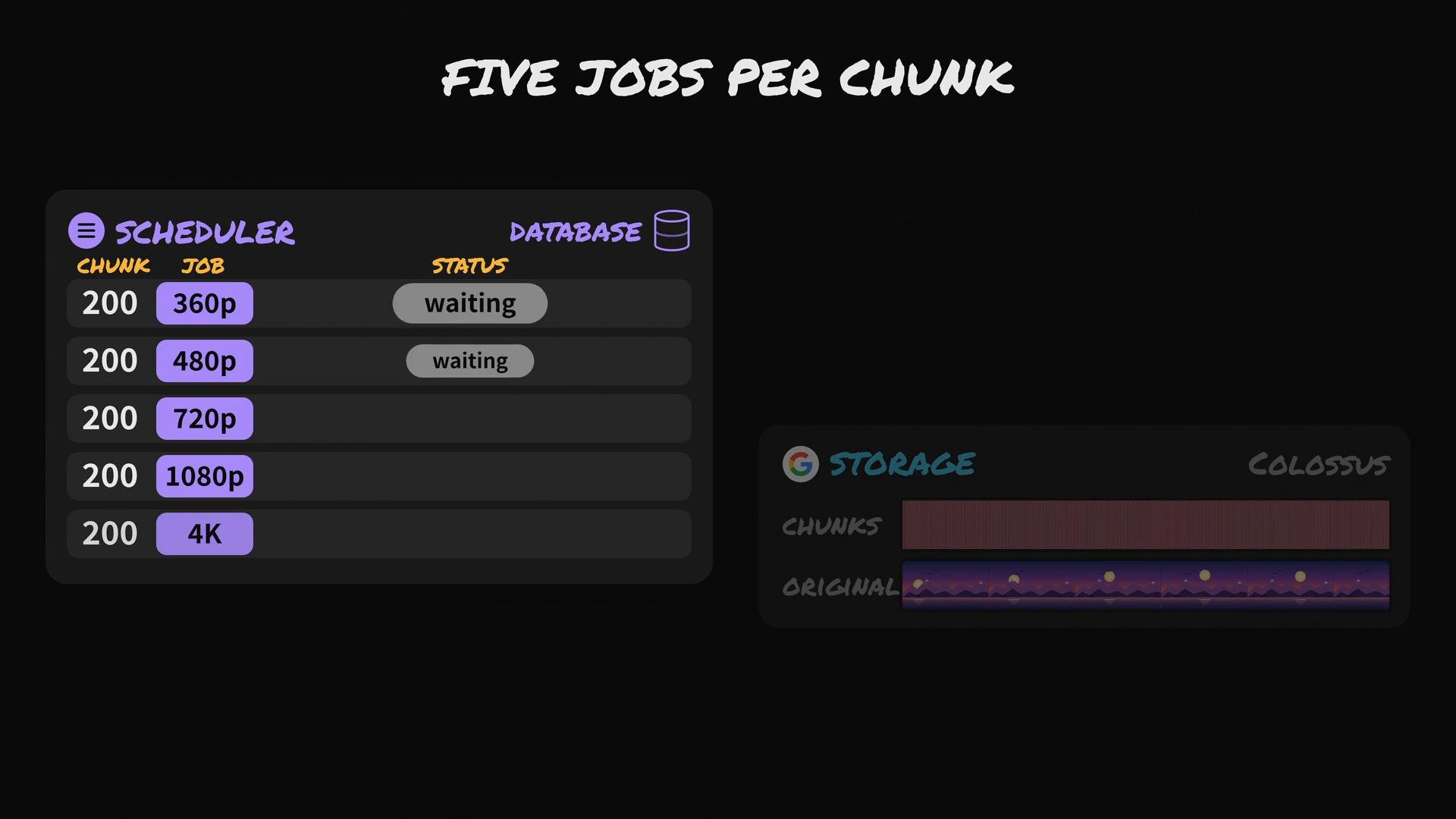
- For each chunk (for example chunk #200), the scheduler creates one job per target rendition/resolution/bitrate: 360p, 480p, 720p, 1080p, and 4K.
- Each job is recorded in the scheduler database with a state (waiting, running, failed, or done) and metadata (worker assigned, start/finish timestamps, retry count).
- Queueing, workers, and retries
- Jobs are pushed onto a work queue. Worker instances poll or are pushed a job, fetch the corresponding chunk from storage, transcode it into the target rendition, and write the encoded segment back to storage.
- When a worker completes a job it notifies the scheduler, which marks that job done and updates progress for that chunk and rendition.
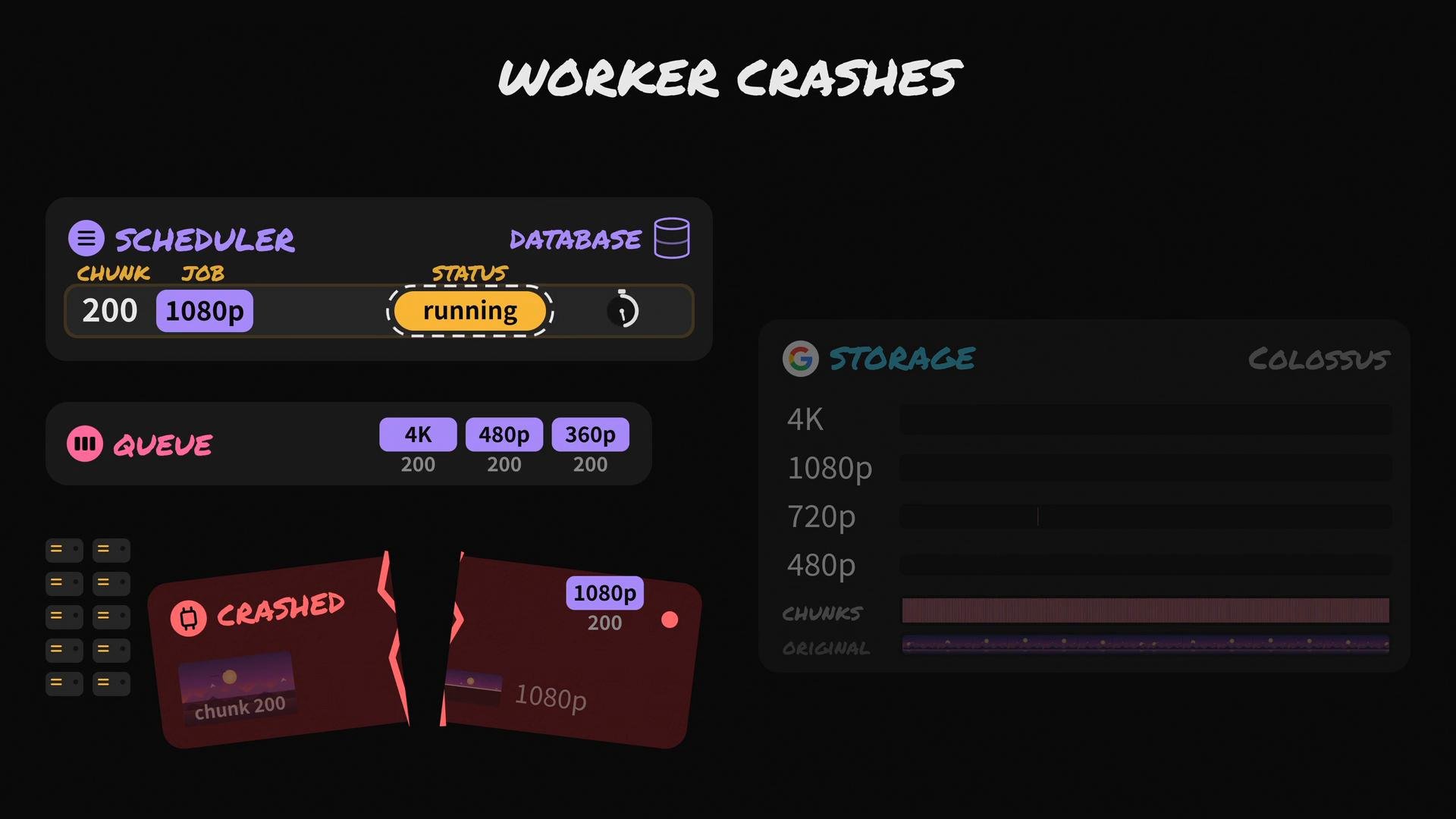
- If a worker crashes, stalls, or exceeds a timeout, the scheduler re-queues the job for retry. Because work is chunk-level, failures are isolated — only small segments are reprocessed.
- Prioritization for fast availability
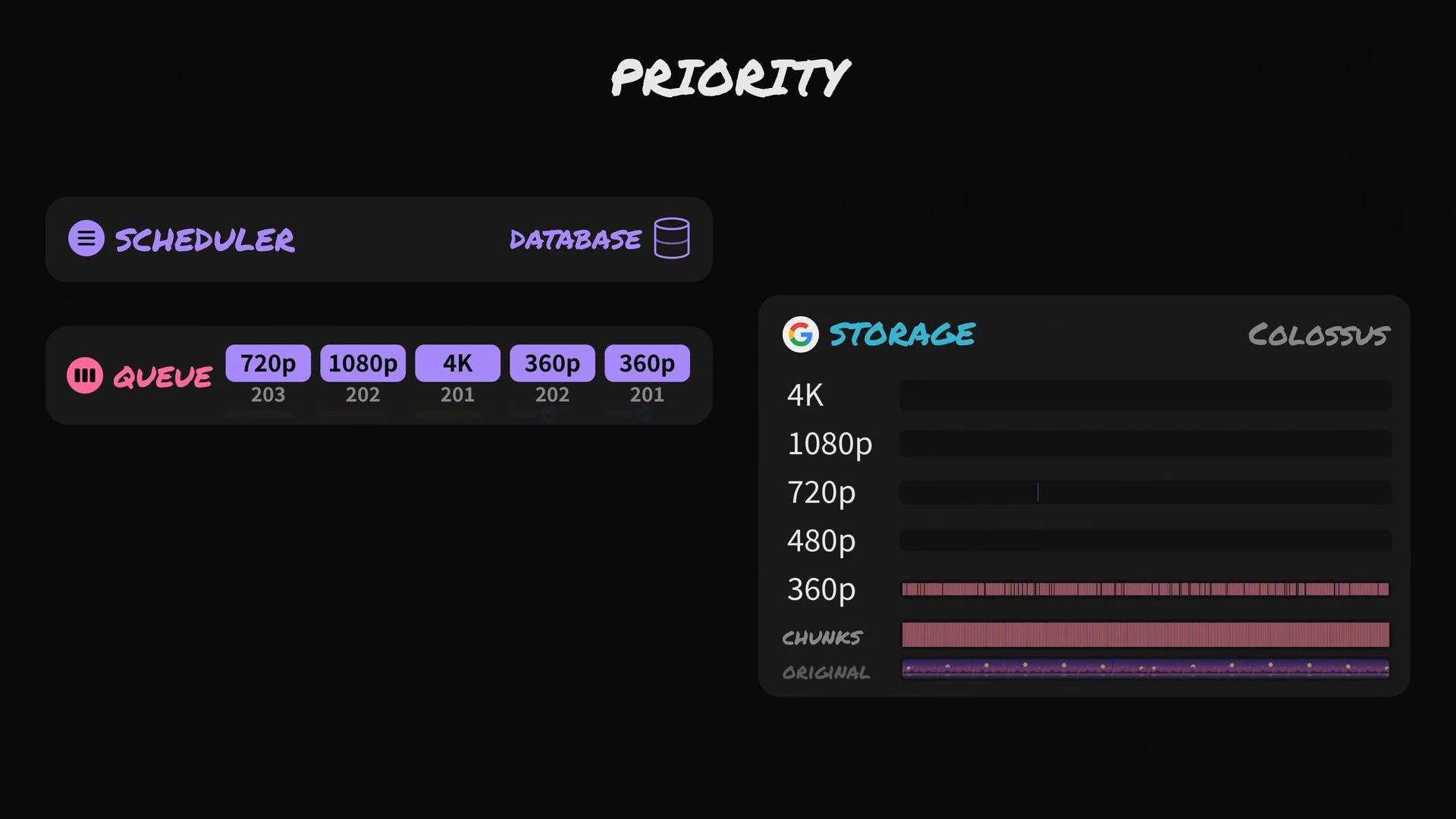
- The scheduler can prioritize faster, low-bitrate encodes (for example 360p) so users get a playable stream quickly while higher-quality renditions are still finishing.
- This approach reduces perceived latency: viewers can start watching with a low-resolution stream while higher resolutions become available progressively.
- Reassembly and manifest/index creation
- After all chunks for a given rendition are complete, the scheduler schedules a final job to reassemble or publish those segments. Depending on the delivery format, this can be:
- Concatenating segments into a single file, or
- Publishing segment files and generating a manifest that points to each segment.
- The worker that performs this step also creates an index/manifest such as a DASH MPD or an HLS M3U8. The manifest lists available renditions, bitrates, and the URLs or byte ranges for each segment.
- Links: DASH MPD — https://en.wikipedia.org/wiki/Dynamic_Adaptive_Streaming_over_HTTP, HLS M3U8 — https://en.wikipedia.org/wiki/HTTP_Live_Streaming
- Playback and adaptive bitrate streaming (ABR)
- The player downloads the manifest and requests only the required segments (usually a few seconds at a time), not the whole file.
- If network conditions change, the player switches renditions and requests the next segment at the new resolution — this is adaptive bitrate streaming (ABR), which delivers smooth playback across varying bandwidths.
- Link: ABR — https://en.wikipedia.org/wiki/Adaptive_bitrate_streaming
Why this design works (summary)
- Parallelism: Chunking allows many workers to operate simultaneously across chunks and renditions, dramatically reducing end-to-end latency.
- Fault isolation: Worker failures affect only a few seconds of video and can be retried quickly.
- Fast initial availability: Prioritizing low-bitrate encodes lets viewers start playback sooner.
- Efficient delivery: Short segments + manifests allow ABR, letting players switch resolutions with minimal interruption.
- Future flexibility: Keeping the original master enables re-encoding for new codecs or distribution formats later.
- Use hardware acceleration (NVENC, QuickSync, etc.) when throughput demands make pure software encoding too slow or expensive.
- Tune encoder settings and quality ladders for the desired perceptual quality vs. bitrate trade-off.
- Monitor worker health, queue latency, and manifest correctness so playback and ABR behave reliably in production.