

- Low write latency for geographically distributed clients.
- Regional write availability during partial outages.
- Simplified regional autonomy for local operations.
How conflicts arise (example)
Imagine two users updating the same row (row 1,000,000) nearly simultaneously:- Alan in Sydney writes
x = 7to the Sydney leader. - John in Virginia writes
x = 9to the Virginia leader.
x. A naive strategy is Last-Write-Wins (LWW): the write with the later timestamp wins and overwrites the other.
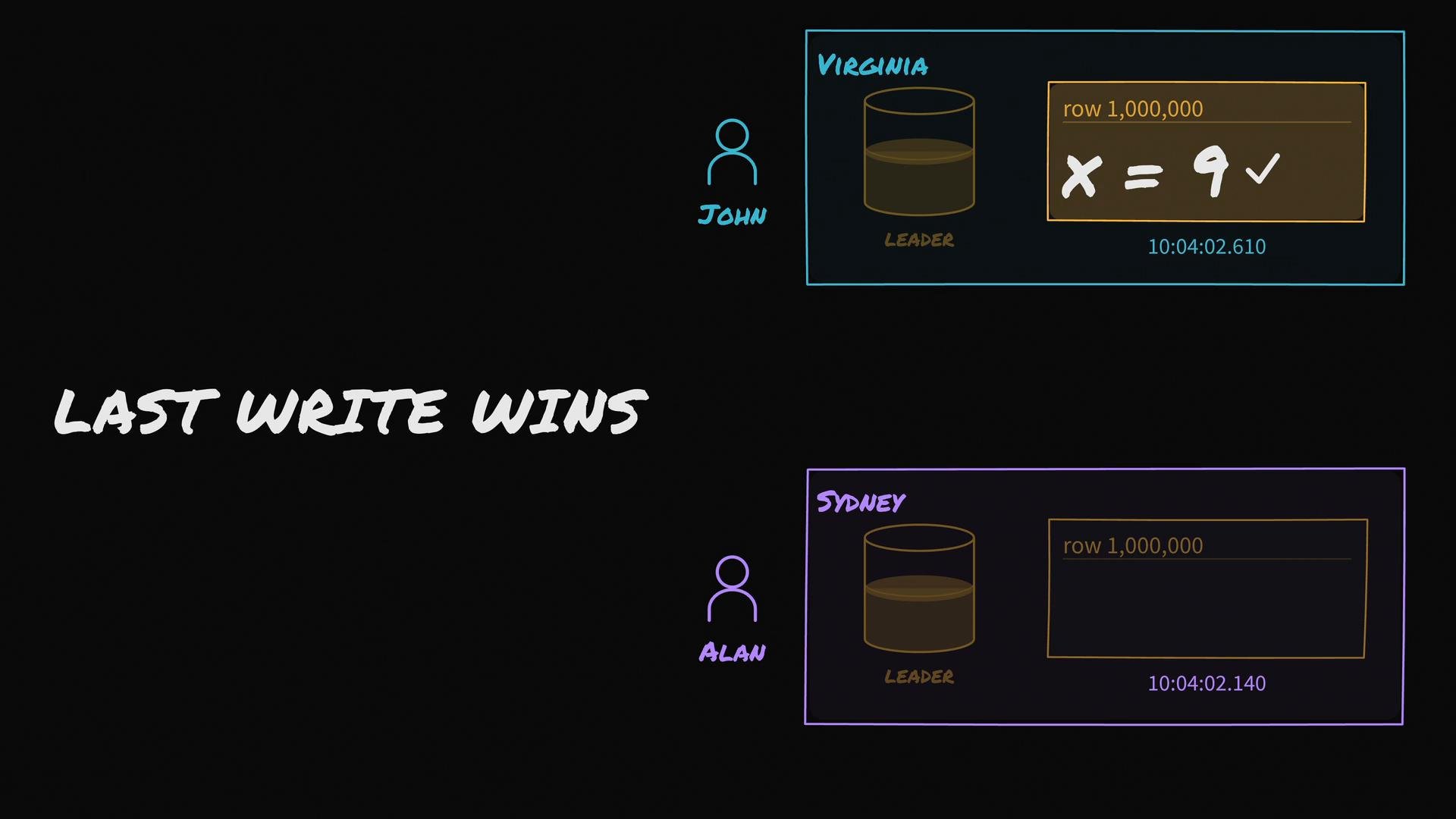
- Silent data loss: one of the concurrent updates is discarded.
- Reliance on clock synchronization: physical clock skew can choose the wrong winner.
- Loss of intent: merging two updates by timestamp discards contextual meaning.
Conflict-resolution strategies
Below is a compact comparison of common strategies for handling conflicts in multi-leader systems.
Use the strategy (or combination) that matches your domain semantics and availability/consistency requirements.
Practical patterns to reduce conflicts
- Route writes by key/customer to a designated regional leader so the same entity is rarely updated in multiple regions.
- Make operations idempotent where possible.
- Prefer data types that can be merged deterministically or designed as CRDTs.
- Surface conflicts to the application for manual or automated resolution when automatic merging is unsafe.
- Use logical or hybrid clocks to reduce reliance on perfectly synchronized physical clocks.
Design for conflict avoidance whenever possible: shard writes by key or customer, use idempotent operations, and choose merge strategies (CRDTs or deterministic merges) that fit your domain.
When to avoid multi-leader
Multi-leader replication is powerful for global low-latency writes, but it is not a universal solution. Avoid or be cautious when:- Your workload has frequent concurrent writes to the same keys from multiple regions and correctness is critical.
- Your business logic cannot be expressed with mergeable data types or deterministic conflict resolution.
- You cannot tolerate the operational complexity of conflict detection, resolution, and debugging.
Be careful with last-write-wins: it can silently drop updates and relies on timestamp ordering. If correctness matters, prefer explicit merge strategies, vector clocks, CRDTs, or designs that avoid concurrent writes to the same keys.
Further reading and references
- CRDTs — Conflict-free Replicated Data Types
- Vector clocks (Wikipedia)
- Martin Kleppmann, “Designing Data-Intensive Applications” — chapters on replication and consensus
- Hybrid Logical Clocks (HLC)