Managed training jobs in Amazon SageMaker help teams deliver models faster by offloading infrastructure and automating repetitive tasks. With SageMaker you can run optimized training at scale, explore hyperparameter combinations automatically, and pay only for the compute you consume—reducing idle EC2 capacity and cutting operational overhead. These advantages let data scientists focus on modeling, experimentation, and iteration instead of provisioning and managing infrastructure.
Optimized training with managed jobs accelerates development and reduces cost by automating hyperparameter search and letting you right-size compute (instance type and instance count) per job.
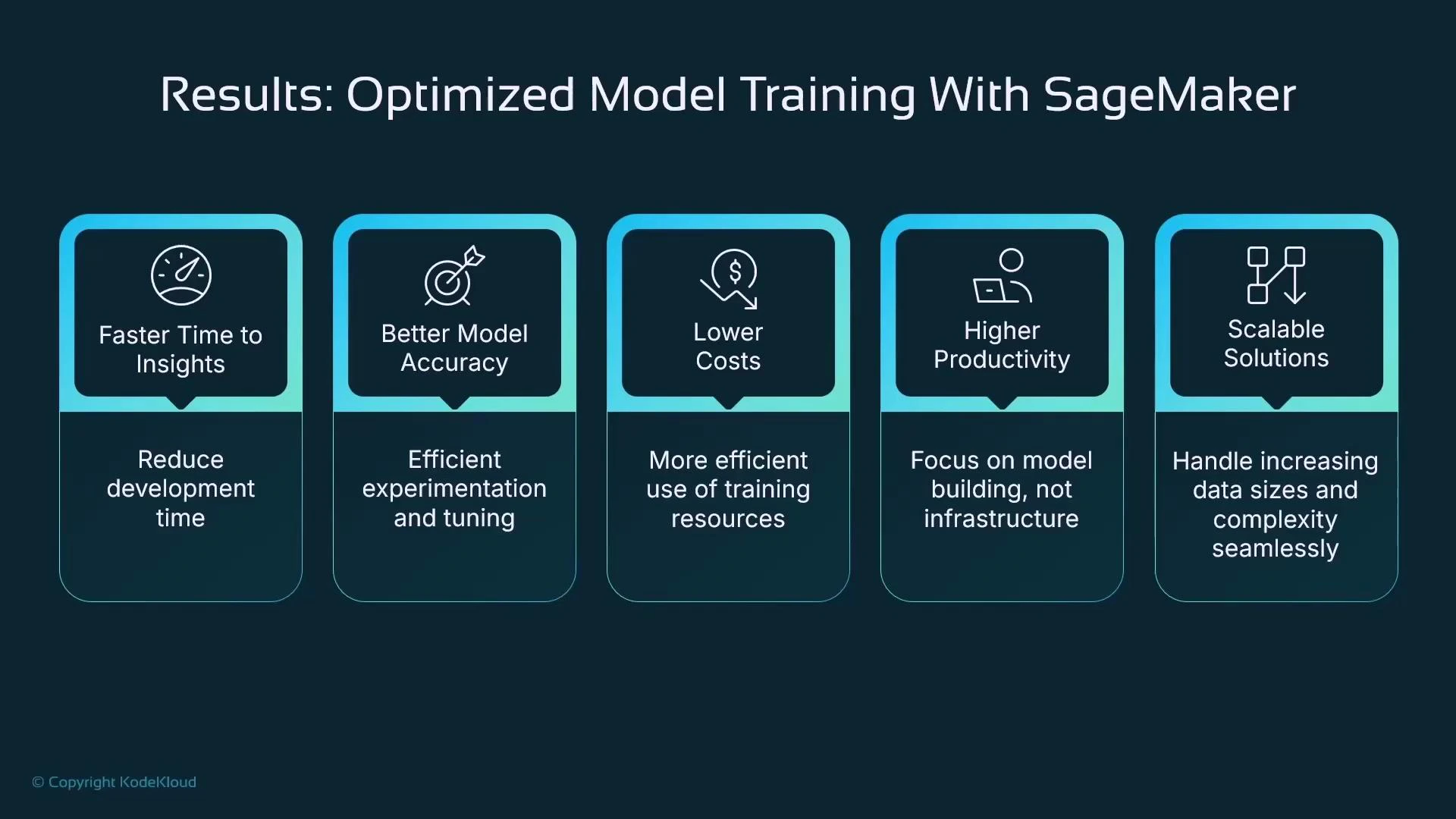
Scalability is straightforward. Adjust an Estimator’s instance_type to scale up (more powerful CPU/GPU) or instance_count to scale out (distributed training). For distributed jobs, SageMaker orchestrates containers across instances so your training script can process larger datasets with minimal changes.
A presentation slide titled "Results: Optimized Model Training With SageMaker" showing five benefit panels—Faster Time to Insights, Better Model Accuracy, Lower Costs, Higher Productivity, and Scalable Solutions—each with an icon and short explanation. It highlights outcomes like reduced development time, efficient tuning, cost savings, higher productivity, and handling larger/more complex data.
What we covered in this lesson/article
  • SageMaker training jobs run your training script inside managed containers. Point the job at your training data (commonly in S3), provide the algorithm or framework, and supply an entry point script. SageMaker pulls the correct container image for the specified framework or algorithm.
  • The SageMaker Python SDK exposes an Estimator base class and framework-specific subclasses (e.g., TensorFlow, PyTorch). Instantiating an Estimator configures the container image, compute, and runtime behavior for your training job.
  • Hyperparameter tuning can be automated with SageMaker HyperParameter Tuning Jobs. You provide ranges, maximum total/concurrent jobs, and a search strategy (e.g., grid or random). SageMaker runs parallel training jobs, evaluates the objective metric, and returns the best hyperparameter configuration.
  • Compute sizing is an Estimator property. Use instance_type and instance_count to meet the scale of your workload (single-instance, multi-GPU, or distributed across instances).
Estimator parameters quick reference
ParameterPurposeExample
image_uriECR container image used to run your training code123456789012.dkr.ecr.us-west-2.amazonaws.com/my-training-image:latest
roleIAM role used by SageMaker to access S3, ECR, CloudWatch, etc.arn:aws:iam::123456789012:role/SageMakerRole
instance_typeCompute instance type for training (CPU/GPU)ml.m5.xlarge, ml.p3.2xlarge
instance_countNumber of instances for distributed training1, 2, 4
entry_pointTraining script that runs inside the containertrain.py
source_dirDirectory packaged and uploaded with the training jobsrc/
hyperparametersDictionary of hyperparameters passed to your script{'epochs': 10, 'learning_rate': 0.01}
Example: configuring an Estimator (Python SDK)
from sagemaker.estimator import Estimator

estimator = Estimator(
    image_uri='123456789012.dkr.ecr.us-west-2.amazonaws.com/my-training-image:latest',
    role='arn:aws:iam::123456789012:role/SageMakerRole',
    instance_type='ml.m5.xlarge',
    instance_count=2,
    entry_point='train.py',
    source_dir='src',
    hyperparameters={'epochs': 10, 'learning_rate': 0.01}
)

# Launch the training job (uploads source_dir, provisions compute, runs training)
estimator.fit('s3://my-bucket/my-training-data/')
This pattern—create an Estimator, set data channels, compute sizing, entry point, and hyperparameters, then call fit()—treats training as a first-class object. SageMaker handles the container lifecycle, resource provisioning, and logging so you can iterate faster.
Replace placeholder values (ECR image URIs, IAM role ARNs, and S3 paths) with your environment-specific resources. Ensure the IAM role has permissions for S3, ECR, CloudWatch, and SageMaker actions.
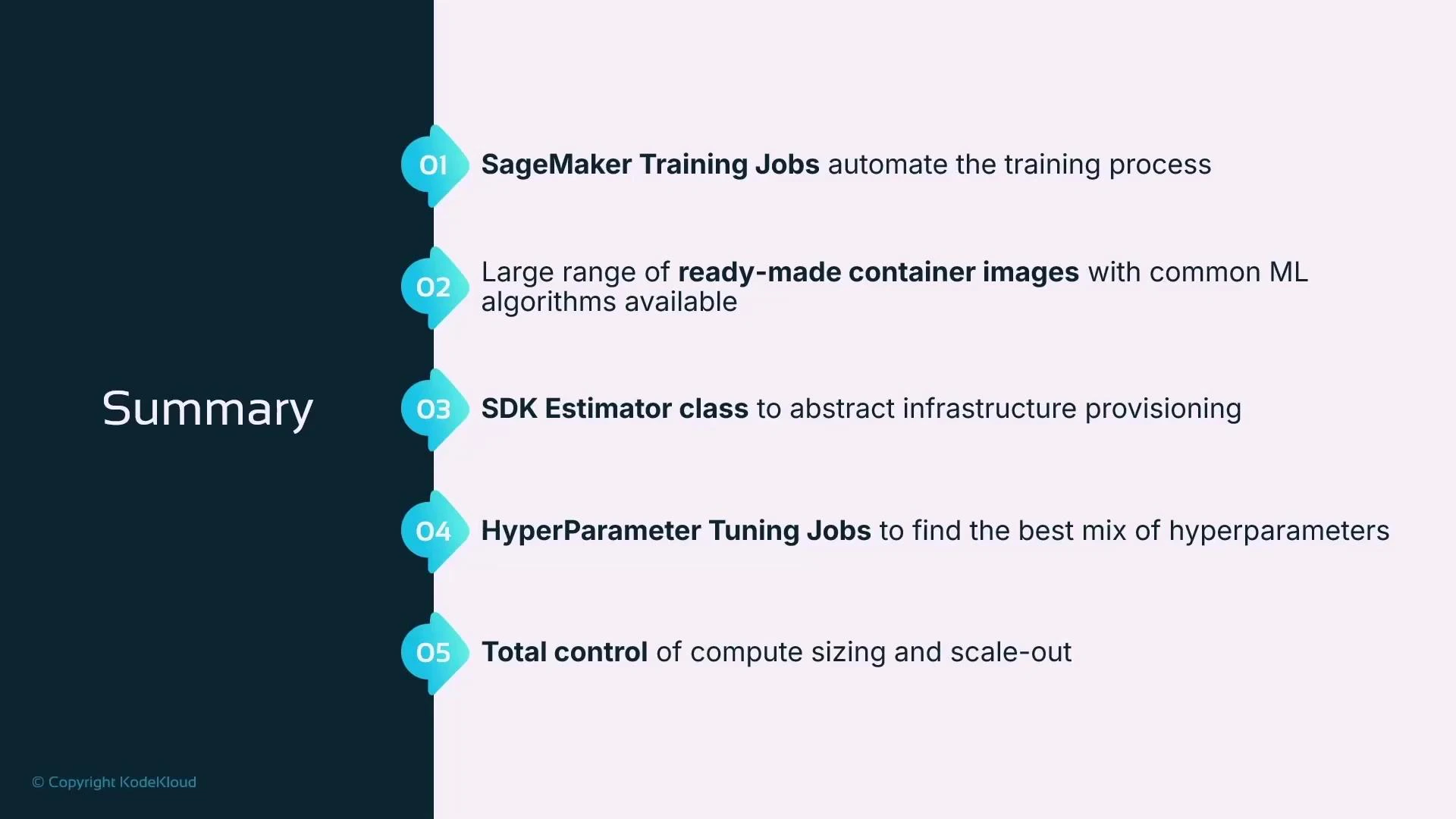
A "Summary" slide listing five AWS SageMaker features: SageMaker Training Jobs, ready-made container images, SDK Estimator class, HyperParameter Tuning Jobs, and total control of compute sizing and scale-out. Each item is numbered with teal markers down the center and the slide has a dark left panel labeled "Summary."
Next steps and references That wraps up this overview of training models using SageMaker managed training jobs. A future demonstration will walk through a complete Studio workflow: launching a training job, monitoring logs and metrics, and evaluating the resulting model artifacts.

Watch Video