

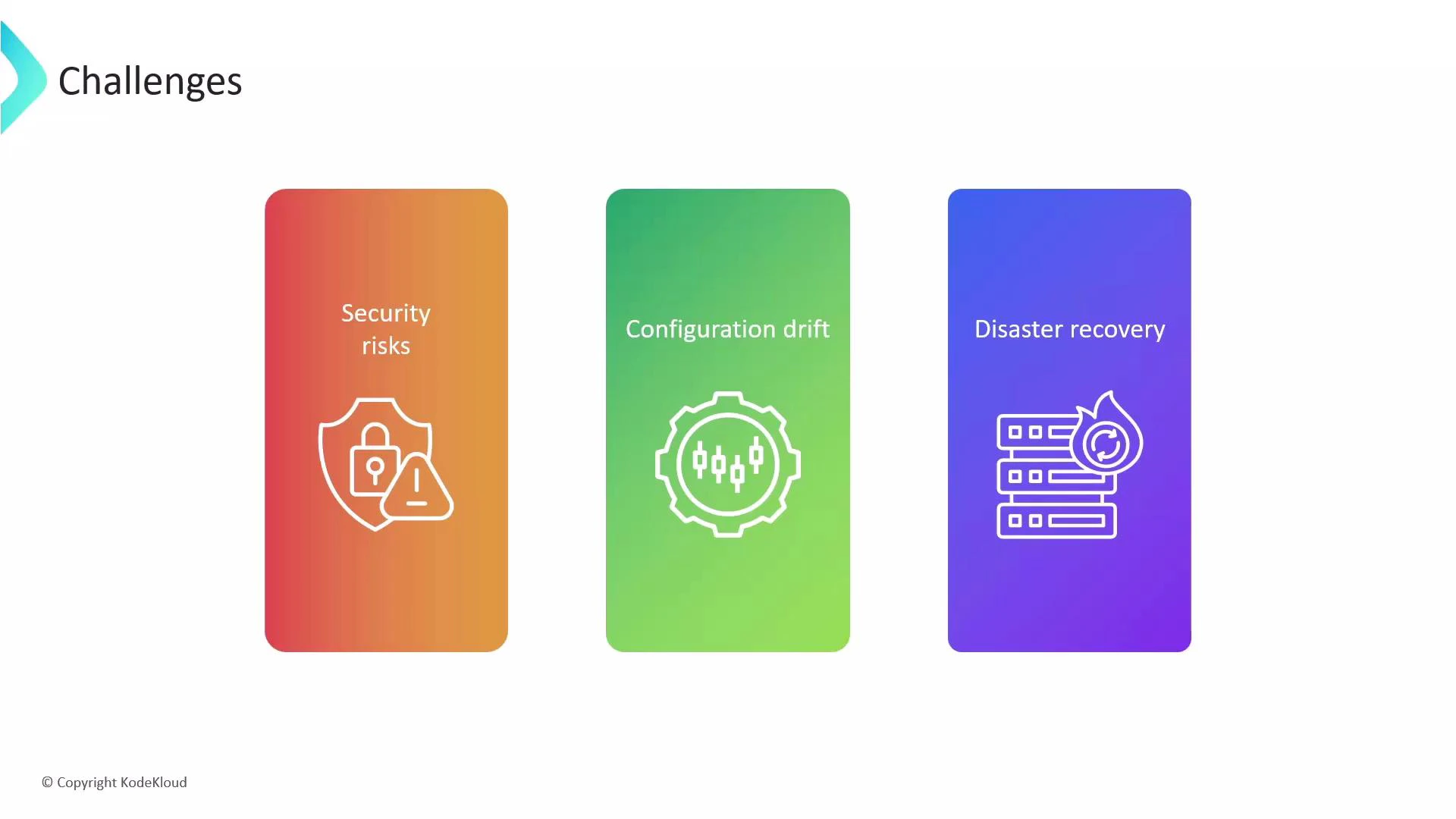
- Security risks: Storing Kubernetes credentials outside the cluster to allow an external CI to push changes — plus more people with powerful access — expanded the attack surface.
- Configuration drift: The cluster’s live state diverged from the intended state in Git, undermining reproducibility.
- Unreliable disaster recovery: Because manual, unrecorded changes existed, applying what’s in Git would not restore the true working system after an outage.
Configuration drift: when manual or out-of-band changes cause the live environment to differ from the version-controlled desired state, making reproducibility and recovery unreliable.
Storing cluster credentials outside the cluster or granting widespread kubectl access increases risk. Prefer in-cluster controllers and limited, auditable access.
Argo CD
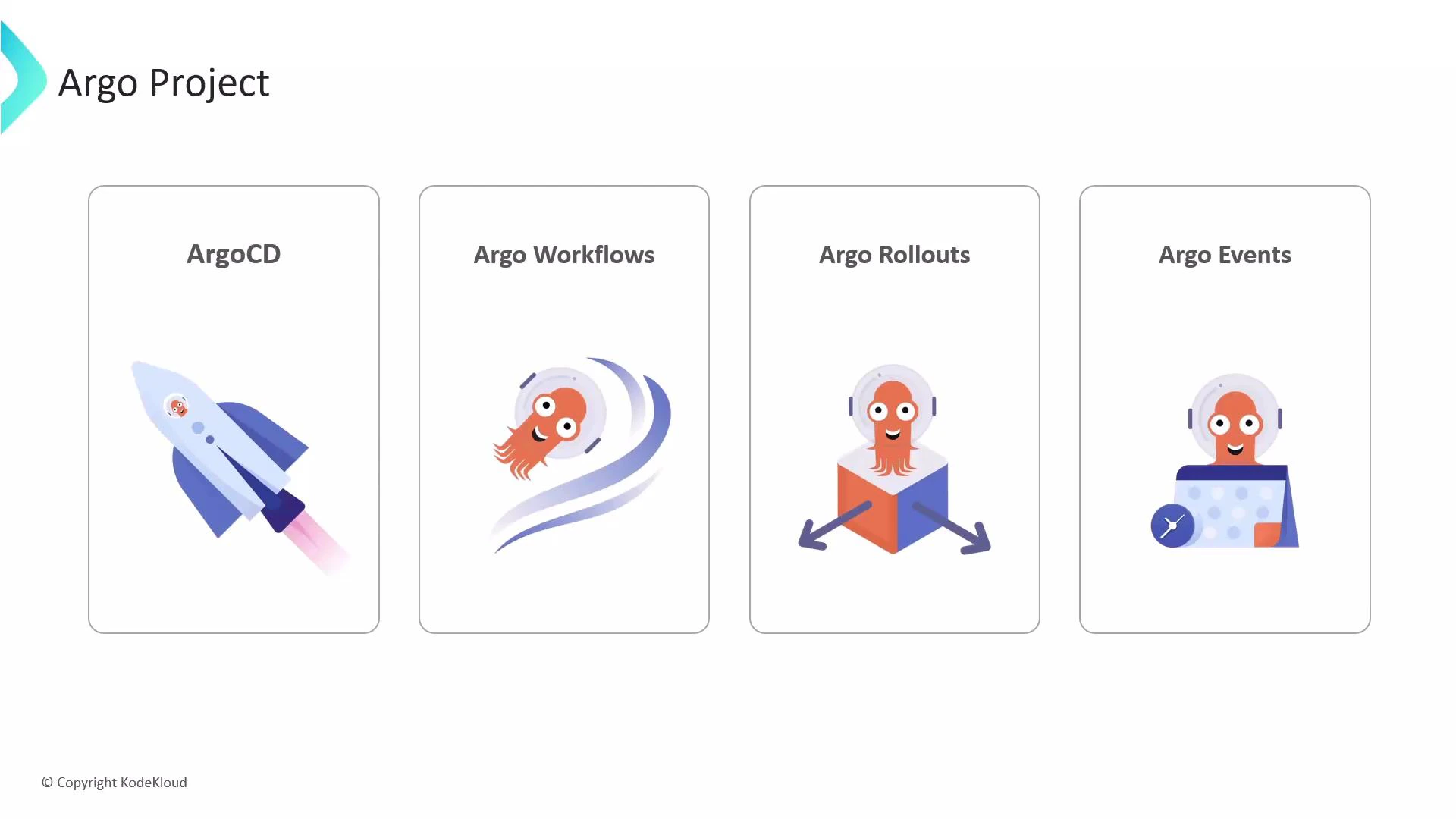
Argo CD is the continuous delivery engine for GitOps on Kubernetes.- Runs inside the Kubernetes cluster and implements a pull-based reconciliation loop: it watches Git repositories and ensures the cluster matches the desired state declared in Git.
- Keeps credentials in-cluster (as Kubernetes Secrets), avoiding the need to expose cluster credentials to external CI systems.
- Detects configuration drift and can automatically or manually revert out-of-band changes by reapplying the desired state from Git.
- Supports disaster recovery by re-creating cluster state from manifests, Helm charts, and Kustomize resources stored in Git.
Argo Workflows
Argo Workflows is a Kubernetes-native workflow engine for orchestrating multi-step jobs as containers.- Define pipelines as steps or DAGs with containerized tasks.
- Use it for build, test, linting, and other CI tasks that run inside Kubernetes, leveraging cluster scale and resource management.
- Integrates with other Argo tools to create complete CI/CD automation.
Argo Rollouts
Argo Rollouts provides progressive delivery strategies to reduce release risk.- Supports canary, blue-green, and other progressive deployment patterns.
- Integrates with monitoring and metrics systems (for example, Prometheus) to perform automated analysis during rollouts.
- On metric regressions (e.g., increased error rates), Argo Rollouts can pause or roll back automatically to protect production.
Argo Events
Argo Events is an event-driven automation framework that connects external signals to in-cluster automation.- Listens for events from Git pushes, webhooks, S3, message queues, and more.
- Triggers workflows, notifies systems, or initiates Argo CD syncs and Argo Rollouts.
- Enables end-to-end event-driven CI/CD: e.g., a Git push → Argo Events → Argo Workflows build/test → success triggers Argo CD sync and Argo Rollouts deployment.
Argo components at a glance
Putting it all together
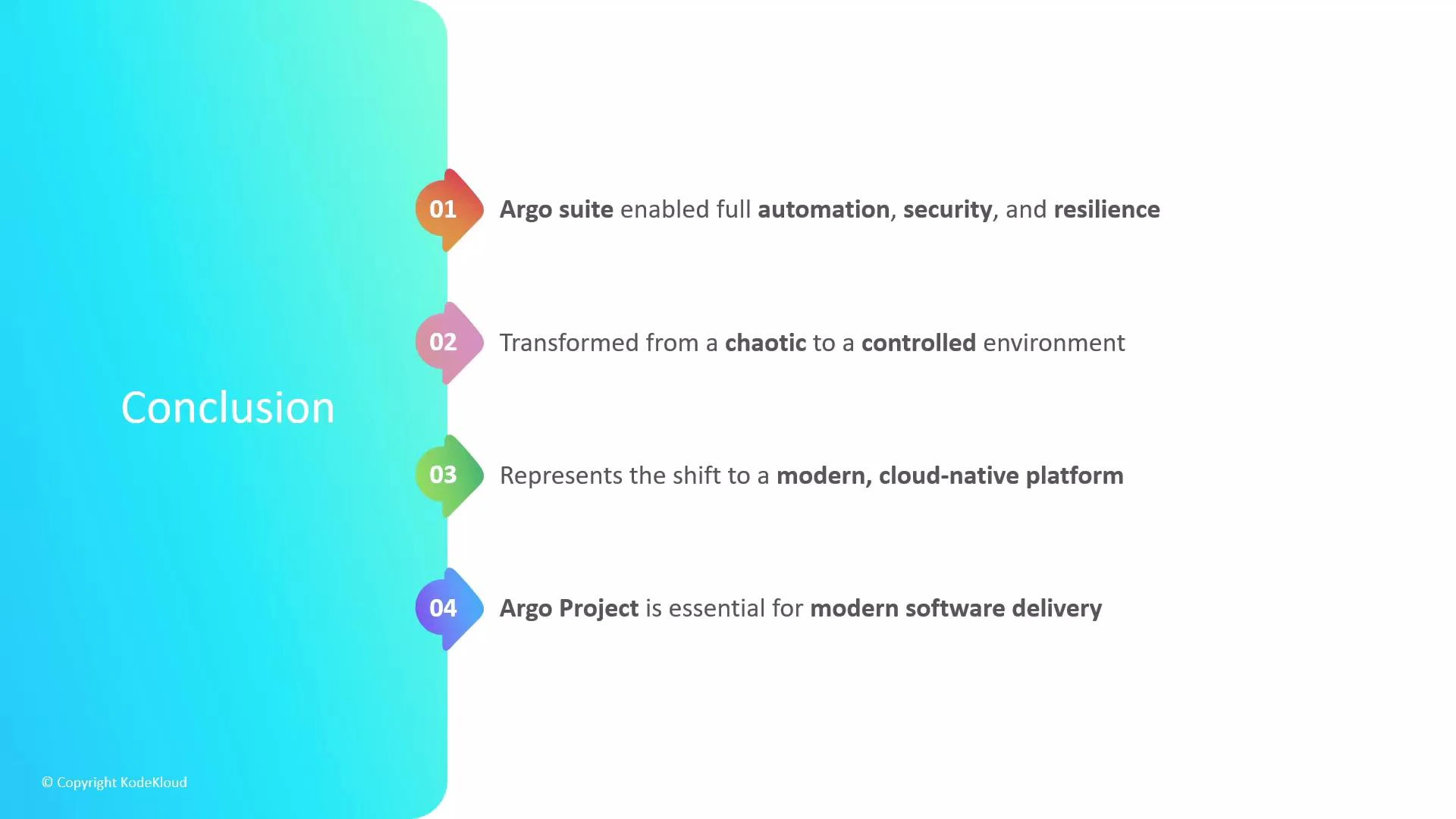
For Dasho, adopting the Argo suite resolved the major failures:- Argo CD restored trust by enforcing Git as the authoritative source and eliminating configuration drift.
- Argo Workflows automated build and test steps inside the cluster.
- Argo Rollouts enabled safe, progressive deliveries with metric analysis and automated rollback.
- Argo Events connected external triggers to internal automation, creating a seamless event-driven pipeline.
Links and references
- Argo Project: https://argoproj.github.io/
- GitOps principles: https://www.gitops.tech/
- Kubernetes documentation: https://kubernetes.io/docs/
- Prometheus (metrics integration): https://prometheus.io/
- Argo CD documentation: https://argo-cd.readthedocs.io/
- Argo Workflows documentation: https://argoproj.github.io/argo-workflows/
- Argo Rollouts documentation: https://argoproj.github.io/argo-rollouts/
- Argo Events documentation: https://argoproj.github.io/argo-events/