

Core Terraform commands
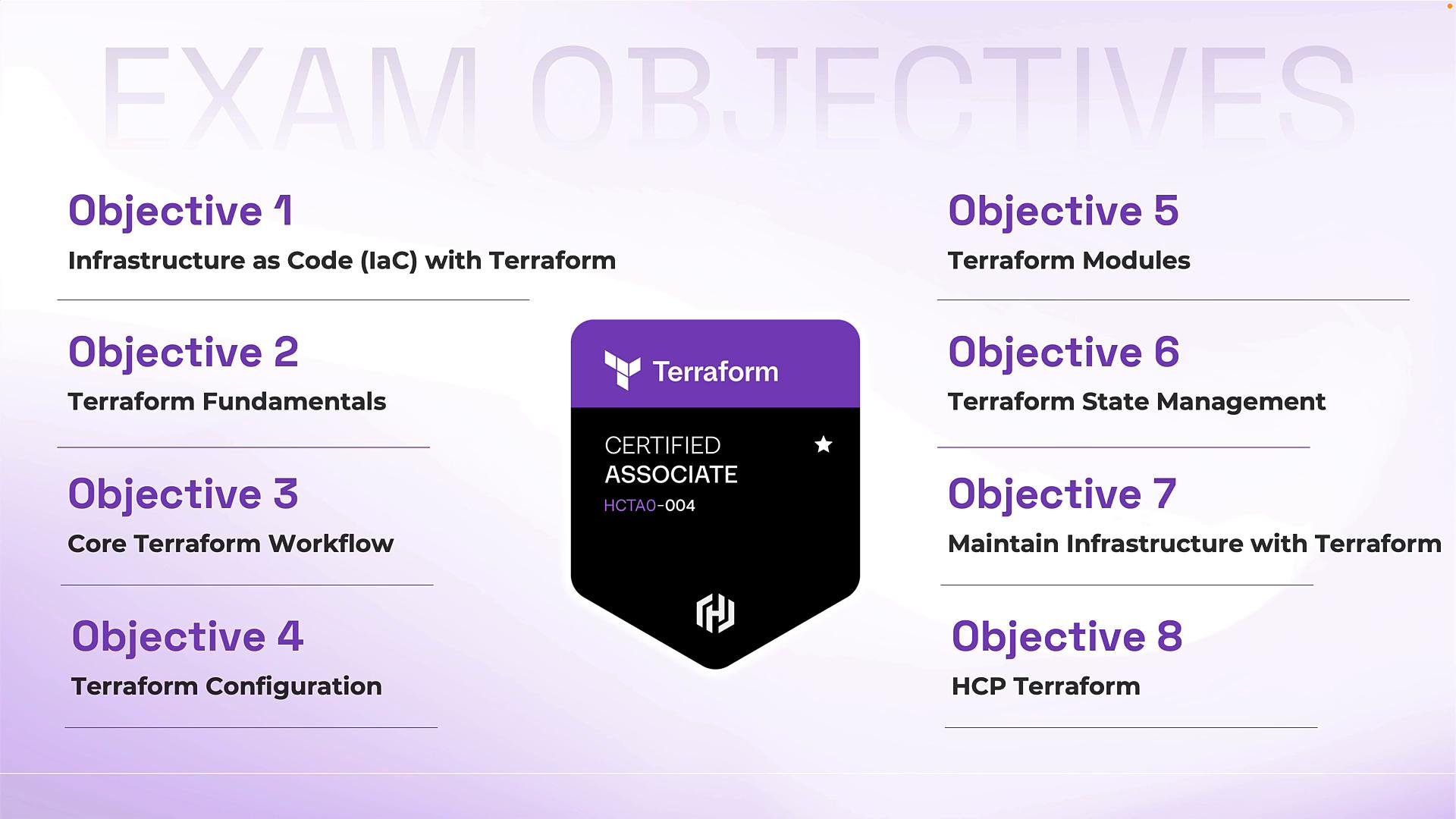
- Infrastructure as Code Fundamentals
- Know the IaC benefits (automation, consistency, reviewability) and differences between imperative and declarative approaches.
- Understand Terraform’s position in a multi-cloud environment and how providers map to cloud APIs.
- Terraform Fundamentals
- Learn provider configuration, resource syntax, attributes, and the role of data sources.
- Grasp the basics of state: what it stores, why it’s necessary, and potential risks if mishandled.
- Core Terraform Workflow
- Practice the day-to-day flow (
init→plan→apply→destroy) and how state and backends affect that workflow. - Understand plan vs apply and how to interpret diffs and dependency graphs.
- Configuration (largest exam area)
- Expect questions on:
- Resource blocks, data sources, and arguments
- Input variables and variable types
- Outputs and how to reference them
- Built-in functions and interpolation
- Explicit dependencies,
count,for_each, and resourcelifecyclerules - Handling sensitive values (using
sensitiveflag, environment variables, and avoiding secrets in state)
- Hands-on: modularize code, use input validations, and test variable scoping.
- Modules
- Know how to create reusable modules, consume modules from the Registry or VCS, and pin module versions.
- Understand module inputs/outputs, nested modules, and best practices for module design.
- State Management
- Compare local vs remote backends (e.g.,
local,s3,azurerm,gcs,remote) and their trade-offs. - Learn about state locking to prevent concurrent writes and state migration patterns.
- Practice detecting drift and restoring state safely.
- Maintenance (Day-2 Operations)
- Import existing resources into Terraform with
terraform import. - Use
terraform statesubcommands to inspect and manipulate state (list,show,mv,rm). - Troubleshoot with
TF_LOGdebug logs andterraform validate/console.
- HCP Terraform (HashiCorp Cloud Platform)
- Understand HCP-specific features: workspaces, runs, remote state management, collaboration, and governance (e.g., Sentinel or policy as code).
- Practice connecting VCS providers and configuring remote runs in HCP.
Focus most of your study time on configuration (Objective 4) and state management (Objective 6). Also get hands-on experience with HCP Terraform features; the HCP section was expanded in the 0.0.4 exam.
- HCP Terraform content expanded — more questions cover remote workspaces, collaboration, and governance features.
- Increased emphasis on state management best practices, locking, and drift detection.
- Expect deeper coverage of configuration topics: advanced functions, complex variable types, and sensitive data handling.
- Terraform documentation — Getting Started
- HCP Terraform (Cloud) home
- Terraform Registry
- Terraform CLI commands reference
- Prioritize hands-on labs for Objectives 4 and 6.
- Practice
terraform importand remote backend configuration. - Explore HCP workspaces and remote runs to understand collaboration workflows.