

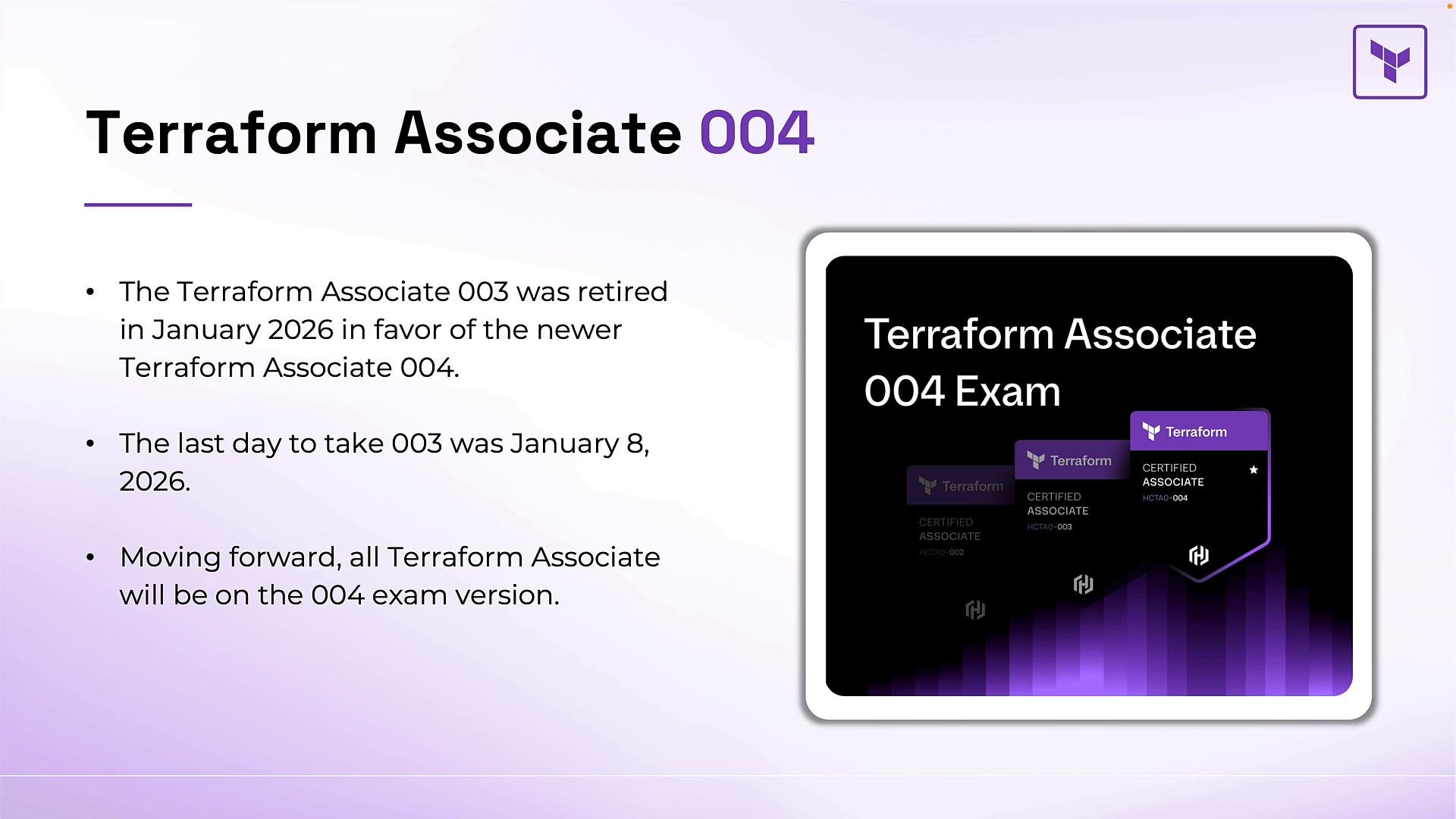
- The overall exam format, duration, and most objectives remain similar.
- Four notable additions were introduced in 004 — prioritize those when studying.
- If you hold 003 it remains valid until expiry; you only need to take 004 when recertifying (or if you choose to upgrade early).
What stayed the same
The 004 exam is an evolution, not a complete rewrite. Core elements that remain consistent:- Objectives largely remain similar, though they were reorganized and some sub-objectives were added.
- Exam length and format: 60 minutes and the same number of questions.
- Question types: multiple choice, multiple select, and true/false remain. Fill-in-the-blank was removed.
- Delivery: online, proctored — HashiCorp updated the proctoring vendor in 2025.
- Credential validity: two years for both 003 and 004.
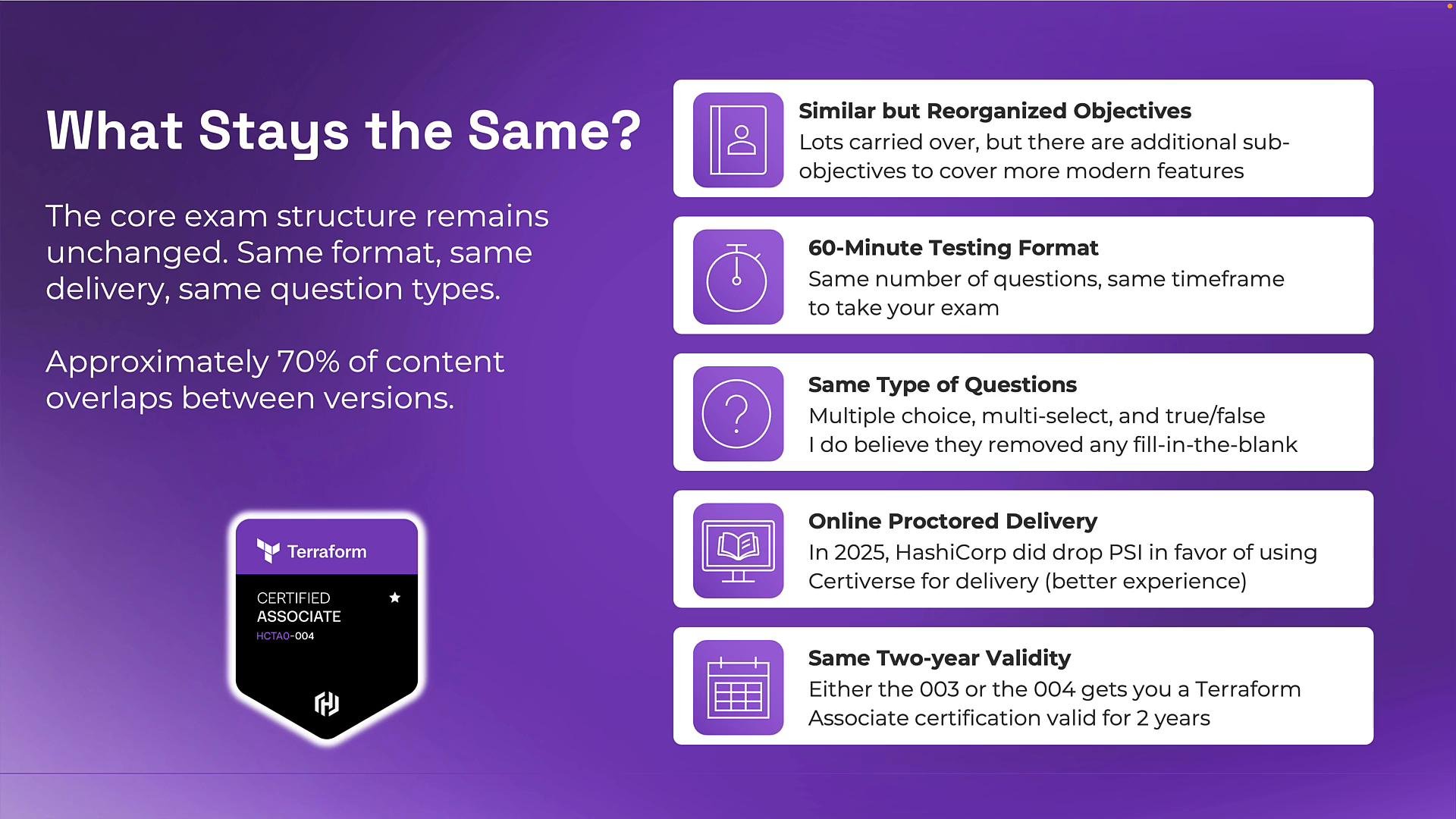
Your Terraform Associate credential (003 or 004) remains valid for two years. If you already have 003, it stays valid until it expires — you only take 004 when you recertify or choose to upgrade early.
Follow the proctoring rules carefully (name match, workspace requirements, camera and environment checks). Failure to comply can interrupt or invalidate your exam session.
What changed — four major additions
About 70% of the exam content overlaps between 003 and 004, but HashiCorp added four important areas that you should prioritize for 004.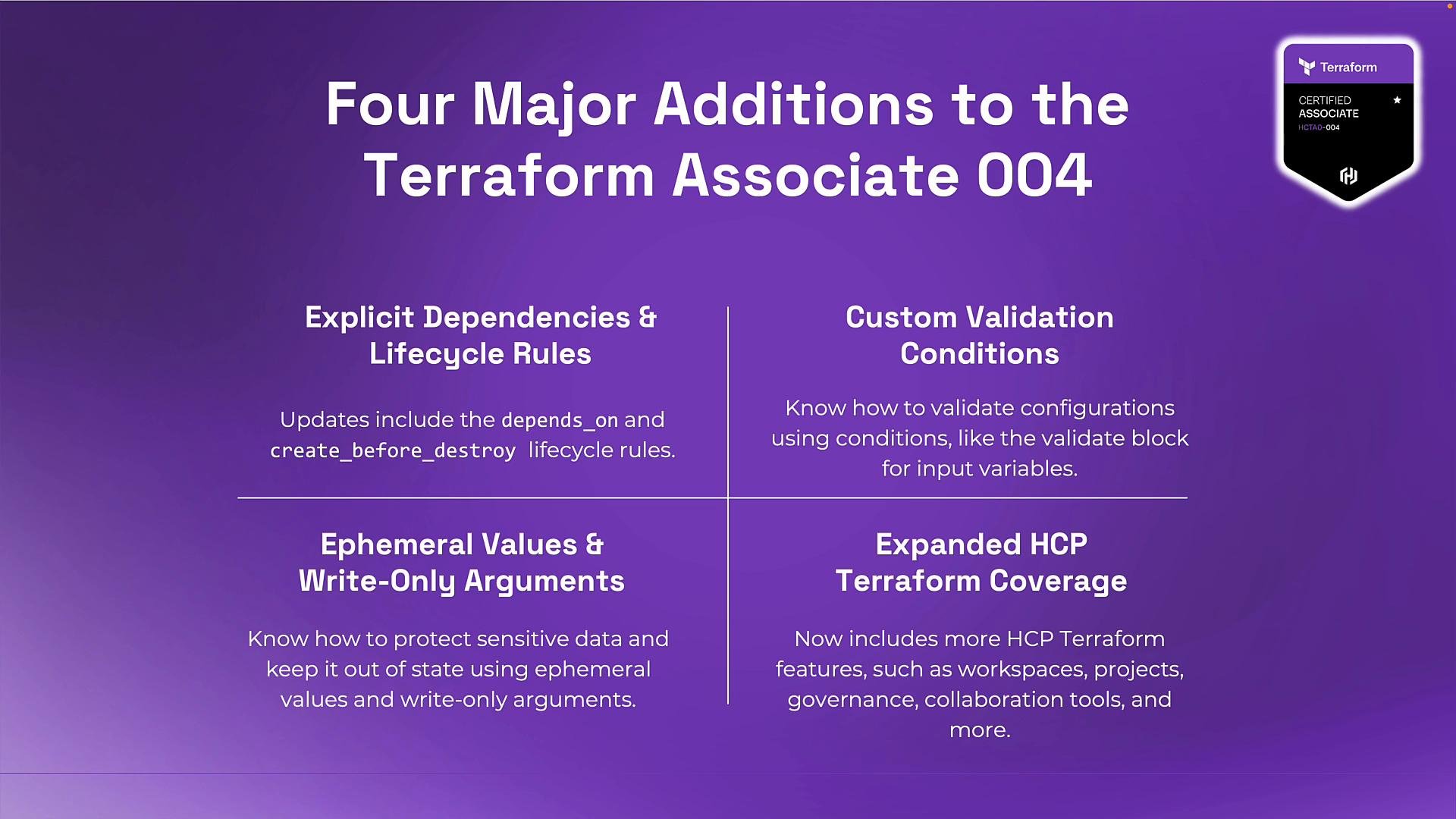
- Explicit dependencies and lifecycle rules
- Custom validation conditions
- Ephemeral values and write-only arguments
- Expanded HCP Terraform / Terraform Cloud coverage
1) Explicit dependencies and lifecycle rules
What to know:- Understand implicit dependencies (resource references in expressions) vs explicit dependencies using
depends_on. - When to use
depends_onto force ordering or prevent race conditions. - Lifecycle meta-arguments:
prevent_destroy,ignore_changes, andcreate_before_destroy, and how they influence resource replacement, ordering, and drift behavior.
- You’ll be asked to reason about resource ordering and replacement strategies in real-world scenarios. Know how lifecycle settings affect plan/apply behavior and how
depends_onchanges the dependency graph.
- Terraform docs — depends_on and lifecycle meta-arguments
- Practical labs: create resources that must be replaced in a controlled order (e.g., attach resources to an instance that needs recreate behavior)
2) Custom validation conditions
What to know:- Variable
validationblocks prevent invalid inputs from reachingterraform apply. - Basic structure:
- Use validation to enforce invariants in root modules and reusable modules.
- Understand how expressions used in
conditionevaluate and how to write clearerror_messagestrings.
- Exam questions may present invalid inputs or module contracts and ask whether Terraform will accept or reject them. Practice writing validation expressions and reading them quickly.
- Terraform Input Validation docs
3) Ephemeral values and write-only arguments
What to know:- Ephemeral values: transient data that should not be persisted to state (for example, ephemeral tokens).
- Write-only arguments: inputs accepted by a resource/provider that are not stored in state (so they cannot be read back).
- Differences compared to sensitive attributes and outputs; ephemeral/write-only are additional mechanisms to minimize secrets in state.
- Examinees should be able to identify patterns for handling secrets and preventing leakage to state files (and to understand provider behavior when attributes are write-only).
- Review provider documentation and examples where arguments are documented as write-only.
- Practice designing modules that accept secrets via secure mechanisms (e.g., remote secret managers) instead of writing them to state.
4) Expanded HCP Terraform / Terraform Cloud coverage
What to know:- Increased emphasis on cloud/platform workflows: workspaces, workspace types, projects, organization constructs.
- Governance and policy enforcement (policy sets, Sentinel, or equivalent policy-as-code).
- Collaboration workflows: remote runs, VCS integration, variable management, and run permissions.
- Many exam scenarios now assume knowledge of remote execution and governance patterns in Terraform Cloud/HCP Terraform. Hands-on familiarity helps answer questions about workflows and policy enforcement.
- Terraform Cloud product docs: Workspaces, Policies, and Remote Runs
- Sentinel (policy-as-code) developer docs
Quick comparison: 003 vs 004
How this affects your study plan
If you passed 003:- Most knowledge transfers directly to 004. Focus study time on the four new areas listed above.
- Test yourself on lifecycle scenarios,
depends_onuses, input validation, secret handling patterns, and Terraform Cloud workflows.
- Follow the updated 004 curriculum. Start with core Terraform concepts (configuration, state, providers, modules), then layer in the 004-specific topics.
- Prioritize hands-on labs (remote runs, variable validation, lifecycle experiments).
- 1–2 days: Review lifecycle meta-arguments,
depends_on, and run small experiments to observe plan/apply behavior. - 1 day: Write and test variable
validationblocks for a module. - 1 day: Read provider docs about secret handling and look for examples of write-only arguments.
- 2–3 days: Hands-on with Terraform Cloud/HCP workspaces, remote runs, and policy enforcement (or watch walkthroughs if you lack access).
- Ongoing: Practice with multiple-choice-style questions and scenario-based problems.
Links and references
- Terraform documentation — Input Validation
- Terraform documentation — Meta-Arguments: lifecycle
- Terraform Cloud documentation
- Sentinel policy-as-code
- HashiCorp Certification — Terraform Associate