

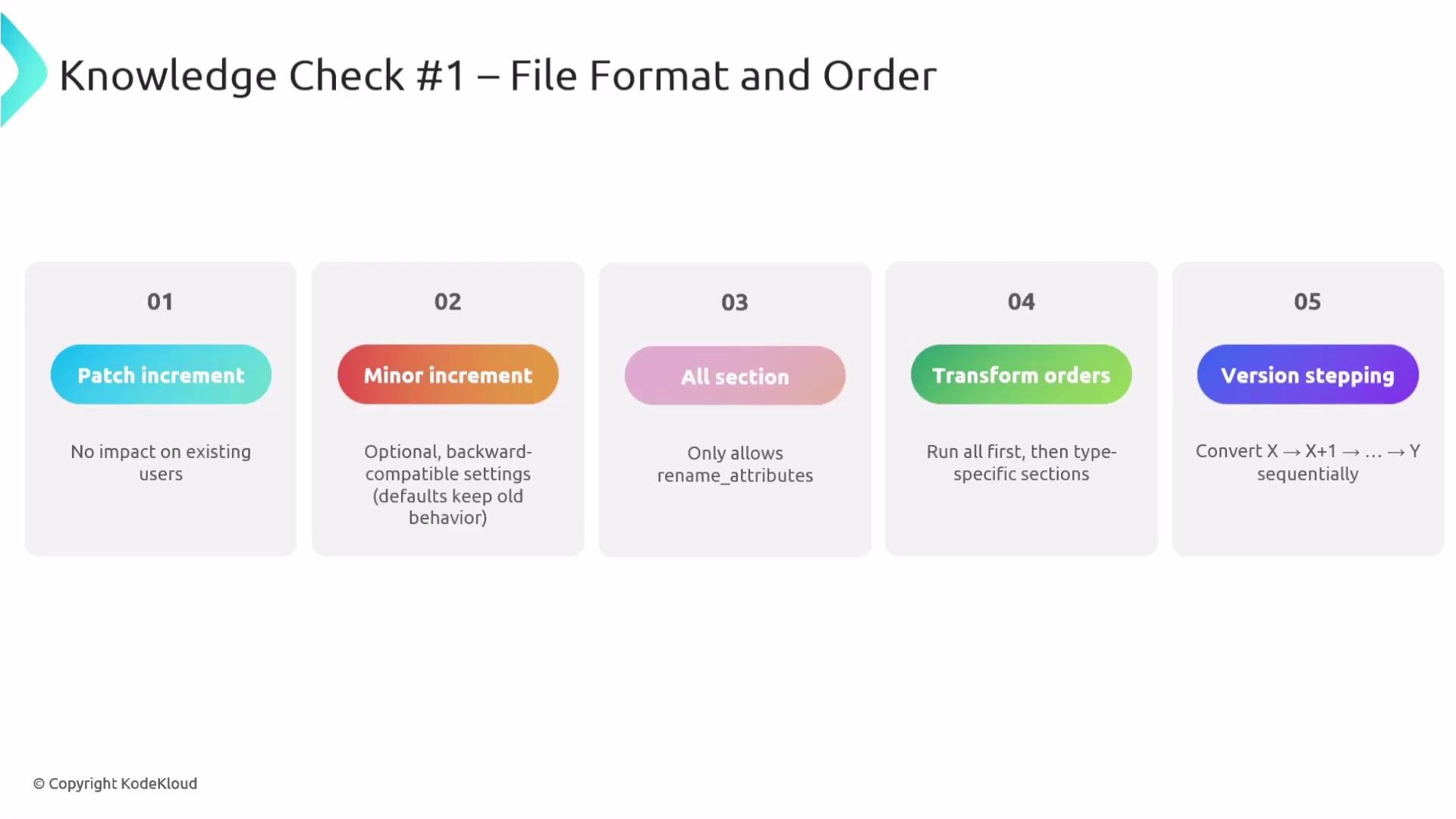
- Patch increments imply no behavioral changes for consumers.
- Minor increments add optional, backward-compatible items.
- The
allsection may only containrename_attributesand runs before signal-specific rules. - Transform order matters: apply global (
all) rules before signal-specific transforms. - When migrating between schema versions, step through intermediate versions sequentially (X → X+1 → … → Y).
- Use
rename_metricsto change a metric’s name andrename_attributesto change labels/attributes. - Resource-level renames use
rename_attributes. - Always set
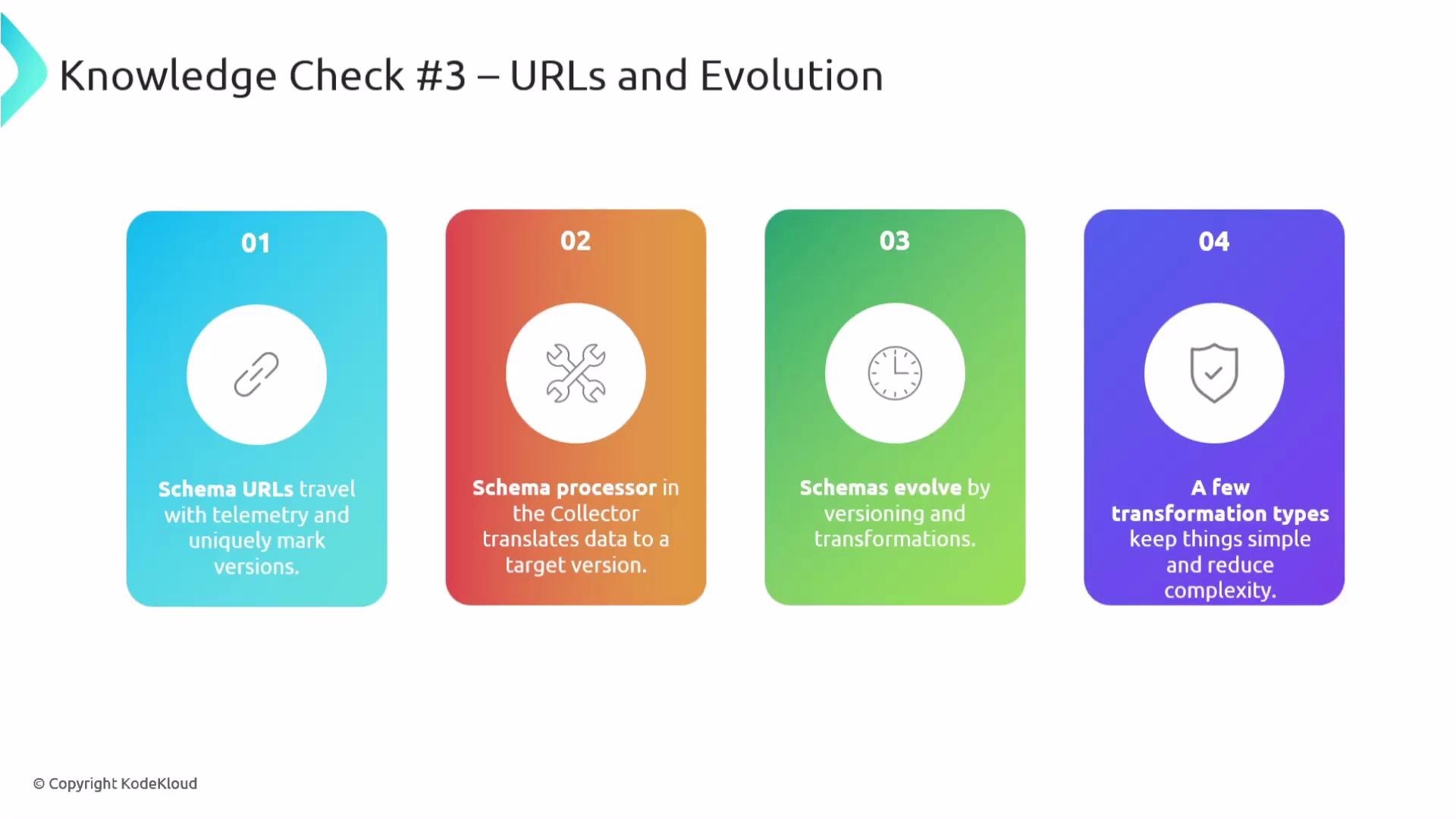
schema_urlto the highest schema version declared; it travels with telemetry. - In
metrics.rename_attributes, omittingapply_to_metricsmakes the renaming apply to all metrics. - Span selectors and event selectors can scope renames to specific spans or span events.
- The collector’s schema processor upgrades/downgrades telemetry by applying rename-based transforms in version order.
- Keep transforms minimal and rename-focused to limit complexity and reduce the chance of unintended semantic changes.
- Always put
all(global)rename_attributesrules first so broad attribute renames are applied before signal-specific renames. - Use
rename_metricsfor the metric name itself andrename_attributesfor metric labels. - Use
apply_to_metrics(when available) to scope an attribute rename to selected metric names; if omitted, the rename applies to all metrics. - For spans and span events, use selectors such as
apply_to_spansorapply_to_eventsto limit renames to specific names or patterns.
Example schema snippet (concise)
Best practice: Always set
schema_url to the highest schema version you list in the configuration. The schema URL travels with telemetry and the collector uses it to decide which transforms to apply when upgrading or downgrading. For further details, see the OpenTelemetry schema docs: https://opentelemetry.io/docs/.- Schema versioning follows semantic versioning: patch = no change, minor = backward-compatible additions, major = breaking changes.
- Schema files have organized sections:
all,resources,spans,span_events,metrics, andlogs. Use each section for focused transforms. - The collector’s schema processor applies transforms sequentially, version-by-version (X → X+1 → … → target).
- Favor rename-only transforms and minimal change sets to avoid accidental semantic shifts.
Validate your YAML and ensure keys and
schema_url values are spelled correctly (for example, opentelemetry.io). YAML syntax errors or incorrect keys can prevent the collector from loading schema transforms.