This article explores DynamoDB DAX, an in-memory caching service that enhances performance for read-intensive applications by reducing latency and load on DynamoDB tables.
In this lesson, we explore DynamoDB DAX—a high-performance, in-memory caching service designed exclusively for Amazon DynamoDB. If your application relies on frequent read operations from a DynamoDB table, DAX can significantly boost performance by reducing latency through effective caching.When your application executes a read-heavy workload, DAX acts as an intermediary cache. If the requested data is already cached, your application receives an extremely low latency response. Otherwise, DAX retrieves the data from the DynamoDB table, caches it, and makes it readily available for future requests. This process greatly enhances performance for subsequent read operations.DynamoDB Accelerator (DAX) dramatically speeds up read-intensive applications by offering a fully managed caching solution specifically for DynamoDB tables. Below, we examine the key features and benefits of using DAX.
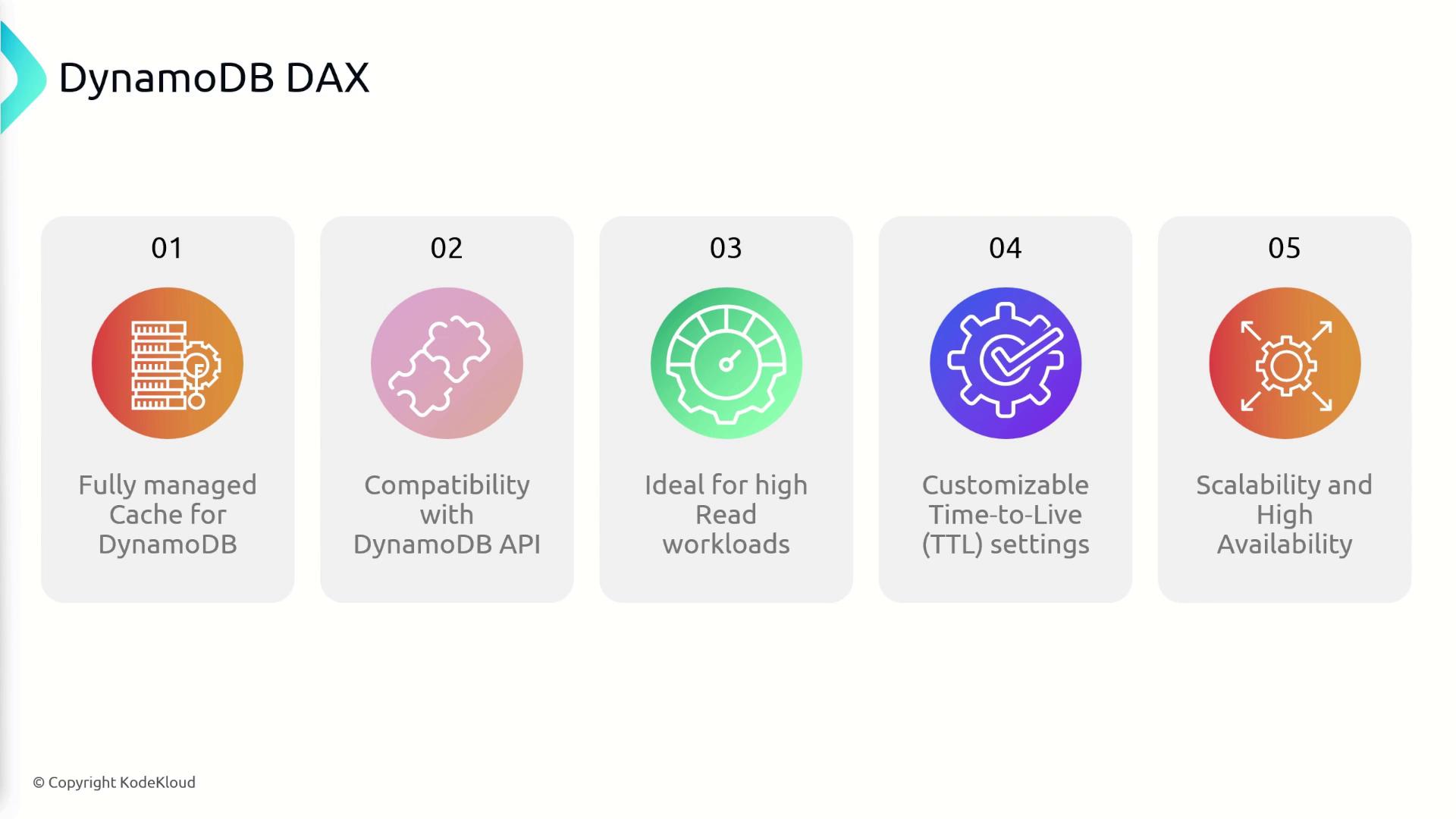
Fully Managed Caching: DAX reduces direct read load on your DynamoDB tables by caching frequently accessed data.
Exceptionally Low Latency: Ideal for latency-sensitive applications, DAX ensures rapid responses for read operations.
Compatibility with DynamoDB API: Seamlessly integrate DAX with your existing DynamoDB workflows without modifying your codebase.
Customizable Time-to-Live (TTL) Settings: Control how long data remains in cache based on your application’s requirements.
Scalability & High Availability: DAX clusters can include up to 10 nodes and support multi-AZ deployments for enhanced fault tolerance.
For applications experiencing high read volumes or performance challenges with DynamoDB, integrating DynamoDB DAX can be an effective solution to improve overall throughput and response times.
To summarize, DynamoDB DAX serves as an effective caching layer for DynamoDB, enhancing performance for read-intensive applications by minimizing latency and reducing the load on your primary database.
By leveraging DynamoDB DAX, you can achieve improved application performance even under heavy read workloads, making it a valuable tool in modern scalable architectures.